
Why Gillette Inorganic Chemicals Plants Sit Inside a Three-Tier Pretreatment System
The National Pretreatment Program is a component of the NPDES program, run as a cooperative effort of federal, state, and local environmental regulatory agencies established to protect water quality (EPA, National Pretreatment Program). The program rests on three types of standards: general and specific prohibitions, categorical pretreatment standards, and local POTW limits—all of which can be enforced by the EPA, the state, and local government (EPA, Pretreatment Standards and Requirements-Applicability).
An "industrial user (IU)" is defined at 40 CFR 403.3(j) as a source of indirect discharge, and pretreatment standards are the pollutant discharge limits that apply to those IUs (EPA, Pretreatment Standards and Requirements-Applicability). The control authority—the POTW where there is an approved pretreatment program, otherwise the Approval Authority—is responsible for identifying which standard(s) apply to each IU and for applying the most stringent requirement where multiple provisions exist (EPA, Pretreatment Standards and Requirements-Applicability).
For a Gillette facility, this matters because EPA and authorized NPDES state pretreatment programs approve local municipalities to perform permitting, administrative, and enforcement tasks for discharges into the municipalities' POTWs (EPA, National Pretreatment Program). Wyoming is an authorized NPDES state, and the City of Gillette POTW administers the local program: it issues the discharge permit, sets the local limits, and runs the inspections. The local limit is often the binding constraint a plant must meet.
Which Federal Categorical Standard Applies to Inorganic Chemicals in 2026
Inorganic chemicals manufacturing is covered by 40 CFR Part 415, the Inorganic Chemicals Manufacturing Point Source Category. The correct subpart must be confirmed against EPA's Attachment 3-1: Summary of Categorical Standards (December 2024)—the specific subcategory must be identified to determine applicable requirements (EPA, National Pretreatment Program).
Categorical pretreatment standards apply to "categorical industrial users (CIU)," defined as an industrial user subject to national categorical pretreatment standards (EPA, Pretreatment Standards and Requirements-Applicability). Whether the standard applies to a given discharge depends on the allocation method used in the standard itself, so the plant should read the subcategory carefully (EPA, Pretreatment Standards and Requirements-Applicability).
A plant can also be pulled into a higher tier of oversight as a "significant industrial user (SIU)." Under 40 CFR 403.3(v), an IU is an SIU if it is subject to categorical pretreatment standards (with the NSCI exception), discharges an average of 25,000 gpd or more of process wastewater to the POTW (excluding sanitary, noncontact cooling, and boiler blowdown wastewater), contributes a process wastestream that makes up 5 percent or more of the average dry-weather hydraulic or organic capacity of the POTW, or is designated as such by the POTW on the basis that the IU has a reasonable potential for adversely affecting the POTW's operation (EPA, Pretreatment Standards and Requirements-Applicability). The same threshold logic is applied in parallel categorical contexts, as described in the fabricated metals plants near Portland 2026 pretreatment guide.
Gillette plants not classified as a CIU under 40 CFR Part 415 may still be designated as an SIU by the POTW on a "reasonable potential" basis (EPA, 40 CFR 403.3(v)).
General and Specific Prohibitions Every Gillette IU Must Meet
General and specific prohibitions apply to all IUs, with applicability depending on POTW ordinance and permit provisions. These requirements are mandatory for every discharger (EPA, Pretreatment Standards and Requirements-Applicability).
EPA lists three ways pretreatment requirements can be expressed: numeric limits, narrative prohibitions, and best management practices (BMPs), which the agency defines as the most effective and practical ways to control pollutants and meet environmental quality goals (EPA, Pretreatment Standards and Requirements-Applicability). BMPs are formally recognized forms of compliance.
For an inorganic chemicals site, typical BMP categories include spill prevention, tank farm secondary containment, raw-material handling controls, stormwater segregation, and slug-load prevention. Because the supplied research does not include numeric thresholds for these items, each must be confirmed against the local POTW's ordinance and the plant's individual permit. The plant should expect parallel oversight from the EPA, the state, and local government (EPA, Pretreatment Standards and Requirements-Applicability).
Local Limits: What the City of Gillette POTW Will Add on Top
Local limits are established by the POTW's ordinance and permit provisions and vary from city to city (EPA, Pretreatment Standards and Requirements-Applicability). The control authority must apply the most stringent applicable requirement when more than one standard covers the same discharge (EPA, Pretreatment Standards and Requirements-Applicability).
Local limits typically address headworks-loading allocations for metals and organics, pH, flow, and priority pollutants. Because this research contains no specific numeric local limits for the City of Gillette, the reader must request the current limits directly from the Gillette POTW before sizing equipment or finalizing a discharge budget. The program structure behind those local limits is the same one EPA and authorized state pretreatment programs use to approve local municipalities to perform permitting, administrative, and enforcement tasks (EPA, National Pretreatment Program).
Failure to meet these standards can result in industrial discharge permit revocation, fines, corrective action plans, increased monitoring, and potential production restrictions (Decachem, wastewater-limits-for-nitrates-and-phosphates). Treat the local limit as the binding number.
Typical Wastewater Parameters for Inorganic Chemicals Plants
The table below lists parameters most inorganic chemicals plants must characterize and discuss with their POTW. These values must be confirmed against the local POTW's limits and the 40 CFR Part 415 subcategory.
| Parameter | Why it matters | Typical unit process | Confirm with |
|---|---|---|---|
| pH | Damages collection systems and biological treatment if outside POTW window | Neutralization / pH adjustment | Local POTW ordinance |
| Total suspended solids (TSS) | Headworks loading, sludge generation | Clarification, filtration | Local POTW local limits |
| Heavy metals (e.g., lead, chromium, nickel, zinc, copper) | Toxicity to POTW biomass, sludge quality | Chemical precipitation, filtration | Local POTW headworks allocation and 40 CFR Part 415 subcategory |
| Fluoride | Common in inorganic chemicals processes; downstream toxicity | Precipitation (e.g., calcium-based), ion exchange | 40 CFR Part 415 subcategory and local POTW |
| Sulfate | Corrosion, concrete sewer attack, TDS | Source reduction, precipitation | Local POTW local limits |
| Total dissolved solids (TDS) | POTW effluent and reuse constraints | Source segregation, membrane | Local POTW |
| Oil and grease | Coating, interference, fire load | DAF, skimming | Local POTW local limits |
| Ammonia | Receiving-water oxygen demand, toxicity | Biological or stripping | Local POTW |
| Temperature | Biomass inhibition, sewer damage | Cooling / equalization | Local POTW ordinance |
Two flow-based facts drive the monitoring tier. A facility that discharges an average of 25,000 gpd or more of process wastewater to the POTW, or contributes a process wastestream that makes up 5 percent or more of the average dry-weather hydraulic or organic capacity of the POTW, is an SIU (EPA, 40 CFR 403.3(v)). The 25,000 gpd threshold excludes sanitary, noncontact cooling, and boiler blowdown wastewaters, so a plant that segregates those streams correctly can stay below the categorical trigger (EPA, 40 CFR 403.3(v)).
How the Treatment Train Is Built to Meet the Strictest Limit
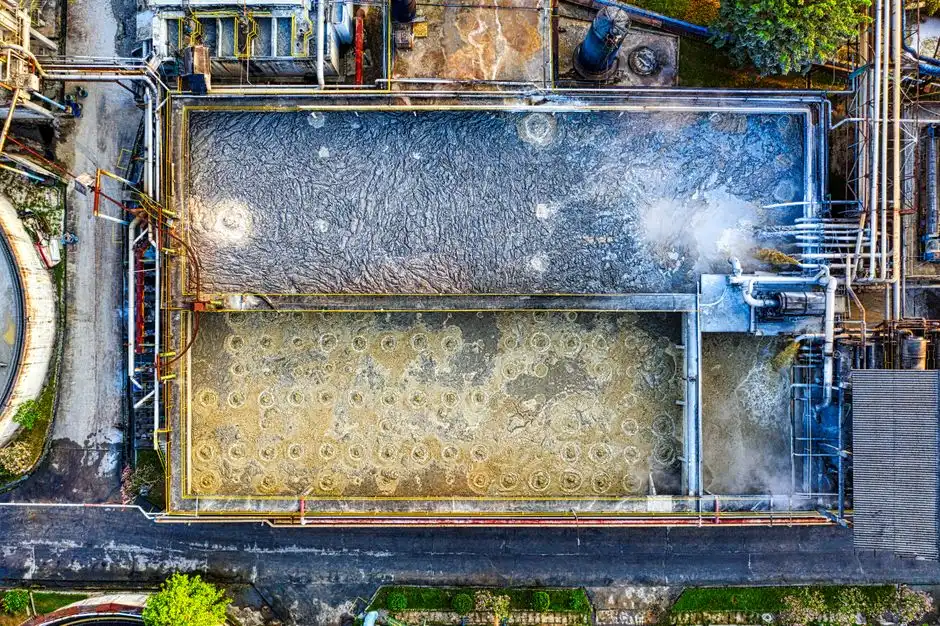
A typical treatment train for an inorganic chemicals plant runs: screening → flow equalization → pH adjustment → chemical precipitation and coagulation → clarification → multimedia or membrane filtration → polishing or disinfection. The specific train depends on the local POTW's limits and the 40 CFR Part 415 subcategory.
Each stage has a defined function. A rotary mechanical bar screen protects downstream equipment from rags and debris. Equalization buffers slug discharges so the downstream chemistry remains stable. pH adjustment and an automatic chemical dosing system target metals and fluoride through chemical precipitation. A dissolved air flotation system or a lamella clarifier handles the resulting solids, and a multi-media filter polishes suspended solids before discharge.
Design must be driven by the local POTW's limits, the 40 CFR Part 415 subcategory requirements, and site-specific influent characterization. The control authority identifies which standards apply, and the design must respond to those specific mandates (EPA, Pretreatment Standards and Requirements-Applicability). A standard treatment train without a current local-limits letter and a 40 CFR Part 415 subcategory check is a common audit finding.
Documentation, Monitoring and Reporting the POTW Will Require

The pretreatment program is enforced by the EPA, the state, and local government in parallel, and the control authority will audit the paper trail as rigorously as the analytical results (EPA, Pretreatment Standards and Requirements-Applicability).
The typical asks include baseline monitoring reports, 90-day compliance reports for CIUs, periodic BMP self-audits, slug-discharge control plans, and routine self-monitoring records. Because specific frequencies are not provided here, the plant must pull them from its individual permit. Sampling frequency may range from weekly to daily (Decachem, wastewater-limits-for-nitrates-and-phosphates).
BMPs are a recognized form of compliance, and EPA lists them alongside numeric limits and narrative prohibitions as the three ways pretreatment requirements are expressed (EPA, Pretreatment Standards and Requirements-Applicability). Treat the BMP file with the same rigor as the Discharge Monitoring Report (DMR). Failure to meet pretreatment standards can result in permit revocation, and accurate documentation is essential during regulatory inspections (Decachem, wastewater-limits-for-nitrates-and-phosphates).
A Practical Compliance Checklist for 2026
Step 1. Confirm the 40 CFR Part 415 subcategory against EPA's Attachment 3-1: Summary of Categorical Standards (December 2024). Do not assume a subpart (EPA, National Pretreatment Program).
Step 2. Request the City of Gillette POTW's current local limits and any headworks-loading allocation in writing. The binding number must come from the control authority.
Step 3. Classify the facility as IU, SIU, or CIU using the 25,000 gpd process-wastewater threshold (excluding sanitary, noncontact cooling, and boiler blowdown wastewater), the 5 percent dry-weather hydraulic/organic threshold, and any POTW "reasonable potential" designation (EPA, 40 CFR 403.3(v)).
Step 4. Build the treatment train and BMP package to address numeric limits, narrative prohibitions, and BMPs in parallel (EPA, Pretreatment Standards and Requirements-Applicability).
Step 5. Lock the documentation cadence—baseline monitoring, 90-day CIU reports, BMP self-audits, slug-control plan—to support the control authority's enforcement role (EPA, Pretreatment Standards and Requirements-Applicability). The same step logic is laid out for a related sector in the chemicals plants near Galva pretreatment compliance guide and the how chemical plants near Germantown meet 2026 pretreatment limits walkthrough.
Frequently Asked Questions
What federal categorical standard applies to an inorganic chemicals plant near Gillette?
Inorganic chemicals manufacturing is covered by 40 CFR Part 415, the Inorganic Chemicals Manufacturing Point Source Category. The exact subcategory must be confirmed against EPA's Attachment 3-1: Summary of Categorical Standards (December 2024) because the subpart determines which numeric standards apply (EPA, National Pretreatment Program).
Who enforces the local limits the City of Gillette POTW
Frequently Asked Questions
What EPA categorical standard applies to inorganic chemicals plants near Gillette?
Industrial inorganic chemical facilities are primarily regulated under 40 CFR Part 415, the Inorganic Chemicals Manufacturing Point Source Category. This regulation sets effluent limitations guidelines (ELGs) based on best practicable control technology (BPT), best available technology (BAT), and new source performance standards (NSPS) for various subcategories, including chlor-alkali, hydrofluoric acid, and aluminum fluoride production.
Because these facilities discharge into local Publicly Owned Treatment Works (POTWs), they must also comply with General Pretreatment Regulations under 40 CFR Part 403, which prohibit the discharge of pollutants that pass through or interfere with POTW operations or contaminate sewage sludge.
What is the difference between an IU, an SIU and a CIU under the EPA pretreatment program?
An Industrial User (IU) is any non-domestic source that discharges pollutants into a POTW. A Categorical Industrial User (CIU) is an IU subject to specific federal categorical pretreatment standards found in 40 CFR Chapter I, Subchapter N, which define strict mass- or concentration-based limits for specific industrial processes.
A Significant Industrial User (SIU) is a broader classification that includes all CIUs, as well as any non-categorical IU that discharges an average of 25,000 gallons per day or more of process wastewater, contributes a process waste stream that makes up 5 percent or more of the average dry weather hydraulic or organic capacity of the POTW, or is designated as such by the control authority due to a reasonable potential for adverse impact.
What happens if a Gillette plant exceeds its local POTW pretreatment limit?
If a facility exceeds its local pretreatment limits, it faces immediate enforcement actions as defined by the POTW’s Sewer Use Ordinance (SUO). Initial responses typically include a Notice of Violation (NOV), which requires the facility to perform additional sampling and submit a corrective action plan to prevent recurrence.
Continued or significant noncompliance can lead to administrative fines, increased monitoring requirements, or the suspension of discharge permits. In cases of intentional or negligent violation, the control authority may seek civil or criminal penalties, and the POTW reserves the legal right to disconnect the facility from the sewer system to protect the integrity of the treatment plant and its compliance with the National Pollutant Discharge Elimination System (NPDES) permit.
How much does it cost to install a pretreatment system for an inorganic chemicals plant in Wyoming?
The cost of installing a pretreatment system varies significantly based on flow volume, contaminant load, and the specific chemical constituents, typically ranging from $250,000 for basic pH neutralization and solids removal to over $5 million for complex systems requiring multi-stage heavy metal precipitation and membrane filtration.
Beyond capital expenditure, facilities must account for ongoing operational expenses, including chemical reagents, energy consumption for pumping and aeration, sludge disposal fees—which can exceed $100 per ton in the Wyoming region—and the cost of mandatory laboratory testing required for compliance reporting.
Which equipment is required to meet typical inorganic chemicals pretreatment limits?
Meeting 2026 pretreatment limits often requires a multi-stage treatment train starting with equalization tanks to balance flow and pH. Chemical precipitation units using coagulants and flocculants are standard for removing heavy metals, followed by clarification or dissolved air flotation (DAF) to separate suspended solids.
For dissolved inorganic constituents, systems may require ion exchange resins, reverse osmosis (RO) units, or specialized adsorption media. Additionally, automated monitoring equipment, including continuous pH, conductivity, and flow meters, is essential for real-time process control and to ensure that effluent quality remains within the specific thresholds mandated by the local POTW.