Why a multi-zone plant cannot specify pumps zone-by-zone
A multi-zone plant runs two or more process zones inside one boundary — coagulation, pH correction, disinfection, polymer feed, cooling-tower bleed — each with its own chemical, flow, and pressure profile, but all sharing one SCADA layer, one maintenance crew, and one spare-parts shelf. Water and wastewater applications represent 24.5% of 2025 US dosing-pump demand, which is the segment where the multi-zone problem is most concentrated (Fact.MR, December 2025). Specifying each zone independently tends to produce fragmented spares, mismatched control protocols, and a single zone failure that escalates into a plant-wide spill.
Diaphragm pumps use suction and discharge check valves, and gas build-up during the suction phase can cause vapor lock and loss of prime; if either set of check valves becomes fouled, the pump will not meter chemical accurately, and routine maintenance on those valves is mandatory (Blue-White). Peristaltic pumps have no valves to clog, pump both fluid and gas without losing prime, and are gentle on shear-sensitive fluids, but peristaltic pumps typically do not perform well against high pressure (Blue-White). A procurement strategy that treats the fleet as one system — not as a stack of standalone pumps — is the only way to keep those failure modes from compounding across zones. For an introduction to the most efficient chemical metering pumps for U.S. wastewater in 2026, see the most efficient chemical metering pumps for U.S. wastewater in 2026.
Pump-type selection by zone: diaphragm, peristaltic, or dual-diaphragm
The chemistry-to-pump-type rule for a US multi-zone fleet in 2026 is: off-gassing or particulate-laden chemistries route to peristaltic, clean high-pressure low-gas duties route to diaphragm, and off-gassing chemistries that also need fine turndown route to engineered dual-diaphragm. Peristaltic pumps pump both fluid and gas and will not lose prime when off-gassing occurs, whereas standard diaphragms can vapor-lock under the same conditions (Blue-White). Diaphragm pumps can also create shear stress on fluids, particularly with high-velocity stroke action, which rules them out for delicate polymer or flocculant feeds (Blue-White).
The Blue-White FLEXFLO A3 peristaltic dosing pump reaches a maximum working pressure of 125 PSI / 8.6 bar with a 2500:1 turndown and a NEMA 4X / IP66 enclosure rating, which moves peristaltic designs into pressure ranges that used to be diaphragm territory (Blue-White). The WMFTS Qdos range covers six models — 20, 30, 60, 120, CWT, and H-FLO — with H-FLO scaled to flow rates up to 600 L/hr, so a multi-zone plant can standardise on one peristaltic family across low-, mid-, and high-flow zones (WMFTS). On the diaphragm side, the Blue-White CHEM-FEED CD3 dual-diaphragm pump covers 0.05 to 53 GPH (0.2 to 200 LPH) with a large turndown ratio and is engineered for off-gassing chemistries including peracetic acid and sodium hypochlorite (Blue-White). The CD3 is also certified to NSF 61, CE, ETL, and NEMA 4X, which lets a buyer map it directly against plant specifications (Blue-White). For a vendor-packaged skid-mounted automatic chemical dosing system, the per-zone table below is the document a procurement manager can hand to the supplier.
| Zone / duty | Recommended pump type | Reference product | Key spec |
|---|---|---|---|
| Clean, high-pressure NaOH injection | Diaphragm | Blue-White CHEM-FEED CD3 | 0.05–53 GPH; NSF 61 |
| Off-gassing chemistry (NaOCl, peracetic acid) | Peristaltic, or dual-diaphragm where pressure demands | WMFTS Qdos / CD3 | Loss-of-prime / vapor-lock behaviour |
| Polymer or particulate-laden feed | Peristaltic | WMFTS Qdos (ReNu PU pumphead at Oak Ridge) | Validated maintenance-free run time |
| Mid- to high-flow zone (up to 600 L/hr) | Peristaltic, higher-flow model | WMFTS Qdos H-FLO | Flow ceiling, fieldbus support |
| Higher-pressure peristaltic duty (up to 125 PSI) | Peristaltic | Blue-White FLEXFLO A3 | 125 PSI / 8.6 bar max, 2500:1 turndown, TFD |
Control I/O that lets one SCADA layer run every pump on the skid
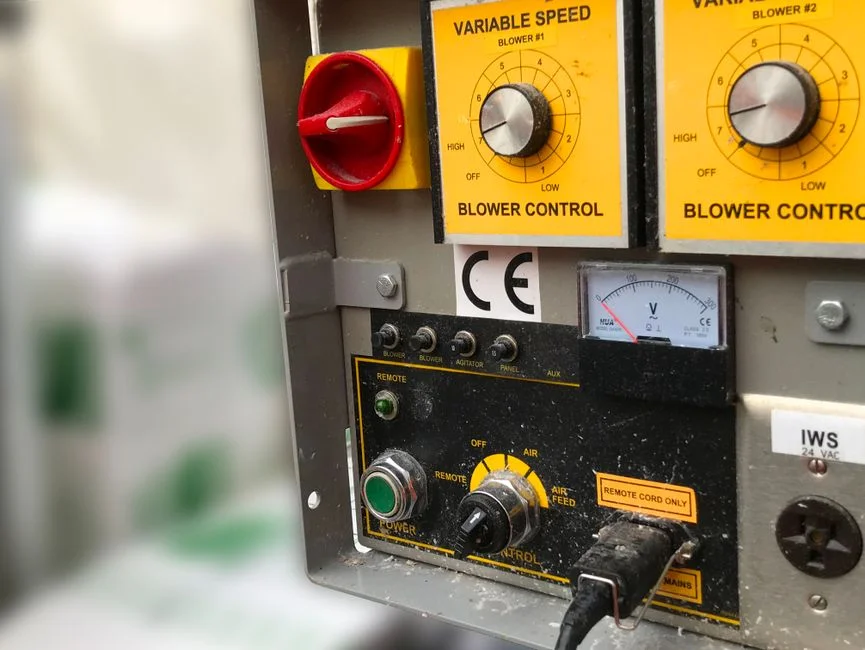
The defining requirement of a multi-zone architecture is that one SCADA layer can address every pump on the skid. The Blue-White CD3 lists its control inputs explicitly: 4-20 mA, 0-10 VDC, and pulse inputs for remote external speed or batch control, plus 0-30 VDC / contact closure remote start/stop, with a VGA multi-colour backlit LCD for local status (Blue-White). The CD3 is driven by a brushless DC variable-speed motor and is certified to NSF 61, CE, ETL, and NEMA 4X, which lets a buyer map it directly against plant specifications (Blue-White). On the fieldbus side, the WMFTS Qdos range supports PROFIBUS, EtherNet/IP, and PROFINET — the three protocols most US municipal and industrial SCADA stacks expect (WMFTS).
Specify at minimum 4-20 mA analog plus one fieldbus option, and confirm the fieldbus matches the plant's existing SCADA stack before signing a PO, because retrofitting a mismatched protocol is a multi-week engineering change. Buyers writing an RFQ for an electromagnetic flow-meter-based control loop should cross-reference the same I/O checklist, since the transmitter and the dosing pump need to share the same analog and fieldbus backbone; the 7 critical factors for selecting an electromagnetic flow meter for wastewater list fieldbus compatibility as one of the seven.
Zone-level fault isolation: leak, dry-run, and tube-failure detection
Zone-level fault isolation is the second I/O requirement of a multi-zone skid. The FLEXFLO A3's built-in Tube Failure Detection (TFD) system detects a wide range of conductive chemicals without false triggering; if a tube fails, the pump automatically shuts off and energises a relay that can call a back-up pump or alarm (Blue-White). TFD prevents chemical spills and added downtime, and is the relay logic a multi-zone architecture needs so a single zone failure does not become a plant-wide spill event (Blue-White).
On the diaphragm side, require equivalent dry-run or rupture sensors so a suction-side failure does not go undetected, and so the SCADA receives a discrete fault per zone rather than a common alarm. Pair each zone's leak detection with a discrete relay output wired to the plant DCS, and confirm during FAT that the relay logic triggers an alarm — not just a pump shutdown — for operator visibility. A packaged skid-mounted automatic chemical dosing system that wires each zone's leak relay into a separate DCS tag is the difference between a recoverable maintenance event and an unscheduled plant shutdown.
Lifecycle cost: published maintenance benchmarks for the multi-zone fleet
Pump choice drives a multi-year maintenance line item, which is the number operations and finance both press on. Diaphragm pumps require routine check-valve cleaning and diaphragm inspection, and that labour line item scales directly with zone count in a multi-zone fleet (Blue-White). Peristaltic pumps trade that check-valve service for tube or pumphead replacement, so the comparison reduces to: how often does the consumable need changing, and how long does the change-out take.
Two published benchmarks let a buyer hold a vendor against a number rather than a marketing claim. The FLEXFLO A3's FlexAPrene Multi-Tube design delivers tube life up to four times longer than average single tubes, which lowers the per-zone maintenance hours (Blue-White). A WMFTS Qdos 60 PU peristaltic pump with a ReNu PU pumphead completed three years of maintenance-free operation in May 2023 while dosing polyaluminium chloride at the City of Oak Ridge, Tennessee water treatment plant (WMFTS). Buyers evaluating a skid-mounted automatic chemical dosing system should ask the vendor to itemise the per-zone service interval against these two benchmarks before signing, and confirm the spare water-treatment parts, valves, and media lead time against the worst-case zone in the fleet.
Five-step procurement methodology for a US multi-zone dosing skid
A multi-zone dosing skid should be specified as one system, not zone-by-zone, and the procurement methodology that delivers that outcome is a five-step sequence anchored in the published data above.
- Enumerate the zones. For each zone, list the chemical, target flow, working pressure, viscosity, particulate loading, and gas-forming tendency. This is the input set a pump manufacturer requires before quoting, and skipping it is the most common reason a multi-zone project ends up with a fleet of misapplied pumps.
- Apply the chemistry rule of thumb. Off-gassing or particulate-laden chemistries route to peristaltic; clean, high-pressure, fine-turndown duties route to diaphragm; off-gassing chemistries that also need fine turndown route to engineered dual-diaphragm (Blue-White).
- Set a minimum turndown ratio per zone. The FLEXFLO A3's 2500:1 turndown and the CD3's broad 0.05–53 GPH range are the published reference points to match or beat (Blue-White).
- Require common control I/O across the skid. At minimum 4-20 mA analog plus one fieldbus option (PROFIBUS, EtherNet/IP, or PROFINET), matching the plant's existing SCADA stack (WMFTS; Blue-White).
- Require zone-level leak detection. TFD on the A3, or equivalent dry-run and rupture sensors on the diaphragm side, with discrete relay output to the plant DCS, so a single zone failure does not escalate (Blue-White).
Standardise on as few pump families as practical so spares, training, and calibration schedules consolidate — a multi-zone fleet is judged on cross-zone standardisation, not on the strength of any single pump. A packaged skid-mounted automatic chemical dosing system that delivers all five of the above is the procurement target.
US market context: sizing, regional growth, and supplier density

The US dosing-pump market is forecast by Fact.MR to grow from USD 2.23 billion in 2025 to USD 3.45 billion by 2035, an absolute increase of USD 1.22 billion and a 4.5% CAGR over the decade (Fact.MR, December 2025). The 2025–2030 phase alone expands from USD 2.23 billion to USD 2.85 billion, a USD 620 million increase representing 50.8% of total decade growth, which is the funding window most multi-zone capital plans sit inside (Fact.MR, December 2025).
Regional CAGRs to 2035 split the country into four deployment zones: West 5.20%, South 4.60%, Northeast 4.5%, and Midwest 4.40% (Fact.MR, December 2025). For procurement, those CAGRs indicate where the densest supplier and service networks already sit — a vendor with a West-region 5.20% CAGR footprint is more likely to hold field stock and factory-trained service coverage in California, Oregon, and Washington than a vendor with no installed base there. ProMinent Group holds an 18.50% US dosing-pump market share, which is a useful benchmark of what an established multi-zone vendor looks like when a buyer is evaluating smaller or specialist suppliers for a fleet rollout (Fact.MR, December 2025). Diaphragm pumps are projected to account for 57.20% of 2025 US dosing-pump demand, reflecting their dominance in water treatment, chemical processing, and pharmaceutical applications (Fact.MR, December 2025). For adjacent process upgrades, the ion exchange system common problems guide covers the polish step that often follows the dosing skid.
Frequently Asked Questions
What is the typical budget for a skid-mounted multi-zone dosing system in 2026?
The Fact.MR data reports the total US dosing-pump market at USD 2.23 billion in 2025, but it does not break out a per-pump or per-skid price (Fact.MR, December 2025). A written quote should be requested that itemises pump, skid, I/O, and lifecycle service separately, and the vendor should be asked to hold the per-zone service interval against the FLEXFLO A3 four-times tube-life benchmark and the Oak Ridge three-year maintenance-free Qdos trial as the lifecycle reference (Blue-White; WMFTS).
How do I shortlist suppliers for a US multi-zone dosing skid?
Use the regional CAGRs to map supplier density before shortlisting: West 5.20%, South 4.60%, Northeast 4.5%, Midwest 4.40% through 2035 (Fact.MR, December 2025). Vendors with an installed base in the region of the plant will hold field stock and factory-trained service coverage; ProMinent Group's 18.50% US dosing-pump share is a useful benchmark of what an established multi-zone vendor looks like (Fact.MR, December 2025). Confirm NSF 61, CE, ETL, and NEMA 4X certification on every pump before adding a vendor to the list (Blue-White).
Which pump type should be specified for sodium hypochlorite dosing?
Peristaltic, because peristaltic pumps pump both fluid and gas and will not lose prime when gas builds up in the pump head, whereas standard diaphragm designs can vapor-lock (Blue-White). Sodium hypochlorite and peracetic acid are the off-gassing chemistries named in the source data. For higher-pressure off-gassing duties, an engineered dual-diaphragm such as the Blue-White CD3 is the documented alternative (Blue-White).
What is the right lead time to plan for a US multi-zone dosing skid in 2026?
Lead time is not reported in the research data. Buyers should request a written lead time that itemises engineering, fabrication, factory acceptance testing, and field commissioning as separate line items, and should plan for a 4-20 mA plus PROFIBUS, EtherNet/IP, or PROFINET fieldbus option to be confirmed against the plant's existing SCADA stack before signing the PO, because retrofitting a mismatched protocol is a multi-week engineering change (WMFTS; Blue-White).