How a Gravity Belt Thickener Works
A gravity belt thickener (GBT) thickens polymer-conditioned waste activated sludge from 0.5–1.0% feed solids to 5–8% total solids by gravity drainage through a moving porous belt. Typical hydraulic loading is 200–250 GPM per meter of belt width, and field installations such as the Newtown Creek WWTP have demonstrated 90%+ solids capture and 95% electrical power reduction versus legacy thickeners (per BDP Industries, S3; Komline-Sanderson, S1).
The machine is mechanically simple. Dilute waste activated sludge enters the feed/distribution zone at one end of a horizontal filter belt woven from porous polyester fabric. The slurry spreads across the full belt width and immediately begins to lose free water through the belt apertures. The retained solids form a sludge blanket that thickens progressively as the belt advances.
The defining feature is a high-rate drainage element that holds back flocculated solids while letting water escape. In Komline's design this is the Roto-Kone device, which continuously turns and agitates the sludge blanket, opening new drainage paths and preventing the blanket from blinding the belt surface. Without this agitation the blanket seals itself, drainage stops, and the thickened-solids target cannot be reached. A GBT improves on a static gravity screen, which only drains once; a belt thickener keeps re-exposing the cake to gravity drainage over the full belt length.
At the discharge end the thickened sludge drops off the belt as a pumpable 5–8% TS cake, ready for anaerobic digestion, mechanical dewatering, or transport. The thickened product is typically fed to a plate and frame filter press for downstream sludge dewatering when the design target is a transportable cake rather than a thickened liquor.
Design Parameters Engineers Actually Need
GBT selection relies on hydraulic feed rate rather than mass loading, requiring three primary data points: feed solids concentration, feed flow (GPM or m³/h), and target thickened-solids concentration. From these, belt width and model family follow directly (Komline-Sanderson, S1).
| Parameter | Value / Range | Source / Notes |
|---|---|---|
| Hydraulic loading (GSC / GSCE) | 200–250 GPM per meter of belt width (12.6–15.8 L/s, 45–57 m³/h) | Komline-Sanderson S1, for 0.5% WAS feed |
| Hydraulic loading (G-25) | Up to 125 GPM total (7.9 L/s, 28 m³/h) | Komline-Sanderson S1 |
| Feed solids range | 0.5–1.0% total solids (WAS) | Komline-Sanderson S1 |
| Thickened sludge concentration | 5–8% TS | Typical design target; varies with sludge type and polymer program |
| Belt widths — GSC | 1.0, 1.5, 2.0, 3.0 m effective width | Komline-Sanderson S1 |
| Belt widths — GSCE (enclosed) | 1.0, 1.5, 2.0 m effective width | Komline-Sanderson S1; fully enclosed for odor/aerosol control |
| Belt width — G-25 | 0.75 m effective width (packaged system) | Komline-Sanderson S1; small-plant duty |
| Polymer (cationic polyacrylamide) dose | 4–12 g/kg dry solids for WAS | Typical engineering range; bench-test confirmation recommended |
| Solids capture (field-demonstrated) | 90%+ | BDP Industries S3, Newtown Creek WWTP |
| Power reduction vs. legacy thickener | 95% | BDP Industries S3, Newtown Creek WWTP |
Polymer conditioning is necessary for effective solids retention. Cationic polyacrylamide flocculant is dosed into the feed line or mixing zone ahead of the belt, and the resulting floc structure holds fines on the belt instead of letting them pass into the filtrate. Under-dosing drives poor capture and cloudy centrate; over-dosing wastes polymer, can re-stabilize the colloid, and increases operating costs without yield benefit. The 4–12 g/kg dry solids band is a starting point; final dose must be confirmed on a representative sample, which Komline's Peapack, NJ lab supports with 5-gallon bench tests (S1).
Belt speed, residence time, and wash-water demand are typically controlled by the manufacturer's PLC. Engineers specify the wash-water interval, as periodic high-pressure spray on the return side of the belt is required to prevent blinding and maintain a stable drainage rate. Vendor scope for polymer feed systems, sludge feed pumps, and thickened-sludge pumps should be locked in during machine selection to ensure a coordinated package (S1).
Field-Proven Performance: What a Well-Designed GBT Delivers
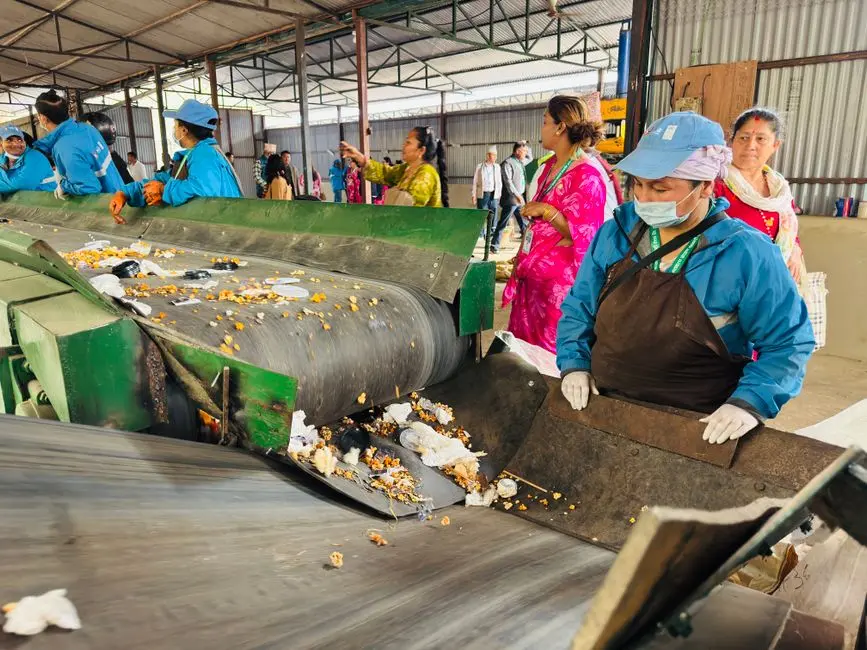
BDP Industries' enclosed GBT at the Newtown Creek WWTP in New York City serves as a benchmark for performance, achieving 90%+ solids capture and 95% reduction in electrical power consumption compared to the prior thickening configuration (BDP Industries, S3).
Operationally, 90%+ capture means less biomass returns to the headworks, reducing polymer waste in the filtrate and providing a cleaner centrate side-stream that minimizes load on the secondary treatment process. The 95% power reduction occurs because gravity drainage replaces energy-intensive dissolved-air flotation pumps, vacuum-assisted screens, or scraper mechanisms on conventional gravity thickeners. For a procurement engineer writing a spec, both numbers provide a baseline for the design basis.
Komline-Sanderson publishes three model families sized to plant scale: the G-25 packaged system for small plants up to 125 GPM, the GSC open-frame machine for medium and large plants in 1.0–3.0 m belt widths, and the GSCE fully enclosed version in 1.0–2.0 m widths for odor and aerosol control (S1). Komline warrants frame, rolls, and bearings for up to 5 years, indicating the expected mechanical service life for a properly installed unit (S1).
Gravity Belt Thickener vs. Other Sludge Thickening Options
Technology selection depends on feed solids, footprint, polymer access, and operator skill. The following table consolidates these trade-offs.
| Criterion | GBT | RDT (Rotary Drum) | DAF Thickener | Conventional Gravity Thickener |
|---|---|---|---|---|
| Typical feed solids | 0.5–1.0% WAS | 0.5–1.5% WAS | 0.3–1.0% WAS | 0.5–2.0% mixed / primary |
| Thickened output | 5–8% TS | 4–7% TS | 3–6% TS | 2–5% TS (variable) |
| Solids capture | 90%+ demonstrated | 85–95% | 90–95% | 60–85% |
| Polymer demand | Moderate (cationic PAM) | Lower | Moderate–high | None typically |
| Footprint | Compact, horizontal | Compact, horizontal | Larger (saturation tank, scraper) | Largest (circular tank) |
| Sensitivity to feed swings | Moderate; tolerates variable feed | Higher | Moderate; needs consistent air saturation | High; underflow concentration drifts |
| Power consumption | Low (95% reduction demonstrated, S3) | Low–moderate | Higher (recycle pumps, saturation) | Low mechanical, but large tankage |
| Operator attention | Low; PLC-controlled | Low | Higher; air system tuning | Low; skimmer and pump control |
Compared to a rotary drum thickener, a GBT handles higher hydraulic loading per unit footprint and tolerates feed-concentration swings more effectively, though it typically requires more polymer. DAF achieves high capture on very dilute WAS but necessitates air-saturation equipment, recycle pumps, and more rigorous operator attention. A conventional circular gravity thickener is the least expensive to install but has the largest footprint and produces an underflow that varies with sludge age and blanket depth. Engineering teams can use the 90%+ capture and 95% power reduction benchmarks from Newtown Creek (S3) to justify GBT selection over gravity tank alternatives.
Selecting and Procuring a GBT in 2026
Model selection is a function of hydraulic feed rate rather than mass loading (S1). Prior to requesting a proposal, define the feed solids concentration (%), feed flow (GPM or m³/h), and target thickened-solids concentration (%). Manufacturers typically recommend a G-25 packaged unit for feed flows up to 125 GPM, or a GSC/GSCE in 1.0–3.0 m belt widths for higher flows, utilizing the 200–250 GPM-per-meter loading figure (S1). The sludge thickener design criteria reference provides the necessary equations for these calculations.
Procure the polymer and pumping system alongside the thickener to ensure compatibility. A coordinated package—including the polymer feed system, sludge feed pump, and thickened-sludge pump—prevents common commissioning failures where the GBT is ready but lacks conditioned feed. Specify the polymer system based on make-down aging, dilution-water quality, and the dose range established by bench testing, and ensure the automatic polymer dosing system integrates with the thickener's PLC and SCADA platform.
Request a bench or pilot test on a 5-gallon representative sludge sample before placing an order. Komline's Peapack, NJ laboratory conducts these tests regularly (S1); other reputable manufacturers provide similar services. For U.S. federally funded projects, confirm Build America, Buy America (BABA) Act compliance in writing at the RFQ stage (S1). For plants considering centrifuge dewatering, the decanter centrifuge working principle outlines the alternative thickening path. Engineers sizing the full thickening-to-dewatering train should also consult the industrial belt filter press cost and ROI guide for capital comparison.
Frequently Asked Questions
What feed solids range can a gravity belt thickener handle?
A GBT is designed for waste activated sludge in the 0.5–1.0% total solids range; Komline-Sanderson specifies the GSC and GSCE machines at 200–250 GPM per meter of belt width for 0.5% WAS feed (S1). Higher feed solids reduce the hydraulic capacity per meter of belt; lower feed solids increase polymer demand and filtrate load.
What is a realistic solids capture rate for a GBT?
BDP Industries' enclosed GBT at the Newtown Creek WWTP demonstrated 90%+ solids capture and 95% electrical power reduction versus the prior thickening configuration (S3). With properly conditioned cationic polyacrylamide flocculant in the 4–12 g/kg dry solids band, 90% capture is the engineering benchmark for a well-designed installation.
How does a GBT compare to a DAF thickener for WAS?
DAF achieves comparable or slightly higher capture on very dilute WAS, but requires air-saturation equipment, recycle pumps