
Why Food Sludge Is a Different Dewatering Problem
Food processing generates 3–8 tons of wet sludge per 100 tons of raw material processed, with that sludge at 80–90% moisture, according to the 2023 USDA generation data reported by HydropureWater in their 2026 engineering spec update. That ratio is roughly 4–10× the per-ton waste load of a typical municipal plant, and the composition is what kills a press sized for municipal duty: fats, proteins, fibers, and biological solids shift in proportion with the production schedule, the season, and the cleaning chemicals used on site.
The mixed matrix is the first thing to internalize. Fats and oils (FOG) compress to a sticky mat. Proteins bind water and resist shear. Cellulose fibers from fruit, vegetable, and brewery streams mat against a screen and blind it. Biological flocs from a secondary treatment step behave more like a municipal sludge, but only after the FOG has been partially biodegraded. A press commissioned on a municipal default will run, then fail: polymer demand spikes, cake moisture climbs, and the discharge plugs within days.
Per the 2025 Morvolous food-sludge field review, protein-rich streams from dairy, poultry, and seafood tend to be sticky and compressible at the press discharge, which is the failure mode most often blamed on "bad sludge" when the real cause is a press configured for municipal feed. The 2025 Morvolous dataset also notes that secondary biological sludge from food processing is generally easier to dewater than DAF float, because the fat content has been partially degraded by biological activity, and most plants combine DAF float and biological sludge into a single dewatering stream. The Springer US 1994 Annachhatre and Bhamidimarri study of aerobic activated sludge on meat processing wastewater confirmed that route at the front end, with more than 85% COD removal at SRT values of 3–13 days, so the biological step that conditions the downstream press feed is a well-established part of the food-plant flow sheet. Sizing a press without that step in mind guarantees a wet cake and a long commissioning list.
The Four Press Types Compared Side by Side
A screw press is the default for most food plants: 25–50% cake solids at 95%+ capture on 1–5% DS feed, 20–30 kWh/ton of sludge, and 1–2 m³/h of washwater, per the HydropureWater 2026 spec data. A belt press trades cake dryness for continuous-duty simplicity on fibrous streams, delivering 15–30% cake solids at 85–90% capture, 40–60 kWh/ton, and 5–10 m³/h of washwater. A plate-and-frame filter press, including the plate and frame filter press for sludge dewatering units common in brewery and high-concentration service, hits 35–45% cake solids but accepts 3–5 h/week of plate-cleaning downtime and a higher $100,000–$300,000+ CAPEX. A decanter centrifuge sits outside the screw/belt/filter-press decision for most food plants because of its 60–80 kWh/ton energy draw and its sensitivity to fine grit in food feed, though it remains the choice for very high-throughput lines willing to trade energy for footprint. The decision for most buyers reduces to which trade-off matches the sludge in their DAF or biological step.
| Parameter | Screw press | Belt press | Plate-and-frame filter press | Decanter centrifuge |
|---|---|---|---|---|
| Cake solids (%) | 25–50 | 15–30 | 35–45 (sometimes higher) | 20–35 |
| Capture (%) | 95+ | 85–90 | 95+ | 90–95 |
| Energy (kWh/ton) | 20–30 | 40–60 | 15–25 (batch) | 60–80 |
| Washwater (m³/h) | 1–2 | 5–10 | 2–4 (periodic) | 2–4 |
| CAPEX (USD) | 80,000–250,000 | 50,000–150,000 | 100,000–300,000+ | 150,000–500,000 |
| Best-fit sludge | Dairy, meat, beverage, low-fiber | Fibrous fruit/veg, high flow | High-solids, minimal haul volume | High-throughput, grit-tolerant |
| Hydienic design | 316L, 3-A option, CIP-ready | Belt tracking limits sanitation | Open-frame, harder to sanitize | Closed, CIP possible |
The washwater and energy columns are the comparison hooks that show up directly on the plant floor: a screw press at 1–2 m³/h of washwater versus 5–10 m³/h on a belt is the difference between a small utility trim and a dedicated washwater treatment loop. Energy at half the draw translates into roughly half the electrical cost at $0.08/kWh, which matters more for plants running 24/7 than for batch processors with shorter duty cycles. For a broader cross-technology comparison, the Best Sludge Press Equipment for Industrial Use: 2026 Engineering Comparison with Data, Costs & Decision Framework piece walks through the same matrix for non-food feeds.
Which Press Matches Your Sludge Sub-Type
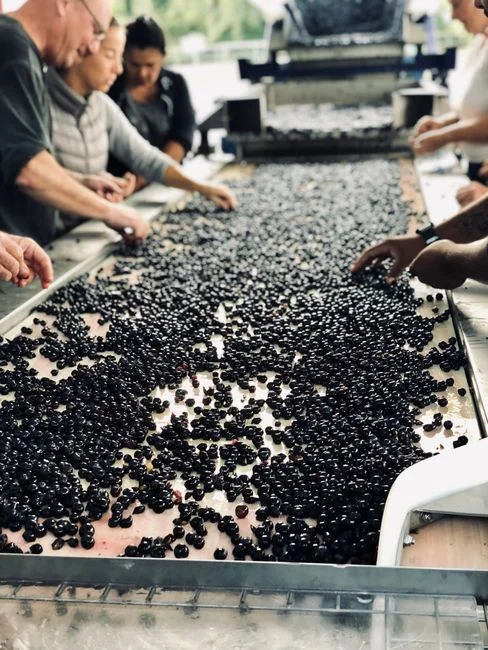
Most food plants combine DAF float and biological sludge into one dewatering stream, and the 2025 Morvolous field data is explicit about the starting configuration for that feed: 0.3 mm screen gap, 50–75% backpressure of maximum, and 50–60% VFD speed. That combination is the baseline for a food-grade screw press with 316L wetted parts and 3-A Sanitary certification, and it is the right starting point for dairy, meat, poultry, beverage, and most brewery feeds. Polymer is matched to the dry-solids load rather than to volume, so the polymer system is sized for peak rather than average, because food-sludge generation is batch-driven and the make-down unit cannot keep up at peak load — the most common cause of wet cake, again per the 2025 Morvolous dataset.
High-fiber streams — citrus peel, potato peel, corn fiber, apple pomace — cut screw press throughput by 30–50% because small fibrous particles partially block the 0.2–0.3 mm screen gap and create uneven dewatering across the drum. The Morvolous review explicitly recommends a belt press or pre-shredding ahead of a screw unit for these feeds. Protein-rich streams from dairy, poultry, and seafood need an oversized polymer system to handle the sticky, compressible discharge behavior; specifying 316L on flights and ring sets is generally justified because ring sets are the single most expensive replacement part in the press lifetime. Brewery spent grain and similar high-concentration streams point at a plate-and-frame filter press, accepting the 3–5 h/week of batch downtime in exchange for the driest possible cake. POME biological sludge combined with DAF float at a palm oil facility in Pahang State ran about 60 m³/day at 2.5–3.5% TS on a screw press, and hit target cake dryness only after the polymer system was right-sized — a useful real-world confirmation of the configuration rules. For the polymer side, the Coagulant Dosing System for Food Processing: 2026 Equipment Selection & Control Guide covers make-up, dosing curves, and CIP integration in detail.
| Sludge sub-type | Recommended press | Starting configuration | Performance to target |
|---|---|---|---|
| Combined DAF float + biological (most common) | Food-grade screw press, 316L | 0.3 mm screen gap, 50–75% backpressure, 50–60% VFD speed, oversized polymer | 25–50% cake solids, 95%+ capture |
| High-fiber citrus, produce peel | Belt press, or screw with pre-shredder | Belt: continuous duty, large belt area; Screw: add maceration to 5–10 mm top size | 15–30% cake solids, 85–90% capture (belt) |
| Protein-rich dairy, poultry, seafood | Screw press, 316L, 3-A Sanitary | 0.3 mm gap, polymer sized for peak load, CIP-compatible piping | 25–45% cake solids, 95%+ capture |
| Brewery spent grain, high-concentration | Plate-and-frame filter press | 35–45% cake target, 3–5 h/week plate cleaning window | 35–45% cake solids, 95%+ capture |
| POME biological + DAF float | Screw press, polymer right-sized | 0.3 mm gap, 2.5–3.5% TS feed, polymer matched to DS not volume | Target cake dryness once polymer is matched |
Sizing the Press to Your Plant in kg DS/h
Sizing a screw press for a food plant starts with feed characterization. The HydropureWater 2026 spec sheet sets the operating envelope at 1–5% DS feed solids, pH 5–9, temperature below 60°C, and maximum particle size 5–10 mm. Abrasive or oversized feed needs pre-treatment — maceration or screening — before it reaches the press. CIP chemical residues and pH excursions are common during shift change, and a press run outside that envelope will plug or wear prematurely.
Lock the throughput target in kg DS/h from the production rate, the operating hours, and the expected sludge generation. The 2023 USDA generation ratio of 3–8 tons of sludge per 100 tons of raw material gives a first-pass estimate, and the actual number falls out of a solids balance across the DAF and biological steps. Match that kg DS/h to a screw diameter: 300 mm covers 200–400 kg DS/h, 400 mm covers 500–800 kg DS/h, 500 mm covers 800–1,200 kg DS/h, and 600 mm covers 1,200–2,000 kg DS/h. The HydropureWater SP range lines up against those bands: SP-300 at 200–400 kg DS/h with a 4.0 kW motor, SP-500 at 500–800 kg DS/h with a 7.5 kW motor and a 3.2 × 1.5 × 2.1 m footprint, SP-800 at 800–1,200 kg DS/h with 11.0 kW, and SP-1200 at 1,200–2,000 kg DS/h with 15.0 kW. Most food plants land on the SP-500 mid-frame, and the only way to confirm is a pilot on actual sludge — most manufacturers will ship a rental unit for an on-site trial. For a deeper dive into volume reduction beyond the press itself, the Sludge Volume Reduction Methods: 2026 Engineering Guide covers thickening, drying, and downstream options.
CAPEX, OPEX, and a Worked Payback in 2024 Dollars
CAPEX bands in 2024 dollars: screw press $80,000–$250,000, belt press $50,000–$150,000, plate-and-frame filter press $100,000–$300,000+. Buyers commonly miss the install line at $20,000–$50,000 and the commissioning line at $10,000–$30,000, both of which belong in the CAPEX, not in a later change order. OPEX is light on a screw press: energy at $0.05–$0.10 per ton, polymer at $5–$15 per ton of dry solids (2–5 kg of polymer per ton DS at typical food-grade polyacrylamide prices), maintenance at $2,000–$5,000 per year, and 0.5–1 FTE for oversight. Energy at 20–30 kWh/ton at $0.08/kWh works out to $1.60–$2.40 per ton of sludge in electrical cost.
The 2024 EREF landfill tipping survey, reported by WasteOptima and cited in the HydropureWater 2026 spec data, put the national average at $62.28 per ton, up from $56.80 per ton in 2023, with a $34.78 Kansas floor and a $124.25 Alaska ceiling. Most states fall between $45 and $85 per ton, and the South Central region averages $44.87 per ton. That is the disposal cost the press is offsetting, and it is the lever the buyer presents to management. The worked example: a 500 kg DS/h screw press running 24/7 for 300 days handles about 360 tons of dry solids per year, and at a typical 45% cake solids the tonnage hauled drops by 60–80% versus raw sludge. At the EREF national average, that maps to roughly $200,000 in annual disposal savings against an $180,000 mid-range installed cost, so payback lands under one year. The Midwest vegetable case study in the HydropureWater 2026 dataset ran the same math and cut disposal from $450,000 to $120,000 per year at 45% cake solids, which is the real-world confirmation of the worked example. Financing options for the upfront line include the USDA REAP grant and the EU LIFE Programme for eligible applicants.
| Cost line | Screw press | Belt press | Plate-and-frame filter press |
|---|---|---|---|
| CAPEX | 80,000–250,000 | 50,000–150,000 | 100,000–300,000+ |
| Installation | 20,000–50,000 | 20,000–50,000 | 30,000–60,000 |
| Commissioning | 10,000–30,000 | 10,000–25,000 | 15,000–40,000 |
| Energy (USD/ton sludge) | 0.05–0.10 | 0.10–0.20 | 0.05–0.10 |
| Polymer (USD/ton DS) | 5–15 | 5–15 | 8–20 |
| Maintenance (USD/year) | 2,000–5,000 | 3,000–7,000 | 4,000–8,000 |
| Typical payback (Midwest EREF avg) | Under 1 year | 1–2 years | 1.5–3 years |
Common Commissioning Mistakes on Food Plants
The three errors that show up on most food-plant installations are sizing the polymer system for average rather than peak load, setting the screen gap to a municipal-default value, and laying out the press room without maintenance access. Food-sludge generation is batch-driven, and the make-down unit cannot keep up at peak load, so the polymer skid is sized for peak, not average. The screen gap starting point for food sludge is 0.3 mm, not 0.2 mm, because small fibrous particles partially block a tighter gap and create uneven dewatering across the drum. Maintenance access is the easiest miss: a basket change at 2–3 years and a screw refurbishment at 5 years are routine, and the access planning belongs on the P&ID, not after installation. A plant processing 100 tonnes/day today may be processing 150 tonnes/day in five years, so size the polymer skid and the layout for the next upgrade, not the current nameplate.
Frequently Asked Questions
What cake solids and capture rate should a food-grade screw press deliver in 2026?
A food-grade screw press with 316L wetted parts and the 0.3 mm screen gap / 50–75% backpressure / 50–60% VFD speed starting configuration delivers 25–50% cake solids at 95%+ solids capture on 1–5% DS feed, per the HydropureWater 2026 engineering spec data. Dairy and beverage sludge typically finishes at the high end of that band (45–50% cake solids), while fat-heavy and protein-heavy streams finish wetter at the same polymer dose.
How much does a sludge press for a food processing plant cost in 2024 dollars?
CAPEX bands in 2024 dollars: screw press $80,000–$250,000, belt press $50,000–$150,000, plate-and-frame filter press $100,000–$300,000+. Buyers commonly add $20,000–$50,000 for installation and $10,000–$30,000 for commissioning. The disposal cost the press is offsetting is the 2024 EREF national landfill tipping average of $62.28 per ton, ranging from $34.78 in Kansas to $124.25 in Alaska.
What food-safety certifications matter when specifying a sludge press?
Specify 316L stainless steel on all wetted parts, FDA-compliant seals and gaskets, Clean-In-Place compatibility, accessible inspection ports, and no dead zones in the basket. For dairy applications, units certified to 3-A Sanitary Standards are the standard ask. Most plants we size for put 316L on the flights and ring sets even when a lower alloy would carry the frame, because ring sets are the single most expensive replacement part in the press lifetime.
How long does a screw press last in a food processing environment?
With proper maintenance — screen replacement every 2–3 years and screw refurbishment about every 5 years — a screw press in a food processing environment delivers 10–15 years of service life, which matches the design life used in the standard payback example. The two interval replacements are routine, and the layout must allow both without a full strip-down.