Why Ozone Generators Are Back on the Pharma Spec Sheet in 2026
EU GMP Annex 1 (revision published August 2023, in force across 2025–2026) tightened contamination control expectations for Water for Injection (WFI) storage and distribution loops, and endotoxin control is now treated as a continuous-state parameter rather than a periodic pass/fail result. That regulatory shift is the primary reason ozone is being re-evaluated for pharmaceutical water treatment: an ozone generator skid for pharmaceutical water and effluent polishing delivers continuous sanitization of a recirculating loop without adding a residual chemical that has to be rinsed out before the next batch. Ozone decays to O2, so the commercial explainer from absolute ozone (2025) is explicit that ozone is not classified as an "added substance" in WFI or purified water loops, a fact that simplifies USP and EP compendial reviews. Pilot data on mixed pharmaceutical–domestic wastewater (MDPI, 2020) shows that ozone oxidises dissolved organic matter (DOM), humic and fulvic acids that conventional chlorine or UV cannot break, which is why procurement committees at formulation and API plants are now reviewing ozone as a primary polishing step rather than a tertiary add-on. India MoEFCC Schedule-Y revisions and WHO TWD updates are pushing discharge limits in the same direction, so the same skid that protects the WFI loop can also drag effluent COD, colour and TOC below the new local thresholds.
How Ozone Works in Pharmaceutical Water Treatment
Direct molecular O3 oxidation attacks electron-rich functional groups on small APIs and is fast at low pH, while indirect hydroxyl-radical (•OH) oxidation dominates at pH > 8 to break the recalcitrant aromatic and heterocyclic structures typical of formulation effluent (MDPI, 2020). On the equipment side, the chain is: oxygen feed (concentrator or LOX) → corona discharge cell (or electrolytic cell for ultra-pure streams) → venturi injector or fine-bubble diffuser → contact/degassing tank → catalytic ozone destructor on the vent → ORP and dissolved-O₃ probes on the return line. Compared to chlorine, ozone is roughly 3,157 times stronger (WHO statistical analysis, ozonepedia, 2025), produces no halogenated disinfection by-products, and leaves no chemical residual once the destructor and ORP trim cycle complete, which is the basis for its acceptance on WFI storage loops where any added substance triggers a full compendial re-validation.
Ozone Dosage vs COD and DOM Removal: What the 2020 Pilot Data Shows
The MDPI 2020 pilot (S1) tested ozone at 5, 10, 20 and 30 mg/L on effluent mixed at 10%, 30% and 50% pharmaceutical wastewater (PW) with domestic wastewater, in a 0.24 m³ contact tank at 1 h HRT and 6 L/min ozone gas flow. The optimum operating point depends on the PW fraction: 15 mg/L O₃ at 43 min for 10% PW (16.5% incremental COD removal), 20 mg/L O₃ at 37 min for 30% PW (24.4% incremental COD removal) and 25 mg/L O₃ at 37 min for 50% PW (19.9% incremental COD removal). Most APIs are fully destroyed at only 5–15 mg/L O₃, while bulk COD polishing peaks around 20 mg/L and 37 min contact for typical pharma effluent. The headline DOM result is 55% removal by post-ozone versus 38% by pre-ozone (MDPI, 2020), the figure to put in front of any committee that still defaults to UV or chlorine for polishing.
| PW fraction in feed | Optimum O₃ dose | Optimum contact time | Incremental COD removal | Engineering takeaway |
|---|---|---|---|---|
| 10% | 15 mg/L | 43 min | 16.5% | Light load, near-stoichiometric API oxidation |
| 30% | 20 mg/L | 37 min | 24.4% | Typical formulation plant, design point for polishing skid |
| 50% | 25 mg/L | 37 min | 19.9% | Heavy API mother-liquor load, pair with biological step |
Ozone alone strips roughly 80% of humic acid and 65% of fulvic acid from the biologically treated effluent, with the remaining fractions dropping a further 25% (S1). That step-change in colour and TOC is what differentiates ozone from Fenton or UV/H₂O₂ at comparable CapEx.
Pre-Ozone vs Post-Ozone in a Biological A2/O Train
The MDPI 2020 paper (S1) compared two trains: hydrolysis acidification → O₃ → modified A2/O ("pre-ozone") and hydrolysis acidification → modified A2/O → O₃ ("post-ozone"). Pre-ozone delivers 69% overall COD, 84% TN, 90% NH₄-N and 92% TP removal, the strongest nutrient performance of the two configurations. Post-ozone delivers 74% overall COD (6.8 percentage points higher than pre-ozone), 87.9% humic acid removal and 73.9% fulvic acid removal, the strongest polishing performance. The decision rule is simple: if the binding limit is ammonia or phosphorus, or if the goal is to break down APIs early so the biological step is not inhibited, put ozone before biology. If the binding limit is COD, colour, TOC or any reuse-driven specification, put ozone after the biological step.
| Parameter | Pre-ozone (O₃ before A2/O) | Post-ozone (O₃ after A2/O) | Driver |
|---|---|---|---|
| Overall COD removal | 69% | 74% | Post-ozone wins by 6.8 pp |
| Total nitrogen (TN) | 84% | Lower | Pre-ozone for nutrient limits |
| Ammonia (NH₄-N) | 90% | Lower | Pre-ozone protects nitrification |
| Total phosphorus (TP) | 92% | Lower | Pre-ozone for TP caps |
| Humic acid removal | ~25% (ozone only) | 87.9% | Post-ozone for colour/TOC |
| Fulvic acid removal | ~19% (ozone only) | 73.9% | Post-ozone for colour/TOC |
| Overall DOM removal | 38% | 55% | Post-ozone for reuse |
A 30% PW feed in the pre-ozone configuration held total effluent nitrogen under 10 mg/L, phosphorus under 0.5 mg/L and COD under 100 mg/L (MDPI, 2020). For a more detailed comparison against membrane polishing, see the reverse osmosis for pharmaceutical water treatment 2026 guide and the pharmaceutical wastewater treatment engineering guide.
Process Train and Equipment Specifications for a Pharma Ozone Skid
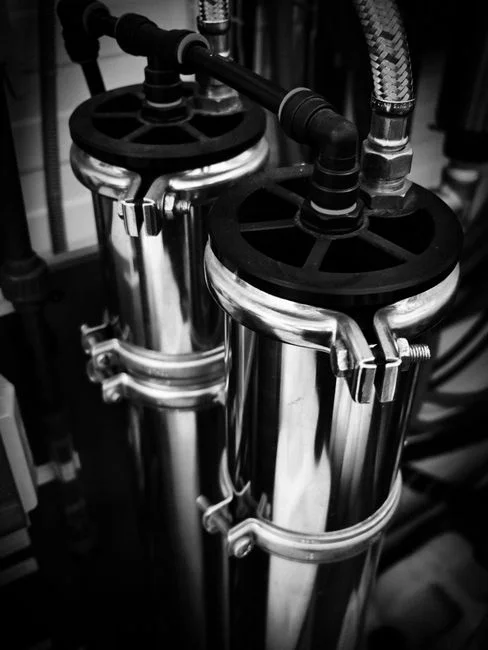
The MDPI 2020 pilot geometry (0.24 m³ contact tank, 1 h HRT, 6 L/min ozone gas, 5–30 mg/L dose range) is a defensible starting point for scale-up because the residence-time-to-dose ratio drives removal efficiency. For an industrial skid, hold HRT near 60 min and run 8–10 mg/L O₃ for WFI loop sanitization or 15–25 mg/L for effluent polishing. The skid in P&ID order is: oxygen concentrator or LOX feed → ozone generator (corona discharge, oil-free) → venturi injector or fine-bubble diffuser in a 316L contact/degassing tank with PTFE internals → ORP and dissolved-O₃ probes on the recirculation line → catalytic ozone destructor on the vent → PLC with auto-dose trim driven by the ORP setpoint. For pre-ozone trains, a PLC-controlled chemical dosing skid for pre-ozone pH adjustment is needed to hold the contact tank at pH 7–8 where the •OH pathway is strong but off-gas ozone stays manageable.
| Component | Specification | Why it matters |
|---|---|---|
| Oxygen feed | PSA concentrator (90–93% O₂) or LOX; dewpoint ≤ −60 °C | Corona cell efficiency and nitrogen-free feed |
| Ozone generator | Corona discharge, 6–12% by weight, oil-free | Pure output, no hydrocarbon carry-over to WFI |
| Dissolution | Venturi injector with booster pump, or fine-bubble diffuser | >90% gas transfer before contact tank |
| Contact tank | 316L SS, PTFE seals, 60 min HRT, baffles for plug-flow | Matches MDPI pilot geometry, scales linearly |
| Instrumentation | ORP probe, dissolved-O₃ probe, pH, conductivity, ambient O₃ | Auto-dose trim and worker safety per OSHA PEL |
| Off-gas treatment | Catalytic ozone destructor (heated MnO₂ or Pd), redundancy | <0.1 ppm vent, TLV compliance |
| Control | PLC with ORP-based trim, trending, batch interlocks | Compendial evidence for sanitization cycles |
Sizing rule of thumb: for a 10 m³/h WFI loop, a 200–300 g/h ozone generator with a 1.0 m³ contact tank is a typical design; for a 50 m³/h effluent polishing train targeting 20 mg/L O₃ at 60 min HRT, the contact tank climbs to ~50 m³ and the generator to 1.0–1.5 kg O₃/h. Absolute ozone (2025) recommends tying generator output to an online monitor so the system runs unsupervised and trims dose to the actual demand of the loop.
Operational, Safety and Compliance Considerations
Ozone is toxic to operators above 0.1 ppmv on an 8 h exposure basis (OSHA PEL, NIOSH REL), so every contact-tank vent must terminate at a heated catalytic destructor, and the room housing the skid needs an ambient O₃ monitor with a hardwired interlock to the generator. Material compatibility is critical: 316L stainless wetted parts, PTFE or Viton seals, and PTFE or stainless gaskets are required because EPDM and natural rubber degrade rapidly under dissolved O₃ above 2 mg/L. For WFI storage and distribution loops, validate that the off-gas destructor brings the loop residual below the compendial detection limit and that ORP-controlled dosing holds loop O₃ at 0.02–0.05 mg/L during a sanitization cycle, decaying to undetectable before point-of-use. For effluent trains, confirm post-ozone BOD and COD against the local discharge or reuse rule, and where reuse is the goal, verify microbial indicators against WHO TWD or IS 10500 targets before commissioning the skid.
Frequently Asked Questions
What ozone dose is needed to destroy active pharmaceutical ingredients?
Most APIs in formulation effluent are fully destroyed at 5–15 mg/L O₃ according to the MDPI 2020 pilot (S1); however, the surrounding matrix matters, and a 30% PW feed needed 20 mg/L and 37 min to reach 24.4% incremental COD removal. For a P&ID, design the contact tank for 20 mg/L and 60 min HRT and let ORP trim downward when influent strength drops.
Should ozone go before or after the biological step in pharma effluent treatment?
Use post-ozone when COD, colour, TOC or reuse compliance is the binding limit (74% overall COD, 87.9% humic acid removal per MDPI 2020), and pre-ozone when ammonia (90% NH₄-N), total phosphorus (92% TP) or early API breakdown is the priority. Many plants run a smaller pre-ozone cell ahead of the bioreactor to protect the biomass and a full post-ozone skid for final polishing.
What contact tank HRT and dose range should be specified for a pharma ozone skid?
Hold HRT near 60 min and design for 8–10 mg/L O₃ on WFI loop sanitization and 15–25 mg/L for effluent polishing