
Why Industrial Plants Are Choosing MBBR Retrofits in 2026
Three regulatory shifts converged in late 2025 and early 2026 to make retrofit more attractive than greenfield expansion for most industrial sites: revised EU IED BAT-AEL ranges that tightened nitrogen and total phosphorus ceilings, US EPA pretreatment rule updates that pushed nutrient and PFAS precursors onto industrial discharge permits, and China's GB 18918-2025 amendments that lowered ammonia limits in many receiving-water categories. Plants designed against 2010-vintage permits now face discharge targets their activated sludge basins were never sized for. Conventional activated sludge is capped at 2,000-4,000 mg/L MLSS by clarifier settleability—the physics constraint an MBBR retrofit bypasses by adding a fixed biofilm phase that operates independently of mixed liquor concentration. The result is 50-100% effective capacity gain inside the original footprint, which is why the four triggering pressures now appearing on plant P&IDs are: 15-50% production increase against a fixed discharge permit, tighter ammonia or TN limits that suspended growth cannot meet year-round, cold-weather nitrification failure below 12-15°C, and footprint-limited sites where civil expansion would exceed 10-15% of the available plot.
What an MBBR Retrofit Actually Changes Inside the Tank
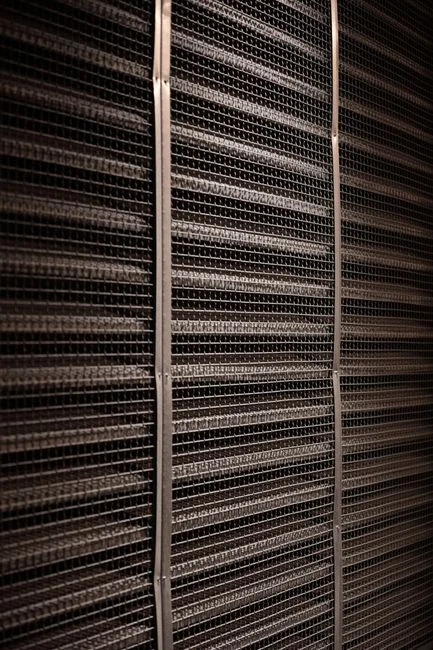
An MBBR retrofit converts the existing aeration basin rather than replacing it. HDPE biofilm carrier media with engineered internal geometry and a protected surface area of 300-800 m²/m³ are poured through existing access hatches at a 30-50% fill fraction, and stainless steel wedge-wire retention screens are anchored over the outlet so carriers stay in the reactor while mixed liquor flows through. The aeration grid is typically upgraded to a medium-to-coarse bubble pattern (or a targeted fine-bubble layout with engineered mixing) to keep carriers in continuous fluidization; drop-in grids or commercial diving team installation allow this work to proceed without draining the tank. The scope most engineers underestimate is balance-of-plant: blowers with sufficient reserve for the higher oxygen demand, retention sieves sized for the design flow, mixers or aeration-zone baffling, DO probes tied into the aeration control loop, and PLC/SCADA logic changes for stage control and backwash sequences. Carriers themselves are 15-25% of the total retrofit CAPEX, with the supporting scope driving the rest (HydropureWater field data, 2026).
MBBR Retrofit vs IFAS, MBR, and Equalization Expansion
The four upgrade paths a process engineer is most likely to compare in 2026 are MBBR retrofit, IFAS hybrid conversion, MBR upgrade, and equalization expansion. These options are not interchangeable. The table below places them on the parameters an EPC lead or plant manager defends to a CFO: capacity gain in the existing footprint, CAPEX relative to a greenfield aeration tank, effluent TSS capability, energy intensity, and invasiveness. MBBR delivers 50-100% capacity gain in the same basin at 20-40% of new-tank CAPEX, with no change to downstream solids separation. IFAS (integrated fixed-film activated sludge) achieves a similar capacity gain but maintains a return activated sludge loop and MLSS control, which adds operational discipline. MBR pushes effluent TSS below 5 mg/L but at a 40-60% CAPEX premium over MBBR and higher aeration energy for membrane scouring. Equalization is a hydraulic tool—it only helps when shock loading is the dominant failure mode, not when biological capacity is short. An MBBR retrofit will not improve final solids separation on its own; if the effluent TSS target is below 10 mg/L, downstream clarifier, DAF system for solids polishing, or filtration must be evaluated in parallel. For plants considering the membrane route instead, the MBR retrofit and upgrade guide covers scope and KPI ranges side by side. Budget for a 2-6 mm headworks upgrade whenever influent carries fats, fibrous solids, or abrasive particulate to prevent media fouling.
| Parameter | MBBR retrofit | IFAS hybrid | MBR upgrade | Equalization expansion |
|---|---|---|---|---|
| Capacity gain in same footprint | 50-100% | 50-100% | 50-100% + solids upgrade | 0% (hydraulic only) |
| CAPEX vs new concrete tank | 20-40% | 25-45% | 60-90% | 30-50% |
| Effluent TSS capability | 10-30 mg/L (clarifier limited) | 10-30 mg/L (clarifier limited) | <5 mg/L | No change |
| Energy intensity (kWh/kg BOD removed) | 0.4-0.7 | 0.5-0.8 | 0.8-1.4 | Negligible |
| Footprint change | None | None | -60% (membranes replace clarifier) | +20-40% (new EQ tank) |
| Retrofit complexity / downtime | Low / zero | Medium / 1-3 days | High / 1-2 weeks | High / 4-8 weeks |
| Best fit when | Biology is the bottleneck, footprint is fixed | Biology + MLSS control can be retained | TSS <10 mg/L or water reuse required | Shock load or batch discharge is the cause |
Diagnosing Whether Your Plant Is a Good MBBR Retrofit Candidate
The diagnostic for an MBBR retrofit is whether the bottleneck is biological capacity inside a structurally sound asset—not screening, equalization, or final clarification. Use the table below as a screening tool before commissioning a pilot. If your plant scores on three or more "fit" rows and fewer than two "limit" rows, MBBR is worth a serious engineering study; if "limit" rows dominate, retrofitting balance-of-plant first will consume most of the budget, suggesting a process redirection like SBR conversion, MBR, or partial stream segregation. Industry context also matters: food and dairy plants typically retrofit for cold-month ammonia failure and CIP-caused hydraulic swings, chemical and metal finishing plants for inhibitory influent and tight zinc/nickel limits, and pulp and paper mills for seasonal cold-weather nitrification collapse combined with high color and resin-acid load. The 4-8 week pilot test is non-negotiable when wastewater chemistry shifts by product campaign, inhibitory compounds are suspected, or total nitrogen removal is the compliance driver (HydropureWater field data, 2026).
| Indicator | Threshold / signal | Retrofit implication |
|---|---|---|
| Aeration tank utilization | Full at design load, civil space <10-15% expansion headroom | Fit — biology is the bottleneck |
| Winter ammonia failure | NH4-N >permit for 6-12 weeks/year at <15°C | Fit — biofilm retains nitrifiers better |
| Hourly load swing | >25-30% between shifts or production campaigns | Fit — biofilm buffers hydraulic and organic shock |
| Clarifier SVI | Frequent bulking, SVI >200 mL/g, TSS carryover | Fit — biology shifts off MLSS dependence |
| Blower reserve | <15% above current peak demand at standard SOTE | Limit — blower upgrade will drive CAPEX |
| Headworks screening | >6 mm openings, no grit removal, visible fats/fibers | Limit — upgrade screening to 2-6 mm first |
| Final clarifier flux | Already at >90% of design solids flux | Limit — add DAF, Lamella, or filtration in parallel |
| Influent toxicity | Phenols, cyanides, heavy metals above inhibition thresholds | Limit — source control + 4-8 week pilot required |
The 5-Step MBBR Retrofit Sequence With Timelines
The retrofit decision window for an industrial plant typically runs 6-14 weeks from data review to mechanical completion, compared to 12-24 months for a greenfield aeration tank. This schedule advantage makes retrofit the logical choice when production is growing. The five steps below should be planned in parallel with procurement.
Step 1 — Data validation (weeks 1-4): Collect 4-8 weeks of representative flow, COD, BOD, ammonia, pH, alkalinity, temperature, and TSS data at hourly resolution. Daily averages hide the 25-30% peak swings that drive carrier sizing. Diurnal data also feeds the blower reserve calculation.
Step 2 — Bottleneck mapping (weeks 4-6): Determine whether the shortfall is biological, hydraulic, or solids-separation. If the secondary clarifier is already at flux limit, carriers will not help, and the answer is DAF, Lamella, or filtration in parallel with the biology. Specifying carriers before this step is the most common cause of post-startup underperformance.
Step 3 — Configuration review (weeks 6-8): Compare full MBBR conversion, hybrid IFAS-style addition, or a targeted nitrification polishing stage against available blower capacity and tank geometry. An IFAS hybrid is often the right answer when the existing RAS loop and MLSS control can be retained; the IFAS energy and ROI data piece covers these trade-offs in detail.
Step 4 — Equipment integration (weeks 8-10): Specify blowers, retention sieves, mixers, DO instrumentation, and control logic. For plants that still run on analog instrumentation, a smart monitoring upgrade for retrofit plants typically pays back inside the first permit cycle by closing the DO control loop and reducing aeration energy 10-20%.
Step 5 — Implementation (weeks 10-14): Phased installation through existing access hatches allows the plant to remain online. Biofilm colonization completes in 4-8 weeks under typical industrial loads, after which the suspended-growth MLSS can be reduced and the RAS rate trimmed to lower clarifier loading.
Post-Startup KPIs: What Stable MBBR Performance Looks Like
Operators reach stable compliance faster by treating the first 30-90 days after startup as a tuning period. The realistic performance bands for a properly scoped industrial retrofit are: BOD removal capacity 20-60% above the pre-retrofit baseline, restored nitrification reliability at mixed-liquor temperatures below 15°C, and hourly peak resilience above 25-30% load swing without effluent excursions (HydropureWater field data, 2026). Media colonization, aeration balance, DO setpoints, sludge wasting, and screen inspections all require tighter monitoring than routine steady-state operations. Three failure modes typically surface during this window, each pointing to a balance-of-plant issue: rising effluent TSS signals a clarifier bottleneck downstream of the new biology, unstable DO across the basin signals a blower shortfall, and media carryover past the screens signals undersized wedge-wire retention or excessive aeration velocity at the outlet. Plants needing sub-10 mg/L TSS should evaluate the MBR alternative before committing to a carrier retrofit that leaves a clarifier on the critical path.
Frequently Asked Questions
What does an MBBR retrofit actually cost relative to a new aeration tank?
Industrial MBBR retrofits typically land at 20-40% of the CAPEX of an equivalent new concrete aeration tank. The carrier media itself is usually only 15-25% of that figure—the rest is blowers, retention sieves, controls, pilot work, and installation labor. For plants with poor headworks, the 2-6 mm rotary mechanical bar screen for headworks upgrade is a prerequisite and should be priced into the budget from day one (HydropureWater field data, 2026).
How long until an MBBR retrofit reaches stable compliance?
Biofilm colonization
Frequently Asked Questions
How much does an MBBR retrofit cost compared to building a new aeration tank?
An MBBR retrofit typically costs 30% to 50% less than constructing a new greenfield aeration tank. By utilizing existing concrete basins and infrastructure, plants avoid significant civil engineering costs, site excavation, and new piping installation.
Capital expenditure for retrofits is primarily driven by media volume, aeration upgrades, and containment screen installation. Depending on the plant size, retrofits can increase volumetric treatment capacity by 50% to 200% within the existing footprint, providing a much higher return on investment than new construction.
Can an MBBR retrofit be done without shutting down the plant?
Yes, MBBR retrofits are specifically designed for phased implementation to maintain continuous plant operations. The process involves installing media retention screens at the outlet and adding aeration grids while the basin remains partially or fully operational.
In most scenarios, the tank is partitioned or retrofitted in cells, allowing the plant to treat a portion of the flow while the upgrade is completed in stages. This approach ensures compliance with discharge permits and avoids the need for temporary bypass systems.
How long does it take for an MBBR retrofit to reach stable performance?
The time to achieve steady-state performance typically ranges from 4 to 8 weeks, depending on the influent temperature, organic loading rates, and existing biomass activity. The colonization of the media by biofilm is faster in summer months compared to winter, where colder temperatures may delay nitrification kinetics.
To accelerate startup, operators often seed the basins with return activated sludge (RAS) or utilize specialized bio-augmentation products. Once the biofilm reaches a thickness of 50 to 200 microns, the system generally operates at full design capacity.
Is MBBR or IFAS better for retrofitting an existing activated sludge plant?
The choice depends on the specific treatment goals: MBBR is preferred for upgrading BOD removal or nitrification without the need for high mixed liquor suspended solids (MLSS), while IFAS is superior if the plant must maintain high MLSS concentrations for denitrification.
IFAS (Integrated Fixed-film Activated Sludge) is technically a hybrid system that maintains both suspended and attached growth. If the existing secondary clarifiers are undersized, MBBR is often the better choice because it does not increase the solids loading rate on the clarifiers, whereas IFAS relies on maintaining a high suspended biomass concentration.
What influent characteristics disqualify a plant from an MBBR retrofit?
Plants with extremely high concentrations of non-biodegradable particulate matter or high levels of toxic heavy metals are generally poor candidates for MBBR. If the influent contains high concentrations of grease or oil that can coat the media surfaces, the biofilm will fail to attach, leading to process failure.
Additionally, if the existing tank geometry prevents the uniform distribution of media or causes excessive dead zones, the hydraulic efficiency will be compromised. Plants with severe hydraulic surges or flow velocities exceeding 0.5 meters per second may also face challenges with media transport and screen clogging, necessitating extensive pre-treatment upgrades before an MBBR installation.