

Quick-Reference: Symptom → Likely Cause → First Action
Anaerobic digester troubleshooting in an industrial plant compresses to four numbers: pH 7.0–7.2, mesophilic temperature 32–35°C (thermophilic 50–60°C), VA/Alk ratio ≤0.34 (ideal <0.1), and methane content 65–70%. A >2–3°C/day temperature swing alone can collapse methanogens and trigger a volatile-acid crash in 48 hours, so always fix temperature before chemistry (per Aquafix/Aquafix Kerns, 2015; Gerardi 91). The table below maps the symptom you see on shift to the probable cause and the first corrective move with a specific numeric target.
| Symptom | Probable Cause | First Action (with target) |
|---|---|---|
| Sudden foam, thick scum, gas-line carryover | Organic overload or over-mixing; filamentous foam (Nocardia/Microthrix) | Stop feeding; cut mixing to intermittent; hold OLR below 50 lb VA/1,000 ft³/day (per Aquafix Kerns, 2015) |
| Falling methane (<60%) with rising CO₂ | Temperature shock or organic overload; VFA buildup | Check 24-h temperature log for >3°C swing; resume feed only after VA/Alk <0.3 |
| pH drop below 6.8, VA/Alk rising past 0.34 | Volatile acid accumulation; buffering exhausted | Raise pH to 6.4 with lime, then push to 7.0–7.2 with NaHCO₃ until VA/Alk <0.3 (per Schnaars, 2012) |
| Sour/rotten-egg gas (H₂S >200 ppm) | Sulfate in feed; insufficient iron | Dose ferric chloride to precipitate sulfide; confirm Fe at 0.2% of COD |
| Industrial high-COD feed (e.g. sugar refinery 18,770 mg/L COD) | Long-chain fatty acid inhibition; pH drop; foaming | Dilute feed or reduce loading; target HRT 21 days, pH 7.01, magnetite 0.42 g/L (per DUT 2024, 50 L AD study) |
| Methane <55% or any parameter out of range >24 h | Systemic upset beyond operator correction | Call a process engineer; do not chase with chemical dosing |
Step 1 — Verify Temperature and Hydraulic Retention Time Before Touching Chemistry
Mesophilic digesters need a stable 32–35°C window; thermophilic units run 50–60°C, with the high end of either range preferred because enzyme kinetics, sludge reduction, and methane yield all rise with temperature (per Gerardi 127, 2003). The hard rule is rate of change: never let a mesophilic digester shift more than 2–3°C in a 24-hour period, and some practitioners hold the limit to 1°F/day. A faster swing kills methanogens before acids are consumed, and the chemistry crash follows in roughly 48 hours.
Hydraulic retention time is the second control knob and is often misread. In a complete-mix digester, SRT equals HRT because solids and liquids move together; ~20 days is the typical mesophilic SRT, while thermophilic systems can finish in 8 hours or less when feed is amenable (per Gerardi 154). For high-COD industrial wastewater, the Durban University of Technology 50 L AD study on sugar refinery effluent (COD 18,770 mg/L) found an optimum HRT of 21 days at pH 7.01, with magnetite addition shortening the lag phase from 9 days to 3 days and lifting methane content to 90% once sensors closed the loop (per DUT 2024, Investigating the upscaling of an anaerobic digester for biogas production from industrial wastewater).
The diagnostic on shift is simple: pull the 24-hour temperature log first. Any probe showing more than 3°C of swing in a day is almost always the root cause; VA/Alk and pH will follow within hours. Fix heat supply, hold feed, and let the biology recover before dosing bicarbonate.
Step 2 — Read pH, Alkalinity, and the VA/Alk Ratio
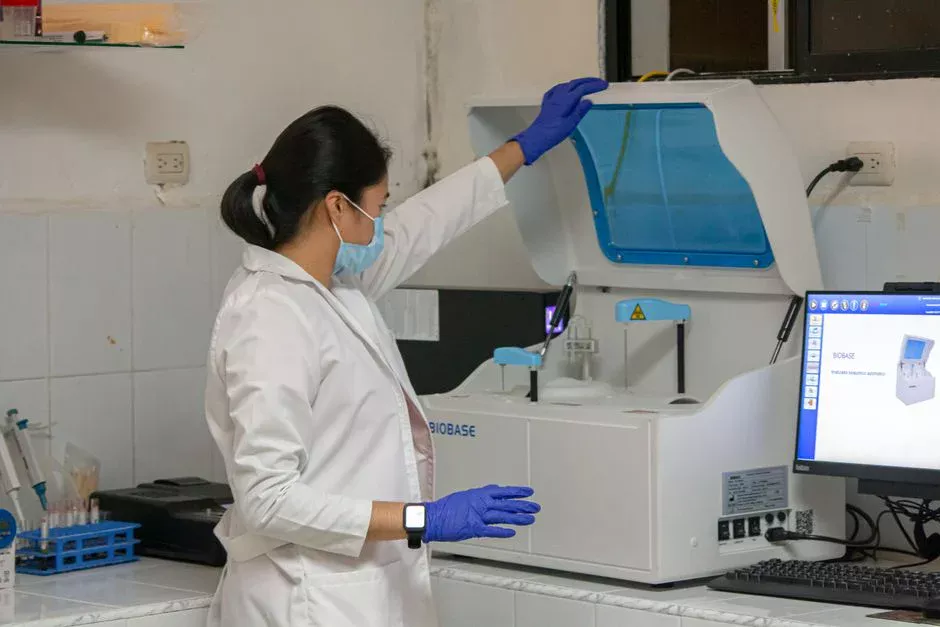
pH alone is a lagging indicator — it only falls after the alkalinity buffer is exhausted, which means by the time you see 6.6 on the meter the upset is already hours old (per Schnaars, 2012). The leading indicator is the VA/Alk ratio, calculated by titrating total alkalinity (H₂SO₄ from pH 7 to 4) and total acid (NaOH from pH 4 back to 7), then dividing. Four operating bands govern the response: ≤0.1 ideal, ≤0.34 stable, 0.34–0.5 caution, and >0.5 unstable. pH itself should sit at 7.0–7.2; 6.8–7.0 is acceptable but already losing methanogen diversity (per Gerardi 101).
Correction has two stages. First, bring pH toward 6.4 with lime — but dose carefully, because excess lime builds insoluble solids and costs digester volume (per Gerardi 102). Once pH reaches 6.4, switch to a bicarbonate salt (NaHCO₃ or KHCO₃) and push to the 7.0–7.2 target. This is where automated chemical dosing for pH and alkalinity correction pays off: a controlled loop holds the band without operator attention.
Watch the toxicity ceiling on the cation you're dosing. Potassium becomes inhibitory at 200–400 ppm and sodium at 100–200 ppm; an operator who pours straight NaHCO₃ into a sodium-loaded digester can flip an acid crash into a salt-inhibition crash (per Mignone 10, 2005). A blended bicarbonate (some K, some Na) reduces that risk. For the titration itself, an on-site operator needs roughly 100 mL of filtrate, a pH probe, and 0.1 N acid/base — full procedure is in the Vermont Water Quality lab manual.
Step 3 — Audit the Biogas: Methane, CO₂, and H₂S Composition
Gas composition is the real-time signal most operators under-use. A healthy digester produces 65–70% CH₄ and 30–35% CO₂; the ratio drifts before any liquid-phase parameter shows distress (per Aquafix Kerns, 2015). Three patterns cover the common shifts.
Pattern A — CH₄ falling, CO₂ rising, VA/Alk climbing together — points to organic overload or a temperature shock. Return to Step 1 and Step 2; the gas is downstream of the biology. Pattern B — CH₄ stable, H₂S rising above ~200 ppm — is a sulfate-in-feed problem; correct it with ferric chloride precipitation to drop dissolved sulfide and protect methanogens from H₂S inhibition. Iron also serves as a micronutrient at 0.2% of COD (per Gerardi 96).
The instrumentation point is worth underlining. The DUT 2024 sugar-refinery AD work added in-line sensors to a 50 L reactor and reached 90% methane content under optimized conditions (HRT 21 d, pH 7.01, 0.42 g/L magnetite) — a level municipal plants rarely see without that control loop. For industrial operators chasing the same stability, the lesson is that a continuous methane analyzer is no longer optional once feed COD climbs past ~5,000 mg/L.
Step 4 — Rule Out Toxicity: Ammonia, Metals, and Sulfide

Toxicity upsets look biological but are chemical, and they do not respond to the same corrective steps. The thresholds below let an operator sort them in minutes.
| Toxin | Beneficial Range | Inhibitory / Toxic Threshold | Trigger Condition |
|---|---|---|---|
| Ammonium (NH₄⁺) | 50–200 ppm (N source) | ~1,500 ppm inhibitory | High-protein food, brewery, rendering waste |
| Ammonia (NH₃) | — | ≥50 ppm toxic | pH >7.2 shifts NH₄⁺ → NH₃ |
| Nickel | 0.001% of COD | 1–2 ppm | Excess micronutrient dosing |
| Copper / Zinc | — | 0.5–1 ppm | Industrial carryover, copper piping |
| Iron | 0.2% of COD | 5 ppm (rare; precipitates as FeS) | Usually self-limiting |
| Sulfide (H₂S) | — | Dissolved H₂S inhibitory; >200 ppm in gas | Sulfate in feed; low Fe |
The dangerous interaction is pH and ammonia: at pH 7.0 most nitrogen sits as NH₄⁺, but above 7.2 a meaningful fraction converts to NH₃, which is toxic at 50 ppm. A digester that is over-alkalized can push itself into ammonia toxicity while pH reads "perfect" (per Gerardi 107).
Metals are a dosing-discipline problem. Ni, Cu, Zn, and Fe are all beneficial at low concentration and toxic just above it, so the rule is to add micronutrients only after a lab confirmation, never on a routine schedule. Acclimation helps: bacteria exposed to gradually increasing concentrations tolerate far higher steady-state levels than clean cultures. The exceptions are chemical cleaners and some antibiotics, which do not acclimate and will kill the culture outright (per Mignone 9, 2005).
Step 5 — Re-check Nutrients, Mixing, and Mechanical Health
Micronutrient depletion is a slow-moving cause operators miss because nothing trips an alarm — methane just drifts down. Targets are 0.01% Co and 0.001% Ni of COD, plus 0.2% Fe; macronutrients should sit near 12% N and 2% P of COD (per Gerardi 96, 98). Other minerals (Mo, W, Se, Mn, Ba) may help but lack strong evidence. The danger is blanket dosing: toxicity hits at low concentration, so add only after a metals scan confirms a gap.
Mixing has a sweet spot. Too little produces dead zones with localized temperature, nutrient, and toxin pockets; too much inverts solids over liquid, drops surface tension, and triggers foam (per Aquafix Kerns, 2015). Most plants run intermittent mixing for that reason, accepting slightly slower digestion in exchange for foam control. If a new foam event appears right after a mixing-energy change, that is the cause.
Mechanical capacity loss is the silent killer. Digesters that skip routine service accumulate 2–3 feet of grease, grit, and struvite crystals on the surface and in the cone, which can shrink the active digester volume by ~20% (per Aquafix Kerns, 2015). The fix is a cleanout, and the symptom is a digester that runs hot, holds less feed, and foams easily. For plants that handle the downstream dewatering step, pairing the cleanout with an upgrade to a sludge dewatering filter press cuts the cake volume returning to the headworks and reduces the recycle load on the digester. Plants struggling with FOG variability in feed should look at upstream DAF for FOG and suspended solids removal — the digester runs more cleanly when FOG is removed before it ever reaches the tank.
For context on the operating-cost side of recovery versus replacement, wastewater plant OPEX benchmarks give a 2026 view of how much an upset actually costs in downtime and lost biogas. Plants that also run a food or beverage line will find beverage and food-industry sludge handling useful, and the sludge dewatering machine selection guide covers the dewatering side of the same workflow.
Operator's Parameter Sheet — Copy and Tape to the Panel

Every value below is a working number from the operator literature or the DUT 2024 industrial-AD study, not a textbook ideal. Tape it to the panel and check it on every shift.
| Parameter | Target Range | Alarm Threshold | Corrective Action |
|---|---|---|---|
| Temperature, mesophilic | 32–35°C (high end preferred) | >3°C swing in 24 h | Hold feed; restore setpoint slowly; ≤1°F/day |
| Temperature, thermophilic | 50–60°C | >3°C swing in 24 h | Same; never shock-restore |
| pH | 7.0–7.2 (6.8–7.0 acceptable) | <6.8 or >7.2 | Lime to 6.4, then NaHCO₃/KHCO₃ blend to 7.0–7.2 |
| VA/Alk ratio | ≤0.1 ideal; ≤0.34 stable | 0.34–0.5 caution; >0.5 unstable | Stop feed; dose bicarbonate; recheck in 12 h |
| Methane (CH₄) | 65–70% (industrial w/ sensors up to 90%) | <60% | Check temperature, then OLR; see Step 3 |
| CO₂ | 30–35% | >40% | Same pattern as CH₄ drop |
| H₂S in gas | <200 ppm | >200 ppm | Dose ferric chloride; verify Fe at 0.2% COD |
| NH₃ (free ammonia) | — | ≥50 ppm | Lower pH target; reduce N-rich feed |
| NH₄⁺ | 50–200 ppm (beneficial) | ~1,500 ppm inhibitory | Dilute feed; check rendering/brewery inputs |
| OLR / VA loading | 30–50 lb VA/1,000 ft³/day | >450 lb/1,000 ft³/day max | Reduce feed rate; intermittent mixing |
| HRT (mesophilic) | ~20 days | <15 days | Reduce flow; risk of washout |
| HRT, industrial high-COD (sugar refinery reference) | 21 days at pH 7.01, 0.42 g/L magnetite | Outside 18–22 d window | Re-tune; magnetite reduces lag phase from 9 to 3 d |
| Co, Ni, Fe micronutrients | 0.01% Co, 0.001% Ni, 0.2% Fe of COD | Ni >1–2 ppm; Cu/Zn >0.5–1 ppm | Dose only after lab confirmation |
| N and P macronutrients | 12% N, 2% P of COD | Deficiency suspected at <10% / <1.5% | Co-digest with N/P-rich stream |
Frequently Asked Questions
What causes sudden foam in an anaerobic digester?
Foam usually comes from organic overload, over-mixing, or filamentous organisms like Nocardia and Microthrix parvicella that float on fats. Stop feed, drop mixing to intermittent, and hold OLR below 50 lb VA/1,000 ft³/day until the surface clears (per Aquafix Kerns, 2015).
What is the fastest way to recover a crashed digester pH?
Bring pH to 6.4 with lime, then push to 7.0–7.2 with a blended NaHCO₃/KHCO₃ dose. Watch the cation ceiling — sodium inhibits at 100–200 ppm and potassium at 200–400 ppm — so a single-salt overdose can swap one crash for another (per Mignone 10, 2005).
Why does methane percentage drop in my digester?
The two leading causes are temperature shock (>2–3°C in 24 h) and organic overload, both of which let volatile acids build and shift the CO₂/CH₄ balance. Check the 24-hour temperature log first, then VA/Alk, before adjusting feed (per Gerardi 91, 127).
What is a normal VA/Alk ratio for an anaerobic digester?
Target ≤0.1 for ideal stability, accept ≤0.34 as stable, treat 0.34–0.5 as caution, and treat anything above 0.5 as unstable requiring immediate corrective action (per Schnaars, 2012).
How do I handle a high-COD industrial feed like sugar refinery wastewater?
The DUT 2024 50 L AD study found optimum operation at HRT 21 days, pH 7.01, and 0.42 g/L magnetite on 18,770 mg/L COD feed, with methane reaching 90% once sensors closed the control loop. Dilute or step-feed the stream, and add an upstream DAF for FOG and suspended solids removal to protect the biology (per DUT 2024).
How often should I sample pH, VA/Alk, and gas composition?
On a stable digester, daily VA/Alk and gas composition with pH on every shift is enough. During an upset, run VA/Alk every 4–6 hours and log gas composition hourly until VA/Alk returns below 0.3 and CH₄ is back above 60% (per Aquafix Kerns, 2015).