Why a Novartis acquisition in Hungary is a regulatory event, not a paper transfer
Hungary's IPPC-style integrated permit is issued to a named operator under Government Decree 314/2005 (XI. 25.) on environmental impact assessment and the integrated permitting procedure — not to the legal entity in the abstract. On a share deal, the existing permit remains on paper, but the new operator must file a change of operator (üzemeltető-váltás) notification with the competent megyei kormányhivatal within 30 days of closing. On an asset deal, the permit terminates outright and a fresh application is required on the new entity's track record. The deal team that treats the operator change as a back-office filing will under-budget the integration by a factor of two or more — AOX, total nitrogen, and the 2024 CWW watchlist routinely convert a "minor upgrade" into a full treatment-train retrofit once baseline data is in hand.
The parent instrument remains the EU Industrial Emissions Directive 2010/75/EU, transposed into Hungarian law principally through Act CLXXXV of 2012 on waste and Act LIII of 1995 on general environmental protection. Once a Novartis Hungarian subsidiary is registered as operator, the site's discharge consent, air permit, and waste-handling licence all align against the Directive's BAT-AEL ceiling. Late or incomplete filing is treated as operating without a valid permit, which under Hungarian law carries suspension risk and per-day administrative fines.
Novartis also brings a global water-quality standard that survives the local transfer. The company's 2021 CDP Water Security disclosure reports 3,063 ML/year of contact water receiving primary, secondary, and tertiary treatment, plus 2,591 ML/year discharged to third parties for off-site treatment — and 100% of operational sites report standard effluent parameters (Novartis CDP Water Security response, 2021). A Novartis-owned site therefore inherits an internal API-loss governance regime and a "no water quality impacts from manufacturing effluents" 2025 corporate target on top of the binding Hungarian numbers, which the deal team should flag in the integration scope.
The four-layer legal hierarchy that binds a Novartis Hungary site
Hungarian permit numbers originate in Brussels and are refined through four layers before they bind a discharge. Each layer can tighten the envelope; none can loosen it without a formal derogation.
Layer 1 — EU IED 2010/75/EU and the BREF ceiling. The Directive forces application of BAT conclusions drawn from the Common Waste Water and Waste Gas Treatment/Management Systems in the Chemical Sector BREF (CAK) and the Common Waste Water BREF (CWW). The CWW BREF entered its 2024 update cycle; conclusions are being transposed into Hungarian competent-authority practice, with tighter COD, TSS, and AOX ceilings applied from 2025 onward (verify the exact transposition date with the authority at writing).
Layer 2 — Hungarian implementing acts. Act CLXXXV of 2012 on waste and Act LIII of 1995 on general environmental protection frame the regime. Government Decree 220/2004 (VII. 21.) sets surface-water quality and industrial ELVs for direct and indirect dischargers. The National Energy and Climate Plan (NEKT) commitments for 2024–2030 add a water-reuse and circular-economy overlay that increasingly appears in permit conditions on large industrial sites — a parameter to verify against the authority's current position.
Layer 3 — Site-specific integrated permit. This is where the BAT-AEL ranges are crystallised into binding ELVs. The permit sets monitoring frequency (typically 24-h composite sampling, monthly or quarterly self-monitoring reports) and ties the operator to a five-year permit review cycle. For sites discharging to the Danube or Tisza catchments, additional river-basin-specific limits under the Water Framework Directive 2000/60/EC can sit on top of the ELVs and push the binding number lower than the BAT-AEL range alone would suggest.
Layer 4 — River-basin and NEKT overlay. Water Framework Directive 2000/60/EC obligations and the NEKT 2024–2030 reuse/circular-economy commitments increasingly surface as binding conditions on large Hungarian sites, particularly where the receiving water is sensitive or where the company has made a public water-reuse commitment.
A 2024 update to the CWW BREF also brought an emerging-contaminants watchlist — PFAS, certain antibiotics, and specific API residues — into the scope of what authorities expect to see in a baseline monitoring campaign, even where the binding ELV has not yet been written into the permit (CWW BREF 2024 update cycle).
Discharge parameters Novartis must hit: what the Hungarian permit numbers actually look like
Discharge consents are drafted against specific numeric limits. The following table consolidates the engineering envelope for a typical direct-discharge pharma site in Hungary. The binding number on each row is the one written into the site permit, which the deal team must request from the seller's records and verify with the authority at writing.
| Parameter | CWW BREF BAT-AEL range | Decree 220/2004 surface-water ELV (typical band) | Pharma site fingerprint |
|---|---|---|---|
| COD | 20–160 mg/L | 75–150 mg/L | High — multi-product API streams drive spikes |
| TSS | 5–60 mg/L | 50–100 mg/L | Moderate — biological floc carryover |
| AOX | 0.5–8 mg/L | 0.5–8 mg/L (often site-specific) | High — frequent deal-breaker in DD |
| Total nitrogen | 5–25 mg/L | 15–50 mg/L (catchment-dependent) | Moderate — fermentation residues |
| PFAS (CWW 2024 watchlist) | Watchlist — no BAT-AEL yet | Expected in baseline monitoring | Variable — depends on legacy process chemistry |
Pharma site-characteristic wastewater is dominated by API residues, high-strength fermentation broth carryover, solvent traces, and elevated temperature. Equalisation is mandatory; without 24–48 hours of flow and pH dampening, downstream biological stages lose removal efficiency and the operator's monthly self-monitoring reports routinely fail the daily-maximum envelope.
AOX deserves a separate paragraph. Adsorbable organically bound halogens sit in a 0.5–8 mg/L BAT-AEL band, but legacy Hungarian brownfields built before BAT-AEL tightening frequently run above 8 mg/L without a dedicated stripper or GAC polish step. In due-diligence terms, AOX is the most common reason a pharma plant flags as a compliance risk on day one, and it drives most of the capex variance in a Hungarian brownfield acquisition. The parallel analysis for a Pfizer Hungary brownfield reached the same conclusion on a different site.
For sites discharging to a municipal POTW, typical inlet baselines sit at 1,000–1,500 mg/L COD, so a pharma site usually pre-treats to below 500 mg/L COD before municipal acceptance. A direct-discharge site, by contrast, must hit the BAT-AEL band directly — and it is the direct-discharge scenario that drives the MBR + AOX polish architecture discussed below.
The 30-60-180 day integration calendar for a Novartis Hungary deal
The legal exposure converts into a sequenced workstream a project manager can put on a Gantt chart. The following calendar assumes a share deal with the megyei kormányhivatal for Baranya, Fejér, or Pest county (confirm with the site address before signing).
- Days 0–30. File the operator-change notification with the megyei kormányhivatal; engage Hungarian environmental counsel; lock the legacy monitoring data and the existing permit file. Output: valid permit continuity, baseline data preserved.
- Days 30–60. Launch a baseline monitoring campaign with 24-h composite sampling on a 7-day rolling schedule, covering COD, AOX, total nitrogen, and the 2024 CWW watchlist (PFAS, antibiotics, API residues). Output: verified actual discharge versus permitted numbers.
- Days 60–90. Run a gap analysis of verified actuals against the BAT-AEL envelope; scope the treatment-train capex envelope; engage a vendor for DAF and MBR sizing. Output: capex submission to the integration PMO, permit-modification scoping note.
- Days 90–180. Confirm whether the authority will trigger EIA screening under Government Decree 314/2005 (a material change in product mix, capacity, or management system can push re-issuance toward 180 days). Output: final permit modification or re-issuance, capex committed.
Days 30–60 are the highest-leverage window. Legacy permitted numbers are often optimistic relative to actual discharge on a multi-product pharma site; the baseline campaign reveals whether the integration team faces a permit-tightening exercise or a full treatment-train retrofit. AOX, total nitrogen, and PFAS are the three parameters that most often move the requirement from "minor upgrade" to "full retrofit" — and they should be reported to the deal team before capex is signed off.
Treatment-train decision tree for a typical Hungarian pharma brownfield
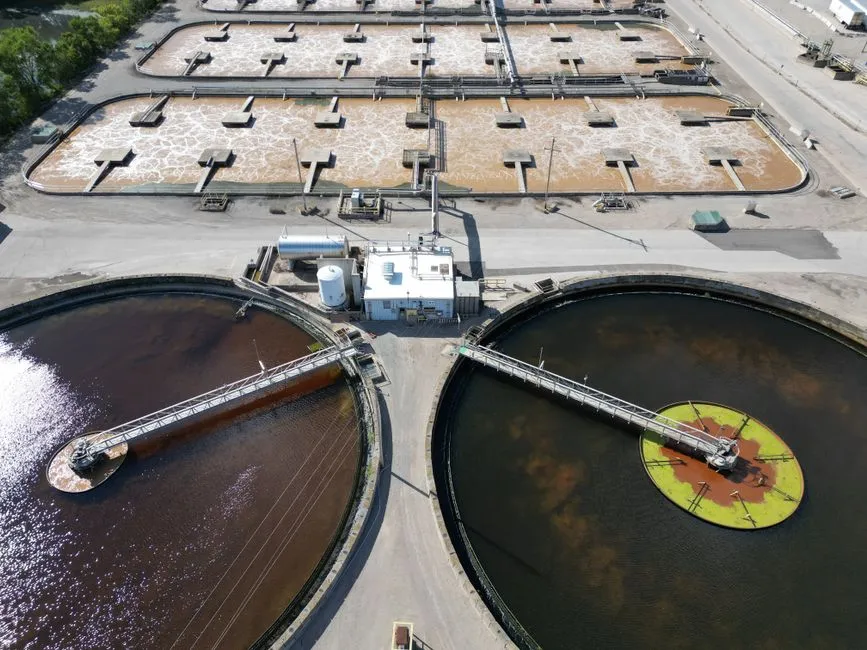
The regulatory calendar converts into equipment scope. The following train is the conventional Hungarian pharma baseline, with the decision points that most often drive a Novartis engineer's equipment list.
Stage 1 — Equalisation and neutralisation. Flow and pH dampening over 24–48 h HRT protects downstream processes and allows for the skimming of oils and floatables. Without this buffer, no biological stage will hold its removal efficiency across a multi-product campaign.
Stage 2 — DAF pre-treatment. DAF removes suspended solids, oil and grease, and API precipitates before they overload the biological stage. A Dissolved Air Flotation pre-treatment unit sized to 4–300 m³/h with micro-bubble generation and automatic skimming matches the peak-shift flows of a multi-product Hungarian brownfield. Sites that carry heavy solvent loads or precipitating API fractions should size the DAF for the worst-case single-batch slug, not the daily average.
Stage 3 — Biological stage. Either conventional activated sludge (CAS) or an MBR membrane bioreactor. MBR delivers sub-micron filtration on the same footprint and tolerates the variable load a Hungarian brownfield will experience as the product mix shifts post-acquisition. For sites targeting direct discharge to surface water under tight BAT-AEL ceilings, MBR is the BAT-compliant default; CAS remains acceptable where the permit envelope is wider or the receiving water is less sensitive.
Stage 4 — Polishing and AOX. Ozonation or UV for trace organics, with chlorination/dechlorination for microbiological control. The AOX stage is the key decision point: a dedicated AOX stripper, granular activated carbon, or an advanced oxidation process such as the Fenton oxidation system for pharmaceutical wastewater covered in the engineering guide. Sites near sensitive receiving waters may also need a tertiary nutrient-removal step.
Stage 5 — Sludge handling. A plate-and-frame filter press dewatered to 25–35% DS, with off-site incineration as the common Hungarian route. Hazardous-waste classification must be confirmed under Act CLXXXV of 2012 waste codes before the dewatered cake leaves site.
For sites targeting water reuse, BAT-compliant design is moving toward MBR + RO or MBR + ozone, aligning with NEKT 2024–2030 reuse targets and the emerging-contaminants watchlist. The architecture mirrors the Novo Nordisk Hillerød 50% water-cut pilot and is a credible roadmap for any Novartis site that has signed onto a public reuse ambition. For comparison, the parallel decision tree for an auto-sector acquisition is laid out in the Ford India plant acquisition compliance guide, which follows the same legal hierarchy under a different regulatory regime.
Frequently Asked Questions
Does the existing IPPC permit transfer automatically on a Novartis share deal?
No. Under Government Decree 314/2005, the integrated permit is issued to a named operator. A share deal requires a "change of operator" (üzemeltető-váltás) filing with the competent megyei kormányhivatal within 30 days of closing; an asset deal requires a fresh application. The existing permit typically remains valid during a 30-day post-closing window provided the notification is in place, but the new operator should treat the modification as urgent.
What COD limit applies to a Hungarian direct industrial discharge?
Limits are site-specific, but the BAT-AEL ceiling under the CWW BREF sits at 20–160 mg/L. The 2024 CWW update is tightening pressure on the upper end, and Hungarian Decree 220/2004 surface-water ELVs typically run 75–150 mg/L for industrial direct dischargers. The binding number is written into the site permit, which must be requested from the operator's records and verified at writing.
How long does permit re-issuance take after a change of operator?
Re-issuance typically takes 60–180 days from filing, depending on whether the competent authority triggers an EIA screening under Government Decree 314/2005. Material changes in production volume, product mix, or discharge composition can push the timeline toward the longer end, and a PFAS or AOX non-compliance flagged during the baseline campaign will extend it further.
Which parameters are the most common compliance gap in a Hungarian pharma brownfield?
AOX, total nitrogen, and the 2024 CWW watchlist (PFAS, antibiotics, API residues) account for the majority of compliance gaps that surface during baseline monitoring on a legacy Hungarian brownfield. Of these, AOX is the most capex-intensive because it usually requires a dedicated stripper, GAC, or AOP step that the original site design did not include.
Is an MBR sufficient as the BAT-compliant default, or is a polishing step mandatory?
MBR is the BAT-compliant default for sites targeting direct discharge to surface water under tight BAT-AEL ceilings. A dedicated polishing step — AOX stripper, GAC, or an advanced oxidation process — is mandatory wherever the permit AOX ceiling is below what MBR alone can deliver, which is the typical case on a Hungarian brownfield built before the 2024 CWW update.