Why Pulp & Paper Wastewater Challenges Conventional Clarifiers
For most pulp and paper wastewater in Black Creek, US in 2026, a Dissolved Air Flotation (DAF) system outperforms a conventional gravity clarifier: it cuts retention time to about 3-5 minutes, removes roughly 85% of TSS, and produces effluent at 20-30 mg/L TSS with 2-3% thickened sludge. Choose a clarifier only when the duty is raw-water grit removal or coarse settleables ahead of the DAF.
Pulp and paper effluent is one of the few industrial streams where four characteristics collide in the same pipe: high TSS (often 800-3,000 mg/L on whitewater), high BOD and COD from dissolved organics, dark color from lignin derivatives, and a suspended solids population dominated by wood fibers, broke, fillers (kaolin, TiO2), and sizing residues (per S2 Ecologix, 2025). That mix defeats a settling-only design for three physical reasons.
First, wood fibers and fillers have densities within roughly 1.02-1.10 g/cm3, only marginally above water at 1.00 g/cm3. Stokes-law settling velocity collapses, so a clarifier must be sized on the slowest species in the mix, not the average. Second, fine fibers and entrained process air form low-density flocs that refuse to consolidate, and the warm whitewater (typically 30-45 °C in a Black Creek mill running a closed loop) further reduces viscosity without enough density gain to drive settling. Third, the entrained micro-bubbles that hurt a clarifier are exactly the lift mechanism a DAF exploits, so flotation physics fit the stream better than gravity physics do.
The hydraulic consequence is decisive: a primary clarifier sized on settling rate demands 1-3 hours of retention for fiber effluent, while a high-rate DAF delivers equivalent or better TSS removal in 3-5 minutes (per S4 Lenox Institute / Krofta, USEPA-sourced, 2022). On a 2 MGD whitewater stream that difference is roughly 12,000 ft3 of live volume versus 1,400 ft3, which is why a clarifier footprint dominates the site plan and a DAF typically fits on a pad above grade.
How a DAF System Actually Clarifies Pulp & Paper Effluent
DAF is a bubble-driven clarifier: pressurize a sidestream or a portion of the feed with air at 60-80 psig until the water is saturated, then release that pressure through a needle valve or friction valve at the inlet of a shallow open tank. The sudden drop in solubility nucleates a cloud of 10-80 micron micro-bubbles that attach to fibers, fillers, and oil droplets, lifting them to the surface in roughly 3 minutes. A rotating or chain skimmer then sweeps the thickened sludge blanket into a hopper, and clarified effluent exits from below the blanket (per S2 Ecologix, 2025).
Two operating modes cover the pulp-mill envelope. Partial-flow pressurization treats only a fraction of the influent under pressure and blends it back into the main flow, which keeps compressor size small but limits the air-to-solids ratio on heavy streams. Recycle-flow pressurization saturates a polished sidestream of clarified effluent and returns it to the contact zone, which decouples floc chemistry from the bubble supply and is the workhorse configuration for fiber recovery and high-TSS whitewater (per S4 Lenox Institute, Figures 2 and 3, 2022).
High-rate DAF performance is well-quantified: 4-5 GPM/ft2 specific clarification capacity, 3-5 minute retention, 85% TSS removal, 20-30 mg/L effluent TSS, 2-3% thickened sludge consistency without a downstream thickener, and single-unit flow capacity up to 7,290 GPM (per S4 USEPA-sourced data, 2022). The unit also operates as a self-contained package: no deep civil works, total flooded load under 150 lb/ft2, and the open tank is self-cleaning during service (per S4).
In a pulp and paper mill, a single DAF can replace or combine several unit operations: whitewater clarification, secondary fiber recovery from broke and recycle streams, TiO2 recovery from coating wastewater, WWTP secondary clarification, lagoon algae separation, and sludge concentration ahead of dewatering (per S4). That functional breadth is the underlying reason DAF shows up across almost every fiber-line flow diagram in modern mill P&IDs.
How a Conventional Clarifier Performs on the Same Stream
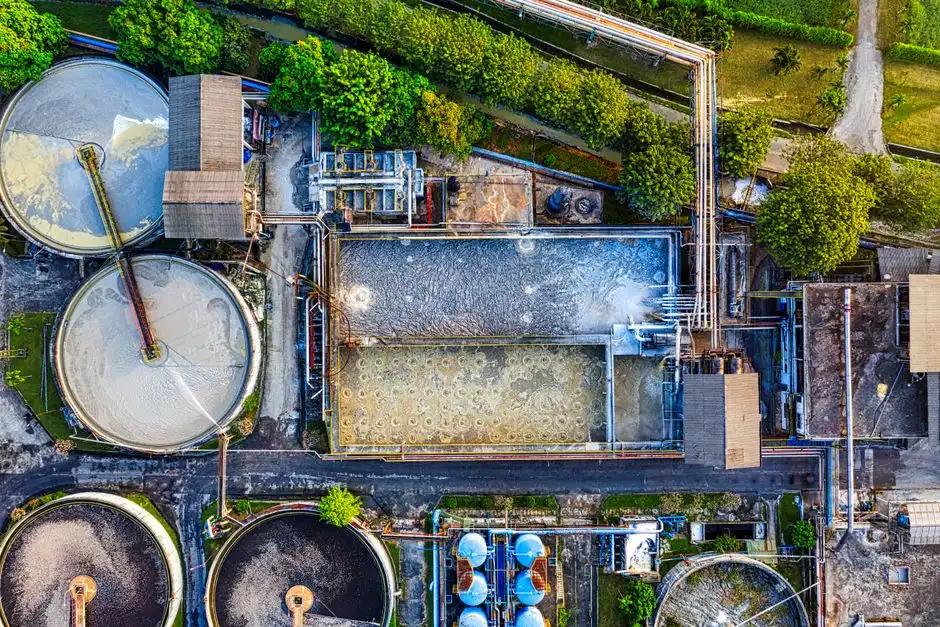
A conventional primary clarifier for a pulp mill is a rectangular or circular basin, often fitted with lamella plates or tube settlers to compress the effective settling path, with a slow-moving scraper or chain-and-flight mechanism that pushes settled sludge to a hoppered bottom. Hydraulic retention is sized at 1-3 hours, surface overflow rates sit in the 600-1,200 GPD/ft2 range, and the design assumes settleables denser than water and a quiescent flow regime. On a fiber stream that assumption breaks almost immediately.
Clarifiers still earn their place on three duties that a DAF handles poorly or inefficiently: raw surface-water intake where the load is grit, sand, and seasonal algae; pre-thickening of coarse settleables ahead of biological treatment; and low-TSS (<200 mg/L) polishing on streams where a DAF CAPEX cannot be justified. On each of these, gravity is the right physics because the solids are heavy, slow, and mineral rather than organic and fibrous.
On wood-fiber effluent, however, the clarifier delivers only 50-70% TSS removal versus DAF's roughly 85%, and the underflow sludge typically lands at 0.5-1.5% dry solids compared to DAF's 2-3%, meaning a clarifier almost always needs a downstream thickener or dewatering stage before haul-off (per S4 USEPA-sourced comparison, 2022). Operators also fight recurring pain points: a floating fiber mat builds on the effluent weir, scum lines plug outlet troughs, and rags and stickies accumulate on scraper flights, which forces many mills to add a DAF polish step downstream of the clarifier anyway, negating the clarifier's CAPEX advantage.
DAF vs. Clarifier: Pulp & Paper Parameter Comparison
The pivot point of any 2026 capex decision is a side-by-side parameter table the procurement team can defend in front of finance. The values below draw on USEPA-sourced performance data (per S4) and Krofta's published Supracell specifications (per S5, 2026 site content), with clarifier figures shown as engineering-typical ranges for fiber streams since the underlying research treats them as a relative baseline rather than a tested equivalent.
| Parameter | High-Rate DAF | Conventional Clarifier |
|---|---|---|
| Hydraulic retention time | 3-5 min (per S4, S5) | 1-3 hr (typical engineering range) |
| Specific clarification capacity | 4-5 GPM/ft2 (per S4, S5) | 0.3-0.8 GPM/ft2 (typical, fiber streams) |
| TSS removal on fiber effluent | ~85% (per S4 USEPA) | 50-70% (typical, per S4 relative baseline) |
| Effluent TSS | 20-30 mg/L (per S4) | 80-150 mg/L typical for fiber effluent |
| Thickened sludge consistency | 2-3% (per S4) | 0.5-1.5% (typical, per S4 relative) |
| Single-unit flow capacity | Up to 7,290 GPM (per S4) | Limited by basin footprint and overflow rate |
| Footprint per MGD (fiber stream) | Compact, above-grade pad | Large below-grade basin |
| Load on foundation | <150 lb/ft2 flooded (per S4) | Heavy reinforced basin |
| Polymer demand | Low-to-moderate (recycle mode) | Low (coagulant-only typical) |
| CAPEX drivers | Skid package, air system, building height | Civil excavation, concrete, scraper mechanism |
| OPEX drivers | Saturation pump kWh, polymer, skimmer wear | Sludge pumping, dewatering, weir cleaning |
| Best-fit duty (pulp & paper) | Whitewater, fiber recovery, effluent polish, FOG/color | Raw-water grit, coarse settleables, low-TSS polish |
The footprint and load-factor rows usually decide the conversation with Black Creek site management, because an above-grade DAF on a 50 ft × 50 ft pad often replaces a clarifier requiring an 80 ft × 120 ft excavation plus 12-14 ft of water depth.
Five Pulp & Paper Criteria to Score DAF and Clarifier
A parameter table is descriptive; a scoring framework is decision-grade. The five criteria below are weighted for a Black Creek mill evaluating a 2026 capex upgrade, and each maps directly to a mill-economics outcome rather than a generic treatment claim.
- Fiber recovery economics. DAF captures saleable long-fiber and broke at the surface as a 2-3% thickened stream that can be returned to the stock prep or sold, while a clarifier routes the same fiber into a dilute 0.5-1.5% underflow that lands in dewatering and is largely lost (per S5 Krofta fiber-recovery case, 2026). On a 200 tpd tissue mill the fiber-value delta routinely covers the DAF OPEX within 12-18 months.
- Footprint and headroom. DAF needs minimal headroom (a single tank roughly 1.5-2 m deep) and can be erected above grade because flooded load is under 150 lb/ft2 (per S4). A clarifier demands deep basins, heavy civil work, and below-grade siting that constrains the rest of the site plan.
- Effluent quality for reuse. DAF effluent at 20-30 mg/L TSS supports warm whitewater reuse through shower nozzles without rapid pluggage, cutting process-heating energy in a Wisconsin winter (per S5 shower-nozzle protection application). Clarifier effluent at 80-150 mg/L TSS usually forces a polish step before reuse.
- Sludge handling. DAF sludge at 2-3% consistency skips a thickener and feeds a belt press or screw press directly (per S4). Clarifier sludge at 0.5-1.5% needs a separate thickening stage, which adds CAPEX, footprint, and polymer demand before dewatering.
- Variable load handling. Pulp mill flows swing with grade changes, broke pulping, and clean-up cycles. DAF tolerates TSS, BOD, COD, and color swings in a single tank; clarifier performance collapses on hydraulic or solids spikes and is slow to recover.
Score each criterion 1-5 against your specific stream data, multiply by a weight that matches your mill's pain point (fiber recovery usually wins on tissue and recycled-fiber lines, footprint usually wins on greenfield), and the total will land firmly on DAF for whitewater, broke, and effluent-polish duties.
2026 Decision Framework for Black Creek Pulp & Paper Mills
For a Black Creek mill in 2026, the default specification is DAF as the primary solids-separation step for whitewater clarification, secondary fiber recovery, and effluent polishing, supported by the USEPA-sourced 85% TSS removal and 2-3% sludge consistency in the comparison table (per S4) and 40+ years of pulp-mill installations documented by Krofta (per S5). Specify a clarifier only when the duty matches its physics, not as a default.
The decision tree in plain language:
- If the duty is whitewater, broke, or fiber recovery: specify DAF. The combination of fiber capture, 20-30 mg/L effluent, and 2-3% sludge is unmatched by gravity separation on the same stream (per S2, S4, S5).
- If raw surface water carries grit, seasonal algae, or settleable inorganics: install a clarifier upstream of the DAF as a roughing step, so the DAF contact zone sees a more uniform feed and the air system does not have to lift sand (per S5 raw-water clarification application, 2026).
- If the only duty is low-TSS (<200 mg/L) and the project cannot justify DAF CAPEX: a clarifier is defensible as a stand-alone, but flag the resulting fiber loss and limited whitewater-reuse potential, and revisit the pick during the next capex cycle.
- For Black Creek specifically: fold in Wisconsin DNR effluent guidance, fiber-line shutdown and clean-up cycle frequency, and warm whitewater reuse economics. Mills reusing warm whitewater through shower nozzles almost always tip the scoring toward DAF once those factors are monetized.
A configurable DAF package such as the HydropureWater DAF system fits the recommended path for most Black Creek pulp and paper duties, with 13 standard models covering 4-300 m3/h and skid packages sized for both above-grade retrofit and greenfield installation. For mills comparing DAF to clarifiers in adjacent food and beverage lines, the same selection logic is laid out in a DAF vs clarifier decision framework for food and beverage processors. If the mill is also evaluating reuse economics against the 2026 regulatory floor, the industrial water reuse compliance guide pairs the technical pick with the discharge context.
Frequently Asked Questions
Is DAF better than a clarifier for paper mill whitewater?
Yes, for paper mill whitewater DAF is the stronger default. A high-rate DAF delivers about 85% TSS removal in 3-5 minutes of retention with 20-30 mg/L effluent and 2-3% thickened sludge, while a clarifier typically removes 50-70% of TSS over 1-3 hours and produces 0.5-1.5% underflow (per S4 USEPA-sourced data, 2022). DAF also recovers saleable fiber that a clarifier would send to dewatering and largely lose.
What drives the CAPEX difference between DAF and a clarifier for a 2 MGD fiber stream?
DAF CAPEX is dominated by the skid package, air-saturation system, and building height; clarifier CAPEX is dominated by civil excavation, concrete basin construction, and the scraper mechanism. Because DAF needs only 3-5 minutes of live volume versus 1-3 hours for a clarifier, the DAF footprint is typically one-tenth of the clarifier footprint on the same flow, which is the single largest line-item swing on a 2 MGD fiber stream.
Can a clarifier replace DAF for pulp and paper sludge thickening?
No, not economically on a fiber stream. A clarifier underflow typically lands at 0.5-1.5% dry solids, which forces a dedicated thickener ahead of any belt press or screw press, while a DAF float at 2-3% feeds dewatering equipment directly (per S4). Skipping the thickener stage is one of the largest OPEX savings a DAF delivers on a pulp-mill P&ID.
When does a clarifier still win for a Black Creek pulp mill in 2026?
A clarifier still wins on raw-water intake with grit and seasonal algae, on coarse settleable inorganics ahead of biological treatment, and on low-TSS (<200 mg/L) streams where the project cannot justify DAF CAPEX. In each case the solids are heavy and mineral, which is the regime where gravity separation is the correct physics. For warm, variable, fiber-laden whitewater and recycle streams, DAF remains the defensible 2026 pick.