The two-layer compliance ceiling for Elizabethtown petroleum discharges
Petroleum plants near Elizabethtown, Kentucky that discharge to a publicly owned treatment works (POTW) — most commonly the Elizabethtown Sewer Department / Hardin County system — operate under a two-layer compliance ceiling: federal categorical standards under 40 CFR Part 419 (Petroleum Refining Point Source Category) and the local sewer-use ordinance adopted by the receiving utility. 40 CFR Part 419 sets subpart-specific daily maximum and monthly average limits for oil and grease, total suspended solids, phenols, chromium, ammonia, and sulfide, and applies whether or not the receiving POTW runs an EPA-approved pretreatment program (per EPA's 2024 guidance on pretreatment standards and requirements, last reviewed 2025-09). Bulk storage terminals and asphalt batch plants typically do not perform the full refining unit operations that trigger every subpart, but desalter brine contact, tank draw, and contaminated stormwater still pull them into categorical compliance once any listed wastewater stream is routed to the sewer.
The eight prohibitions at 40 CFR 403.5(b) are the second compliance layer, and they apply to every industrial user regardless of categorical status. As restated on EPA's pretreatment program page (last updated 2025-09), the prohibitions cover: (1) closed-cup flashpoint below 140°F (60°C) per 40 CFR 261.21; (2) pH below 5.0 (corrosive structural damage); (3) solid or viscous pollutants causing obstruction; (4) slug loads discharged at flow rates or concentrations that cause interference; (5) heat that pushes the POTW treatment plant above 40°C (104°F); (6) petroleum oil, nonbiodegradable cutting oil, or mineral oil origin products at amounts causing pass-through or interference; (7) pollutants that release toxic gases, vapors, or fumes; and (8) trucked or hauled pollutants except at POTW-designated points.
Pass-through (40 CFR 403.3(p)) and interference (40 CFR 403.3(k)) are the legal hooks the control authority uses when enforcement escalates. Pass-through means the pollutant exits the POTW in violation of the receiving POTW's NPDES permit; interference means the discharge disrupts the POTW's treatment processes, sludge handling, or worker safety. For petroleum facilities, oil and grease is the dominant pass-through vector because emulsified oil survives primary clarification and rides out with the effluent. Local limits are routinely more stringent than the federal categorical numbers because the control authority must protect its own NPDES permit and biosolids program — the engineer designs to whichever bar is lower.
What a Kentucky sewer-use ordinance actually says
Kentucky ordinances translate the federal floor into numeric local limits, and the engineer designs to the more stringent of the two. The Shelbyville KY §31.060 table is a useful model because it is one of the few live Kentucky sewer-use ordinances with a complete numeric table published in the state code library. It establishes two layers of numeric limits: a "maximum allowable concentration without surcharge" set covering the standard domestic-strength parameters, and a tighter set of categorical-style limits covering metals, phenols, pH, and other pollutants of concern for industrial users.
The ordinance also restates the federal dilution prohibition at 40 CFR 403.5(b)(9): "No user shall ever increase the use of process water or, in any way, attempt to dilute a discharge as a partial or complete substitute for adequate treatment to achieve compliance." The Commission may impose mass limitations where dilution is being used, and any industrial waste discharge that violates EPA categorical pretreatment standards is in violation of the chapter. A separate clause requires the existing industrial user to request certification 30 days in advance of any process change that may fall into a pretreatment subcategory — the same notification window the federal rule establishes.
Lower explosive limit (LEL) is treated as an effluent parameter, not just an atmospheric hazard: at no time shall two successive readings on an explosion hazard meter, at the point of discharge or at any point in the system, exceed 5% LEL, and no single reading may exceed 10% LEL. The haulers rule requires written permission from the Manager, designated discharge points, a fee schedule, and immediate revocation on any illegal dump. Engineers should treat these as the floor and confirm the Elizabethtown-specific ordinance language with the control authority before final sizing.
| Parameter | Limit (mg/L unless noted) | Source |
|---|---|---|
| BOD | 250 | Shelbyville §31.060 (max without surcharge) |
| TSS | 250 | Shelbyville §31.060 (max without surcharge) |
| NH3-N | 25 | Shelbyville §31.060 (max without surcharge) |
| Arsenic | 0.30 | Shelbyville §31.060 categorical |
| Chromium, hexavalent | 0.29 | Shelbyville §31.060 categorical |
| Chromium, total | 2.25 | Shelbyville §31.060 categorical |
| Lead | 0.15 | Shelbyville §31.060 categorical |
| Mercury | 0.0005 | Shelbyville §31.060 categorical |
| Nickel | 0.35 | Shelbyville §31.060 categorical |
| Zinc | 1.50 | Shelbyville §31.060 categorical |
| Phenols | 15 | Shelbyville §31.060 categorical |
| pH | 6.0–10 | Shelbyville §31.060 categorical |
| LEL at discharge | ≤5% two successive / ≤10% single | Shelbyville §31.060(A)(general prohibitions) |
Stream inventory at a typical Elizabethtown-area petroleum site

Source control starts with a complete stream inventory. An Elizabethtown-area terminal, asphalt batch plant, or small refinery typically generates six distinct petroleum-contact streams, and each one has a different temperature, oil speciation, and flow profile that determines how it has to be handled before the main treatment train. Routing these streams to the right unit operation up front is what keeps the DAF inside its design envelope and avoids the slug events that drive 40 CFR 403.5(b)(4) violations.
Desalter brine and produced water arrive hot (180–220°F) and heavily emulsified, often carrying 100–1,000 mg/L oil and grease along with high total dissolved solids and dissolved sulfides from the crude. Without cooling and chemical demulsification, this stream overwhelms any DAF unit and strips dissolved sulfides into the collection system as H2S. Tank draw and tank bottoms behave differently — they discharge intermittently, often in batches of 5,000 mg/L oil or higher, and are the single most common trigger for slug-load violations under 40 CFR 403.5(b)(4).
Spent caustic from sulfidic-crude treatment is the most aggressive stream in the inventory: pH above 12, sulfide-laden, and capable of releasing H2S the moment it is neutralized. Every caustic stream must be oxidized (typically with sodium hypochlorite or hydrogen peroxide) and brought to a pH below 9 before it enters the equalization basin, both to protect downstream equipment and to keep the collection system safe for POTW workers. Boiler blowdown and cooling tower bleed run low in oil but high in temperature and dissolved solids, so they need a cooling step and pH adjustment. Stormwater contact water from tank-farm secondary containment is episodic but high-volume and carries visible sheen; many sites divert it through a dedicated oil-water separator during the first 30 minutes of a rain event before forwarding to the main treatment train. Equipment wash is small-volume and intermittent but routed through the same DAF as tank draw.
| Stream | Temp / pH profile | Oil & grease range | Primary handling | Regulatory hook |
|---|---|---|---|---|
| Desalter brine / produced water | 180–220°F, neutral | 100–1,000 mg/L | Cool, demulsify, sulfide oxidation | 403.5(b)(5) heat; 403.5(b)(7) toxic gas |
| Tank draw and bottoms | Ambient, neutral | Often >5,000 mg/L slug | Equalization, slug monitoring | 403.5(b)(4) slug loads |
| Spent caustic | Ambient, pH >12 | Variable, sulfide-laden | NaOCl/H2O2 oxidize, pH <9 | 403.5(b)(7) toxic gas |
| Boiler blowdown / cooling tower bleed | Hot, neutral-to-alkaline | <20 mg/L | Cool, pH trim | 403.5(b)(5) heat |
| Stormwater contact water (tank farm) | Ambient, neutral | Visible sheen, episodic | First-flush OWS, 30 min diversion | 403.5(b)(6) oil pass-through |
| Equipment wash | Ambient, near-neutral | Variable | Routed to DAF with tank draw | 403.5(b)(6) oil pass-through |
The 2026 treatment train that hits ≤25 mg/L oil and grease
The unit-operation sequence that reliably hits 25 mg/L oil and grease, pH 6.5–8.5, flashpoint above 140°F, and discharge temperature below 40°C (104°F) at the POTW headworks is equalization → screening → DAF → pH/temperature trim → surge → control manhole. Each stage ties to a specific clause in 40 CFR 403.5(b), so the design intent is documented in the P&ID narrative as well as the equipment list.
The equalization basin is the buffer that lets a downstream DAF run at steady design flow. 24 to 48 hours of hydraulic retention time, mechanical mixing to keep solids in suspension, and air sparging to strip dissolved sulfides and keep the basin aerobic are standard. For a 50 m³/h average discharge, a 1,200–2,400 m³ basin is typical. The basin's primary regulatory job is to absorb the slug events — tank draws, batch cleanouts, stormwater surges — that would otherwise arrive at the POTW as a single high-strength pulse and violate 40 CFR 403.5(b)(4).
From equalization, flow passes through a rotary bar screen headworks with 2–6 mm aperture to drop out rags, debris, and large solids before they reach the DAF pump nozzles, addressing 40 CFR 403.5(b)(3). The industrial DAF system is the workhorse: 10–20% recycle pressurized at 4–6 bar, surface loading 15–25 m/h, and an air-to-solids ratio tuned to the oil load. Micro-bubbles of 10–50 µm attach to oil droplets and float them to the surface, where a slow-moving skimmer (0.5–1.0 m/min) drags the oil phase into a sludge hopper. The 25 mg/L oil and grease number is what this stage is sized to deliver, satisfying 40 CFR 403.5(b)(6).
Between the DAF and the discharge surge basin, a PLC-controlled chemical dosing skid feeds sodium hydroxide or sulfuric acid on a PID loop to hold pH between 6.5 and 8.5 for biological compatibility downstream; a plate heat exchanger or quench basin drops the stream to below 40°C (104°F) before it reaches the POTW headworks. A final surge basin with level control smooths flow to the control manhole, and an inline oil-in-water probe plus total oil analyzer provides real-time compliance documentation the POTW can audit on demand.
| Stage | Operating envelope | 403.5(b) clause addressed |
|---|---|---|
| Equalization | 24–48 h HRT, mechanical mixing, air sparge | (b)(4) slug-load prohibition |
| Rotary bar screen | 2–6 mm aperture, up to 300 m³/h | (b)(3) solids/viscous obstruction |
| DAF | 10–20% recycle, 4–6 bar, 15–25 m/h surface loading | (b)(6) oil pass-through |
| pH/temperature trim | pH 6.5–8.5 PID; <40°C (104°F) | (b)(2) pH; (b)(5) heat |
| Surge + control manhole | Level control, 24/7 access, autosampler | Documentation, sampling access |
For 50 m³/h Elizabethtown-area flows, frame size typically lands in the DAF-5 to DAF-20 range within the 4–300 m³/h DAF family (per HydropureWater 2026 bid history).
DAF sizing parameters an Elizabethtown engineer must specify
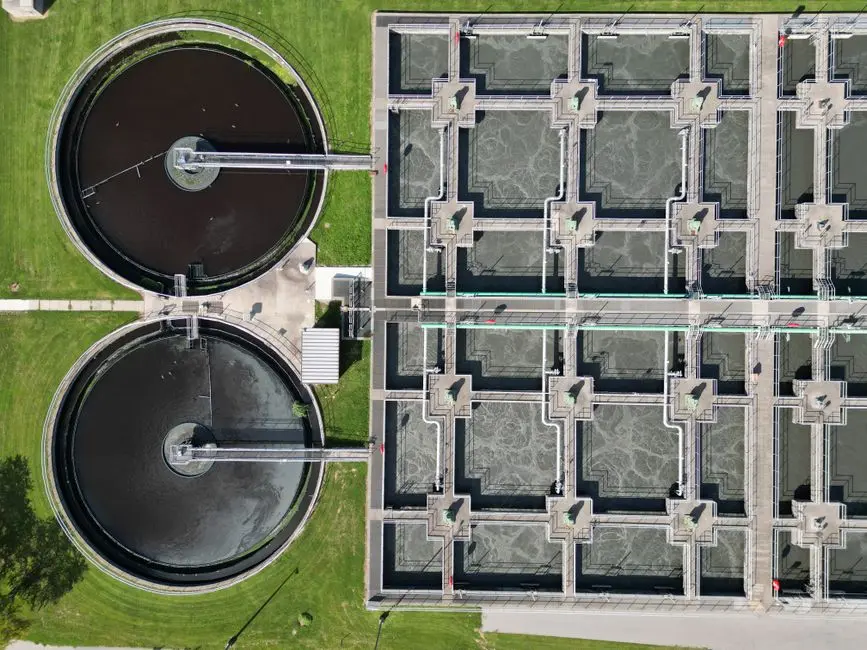
The 25 mg/L oil and grease number is not a result of DAF alone — it is the combined effect of surface loading, recycle ratio, saturator pressure, and chemistry. A defensible industrial DAF system specification for an Elizabethtown-area terminal covers each of these explicitly so the vendor bid is apples-to-apples. Engineers who specify only "dissolved air flotation, 50 m³/h" get a unit sized to a nameplate, not to the 25 mg/L number that the permit will judge.
Surface loading sets the footprint: 15–25 m/h for oily wastewater, 10–15 m/h when the influent is high in TSS or the emulsion is heavy. Recycle ratio improves bubble density but trades against pumping energy; saturator pressure above 6 bar shows diminishing returns because bubble size stops shrinking linearly. Air-to-solids ratio is tuned to oil load — oil-laden streams need a higher ratio to lift emulsified oil. Chemistry closes the gap: anionic polyacrylamide at 1–5 mg/L jar-tested per batch provides the floc structure, and a coagulant (alum, PAC, or ferric chloride at 50–150 mg/L) is dosed upstream of the polymer when influent oil is heavily emulsified. A 50–100 µm multimedia polish filter downstream of the DAF is the right answer when the local POTW cap is 15 mg/L or tighter (per HydropureWater field data, 2026).
| Parameter | Typical range | Design note |
|---|---|---|
| Surface loading (oily) | 15–25 m/h | Drop to 10–15 m/h for heavy emulsion |
| Recycle ratio | 10–20% | Higher improves bubble density; energy trade |
| Saturator pressure | 4–6 bar | Diminishing returns above 6 bar |
| Air-to-solids ratio | Tuned to oil load | Higher ratio to lift emulsified oil |
| Anionic polyacrylamide | 1–5 mg/L | Jar-tested per batch |
| Coagulant (alum/PAC/ferric) | 50–150 mg/L | Upstream of polymer for emulsified feed |
| Polish filter | 50–100 µm multimedia | For ≤15 mg/L local cap |
Documentation, sampling, and surcharge economics
Equipment alone does not satisfy the regulator. The control manhole is the legal sampling point: it sits at the property line, is accessible 24/7, complies with OSHA 1910.146 confined-space entry rules, and is where the POTW inspector pulls the compliance sample. The manhole typically houses a 24-hour refrigerated composite autosampler, a flow meter with totalizer, and a dedicated pH/temperature probe in the flow stream.
Sampling protocol is the part the engineer documents but the lab technician executes. Minimum baseline: 24-hour flow-proportional composite for oil and grease, four grab samples per shift for pH and temperature, and a closed-cup flashpoint test per 40 CFR 261.21 on any stream with potential flammability. Oil and grease is analyzed by EPA Method 1664 HEM (silica-gel treated); the HEM-SGT variant is the standard for petroleum-bearing matrices. Reporting frequency is monthly self-monitoring for oil and grease, pH, temperature, and flow; a full 40 CFR 419 categorical scan (subpart-dependent pollutant list) is typically quarterly or semi-annual, per the discharge permit.
The slug control plan is the written procedure that defends the facility against a 40 CFR 403.5(b)(4) violation. It documents tank-draw sequencing, batch-discharge volume limits, and the high-level setpoints at which the operator must shut down a transfer and call the EHS manager. Surcharge exposure is the financial pressure that keeps the slug plan honest. POTWs typically assess surcharges for excessive BOD, TSS, oil and grease, and flow. For a 50 m³/h discharger operating at 80 mg/L oil and grease against a 25 mg/L cap, surcharge exposure on oil alone routinely runs $40,000–$80,000 per year (HydropureWater field data, 2026, mid-size southern POTW tariff). Records retention is three years minimum, with chain of custody on every sample, every calibration, and every slug-event log entry.
Frequently Asked Questions
What is the typical oil and grease limit a Kentucky POTW imposes on a petroleum discharger?
The most common local cap is 25 mg/L total petroleum oil at the control manhole, mirroring the model ordinance language used across the region. Some local limits run tighter at 15 mg/L where the receiving POTW has limited oil-handling capacity. The engineer designs to the more stringent of the categorical floor and the local cap, and confirms the actual number against the discharge permit issued by the Elizabethtown Sewer Department before sizing the DAF.
Does DAF alone satisfy 40 CFR Part 419 categorical limits for a petroleum discharger?
No. DAF handles the oil and grease and TSS sides of the categorical standard but does not address pH, temperature, or slug control on its own. The defensible 2026 train pairs DAF with equalization upstream and pH/temperature trim downstream, with a control manhole at the property line as the compliance evidence the POTW actually audits. Oil and grease is measured by EPA Method 1664 HEM (silica-gel treated) on a 24-hour flow-proportional composite, and the categorical scan covers phenols, chromium, ammonia, and sulfide per the subpart.
How is closed-cup flashpoint tested for compliance with 40 CFR 403.5(b)(1)?
Closed-cup flashpoint is tested per 40 CFR 261.21 on a representative sample of any stream with potential flammability — typically desalter brine, light-product tank draw, and any stream exiting a process area at elevated temperature. Streams measuring below 140°F (60°C) must be segregated to a slop tank and not routed forward; a 10°F safety margin (150°F operating threshold) is standard practice. Shelbyville KY §31.060 layers an additional LEL-based ceiling on top, requiring no two successive readings above 5% LEL and no single reading above 10% LEL at the point of discharge.
What is the most common slug-control violation at a petroleum facility, and how is it prevented?
Tank draw and tank-bottom releases at 5,000+ mg/L oil are the single most common trigger for a 40 CFR 403.5(b)(4) slug-load violation. Prevention rests on three layers: an equalization basin sized to absorb the largest credible batch (24–48 h HRT is standard), level-control and shutoff setpoints on every transfer pump, and a written slug control plan filed with the POTW that names the responsible operator, documents the maximum batch volume, and lists the alarm setpoints that trigger a transfer shutdown.