What 'Meeting Pretreatment Limits' Means for a Houston OCPSF Plant
Industrial organic chemicals plants near Houston meet pretreatment limits by complying with two layered rule sets before discharging to the City sanitary sewer: the federal categorical standard 40 CFR Part 414 (Organic Chemicals, Plastics and Synthetic Fibers, OCPSF), which sets subcategory-specific effluent limits, and the City of Houston's local limits under Chapter 47, Section V, which add site-specific numeric caps including pH 5.0–11.0, sulfides below 5 mg/L, temperature ≤45°C, and total oil & grease of 200 mg/L (effective Dec 2, 2023). A typical treatment train combines flow and pH equalization, oil/water separation (DAF), pH adjustment, biological treatment (activated sludge or MBR), clarification, and monitoring against an Industrial Waste Permit issued by Houston's Industrial Wastewater Service.
The two rule sets are not redundant. The EPA promulgated 40 CFR Part 414 in 1987 (last amended 1993) to set technology-based categorical effluent limits for OCPSF facilities; the City of Houston, acting as the Control Authority under 40 CFR Part 403, layers local limits on top to prevent pass-through (per 40 CFR 403.3(p)) and interference (per 40 CFR 403.3(k)) at the receiving POTW. Any facility subject to 40 CFR Part 414 is automatically a Categorical Industrial User (CIU), and any industry discharging ≥25,000 gpd of process wastewater or contributing ≥5% of the POTW's average dry-weather hydraulic or organic capacity is a Significant Industrial User (SIU). Houston requires an Industrial Waste Permit before any discharge, issued for a two-year term and renewable, with self-monitoring data feeding an annual surcharge calculation on CBOD, NH3, and TSS above domestic baseline.
The OCPSF Categorical Standard at 40 CFR Part 414 — Who and What It Covers
40 CFR Part 414 was promulgated in 1987 and amended in 1989, 1990, 1992, and 1993, and currently covers wastewater discharges from more than 1,000 chemical facilities nationwide (per EPA's OCPSF Effluent Guidelines page). The rule applies to process wastewater from the manufacture of products in seven subcategories — rayon fibers, other fibers, thermoplastic resins, thermosetting resins, commodity organic chemicals, bulk organic chemicals, and specialty organic chemicals — and is incorporated into NPDES permits for direct dischargers and into POTW pretreatment programs for indirect dischargers. In February 2019, EPA's PFAS Action Plan flagged PFAS manufacturers and formulators as already regulated under OCPSF, and an ANPRM is currently soliciting data that may lead to a future PFAS-specific rulemaking under this category.
For applicability questions on 40 CFR Part 414, contact EPA's Samantha Lewis at [email protected] or 202-566-1058.
| Subcategory (40 CFR Part 414) | Representative Products | Typical SIC Codes |
|---|---|---|
| Rayon fibers | Viscose rayon, cellulosic filament | 2823, 2824 |
| Other fibers | Non-cellulosic synthetic fibers (nylon, polyester, acrylic) | 2823, 2824 |
| Thermoplastic resins | Polyethylene, polypropylene, PVC, polystyrene, PET | 2821 |
| Thermosetting resins | Phenolic, epoxy, polyurethane, melamine | 2821 |
| Commodity organic chemicals | Ethylene, propylene, benzene, toluene, methanol | 2869, 2879 |
| Bulk organic chemicals | Aniline, phenol, acetone, acetic acid | 2869 |
| Specialty organic chemicals | Dyes, pigments, additives, intermediates, PFAS feedstocks | 2865, 2899, 2821 |
City of Houston Local Limits and Prohibited Discharges You Must Design For
Houston Code Section 47-188 sets the numeric limits enforced at the point of connection to the POTW. The headline numbers: pH must stay between 5.0 and 11.0 Standard Units; sulfides must be below 5.0 mg/L; temperature must not exceed 45°C (113°F); closed-cup flash point must be ≥60°C (140°F); and total oil & grease must not exceed 200 mg/L — a number that dropped from 750 mg/L to 200 mg/L effective December 2, 2023, per the City's Industrial and Pretreatment FAQ. Floating oil and grease is prohibited at any concentration, meaning skimmings must be removed before the sewer, not just diluted.
Beyond the numeric caps, the City prohibits a defined set of discharges regardless of pretreatment classification: flammable, reactive, explosive, corrosive, or radioactive substances; noxious or malodorous materials; medical or infectious wastes; solid or viscous materials capable of obstructing flow; toxic substances; non-biodegradable oils; and any pollutant that emits hazardous gases. The City also runs a sanitary sewer surcharge program on CBOD, NH3, and TSS above domestic-baseline concentrations, recalculated annually from self-monitoring data — biological performance translates directly into operating cost through this mechanism.
| Parameter | Houston Local Limit (Code 47-188) | Unit | Notes |
|---|---|---|---|
| pH | 5.0 – 11.0 | S.U. | Instantaneous min/max |
| Sulfide | < 5.0 | mg/L | Total dissolved sulfide |
| Temperature | ≤ 45 (113) | °C (°F) | At point of discharge |
| Flash point (closed cup) | ≥ 60 (140) | °C (°F) | Lower values prohibited |
| Total oil & grease | ≤ 200 | mg/L | Effective Dec 2, 2023 |
| Floating oil & grease | None permitted | — | Visible layer prohibited |
| CBOD, NH3, TSS | Surcharge trigger above domestic baseline | mg/L | Annual billing-rate calculation |
Typical Influent Profile of a Houston OCPSF Plant and What It Implies for Design
Houston OCPSF plants do not publish site-specific influent data, but the typical envelope is well established across the category: high and variable COD and BOD from organic synthesis, washing, and condenser bleeds; fluctuating pH driven by acid or caustic process streams used for neutralization or catalysis; periodic solvent and organic surges from batch campaigns and equipment washdowns; suspended solids from catalyst handling, polymer fines, and resin transfer; and intermittent oil and grease from pump seals, compressor condensate, and tank-farm areas. PFAS, depending on product mix, is a 2019 ANPRM watch-item that increasingly shapes source control and monitoring even before numeric limits are set.
The design consequence is that equalization is non-optional. Without flow and composition dampening, raw swings will blow pH (outside 5.0–11.0), drive sulfide above 5 mg/L during anaerobic pockets, and push O&G past the 200 mg/L cap on its way to the sewer. Many OCPSF reactors also run hot, so the ≤45°C ceiling must be engineered in via quench, cooling, or equalization retention — not assumed at the discharge flange. A useful sizing reference for organics loading is the global COD and BOD discharge limit reference, which sets the envelope your equalization basin has to absorb.
A 2026 Treatment Train That Reliably Closes the Gap
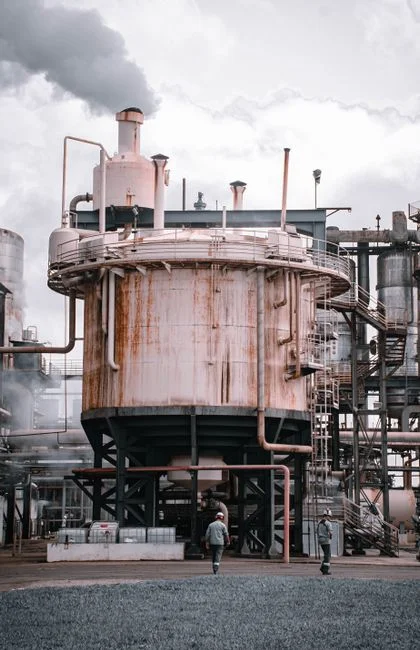
Six unit operations, in this order, close the gap between the OCPSF influent envelope above and the Houston + 40 CFR Part 414 compliance targets at the sewer connection. Each step has a specific limit it is responsible for hitting; do not assume one unit can do another's job.
Step 1 — Equalization. Balance flow, pH, and temperature in a sized basin; design HRT for 8–24 hours depending on diurnal swing amplitude so downstream units see a steady feed and pH stays inside 5.0–11.0. Equalization is also where the ≤45°C ceiling is engineered in via mixing and residence time.
Step 2 — Oil/water separation via DAF. A DAF system for oil and grease removal typically achieves 80–95% O&G removal at hydraulic loadings of 2–5 m³/m²·h, taking residual O&G comfortably below the 200 mg/L Houston cap and protecting the downstream biological stage from solvent toxicity. Skimmings must be routed to a dedicated oil-recovery or hazardous-waste drum, not returned to the head of the plant.
Step 3 — pH adjustment and chemical dosing. Use an automatic chemical dosing system for pH and sulfide control to land pH at 6.5–8.0 before biotreatment and to feed sulfide-control chemistry (typically iron salt or oxygen/air oxidation) to keep total sulfide below 5 mg/L at the discharge flange.
Step 4 — Biological treatment. Either conventional activated sludge at MLSS 3,000–5,000 mg/L and HRT 6–12 h, or an MBR system for biological CBOD and TSS removal at MLSS 8,000–12,000 mg/L and HRT 4–8 h. MBR delivers tighter effluent quality and a smaller footprint — useful for sites near the capacity ceiling. See the MBR installation and commissioning guide for the commissioning specifics.
Step 5 — Clarification / polishing. A lamella clarifier for TSS polishing at surface overflow rate 2–4 m³/m²·h, or the MBR membrane itself, holds TSS below the surcharge threshold and protects downstream monitoring instrumentation from fouling.
Step 6 — Monitoring and self-reporting. Continuous flow, pH, and temperature; scheduled sampling for O&G, sulfide, CBOD, TSS, and NH3 on the cadence the Industrial Waste Permit specifies. Sampling quality is what feeds the annual surcharge.
| Step | Unit Operation | Primary Design Intent | Typical Design Parameter | Limit It Protects |
|---|---|---|---|---|
| 1 | Equalization basin | Dampen flow, pH, temperature | HRT 8–24 h | pH 5.0–11.0, T ≤45°C |
| 2 | DAF | O&G removal | 2–5 m³/m²·h; 80–95% removal | O&G ≤200 mg/L |
| 3 | pH / sulfide dosing | Neutralize; precipitate sulfide | NaOH/H₂SO₄; FeCl₂ or FeCl₃ | pH 5.0–11.0; sulfide <5 mg/L |
| 4 | Activated sludge or MBR | CBOD and NH3 removal | MLSS 3,000–12,000 mg/L; HRT 4–12 h | CBOD / NH3 surcharge |
| 5 | Lamella clarifier or MBR membrane | TSS polishing | SOR 2–4 m³/m²·h; flux 10–20 LMH | TSS surcharge |
| 6 | Monitoring / self-reporting | Permit compliance | Continuous + scheduled sampling | Permit; surcharge billing |
Permit Path and Ongoing Compliance Mechanics in Houston
The first action is a call to Houston's Industrial Wastewater Service (IWS) at (832) 395-5800 or [email protected] to discuss operations and request an Industrial Waste Survey form. Once submitted, IWS reviews the survey, performs an on-site inspection, and either waives the permit, schedules a pre-application meeting, or moves directly to the application. If a permit is required, the applicant pays both a Permit Application Fee and a Permit Administrative Fee per the City's annual fee schedule, and receives an Industrial Waste Permit with a two-year term; renewal is initiated automatically with a notification sent at least one month before expiration.
Self-monitoring data on CBOD, NH3, and TSS feeds the City's annual sanitary sewer surcharge calculation, so the quality of your monitoring directly drives your operating cost. Enforcement under Houston's progressive response plan escalates from Notice of Violation (NOV) through Administrative Order to potential service termination or administrative fines; documented communication with IWS at the first sign of a violation is the expected first response, not the last. Texas Commission on Environmental Quality (TCEQ) wastewater pretreatment rules apply on top of City of Houston requirements where the City is the delegated Control Authority.
Frequently Asked Questions
Which federal regulation applies to a Houston organic chemicals plant discharging to the sanitary sewer?
Any facility manufacturing products in the rayon fibers, other fibers, thermoplastic resins, thermosetting resins, commodity organic chemicals, bulk organic chemicals, or specialty organic chemicals subcategories is subject to 40 CFR Part 414, the Organic Chemicals, Plastics and Synthetic Fibers (OCPSF) Effluent Guidelines, last amended in 1993. Contact EPA's Samantha Lewis at [email protected] / 202-566-1058 for applicability confirmation.
What are the City of Houston's numeric local limits at the sewer connection?
Per Houston Code 47-188: pH 5.0–11.0 S.U., sulfide <5.0 mg/L, temperature ≤45°C (113°F), closed-cup flash point ≥60°C (140°F), total oil & grease ≤200 mg/L (effective December 2, 2023), and no floating oil and grease at any concentration. Surcharges apply to CBOD, NH3, and TSS above domestic baseline.
Is a Houston OCPSF plant required to obtain an Industrial Waste Permit?
Yes. Any facility subject to 40 CFR Part 414 is a Categorical Industrial User and Significant Industrial User under 40 CFR Part 403, and must obtain an Industrial Waste Permit from the City of Houston Industrial Wastewater Service before discharge. Contact IWS at (832) 395-5800 or [email protected] to start the Industrial Waste Survey; permits are issued for two years and renewable.
What treatment train reliably meets the 200 mg/L O&G Houston limit and OCPSF categorical limits?
A six-step train of equalization (HRT 8–24 h) → DAF oil/water separation (2–5 m³/m²·h, 80–95% O&G removal) → pH and sulfide chemical dosing → biological treatment (activated sludge or MBR) → lamella clarification or MBR membrane polishing → continuous and scheduled self-monitoring tied to the Industrial Waste Permit.