
Why Texas SB 1586 Changes Site Selection for Dallas Package Plants
Texas SB 1586 (89R) amended Section 26.054 of the Water Code to prohibit TCEQ from issuing a permit for any proposed packaged sewage treatment plant located within 1,000 feet of an existing municipal wastewater line (source: capitol.texas.gov, 2025). The same statute adds a second gate: if a permitted wastewater facility already operates within three miles of the proposed service area and has not affirmatively denied a service request for the same parcel, the package-plant permit is denied (per Sec. 26.054(b)(3)). Together, these two clauses act as a proximity screen that runs before any equipment specification is reviewed.
For a Dallas-area residential subdivision, this is the controlling constraint. Most developable tracts in Collin, Denton, Ellis, and Kaufman counties sit either inside a municipal CCN boundary or within a short distance of one, so the 1,000-foot line and the 3-mile denial clause typically eliminate a majority of candidate sites on the first pass. The legislature's stated rationale, per the bill analysis, was concern over "unchecked proliferation of small package plants across suburban Texas" that "increases the risk of system failures and undermines cities' ability to plan for long-term wastewater service." TCEQ's enforcement posture tightened through 2025 as a direct result, and a subdivision that cannot clear the SB 1586 screen should be re-platted or routed to municipal service before any vendor is contacted.
Sizing a Package Plant for a Dallas Housing Development
Residential design flow in Texas follows TCEQ Chapter 285's On-Site Sewage Facility rule, which sets the baseline at 100 gallons per bedroom per day for single-family dwellings. A 200-home subdivision at 3 bedrooms per home generates 60,000 gpd, or roughly 9.5 m³/h on a 24-hour basis, sitting comfortably inside the 1–80 m³/h envelope of a standard buried A/O integrated sewage treatment plant. The table below shows how unit count translates into the WSZ model class.
| Subdivision size | Bedrooms (avg.) | Design flow (gpd) | Design flow (m³/h) | WSZ model class |
|---|---|---|---|---|
| 50 homes | 3 | 15,000 | 2.4 | WSZ-2 / WSZ-3 |
| 100 homes | 3 | 30,000 | 4.7 | WSZ-5 |
| 200 homes | 3 | 60,000 | 9.5 | WSZ-10 |
| 400 homes | 3.5 | 140,000 | 22.1 | WSZ-20 / WSZ-25 |
| 800 homes | 3.5 | 280,000 | 44.1 | WSZ-50 |
Average daily flow is only the starting point. Residential collection systems are typically designed with a peaking factor of 2.5–4× average daily flow to handle morning and evening peaks, and TCEQ review will check that the selected model can pass the peak hour without hydraulic washout. Dallas-area projects also have to budget for infiltration and inflow: the region's expansive clay soils swell when saturated and shrink in drought, opening collection-system joints and pushing I/I ratios above 1.5× in some subdivisions (HydropureWater field data, 2025). The engineering response is not to upsize the biological reactor but to add equalization volume and a rotary mechanical bar screen headworks rated for the peak solids load, so the downstream A/O zones see a buffered, screened feed.
Treatment Processes That Fit Residential Subdivisions
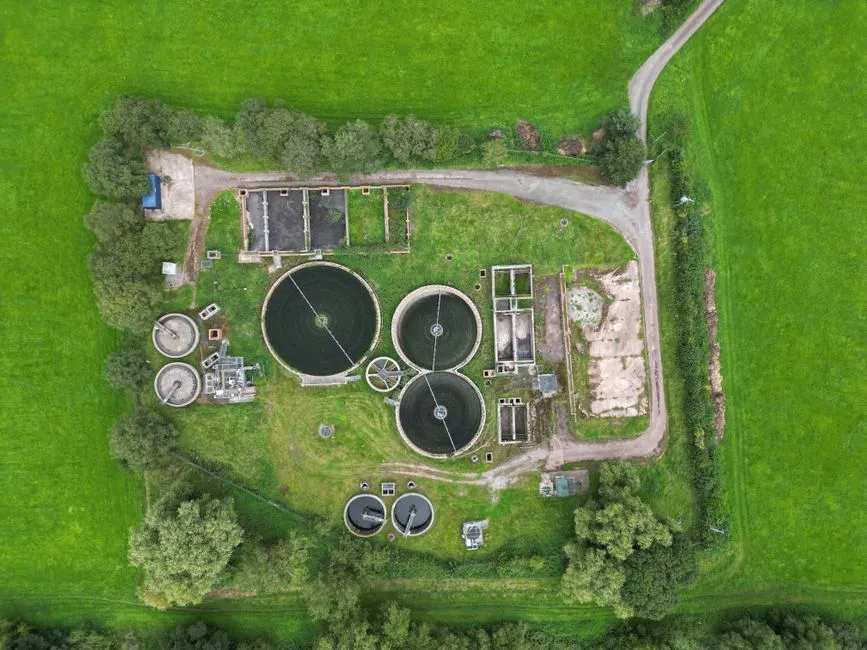
Three process configurations account for nearly every residential package plant bid a Dallas developer will see: A/O biological contact oxidation, membrane bioreactor (MBR), and sequencing batch reactor (SBR). Each has a different cost-versus-performance profile, and the choice is driven as much by site constraints and discharge limits as by flow.
| Process | Typical footprint | Effluent quality | Operator requirement | Best fit |
|---|---|---|---|---|
| A/O biological contact oxidation (WSZ) | Buried, 100% below grade | Meets TCEQ Chapter 217 secondary; <30 mg/L BOD, <30 mg/L TSS | None on-site; remote monitoring | Residential subdivisions, no reuse requirement |
| MBR (submerged PVDF) | 60% smaller than conventional activated sludge | <1 μm filtered; <5 mg/L BOD, <5 mg/L TSS, near-zero turbidity | Membrane CIP every 6–12 months | Type I reuse for irrigation, tight sites |
| SBR | Above-grade tanks typical | Secondary standard; variable with cycle tuning | Periodic cycle adjustment | Highly variable flows, retrofits |
The A/O configuration built into the WSZ series combines anoxic and aerobic zones with integrated sedimentation and a disinfection stage (typically on-site chlorine dioxide disinfection for residual stability across Dallas' warm summer distribution lines). MBR units run the same biological reaction but retain biomass on submerged PVDF membranes with nominal pore sizes below 1 μm, which is what unlocks TCEQ Type I reuse eligibility. SBR remains a viable third option for sites with very erratic flows, but the above-grade tankage is harder to integrate into a platted residential landscape. For a more detailed treatment-train comparison, the package sewage treatment plant buyer's guide methodology walks through selection criteria in a different regulatory context but the same process logic.
Buried Installation vs Trailer-Mounted: Why Dallas Subdivisions Bury the Plant
A buried A/O unit can be installed entirely below finished grade, with a turf cap or landscape feature above it, which is the single biggest reason developers in the Dallas–Fort Worth metroplex default to that configuration. Above-grade package plants, even when painted to match a development's palette, show up as a utility "box" in the middle of finished lots and reliably draw opposition at planning hearings and HOA design review. The WSZ buried configuration eliminates the visual impact, drops the noise footprint to background level (no on-site operator, no blowers above grade), and removes the routine site visits that attract complaints.
Trailer-mounted WSZ units do have a legitimate role, but it is narrower than most sales literature suggests. They fit construction-camp and phased-development scenarios where the permanent buried plant will not be commissioned until phase two or three, and they let the developer put a working plant online within days rather than waiting for excavation, buoyancy protection, and TCEQ engineering design review. TCEQ setback, isolation distance, and access requirements still apply to buried units; the burial solves aesthetic and acoustic issues, not regulatory ones. For a permanent residential subdivision of any scale, burial is the default and the trailer is the bridge.
Buried A/O Unit vs MBR Skid: Which Fits Your Subdivision?
The A/O-versus-MBR choice is rarely about hydraulic capacity; both can be sized to the same flow envelope. It is about effluent quality, footprint as a planning constraint, and who carries the long-term operating cost. The table below is the version a developer can put in front of a city engineer or an engineer of record.
| Decision axis | Buried WSZ A/O unit | MBR skid (PVDF) |
|---|---|---|
| Effluent quality | Secondary; <30 mg/L BOD/TSS; suitable for surface discharge under TCEQ Chapter 217 | Near-reuse; <5 mg/L BOD/TSS, <1 NTU turbidity; TCEQ Type I reuse eligible |
| Plan-view footprint | Standard activated-sludge envelope; visually disappears below grade | 60% smaller than conventional activated sludge but typically above-grade skid |
| Energy & OPEX | Low aeration duty; no operator; minimal consumables (per HydropureWater field data, 2025: 0.3–0.5 kWh/m³) | Higher aeration + membrane scour; periodic CIP chemicals; 0.6–0.9 kWh/m³ typical |
| Maintenance burden | Annual inspection, sludge pump-out every 2–4 years | Membrane integrity testing, chemical CIP every 6–12 months, membrane life 5–8 years |
| Permit pathway | Standard Chapter 217 discharge permit; no reuse application required | Reuse authorization adds a parallel TCEQ review but can simplify the discharge question |
| Best fit for | Subdivisions where reuse is not required and aesthetic integration is the priority | Subdivisions targeting Type I irrigation reuse or facing tight receiving-water limits |
The buried A/O unit wins on capital cost, energy, and neighborhood integration. The MBR membrane bioreactor skid wins on effluent quality and reuse eligibility, which is the differentiator when a developer wants to offset potable demand by irrigating common areas or HOA greenspace with treated effluent. Both face the same SB 1586 proximity screen, but the MBR's reuse pathway can shorten the city's review on discharge options because the effluent is going to a controlled on-site use rather than a receiving stream. For a deeper look at how the membrane stage actually performs, the MBR membrane bioreactor engineering process explainer covers the operating data in detail.
A Practical Decision Framework for the Developer
Step 1: Run the SB 1586 screen. Pull the municipal wastewater line GIS layer from the city or utility district, buffer the parcel by 1,000 feet, and confirm the tract is outside that band. Then identify every TCEQ-permitted wastewater facility within three miles and document a formal service request to each, with a written denial on file. Without both clearances, the rest of the exercise is academic.
Step 2: Define the discharge target. If the effluent goes to a receiving stream or stormwater system under TCEQ Chapter 217, a buried A/O unit sized per Chapter 285 will meet the standard. If the project needs Type I reuse water for irrigation, the MBR's sub-micron effluent is the cleanest path to that authorization.
Step 3: Match the constraint that binds hardest. On a tight lot in a built-out subdivision, MBR's smaller plan-view footprint may decide it. On a greenfield tract with open land and HOA pressure against visible infrastructure, the buried A/O unit usually wins. Step 4: Budget realistically. Burial introduces civil costs (excavation, buoyancy protection in Dallas' high clay-water-table zones, traffic-rated lids if sited under pavement) that a wastewater treatment plant CAPEX and OPEX benchmark from a comparable market can help frame, plus the TCEQ engineering design review fee and the construction-stage inspection. The buried configuration typically adds 15–25% to the equipment CAPEX but recovers that differential through eliminated above-grade structures and lower ongoing operator cost.
Frequently Asked Questions
Does Texas SB 1586 actually block package plants near Dallas?
Yes. Under Texas SB 1586 (89R), TCEQ cannot issue a permit for a packaged sewage treatment plant located within 1,000 feet of a municipal wastewater line, and a permit is also denied if any permitted facility within three miles has not formally declined service to the same parcel (per Sec. 26.054(b), capitol.texas.gov analysis, 2025).
What flow rate should I use to size a residential package plant in Texas?
TCEQ Chapter 285 sets residential design flow at 100 gallons per bedroom per day for single-family dwellings. A 200-home subdivision at 3 bedrooms each generates 60,000 gpd, or about 9.5 m³/h, which falls inside the standard 1–80 m³/h WSZ envelope.
What effluent quality can an MBR package plant realistically hit?
A submerged PVDF MBR produces filtered effluent with BOD and TSS typically below 5 mg/L and turbidity under 1 NTU, which is the envelope TCEQ accepts for Type I reuse. A buried A/O integrated plant with sedimentation and disinfection typically meets secondary standards of <30 mg/L BOD and <30 mg/L TSS under Chapter 217.
Do buried package plants still need TCEQ setbacks and access?
Yes. Burial addresses aesthetics, noise, and operator presence, but TCEQ setback, isolation distance, and vehicle access requirements apply to the unit regardless of whether it is below grade. The site plan must still show the isolation radii and a maintained access route for inspection and sludge removal.