
Why Jakarta Hospital Wastewater Demands More Than Conventional Treatment
Multidrug-resistant E. coli with high genomic diversity was confirmed in Jakarta hospital wastewater by six sequenced isolates published in Molecular Biology Reports on 2025-09-29 (DOI 10.1007/s11033-025-11076-z, PMID 41020918), making the local resistance picture operational rather than theoretical. The same study reported variable virulence profiles across the six isolates, which means a disinfection stage tuned only to total coliforms can still pass viable resistant organisms downstream if log reduction is not specified and verified. Layered against a global envelope of COD 120–500 mg/L, TSS 150–160 mg/L, BOD ~200 mg/L, plus pharmaceutical residues and viruses (PMC review, PMC7680650), Jakarta hospitals face a design problem that a single biological step cannot close. The defensible answer is a treatment train that provides robust BOD/COD reduction on the front end and verifiable disinfection on the back end, with the two stages linked by a hydraulic buffer that survives monsoon peaks. Anything weaker than that combination is gambling with the 2025 genomic evidence.
Indonesian and Jakarta-Specific Compliance Framework
Four instruments govern every Jakarta hospital discharge permit, and the design must hit all of them. PP 22/2021 is the umbrella regulation on environmental management that governs the quality of wastewater leaving any hospital premises, including the documentation and monitoring requirements that Bappeda and DLH check during audits. PermenLHK 5/2014 sets the national effluent quality standards — BOD, COD, TSS, pH, ammonia, and fecal coliform thresholds — that apply to hospital effluent entering municipal sewers or surface water, with the fecal coliform limit at <2,000 MPN/100 mL for discharge to water bodies and stricter criteria for any reuse pathway. Permenkes 7/2019 on hospital environmental health mandates on-site wastewater treatment before discharge and explicitly covers any reuse for cooling-tower make-up, landscape irrigation, or toilet flushing. Jakarta DKI Pergub and DLH enforcement overlays add monthly self-monitoring reporting, on-site reuse documentation, and spot sampling frequency that other provinces do not require. Once a hospital recycles any fraction of its effluent, the design must meet the tighter reuse bar in PermenLHK 5/2014 plus WHO water-reuse guidelines, which typically drive fecal coliform targets to <200 MPN/100 mL and require turbidity below 1 NTU upstream of disinfection.
| Instrument | Scope | Key limits driving design |
|---|---|---|
| PP 22/2021 | Umbrella environmental management | Permit, monitoring, reporting framework |
| PermenLHK 5/2014 | National effluent quality standards | BOD 30 mg/L, COD 100 mg/L, TSS 30 mg/L, NH₃-N 10 mg/L, fecal coliform <2,000 MPN/100 mL (discharge); stricter for reuse |
| Permenkes 7/2019 | Hospital environmental health | On-site treatment mandatory; reuse subject to quality criteria |
| Jakarta DKI Pergub / DLH overlays | Capital-specific enforcement | Monthly self-monitoring, reuse documentation, spot sampling |
Typical Jakarta Hospital Flow Rates and Influent Characteristics
Design flow in m³/day is the first metric a treatment train is sized against, scaling with bed count, outpatient load, and monsoon infiltration. The PMC review of hospital wastewater treatment (PMC7680650) reports a developing-country benchmark of roughly 290 m³/hospital/day and 250 L/patient/day, with a 1,120-bed Portuguese reference site at 1,000 m³/day. For Indonesian conditions, a class B 200-bed hospital in Jakarta typically generates 50–80 m³/day once OPD wash-hand basins, kitchen, and laundry are included, while a 500-bed referral hospital runs 150–250 m³/day. The influent envelope that any biological stage must absorb includes COD 120–500 mg/L, BOD ~200 mg/L, TSS 150–160 mg/L, plus pharmaceutical residues and pathogens. Jakarta's rainy season adds a variable that breaks undersized plants: inflow and infiltration at older sites can push I/I above 30% of average flow, requiring the equalisation tank to buffer 1.5–2× design average flow to ensure downstream membranes or batch reactors tolerate the peak without shedding solids. Failure to perform this calculation is the most common reason a working biological plant fails its DLH sample after heavy rainfall.
Process Train Options for Jakarta Hospitals: MBR, SBR, and Ozone Package
Three realistic trains cover most Jakarta hospital procurement cases, with the choice dictated by footprint, peak-flow tolerance, and the strength of the disinfection barrier. Option 1 is a submerged MBR membrane bioreactor followed by UV or ozone, running PVDF membranes at 0.1 μm pore size, producing effluent turbidity below 1 NTU, and cutting the aeration tank footprint to roughly 60% of a conventional activated-sludge layout. Option 2 is a sequencing batch reactor (SBR) followed by chlorination, which uses one tank for fill-react-settle-decant cycles and simpler controls; the trade-off is sensitivity to peak monsoon flows unless equalisation is generous. Option 3 is a biological stage plus the ozone disinfection package, which the HydropureWater product catalog lists at 99%+ microbial kill rate, ≥0.5 m² footprint, and no chemical dosing. For sites with existing chlorination infrastructure, an on-site chlorine dioxide generator is the relevant upgrade because ClO₂ is a stronger oxidant than chlorine against MDR organisms and does not generate the same halogenated by-products, simplifying the reuse-eligibility case during DLH reviews.
| Parameter | MBR + ozone/UV | SBR + chlorination | Biological + ozone |
|---|---|---|---|
| Typical footprint | ~60% of CAS for same load | Larger (single tank, batch) | Compact, biological stage + ozone polish |
| Effluent turbidity | <1 NTU | 5–20 NTU before filtration | <1 NTU after MBR feed to the compact medical wastewater system |
| Microbial log reduction | UV: 3–4 log; ozone: ≥3–4 log | Chlorine: 2–3 log, dose-dependent | Ozone: 99%+ kill |
| MDR organism handling | Strong with ozone or medium-pressure UV | Weaker; depends on Cl₂ residual | Strong; ozone oxidises cell walls |
| Peak-flow tolerance | Good with equalisation | Moderate; cycle time extends | Good with equalisation upstream |
| Reuse eligibility | Yes, with downstream barrier | Marginal, filtration usually required | Yes, the ozone polish is reuse-ready |
| Operator skill | Moderate (membrane maintenance) | Low–moderate | Low (skid-mounted, automated) |
Recommended Treatment Train for a 200-Bed Jakarta Hospital
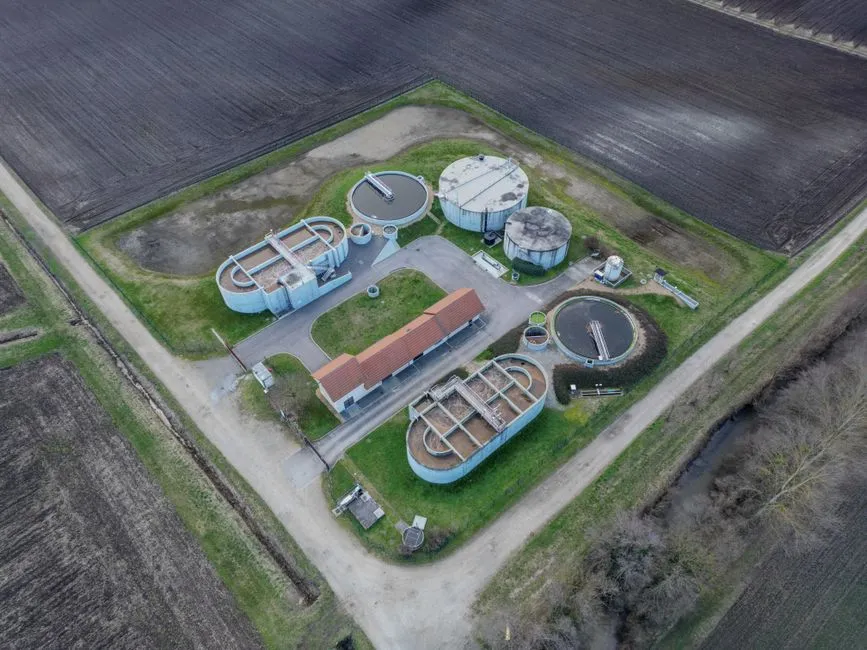
The worked example below is sized for a class B 200-bed hospital in central Jakarta with a high outpatient load, monsoon-affected sewer laterals, and a stated goal of on-site reuse for cooling-tower make-up. Design flow is set at 50 m³/day average, with a peak factor of 2.0 driving equalisation at 100 m³/day hydraulic capacity; the equalisation tank is buried and sized at 8 hours of average flow (roughly 17 m³), which buffers both the diurnal OPD peak and the wet-season I/I surge. The biological step is a packaged submerged MBR membrane bioreactor with PVDF membranes at 0.1 μm pore size, designed for 28–32 °C wastewater, MLSS 8,000–10,000 mg/L, and DO 1.5–2.0 mg/L, producing an effluent consistently under 50 mg/L COD and below 1 NTU turbidity. Disinfection is the ozone disinfection package at ≥0.5 m² footprint, which delivers the 99%+ kill needed against the MDR E. coli documented in Jakarta hospital wastewater (Mol Biol Rep, 2025-09-29, PMID 41020918) without the chemical handling of a chlorine system. The sludge line is a small plate-and-frame filter press sized to 1–2 m² filtration area, dewatering waste activated sludge from the MBR bleed to a 20–25% dry solids cake suitable for off-site incineration. Total service-yard footprint fits inside roughly 30 m².
Engineering Adjustments for Jakarta's Tropical and Seismic Context
Generic specifications often fail in Jakarta due to the local climate and infrastructure conditions. Temperature: design biological kinetics for 28–32 °C ambient and wastewater, which roughly doubles BOD uptake rate versus the 15–20 °C assumptions in European supplier curves; specify fine-bubble diffusers and DO control around 1.5–2.0 mg/L to keep endogenous respiration from stripping the biomass. Power resilience: a 30-second UPS on blowers, permeate pumps, and the MBR PLC prevents membrane fouling and aeration-tank turnover crashes during the grid blips common in Jakarta's rainy season. Flooding: place the MBR tank above the 100-year flood level or use a buried WSZ underground packaged sewage plant rated for hydrostatic loading, as several Jakarta districts sit in flood-prone zones. Odour: cover the equalisation tank and vent through a small activated-carbon unit to keep the hospital's own air intakes and neighbouring residential lots complaint-free, which is a routine DLH inspection point.
Frequently Asked Questions
What counts as hospital wastewater in Indonesia under Permenkes 7/2019?
Permenkes 7/2019 defines hospital wastewater as all liquid waste from inpatient wards, outpatient clinics, operating theatres, laboratories, laundry, kitchen, and toilets, plus any effluent from on-site diagnostic equipment. Pharmaceutical residues, blood, and pathological waste streams must be pre-treated (typically by chemical disinfection or thermal inactivation) before joining the main treatment train, and radioactive waste streams are excluded from the wastewater pathway.
Which process train should a high-risk Jakarta hospital choose to address documented MDR loads?
For hospitals serving MDR, TB, or COVID-19 cohorts, an MBR followed by the ozone package is the defensible train: the MBR cuts turbidity below 1 NTU so the ozone demand remains predictable, and ozone oxidises resistant organisms that chlorine misses at standard doses. The 2025 Mol Biol Rep study (PMID 41020918) confirms this combination as the risk-minimised choice.
What design flow should a 200-bed versus a 500-bed Jakarta hospital size for?
A 200-bed class B hospital typically needs a 50 m³/day plant at average flow with a 2.0 peak factor, and a 500-bed referral hospital runs 150–250 m³/day average, with the equalisation tank sized for 1.5–2× average to absorb monsoon infiltration. These are starting points; site-specific water balances from the hospital engineering team are required.
Which document sets the binding discharge limits for a Jakarta hospital?
PermenLHK 5/2014 sets the binding national limits — BOD 30 mg/L, COD 100 mg/L, TSS 30 mg/L, NH₃-N 10 mg/L, and fecal coliform below 2,000 MPN/100 mL for surface-water discharge, with stricter criteria for any on-site reuse. PP 22/2021 governs the permit and monitoring framework, and Jakarta DKI Pergub overlays add monthly self-monitoring and reuse documentation.