
Why Indigo Denim Wash Water Breaks a Standard MBR Design
Indigo denim wash water is one of the hardest textile streams to put through a membrane bioreactor because the dye itself is engineered to be chemically unstable. Indigo is a vat dye: in the dye bath it is reduced with sodium hydrosulfite (Na₂S₂O₄) at pH 10–11 to soluble leuco-indigo, which then re-oxidizes to insoluble blue pigment on the cotton fiber the moment it meets air. The wash water the MBR receives still carries 5–50 mg/L of residual sulfide, 50–200 mg/L of hydrosulfite, and pH swings between 9 and 11, plus the sizing agents (PVA, starch), surfactants, and 1–3 g/L of salt that the dyeing process leaves behind. Generic textile MBR sizing — copied from a municipal or mixed-fabric datasheet — will undersize the equalization basin, select a flux designed for settled sewage, and pick a membrane that fouls inside a week on indigo particles. The 2022 Nature review on hazardous-pollutant removal notes that manufacturing water demand could rise 400% by 2050, and denim is the highest-water-consuming textile category; the MBR is therefore a reuse enabler, not just a discharge-compliance box, and it must be sized against indigo's specific chemistry rather than a generic "textile" curve.
Step 1: Characterize the Influent Before You Touch a Calculator
Every downstream number — tank volume, membrane area, blower size — is wrong if the influent is wrong. Run a composite sampling program across at least three full production shifts before sizing, because denim wash is batch-driven and a single grab sample can under- or over-size the aeration tank by 30–50%. The table below shows the parameter ranges an engineer should expect on a typical indigo wash line; site-specific values go in the right-hand column.
| Parameter | Typical Range (Indigo Denim Wash) | Site Value |
|---|---|---|
| Flow per wash line | 50–500 m³/d | ______ m³/d |
| COD | 1,500–4,000 mg/L | ______ mg/L |
| BOD₅ | 400–1,000 mg/L | ______ mg/L |
| BOD₅ : COD ratio | 0.2–0.3 (denim) vs ~0.5 (municipal) | ______ |
| Color | 2,000–5,000 Pt-Co | ______ Pt-Co |
| TSS | 200–800 mg/L | ______ mg/L |
| Sulfide (S²⁻) | 5–50 mg/L | ______ mg/L |
| pH | 9–11 | ______ |
| Temperature | 30–55 °C | ______ °C |
| Total dissolved solids (salt) | 1,000–5,000 mg/L | ______ mg/L |
Two numbers in that table deserve a flag. The BOD₅:COD ratio of 0.2–0.3 is far below the 0.4–0.6 typical of municipal sewage, which means the biomass is digesting a slow, partially recalcitrant load and the MBR kinetics must be derated accordingly — SRT, not HRT, becomes the controlling design variable. The temperature range up to 55 °C also forces diffuser selection (epoxy-protected EPDM, not standard rubber) and pushes the tank volume slightly higher because the oxygen transfer efficiency drops about 2% per °C above 20 °C.
Step 2: Front-End Pretreatment Train (Equalization, DAF, and Sulfide Stripping)
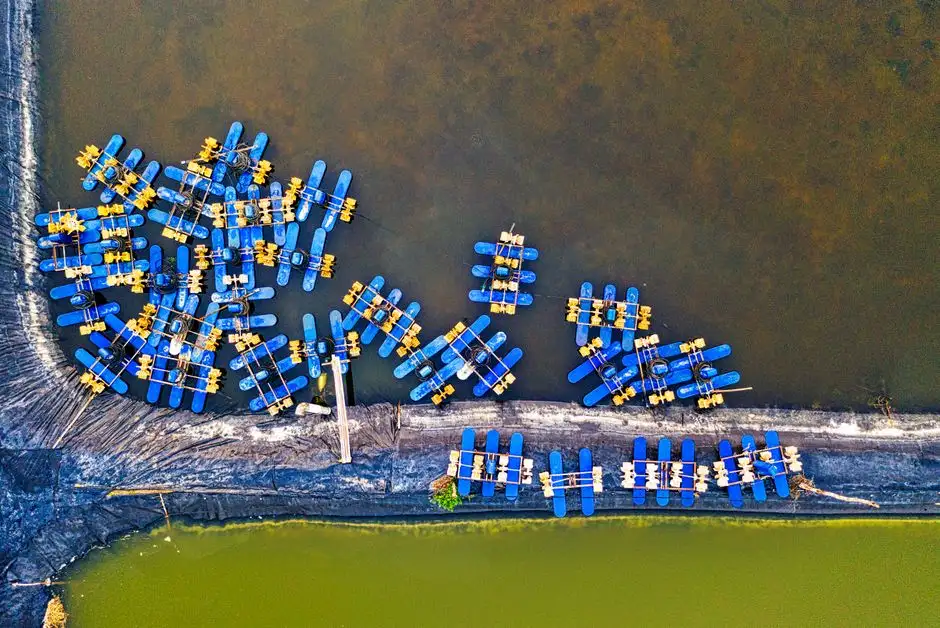
An MBR sized on raw wash water fouls within days. The influent must pass through three unit operations before the membranes ever see it.
Equalization basin. Size the EQ at 12–24 hours of retention (Q × 0.5 to Q × 1.0) and provide both mixing and coarse-bubble aeration. The aeration does two jobs: it dampens the batch pulses from each wash machine, and it oxidizes residual hydrosulfite and sulfide so the dissolved oxygen in the MBR feed stays above 1.5 mg/L. Without that, the biomass sees alternating reducing and oxidizing conditions and nitrifiers die off within one SRT cycle.
Dissolved air flotation (DAF). A DAF unit between EQ and MBR floats out loose indigo particles, surfactants, oils, and the colloidal sizing residues that would otherwise blind the membrane surface. For flows in the 50–500 m³/d denim range, a unit in the 4–22 m³/h range, such as the dissolved air flotation system, covers the full per-line envelope. Hydraulic residence time inside the DAF is 20–30 minutes, and a polymer dose of 5–15 mg/L is typical for denim wash water.
Sulfide control. Keep total sulfide below 0.5 mg/L entering the MBR, because sulfide above 1 mg/L is biocidal to nitrifiers and will shut down ammonia oxidation inside the bioreactor. The cheapest route is extended aeration in the EQ basin; if that cannot hit the target, dose 10–30 mg/L of FeCl₃ or FeSO₄ into the EQ outlet to precipitate iron sulfide.
Step 3: Calculate Aeration Tank Volume, HRT, SRT, and MLSS
The MBR tank is sized by three linked equations: hydraulic retention time (HRT), solids retention time (SRT), and the food-to-microorganism ratio (F/M). For indigo denim the design defaults are tighter than the UPC 2021 textile study (which used 1.3-day HRT on mixed textile effluent) because indigo is more recalcitrant and carries a higher recalcitrant-COD fraction.
| Design Parameter | Recommended Range (Indigo Denim) | Symbol / Formula |
|---|---|---|
| HRT | 24–36 h (1.0–1.5 d) | V (m³) = Q (m³/d) × HRT (d) |
| MLSS | 8,000–12,000 mg/L | Direct setpoint |
| SRT | 25–40 d | SRT = V × MLSS / (Q_w × TSS_w) |
| F/M | 0.05–0.15 kg BOD/kg MLSS·d | F/M = (Q × BOD) / (V × MLSS) |
| Oxygen demand (carbonaceous) | 1.5–2.0 kg O₂/kg BOD removed | O₂,c = 1.7 × Q × BOD |
| Oxygen demand (endogenous) | 0.10–0.15 kg O₂/kg MLSS·d | O₂,e = 0.15 × V × MLSS |
| Air supply (fine-bubble) | 0.6–0.8 Nm³ air / m³ tank / min | Q_air = 0.7 × V × 60 |
Worked example, 300 m³/d stream at 2,500 mg/L COD and 600 mg/L BOD. At 36 h HRT, V = 300 × 1.5 = 450 m³. With MLSS = 10,000 mg/L, F/M = (300 × 0.6) / (450 × 10) = 0.04 kg BOD/kg MLSS·d — slightly below the target range, which is acceptable on denim because BOD is partly recalcitrant. Carbonaceous oxygen demand: 1.7 × 300 × 0.6 = 306 kg O₂/d. Endogenous: 0.15 × 450 × 10 = 675 kg O₂/d. Total field oxygen demand ≈ 980 kg O₂/d, or roughly 40 kg/h. At standard oxygen transfer efficiency (SOTE) of 25% for fine-bubble diffusers at 8 m depth, that requires about 350–400 Nm³/h of blower capacity. Always spec a redundant blower — one operating, one standby — plus a dedicated membrane-scour blower that runs continuously under the cassettes.
Step 4: Select the Membrane Module and Calculate Required Area
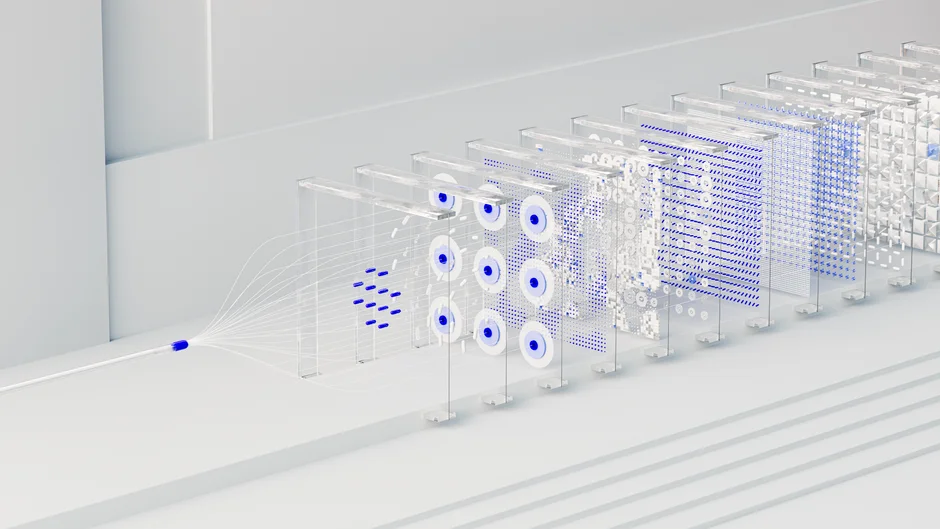
For indigo denim the only membrane chemistry that survives is PVDF (polyvinylidene fluoride); PES and PSf oxidize, and cellulose acetate cannot handle pH 11. The remaining choice is flat-sheet versus hollow-fiber geometry.
| Criterion | PVDF Flat-Sheet (e.g. DF series, 0.1 µm) | PVDF Hollow-Fiber (0.03–0.1 µm) |
|---|---|---|
| Packaged area per cassette | ~10–25 m² | ~25–50 m² |
| Backwash mode | In-place, mechanical | Backflush on filtrate side |
| Behavior on indigo particles | Surface fouls, recovers on CIP | Particles lodge in lumen, often irreversible |
| Air-scour demand | 0.10–0.20 Nm³/m²·min | 0.05–0.10 Nm³/m²·min |
| Operating flux on denim | 12–18 L/m²·h | 10–14 L/m²·h |
| Best fit for denim | High TSS, batch effluent | Low TSS, polishing duty |
The Nature 2022 review classifies MF/UF membranes by pore size as 100–1,000 nm (MF) and 5–100 nm (UF); 0.1 µm (100 nm) sits at the MF/UF boundary and is the practical upper limit for indigo because smaller pores capture dye colloids but foul 2–3× faster. Use flux 12–18 L/m²·h for denim — well below the 20–25 L/m²·h used for municipal sewage — because of the color and surfactant loading. Membrane area follows A = Q / (Flux × 24 × 0.001). For Q = 300 m³/d and flux = 15 L/m²·h, A = 300 / (15 × 24 × 0.001) = 833 m². Round up to allow for downtime, so spec 950–1,000 m² across 10–12 modules. Standard operating regime: 9 minutes filtration, 1 minute backwash, continuous coarse-bubble air scour at 0.15 Nm³/m²·min. Source the modules from a supplier that offers both the cassette and the integrated MBR system framing so the air-scour, permeate manifold, and backwash pump are pre-piped. For indigo specifically, the DF series PVDF flat-sheet membrane modules are the safer geometry because the flat surface releases indigo and salt cake more reliably on clean-in-place than a hollow-fiber bundle.
Step 5: Work the Numbers for a 500 m³/d Denim Wash Line
Inputs: Q = 500 m³/d, COD = 3,000 mg/L, BOD = 700 mg/L, color = 3,500 Pt-Co, TSS = 500 mg/L, sulfide = 20 mg/L, pH 10, T = 40 °C. Run the full train: EQ → DAF → MBR. The numbers below are designed to be copied into a PFD and a P&ID.
| Unit Operation | Calculated Output |
|---|---|
| Equalization basin (12 h) | 250 m³, coarse-bubble aeration, FeCl₃ dose 15 mg/L if S²⁻ > 5 mg/L |
| DAF | 22 m³/h, polymer 8 mg/L, sludge ~2% w/w |
| MBR tank (36 h HRT) | 750 m³, MLSS 10,000 mg/L, SRT 30 d, F/M ≈ 0.05 |
| Aeration blowers | ~360 Nm³/h for process air; redundant blower + dedicated membrane-scour blower at 0.15 Nm³/m²·min |
| Membrane area | 1,150 m² (12 modules × ~100 m²), flux 15 L/m²·h, 0.1 µm PVDF flat-sheet |
| Effluent targets | COD < 100 mg/L, TSS < 1 mg/L, color < 300 Pt-Co |
| Sludge handling | ~150 m³/d at 1% solids → plate-and-frame filter press to ~22% cake |
That effluent meets typical Chinese GB 4287-2012 indirect-discharge limits and is reuse-grade for dyeing-machine wash-down and boiler-feed make-up after polishing; it is not reuse-grade for the dye bath itself, which would need RO downstream (see this RO vs NF comparison for industrial wastewater for the polishing step). On CAPEX, a standalone MBR of this size lands in the $400K–$900K USD envelope depending on tank material, blower redundancy, and building works. The UPC 2021 thesis on MBBR-MBR hybrid reports a 68.4% CAPEX saving versus standalone MBR on mixed textile effluent, but the MBBR-MBR only achieved comparable COD removal at the cost of lower color removal (the biofilm cannot reduce color the way a long-SRT MBR can), so for indigo specifically a standalone MBR remains the more defensible choice unless color targets are loose.
Frequently Asked Questions
What flux rate should I use for a denim MBR?
12–18 L/m²·h on submerged PVDF flat-sheet, against 20–25 L/m²·h used for municipal sewage. The derate reflects indigo's color (2,000–5,000 Pt-Co) and surfactant load, both of which compress sustainable flux (per HydropureWater field data on denim wash lines, 2025–2026).
How do I handle sulfide in the MBR feed?
Strip it in the equalization basin by aerating to below 0.5 mg/L total sulfide, or dose 10–30 mg/L FeCl₃ to precipitate FeS. Sulfide above 1 mg/L is biocidal to nitrifiers and will crash ammonia oxidation inside the MBR within one SRT cycle (per standard nitrification inhibition references).
Flat-sheet or hollow-fiber PVDF for indigo denim?
Flat-sheet. Indigo particles and salt scaling foul hollow-fiber lumens irreversibly; flat-sheet cassettes recover on routine CIP with 1,000–2,000 mg/L NaOCl. The DF series PVDF flat-sheet is the geometry of choice on high-TSS, high-color denim streams.
Can the MBR effluent be reused?
Yes, for dyeing-machine wash-down and boiler make-up. Effluent of COD <100 mg/L, TSS <1 mg/L, color <300 Pt-Co is reuse-grade for those duties; direct dye-bath reuse requires RO or NF polishing because residual color and TDS remain too high for the leuco-indigo reduction bath (per EPA reuse guidelines for industrial process water).
What is realistic membrane life on indigo denim?
3–5 years with disciplined CIP cycles (weekly maintenance wash, quarterly recovery clean), versus 5–8 years on municipal sewage. The lifetime is set by cumulative irreversible fouling from surfactants and dye colloids, not by mechanical failure.