Why EGSB Reactors Fail: How the Design Defines Its Own Failure Modes
EGSB (expanded granular sludge bed) reactors were specifically designed to eliminate the hydraulic short-circuiting, dead zones, and clogging that plague UASB designs, and they do this by operating at upflow velocities an order of magnitude higher than a conventional UASB (per the MDPI EGSB-CMBR study, 2022). That design choice is also the source of nearly every operational failure mode an engineer will see on shift. The expanded granular sludge bed reactor is engineered around three coupled parameters: a hydraulic loading rate of 4–8 m/h, an organic loading rate of 8–25 kg COD/m³·d, and a recirculation ratio between 1:1 and 6:1. Push past any one of these windows and the reactor moves from "robust" to "fragile" inside a single shift.
The granule bed itself, which is the engine of the reactor, tolerates far less hydraulic and toxicant variation than a flocculent UASB sludge because dense methanogenic granules have a fixed settling velocity. Once upflow velocity crosses roughly 8 m/h, the hydraulic drag on a 2–3 mm granule exceeds its settling force and washout begins. Once the VFA/alkalinity ratio crosses 0.4, methanogenic activity stalls before pH itself moves. Every problem catalogued below is, mechanically, a deviation from one of these three design windows. Read it that way and the alarm panel becomes a checklist rather than a mystery.
Symptom-to-Cause Diagnostic Matrix: The Operator's Quick Reference
The matrix below is built for shift-floor use. It maps the seven alarm conditions an EGSB operator most often sees, the most likely root cause, the first thing to measure, and the first knob to turn. The zeolite-support study (Performance of EGSB reactor using natural zeolite, 2024) confirms that EGSB was created specifically to solve the failure modes of UASB — short circuits, dead zones, and preferential flows — and those same modes reappear whenever the EGSB is mis-operated. Theory has been kept out of the table on purpose.
| Observable symptom | Most likely root cause | First diagnostic step | First corrective action |
|---|---|---|---|
| Sudden COD breakthrough (>30% rise in effluent) | Organic overload or hydraulic surge | Check influent flow and COD against design OLR | Cut feed; raise recycle ratio to flush VFA |
| Falling biogas yield (>15% drop in Nm³ CH₄/kg COD) | Toxicant in-feed or temperature drift | Sample for sulfide; verify reactor temperature | Dose FeCl₂ for sulfide; restore 35–38 °C |
| Rising effluent VFA (>1,000 mg/L as acetic) | Methanogenic inhibition | Calculate VFA/alkalinity ratio | Cut OLR; dose NaHCO₃ to >2,000 mg/L CaCO₃ |
| Sludge blanket drop (bed level down >0.5 m) | Granule washout | Measure effluent TSS and inspect particle morphology | Reduce upflow velocity; cap recycle at design max |
| Foaming at gas-liquid interface | Lipid/surfactant overload or filamentous bulking | Check influent FOG; sample scum | Reduce FOG loading; install/clean scum baffle |
| H₂S odor in off-gas (>200 ppm) | Sulfate-rich feed or sulfide toxicity | Strip-test dissolved sulfide | Dose Fe²⁺ at 2–5 mg Fe/L to precipitate FeS |
| Temperature excursion (<30 °C or >40 °C) | Heat-trace failure or summer feed | Verify reactor temperature at three depths | Restore 35–38 °C mesophilic band; pause feed if <28 °C |
Granule Washout and Sludge Bed Loss
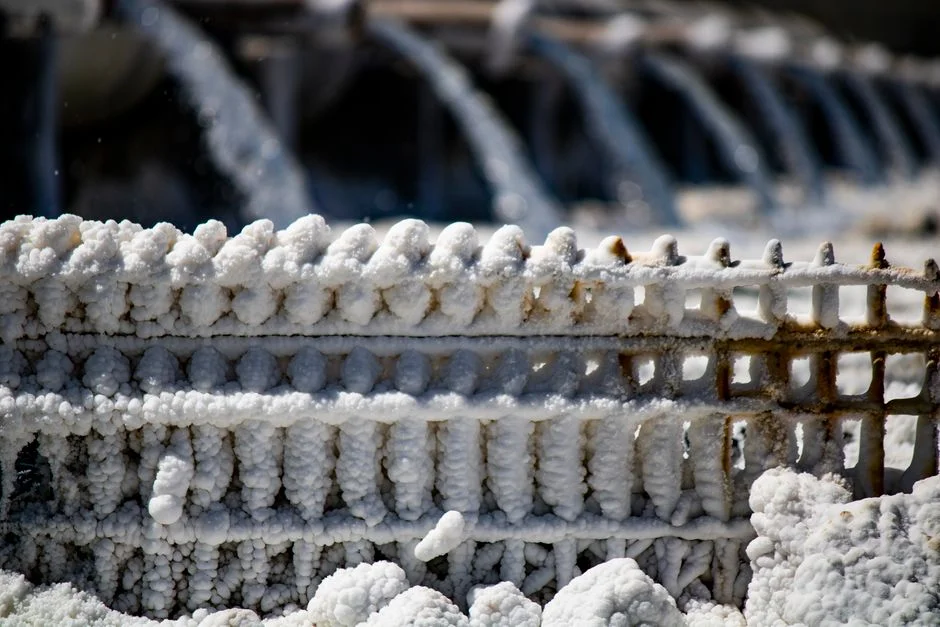
Granule washout is the EGSB failure mode that most often gets misdiagnosed as simple TSS carryover. The physical mechanism is straightforward: once upflow velocity exceeds roughly 8 m/h, the hydraulic drag on a dense 2–3 mm methanogenic granule overcomes its settling velocity and the granule lifts out of the bed. A second, less obvious cause is a recycle ratio that is too low; recycle is what creates the hydraulic cushion that lets the bed expand without losing inventory. When recycle drops below the design 1:1 floor, the cushion thins and even normal upflow begins to peel granules off the top of the blanket.
Diagnosis starts at the effluent TSS stream. True granule loss shows intact, dense, dark-brown to black particles roughly 1–3 mm across; dispersed growth or floc carryover looks fluffy, light tan, and irregular. Measure both TSS and VSS, and note the VSS/TSS ratio: a granule-washout event will keep VSS/TSS above 0.80, while a dispersed-growth carryover will drop below 0.70 as inerts accumulate. The first corrective action is to cap the recycle pump at its design maximum and reduce upflow velocity toward 5–6 m/h. The long-term fix is to inspect the influent distribution header for channeling — a single feed point creates a localized upflow jet that is the actual washout zone, and the cure is a rebalanced multi-point inlet rather than more recycle.
VFA Accumulation, Souring, and pH Collapse
VFA accumulation is the canonical EGSB souring sequence, and it almost always announces itself 24–48 hours before pH itself moves. The early-warning signal is the VFA/alkalinity ratio, expressed on a mg/L as acetic acid to mg/L as CaCO₃ basis: a ratio above 0.4 means the acidogenic population is outrunning the methanogenic one, and a ratio above 0.8 means the buffer is functionally exhausted. The four drivers account for almost every souring event a process engineer will see: organic overload, hydraulic surge, temperature drop below 30 °C, and a toxicant in-feed (most commonly sulfide, ammonia above 1,500 mg/L, or a chlorinated solvent slug).
The corrective sequence matters, because doing the steps in the wrong order is what turns a recoverable upset into a multi-week recovery. Step 1 is to cut the organic loading rate — reduce feed by 30–50% or pause it entirely if the ratio is above 0.8. Step 2 is to raise the recycle ratio to flush accumulated VFA out of the bed. Step 3 is to dose alkalinity as NaHCO₃ or Na₂CO₃ to keep total alkalinity above 2,000 mg/L as CaCO₃. Step 4 is to restart normal feed only after VFA has fallen below 500 mg/L and the ratio is back under 0.3. The common mistake is dosing caustic (NaOH) to "fix" pH directly — that raises pH without restoring buffering capacity, and the bed resours within hours. Bicarbonate alkalinity is the proper control variable, not pH.
Three-Phase Separator Clogging and Hydraulic Short-Circuiting

Fouling of the gas-solid-liquid (three-phase) separator is the failure mode that quietly undoes the entire reason EGSB exists. The MDPI EGSB-CMBR study (2022) is explicit that EGSB was designed to solve the UASB failure modes of short-circuiting, dead space, and clogging — and a fouled three-phase separator reintroduces all three. Symptoms show up first as localized gas pockets visible through the sight glasses, then as an uneven sludge bed profile when the bed is sounded, and finally as channeling through specific sampling ports while the rest of the bed sits undisturbed.
The diagnostic that catches this early is the pressure differential across the separator. A clean EGSB separator runs at a ΔP of 10–30 mbar; a rise above 50 mbar typically indicates scum buildup or CaCO₃ scaling on the deflector plates. Corrective action is mechanical, not chemical: scheduled surface scum and floating-debris removal, a physical inspection of the deflector plates for scaling, and — if fouling recurs on a monthly cycle — a retrofit with a gas-wash-down nozzle that pulses biogas across the deflector surface during the back-flush cycle. A DAF pre-treatment unit upstream will cut the FOG load reaching the separator and extend the cleaning interval in plants running oily or greasy feed.
Sulfide Toxicity and Micronutrient Deficiency
Sulfide toxicity and micronutrient deficiency are easy to confuse because both present as falling gas yield, but they sit at opposite time scales. Sulfide toxicity is an event: total dissolved sulfide above 200 mg/L inhibits methanogens, and the signature is a simultaneous VFA rise and gas drop with no temperature or hydraulic change. The corrective dose is FeCl₂ or FeSO₄ at 2–5 mg Fe/L, which precipitates the sulfide as FeS; verify with an on-site sulfide test strip and target residual dissolved sulfide below 50 mg/L.
Micronutrient deficiency is a slow drift. It shows up as chronic low gas yield, pale rather than dark-brown granules, and reduced methanogenic activity per gram of VSS even when VFA/alkalinity looks acceptable. The fix is a trace-metal solution of Fe, Co, Ni, and Mo dosed at 0.5–2 mg/L each, which is the typical engineering band for EGSB micronutrient supplementation. The reason alkalinity adjustment alone cannot recover this bed is biochemical: methanogens require nickel as the metal center of coenzyme F430 and cobalt as a cofactor for methyltransferase — without these, restoring pH and alkalinity cannot restore activity. If the granule bed in your reactor has been running on a stripped feed (distillery, starch, or某些 pulp-and-paper streams are common culprits) for more than 60 days, dose the trace panel and measure gas yield over the next two weeks before assuming the bed itself has failed.
Preventive Parameter Windows and Operating Discipline
The parameter table below is the operating envelope every EGSB plant should be audited against once per quarter. Hitting all of these windows is what keeps the six failure modes above from showing up in the first place. Deviating from one window is a yellow flag; deviating from two simultaneously is the precondition for a souring or washout event.
| Parameter | Recommended steady-state window | Alarm tier | Action window |
|---|---|---|---|
| Upflow velocity | 4–8 m/h | Level 2 (act in 12 h) | Cut recycle or feed if >9 m/h |
| Organic loading rate (OLR) | 8–25 kg COD/m³·d | Level 2 (act in 12 h) | Throttle feed if >28 kg COD/m³·d |
| Recycle ratio | 1:1 to 6:1 (feed:recycle) | Level 1 (24 h) | Investigate if outside band |
| Reactor temperature | 35–38 °C (mesophilic) | Level 3 (immediate if <30 °C) | Pause feed if <28 °C |
| VFA/alkalinity ratio | <0.4 (acetic : CaCO₃ basis) | Level 2 (act in 12 h) | Cut OLR if >0.4; pause if >0.8 |
| Total alkalinity | >2,000 mg/L as CaCO₃ | Level 1 (24 h) | Dose NaHCO₃ if trending <2,200 |
| Effluent TSS | <200 mg/L (normal); >500 mg/L = washout | Level 2 (act in 12 h) | Reduce upflow; inspect inlet distribution |
| Gas yield | 0.30–0.35 Nm³ CH₄/kg COD removed | Level 1 (investigate 24 h) | Check sulfide, micronutrients, temperature |
| Dissolved sulfide | <200 mg/L | Level 2 (act in 12 h) | Dose Fe²⁺ at 2–5 mg Fe/L |
The alarm-hierarchy discipline matters more than the numbers themselves. Treat the VFA/alkalinity ratio as a level-2 alarm that demands action within 12 hours; treat a pH drop below 6.8 as a level-3 alarm that demands immediate intervention; treat a gas yield drop as a level-1 alarm that warrants investigation within 24 hours but rarely requires emergency action. Daily VFA and alkalinity sampling, weekly TSS, and a monthly micronutrient panel is the minimum cadence for a stable EGSB line. Plants running high-strength anaerobic streams such as the ones covered in our printing and dyeing wastewater treatment guide and the starch wastewater treatment guide typically tighten the VFA/alkalinity check to twice per shift during commissioning. If the upstream effluent stream is variable, an MBR polishing system downstream will protect the receiving water body while the EGSB is being rebalanced, but the upstream reactor has to come back inside its design window first.
Frequently Asked Questions
What VFA level is dangerous in an EGSB?
A VFA/alkalinity ratio above 0.4 (mg/L as acetic to mg/L as CaCO₃) is the early warning, typically 24–48 hours before pH itself falls. The hard floor is total alkalinity above 2,000 mg/L as CaCO₃; below that, the buffer is exhausted and a pH crash follows within hours.
How do I stop granule washout?
Cap the upflow velocity at 8 m/h and bring the recycle ratio back into the 1:1 to 6:1 design band. If washout persists, inspect the influent distribution header for a single-point feed jet, because channeling — not upflow itself — is usually the actual cause.
What causes EGSB short-circuiting?
Short-circuiting is a reappearance of the original UASB failure mode that EGSB was designed to eliminate (per the MDPI EGSB-CMBR study, 2022). In a running EGSB, it almost always traces to a fouled three-phase separator — a ΔP rise above 50 mbar across the separator is the diagnostic signal.
Can an EGSB recover from souring?
Yes, if the corrective sequence is followed in order: cut OLR by 30–50%, raise recycle to flush VFA, dose NaHCO₃ to keep alkalinity above 2,000 mg/L as CaCO₃, then restart normal feed only after the VFA/alkalinity ratio falls below 0.3. Avoid dosing NaOH — it raises pH without restoring buffering.
What micronutrients do EGSB granules need?
Fe, Co, Ni, and Mo at 0.5–2 mg/L each. Nickel is the metal center of coenzyme F430 and cobalt is a methyltransferase cofactor — without these, alkalinity adjustment alone cannot restore methanogenic activity, which is why chronic underperformance persists in micronutrient-stripped feeds.