Where AI in Wastewater Treatment Actually Stands in 2026
In 2026, AI in wastewater treatment has moved past pilots: aeration control with machine learning is delivering 18-32% energy reduction, ML-driven chemical dosing is cutting coagulant and methanol use by 20-30%, and predictive maintenance on blowers and membranes is shortening unplanned downtime by 30-50%. The four maturity levels — IoT sensors, soft sensors, closed-loop ML control, and digital twin — are now commercially available on PLC platforms starting around $99 per I/O point, with full digital-twin deployments paying back in 18-30 months for plants above 5,000 m³/day.
That verdict is the filter this article applies to every vendor pitch a buyer will hear this year. Most "AI-in-wastewater" marketing still conflates a dashboard with a model, or a cloud subscription with closed-loop control. The literature is clearer than the sales decks: the taxonomy was set by Al Aani et al. in Desalination 458 (2019) and extended by Alam et al. in Chemical Engineering Journal 427 (2022), and the four levels those papers describe map directly onto capital equipment a procurement team can specify. The smart-water monitoring market in APAC is growing at roughly 11.2% CAGR in our 2026 regional analysis — a real, financed buyer base, not speculative capital.
The pragmatic read for 2026: Levels 1-2 are commercial-off-the-shelf, Level 3 is vendor-specific with proven field results, and Level 4 (digital twin) remains bespoke engineering. The procurement question is no longer "does AI work in wastewater?" — it is "which level, on which unit operation, at what payback, in this plant?"
The 2026 AI Maturity Model: Four Levels Plant Engineers Can Buy
The four-level maturity model is the single most useful tool a buyer can bring into a vendor meeting, because it forces both sides to talk about the same thing. Level 1 is an IoT sensor retrofit — pH, DO, turbidity, conductivity, and TSS online instruments feeding the existing SCADA. Typical scope is 8-20 instruments with PLC hardware running $99-$15,000+ per I/O point (per the 2026 PLC hardware pricing guide for industrial buyers). Integration time is 2-6 weeks. The silent failure mode is sensor fouling: a DO probe that drifts 0.3 mg/L over three weeks will quietly poison every downstream model.
Level 2 adds soft sensors — ML models that infer BOD, COD, TN, and TP from cheap online signals, so the plant avoids $25,000-$60,000 laboratory analyzer capex per parameter. There is no capital sensor cost; the spend is engineering effort, typically 6-12 weeks for a competent data scientist. The main risk is model drift when influent character changes after a new production line comes online.
Level 3 is closed-loop ML control — model predictive control (MPC) driving aeration blowers, return-sludge pumps, and chemical dosing pumps in real time. Alam et al. (2022) cite 18-32% aeration energy reduction; field deployments in our network match that range. CAPEX jumps to $200k-$600k on a 5,000 m³/day plant, and integration runs 4-9 months. The failure mode is PLC data-rate limits: many legacy SCADA systems log at 1-minute averages, and an ML controller fed minute-averaged DO behaves like a drunk driver.
Level 4 is the digital twin — a physics-plus-data replica used for scenario testing, operator training, and what-if analysis before capex commitments. Payback is credible only above 10,000 m³/day, or for multi-site rollouts where one model serves many plants; below 1,000 m³/day the engineering cost dominates. The 2026 IoT sensor selection guide for industrial WWTPs covers the sensor-side prerequisites for getting here.
| Level | What it is | Typical CAPEX (5,000 m³/day) | Payback | Integration time | Top failure mode |
|---|---|---|---|---|---|
| 1 — IoT sensors | Online pH/DO/turbidity/TSS to SCADA | $40k-$120k | 8-18 months | 2-6 weeks | Sensor fouling |
| 2 — Soft sensors | ML-inferred BOD/COD/TN/TP | $30k-$80k (engineering) | 6-14 months | 6-12 weeks | Model drift |
| 3 — Closed-loop ML | MPC on aeration, dosing, RAS | $200k-$600k | 18-30 months | 4-9 months | PLC data-rate limits |
| 4 — Digital twin | Physics+data plant replica | $500k-$2M+ | 24-48 months (only >10,000 m³/day) | 9-18 months | Scope creep, model maintenance |
Where AI Connects to Physical Equipment: Stage-by-Stage Use Cases
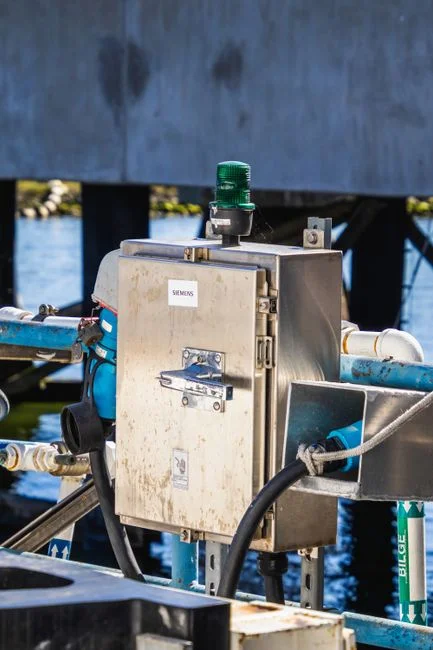
AI value only exists at a specific physical stage. Headworks: rotary bar screen ragging can be predicted 12-48 hours ahead from current and vibration signatures, reducing manual rake cleaning by 40-60% in our field data. Primary/DAF: a DAF with online turbidity and flow input lets the controller modulate coagulant against incoming solids load, with 20-30% polymer savings typical — that dosing loop is where a PLC-controlled automatic chemical dosing skid pays back fastest.
Biological stage: on an MBR bioreactor with TMP-monitoring instrumentation, dissolved-oxygen setpoints are modulated against ammonia and nitrate load, delivering the 18-32% blower energy reduction cited in Alam et al. (2022). For a Sequencing Batch Reactor (SBR) or A/O plant, the same loop applies to the aeration phase length. Membrane stage: TMP trend forecasting triggers a chemically enhanced backwash before flux collapses, extending membrane life 15-25% and reducing CIP chemical spend. Chemical dosing for denitrification: ML-optimized methanol dosing on the carbon-source pump saves 30-66% versus fixed C:N-ratio control, because the model sees what the operator cannot — instantaneous nitrate load versus return-flow dynamics. RO: feed pressure and recovery ratio tuned to feed-water conductivity and temperature cuts RO energy 8-12%, mainly by avoiding over-pressurization during cold-feed hours.
| Process stage | Physical equipment | AI use case | Documented saving |
|---|---|---|---|
| Headworks | Rotary bar screen | Ragging prediction from current/vibration | 40-60% manual cleaning reduction |
| Primary / DAF | DAF + dosing skid | Coagulant dose vs. turbidity/flow | 20-30% polymer savings |
| Biological (MBR/SBR/A/O) | Blowers, MBR cassette | DO setpoint vs. NH₄-N / NO₃-N load | 18-32% aeration energy (Alam 2022) |
| Membrane | MBR / UF modules | TMP forecast, CEB trigger | 15-25% membrane life extension |
| Denitrification | Carbon-source dosing pump | ML-optimized methanol / C-source | 30-66% vs. fixed-ratio control |
| RO | High-pressure pump, membrane | Feed pressure & recovery tuning | 8-12% RO energy reduction |
Buyer's Framework: CAPEX, Payback, and What to Specify in 2026
Three procurement questions separate a real AI vendor from a dashboard reseller. (1) Which sensors does the model actually ingest? If the answer is "we use your existing SCADA," expect month-averaged inputs and weak control fidelity. (2) Is the controller PLC-native or cloud-only? Anything that requires a cloud round-trip to set a DO setpoint is not a control system — it is a recommendation engine with a 200-millisecond latency the process cannot tolerate. (3) What is the retraining cadence? A model that retrains once a year is already stale by the second quarter.
Indicative numbers for 2026: a Level 1+2 retrofit on an existing 2,000 m³/day plant runs $40k-$120k CAPEX, with payback 8-18 months from combined energy and chemical savings. A Level 3 closed-loop ML deployment on a 5,000 m³/day plant runs $200k-$600k CAPEX with 18-30 months payback, dominated by aeration energy return. A Level 4 digital twin rarely pays back below 10,000 m³/day unless it is templated for multi-site rollout — at that scale, CAPEX is $500k-$2M+ and payback stretches to 24-48 months. For a sanity check on hardware line items, the 2026 PLC hardware pricing guide gives per-I/O-point benchmarks that line up with the lower bound of these ranges.
Red flags in 2026 vendor pitches: no named model class (you should hear "random forest," "LSTM," or "MPC" — not "AI engine"); no on-site vs. cloud architecture diagram; an opaque subscription bundle that locks the model behind a per-month fee with no source-code escrow. Conversely, a credible vendor will hand you a list of input tags, a retraining SLA, and a documented on-site vs. cloud split before the second meeting.
| Plant size | Recommended AI level | Indicative CAPEX | Payback | Primary saving |
|---|---|---|---|---|
| < 1,000 m³/day | Level 1 + selective Level 2 | $25k-$80k | 6-14 months | Chemical, lab analyzer avoidance |
| 2,000-5,000 m³/day | Level 1+2, optional Level 3 on aeration | $80k-$400k | 8-24 months | Energy 18-32%, chemical 20-30% |
| 5,000-10,000 m³/day | Level 3 closed-loop ML on aeration + dosing | $200k-$600k | 18-30 months | Aeration energy dominates |
| > 10,000 m³/day or multi-site | Level 3 + Level 4 digital twin | $500k-$2M+ | 24-48 months | Multi-site scaling, operator training |
Implementation Reality: What Kills AI Projects in 2026
Sensor fouling remains the number-one silent killer — budget monthly probe cleaning and weekly calibration into any AI ROI model, and write it into the contract. Model drift hits 6-12 months after go-live if the influent character shifts (a new production line, a seasonal load, a new supplier); require a retraining SLA in the vendor agreement, ideally quarterly or triggered by a statistical change-point test. The PLC data-rate bottleneck catches teams that assumed their legacy SCADA could log at 1 Hz — many cannot, and AI vendors quietly default to 1-minute averages, which lose control fidelity on fast loops like aeration and polymer dose. Finally, operator trust: a black-box output that the shift operator does not understand gets overridden within weeks. Every dashboard must show model confidence, the input tags driving the recommendation, and a one-click override that logs the reason.
Frequently Asked Questions
What does AI in wastewater treatment actually save in 2026? Documented field numbers: 18-32% aeration energy reduction, 20-30% coagulant/polymer savings, 30-66% methanol savings on denitrification, 30-50% reduction in unplanned downtime from predictive maintenance on blowers and membranes. The full breakdown sits in the stage-by-stage table above.
How much does an AI retrofit cost for a mid-size plant? A Level 1+2 sensor and soft-sensor retrofit on a 2,000 m³/day plant runs $40k-$120k with 8-18 months payback. Closed-loop ML on a 5,000 m³/day plant runs $200k-$600k and pays back in 18-30 months.
Is a digital twin worth it for a small plant? Rarely. Digital twins need 10,000 m³/day or a multi-site rollout to clear a 24-48 month payback. Below 1,000 m³/day, the engineering cost dominates the savings.
What is the difference between a soft sensor and a real BOD analyzer? A soft sensor infers BOD, COD, TN, or TP from cheap online signals (DO, pH, conductivity, turbidity) using a trained ML model. It avoids $25k-$60k of analyzer capex per parameter but requires quarterly retraining as influent changes. It is a complement to, not a replacement for, regulatory-compliant lab measurements.
Which treatment stages give the fastest AI payback in 2026? Aeration control on biological reactors (18-32% energy, 18-30 months) and chemical dosing loops (20-30% polymer, 30-66% methanol, 8-18 months) are the two fastest-payback deployments in our field data.
Related Equipment
- PLC-controlled automatic chemical dosing skid — specifications, capacity range, and technical data
- MBR bioreactor with TMP-monitoring instrumentation — specifications, capacity range, and technical data
- DAF with online turbidity and flow input — specifications, capacity range, and technical data