Why Display Panel Wastewater Requires Specialized Water Reuse Systems
Display panel manufacturing processes, encompassing TFT-LCD, OLED, and microLED fabrication, generate wastewater characterized by a complex and challenging contaminant profile that generic treatment systems often fail to address effectively. These processes introduce high concentrations of tetramethylammonium hydroxide (TMAH), a key etchant, which can range from 50 to 500 mg/L. Additionally, significant levels of heavy metals like copper (Cu), nickel (Ni), and chromium (Cr) (10–100 mg/L), alongside substantial organic loads (COD/BOD) of 500–5,000 mg/L, are commonly found, as documented by SEMI S23-0718 and EPA 2024 data. Conventional wastewater treatment methods, such as standard activated sludge processes, are ill-equipped to consistently meet the stringent discharge limits of <0.5 mg/L for TMAH and <0.1 mg/L for heavy metals, thereby risking substantial regulatory fines and severe environmental repercussions.
The escalating global water scarcity and the consequent rise in water utility costs—reaching approximately $3.50/m³ in Taiwan and $5.20/m³ in South Korea—are compelling display panel manufacturers to aim for water reuse rates exceeding 90%. Water plays a critical role in various display panel manufacturing stages, including Chemical Mechanical Planarization (CMP), etching, and rinsing. Implementing advanced water reuse systems not only drastically reduces the demand for fresh water intake but also significantly minimizes the volume of wastewater requiring discharge, thereby offering substantial long-term operational resilience and cost savings.
Hybrid ZLD System Design: Process Flow and Contaminant Removal Mechanisms
A robust hybrid Zero Liquid Discharge (ZLD) system for display panel wastewater integrates multiple treatment stages to achieve near-complete contaminant removal and water recovery. For a typical flow rate of 100 m³/h, the process begins with Dissolved Air Flotation (DAF), followed by a Membrane Bioreactor (MBR), and concludes with Reverse Osmosis (RO). This multi-barrier approach ensures a high degree of purification. The DAF stage effectively removes suspended solids and fats, oils, and grease (FOG) with a typical removal efficiency of 92–97%. Following this, the MBR stage utilizes submerged membranes to tackle dissolved organic matter, achieving COD/BOD removal rates of 95–99%. Finally, the RO stage polishes the water, removing residual TMAH, heavy metals, and dissolved salts to meet stringent reuse standards, with overall contaminant removal efficiencies reaching 99.9%.
The DAF process operates at hydraulic loading rates of 5–10 m/h, as recommended by EPA 2024 guidelines, employing micro-bubble flotation to separate lighter contaminants. The MBR stage, characterized by its compact design, utilizes submerged Polyvinylidene Fluoride (PVDF) membranes with a pore size of 0.1 μm. Operating at mixed liquor suspended solids (MLSS) concentrations of 8,000–12,000 mg/L, the MBR significantly reduces the physical footprint by up to 60% compared to conventional activated sludge systems. The subsequent RO stage employs high-rejection membranes, such as those from DuPont FilmTec™, to achieve TMAH levels below 0.5 mg/L and heavy metals below 0.1 mg/L. These systems are designed for recovery rates of up to 85%, minimizing brine generation. Sludge generated from the MBR is dewatered using a plate-and-frame filter press, achieving 20–25% solids content, which can reduce disposal costs by approximately 30%.
| Treatment Stage | Primary Contaminants Removed | Typical Removal Efficiency | Key Equipment | Process Parameters |
|---|---|---|---|---|
| Dissolved Air Flotation (DAF) | TSS, FOG, Colloids | 92–97% | DAF system | Hydraulic Loading: 5–10 m/h |
| Membrane Bioreactor (MBR) | COD, BOD, Ammonia | 95–99% | Integrated MBR system | MLSS: 8,000–12,000 mg/L, Membrane Pore Size: 0.1 μm |
| Reverse Osmosis (RO) | TMAH, Heavy Metals, Dissolved Salts | 99.9% (overall) | High-rejection RO membranes | Recovery Rate: Up to 85% |
| Sludge Dewatering | Water from sludge | N/A | Plate-and-frame filter press | Solids Content: 20–25% |
Boron and Metal Recovery: Turning Wastewater into a Resource
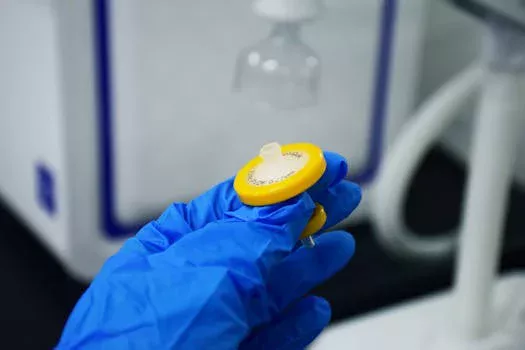
Beyond achieving zero liquid discharge, advanced display panel wastewater treatment systems can incorporate technologies for the recovery of valuable elements like boron and various heavy metals, transforming waste streams into revenue-generating resources and further enhancing sustainability. Research, such as that published in PMC6714614, demonstrates the feasibility of using waste-derived mesoporous aluminosilicate (MAS) materials for boron recovery, achieving efficiencies of up to 84.5% and a crystallization ratio of 93.4%. The MAS material, with a high Langmuir adsorption capacity of 105 mg/g for Ba²⁺, facilitates boron crystallization through the formation of barium peroxoborate.
For heavy metals such as copper, nickel, and chromium, electrowinning or ion exchange systems offer recovery rates of 95–99%. These systems can provide a significant return on investment, with payback periods typically ranging from 2 to 3 years for high-volume manufacturing facilities. The integration of these recovery processes with water reuse systems means that recovered boron and metals can potentially be reintroduced into the display panel manufacturing process or sold as valuable byproducts, directly offsetting the operational costs associated with wastewater treatment. Chemical oxo-precipitation (COP) is another effective method for boron recovery; its compatibility with hybrid ZLD systems, particularly in conjunction with automated chemical dosing systems, ensures efficient and controlled precipitation, leading to high recovery rates.
PLC-controlled chemical dosing systems are crucial for precise pH adjustment and the controlled addition of reagents like barium chloride or hydrogen peroxide, which are essential for effective boron and metal precipitation and subsequent recovery.
System Comparison: Hybrid ZLD vs. Standalone MBR vs. DAF + RO
Selecting the optimal wastewater treatment system for display panel manufacturing requires a thorough evaluation of different configurations based on capital expenditure (CAPEX), operational expenditure (OPEX), physical footprint, and effluent quality, particularly concerning reuse applications. A comprehensive comparison reveals the distinct advantages of hybrid ZLD systems over standalone or simpler configurations.
A hybrid ZLD system, comprising DAF, MBR, and RO, typically incurs a CAPEX of approximately $2.8 million for a 100 m³/h plant and an OPEX of $1.20/m³. This configuration achieves superior contaminant removal, ensuring TMAH and heavy metals are reduced to <0.1 mg/L, enabling up to 85% water reuse for high-purity applications. In contrast, a standalone MBR system, while more cost-effective with a CAPEX of around $1.5 million and OPEX of $0.80/m³, primarily focuses on COD removal (95%) and offers moderate water reuse potential (60%), making its effluent suitable for applications like cooling tower makeup. A DAF + RO system presents an intermediate option, with a CAPEX of $2.0 million and OPEX of $1.00/m³. It excels in TSS removal and provides about 70% water reuse, suitable for non-critical rinse water. The integrated nature of the MBR in the hybrid ZLD system contributes to a significantly reduced physical footprint, often requiring up to 30% less space compared to conventional treatment trains, a critical factor in space-constrained manufacturing facilities.
| System Configuration | Approx. CAPEX (100 m³/h) | Approx. OPEX ($/m³) | Footprint | TMAH Removal | Heavy Metal Removal | Water Reuse Potential |
|---|---|---|---|---|---|---|
| Hybrid ZLD (DAF + MBR + RO) | $2.8M | $1.20 | Smallest | >99.9% (<0.1 mg/L) | >99.9% (<0.05 mg/L) | Up to 85% (Ultrapure Water) |
| Standalone MBR | $1.5M | $0.80 | Medium | Moderate | Moderate | Up to 60% (Cooling Tower Makeup) |
| DAF + RO | $2.0M | $1.00 | Medium-Large | >99% (<0.5 mg/L) | >99% (<0.1 mg/L) | Up to 70% (Non-critical Rinse Water) |
Water Reuse Applications: From Cooling Towers to CMP Rinse Water
The quality of treated wastewater dictates its suitability for various industrial reuse applications within display panel manufacturing, directly impacting cost savings and operational efficiency. Understanding these applications allows manufacturers to optimize their water management strategies.
Effluent from an MBR stage, typically with COD below 50 mg/L and TSS below 5 mg/L, is suitable for use as cooling tower makeup water. This quality level meets ASHRAE guidelines for recirculating water systems, capable of reducing freshwater intake for cooling by up to 50%. For the most demanding applications, such as CMP rinse water, which requires ultrapure water (UPW) standards, the permeate from an RO system is essential. This RO permeate, meeting SEMI S23-0718 standards with TMAH <0.5 mg/L and heavy metals <0.1 mg/L, ensures process integrity and product quality. Even the effluent from a DAF stage, with TSS typically below 30 mg/L, can be reused for non-critical facility applications like floor washing or landscape irrigation, requiring minimal additional treatment. A real-world case study at a TFT-LCD plant in Taiwan involving a 100 m³/h hybrid ZLD system demonstrated a remarkable 90% water reuse rate. This resulted in annual savings of approximately $1.2 million in water procurement costs and an 80% reduction in wastewater discharge fees.
Pretreatment requirements vary significantly by application. For instance, CMP rinse water reuse may necessitate UV disinfection using systems like a chlorine dioxide generator to eliminate microbial contamination. Cooling tower makeup water might require pH adjustment to prevent scaling and corrosion. These tailored approaches maximize the value derived from treated wastewater.
Regulatory Compliance: SEMI S23-0718, EU IED, and Global Standards
Adherence to stringent regulatory standards is paramount for display panel manufacturers implementing water reuse systems. Hybrid ZLD systems are engineered to meet and often exceed these requirements, ensuring both environmental responsibility and operational legality.
The SEMI S23-0718 standard, critical for semiconductor and display manufacturing, mandates strict limits for key contaminants: TMAH <0.5 mg/L and heavy metals (Cu, Ni, Cr) <0.1 mg/L. Advanced hybrid ZLD systems consistently achieve effluent concentrations well below these thresholds, typically reaching <0.1 mg/L for TMAH and <0.05 mg/L for metals. the EU Industrial Emissions Directive (IED) 2010/75/EU mandates the application of Best Available Techniques (BAT) for wastewater treatment, emphasizing water reuse and ZLD where technically and economically feasible. In China, standards such as GB 31570-2015 set discharge limits for electronic industry wastewater, including COD <80 mg/L and NH₃-N <15 mg/L, which are readily met by these advanced systems. Global frameworks like ISO 30500 for non-sewered sanitation systems and the EPA's Guidelines for Water Reuse (2024) provide comprehensive guidance on treated wastewater quality and safe reuse practices. Third-party certifications, such as NSF/ANSI 61 for drinking water system components, can further validate the safety and compliance of treated water for specific reuse applications, bolstering confidence in system performance and regulatory adherence.
Frequently Asked Questions
What are the primary contaminants in display panel wastewater?
The primary contaminants include high concentrations of TMAH (50–500 mg/L), heavy metals (Cu, Ni, Cr: 10–100 mg/L), and significant organic loads (COD/BOD: 500–5,000 mg/L), stemming from etching, cleaning, and CMP processes.
How does a hybrid ZLD system achieve 99.9% contaminant removal?
A hybrid ZLD system employs a multi-stage process: DAF removes suspended solids, MBR treats dissolved organics, and RO eliminates residual TMAH, heavy metals, and salts, with each stage contributing to the overall high removal efficiency.
What is the typical CAPEX and OPEX for a 100 m³/h hybrid ZLD system for display panel wastewater?
For a 100 m³/h system, the estimated CAPEX starts at $2.8 million, with an OPEX of approximately $1.20 per cubic meter of treated water.
Can treated display panel wastewater be reused for CMP rinsing?
Yes, RO permeate from a hybrid ZLD system, meeting SEMI S23-0718 standards (<0.5 mg/L TMAH, <0.1 mg/L metals), is suitable for CMP rinse water applications, providing ultrapure water reuse.
What are the benefits of recovering boron and metals from display panel wastewater?
Recovery turns wastewater into a resource, potentially generating revenue from byproducts, offsetting treatment costs, and contributing to a circular economy. Recovered materials can sometimes be reintroduced into manufacturing processes.
How does MBR technology contribute to system footprint reduction?
MBRs achieve higher biomass concentrations (8,000–12,000 mg/L MLSS) and integrate clarification with biological treatment, reducing the physical space required by up to 60% compared to conventional systems.
What regulatory standards must display panel wastewater treatment systems comply with?
Key standards include SEMI S23-0718 for TMAH and heavy metals, the EU Industrial Emissions Directive (IED), and national regulations like China's GB 31570-2015, alongside international guidelines for water reuse.
Related Equipment
- DAF system for TSS and FOG removal in display panel wastewater — view specifications, capacity range, and technical data
- Integrated MBR system for COD/BOD removal and water reuse — view specifications, capacity range, and technical data
- High-rejection RO membranes for TMAH and heavy metal removal — view specifications, capacity range, and technical data
Need a customized solution? Request a free quote with your specific flow rate and pollutant parameters.