Why LED Wastewater Recycling Is a Manufacturing Imperative
LED recycling recovers 90–95% of process water with MBR plus RO, or 99%+ with ZLD, while meeting metal discharge limits that biological plants cannot hit. LED wastewater carries lead, arsenic, copper, TMAH, and HF; untreated discharge triggers fines and production halts. CapEx for 50–500 m³/day ZLD typically runs $1.2–5 million at $0.75–1.50/m³ OPEX.
LED manufacturing wastewater carries lead, arsenic, copper, organic solvents such as TMAH, and hydrofluoric acid at concentrations that conventional biological plants cannot handle. Global LED output is projected to reach $120 billion by 2027 (Statista 2024), which scales the wastewater load with production. China GB 31573-2015 sets total lead at 0.5 mg/L at the workshop wastewater outlet; earlier draft figures of roughly 0.1 mg/L understate that published limit. U.S. metal-finishing categorical limits under 40 CFR 433 set lead at 0.69 mg/L daily maximum and 0.43 mg/L monthly average. Clean Water Act civil judicial penalties under 33 U.S.C.Chinese authorities can halt production immediately for non-compliance. A 2024 retrofit in Shenzhen reached 99.5% water recovery and 75% freshwater reduction on a ZLD system, avoiding an estimated $2.1 million in fines.
LED Wastewater Composition: Contaminants, Concentrations, and Treatment Challenges
LED effluent mixes inorganic and organic pollutants across a wide pH range. Heavy metals dominate the toxic load, while TMAH and HF drive COD and corrosion risk. pH often swings between 2 and 12, and lime dosing at 5–10% Ca(OH)₂ slurry can bring it into the 6–9 range with about 95% adjustment efficiency. Trace gallium and indium at 0.1–1 mg/L are technically recoverable, but most plants we size for run at the lower end of that range and write those metals off.
| Contaminant | Typical Concentration (mg/L or %) | Treatment Challenge | Primary Removal Technologies |
|---|---|---|---|
| Lead (Pb) | 5–50 mg/L | High toxicity, regulated discharge limits | Chemical Precipitation, Ion Exchange, Membrane Filtration |
| Arsenic (As) | 1–10 mg/L | High toxicity, regulated discharge limits | Chemical Precipitation, Adsorption, Membrane Filtration |
| Copper (Cu) | 20–200 mg/L | High toxicity, regulated discharge limits | Chemical Precipitation, Ion Exchange, Membrane Filtration |
| TMAH (Tetramethylammonium Hydroxide) | 1–5% | High COD, potential for foaming in biological systems | Biological Treatment (MBR), Advanced Oxidation Processes (AOPs) |
| Hydrofluoric Acid (HF) | 0.5–2% | Extreme corrosivity, high toxicity | Neutralization, Calcium Precipitation, Membrane Filtration |
| Suspended Solids (TSS) | 100–500 mg/L | Clogging of downstream equipment, impact on water clarity | Screening, Sedimentation, Filtration, MBR |
| Trace Precious Metals (Ga, In) | 0.1–1 mg/L | Low concentration, high recovery cost | Specialized Ion Exchange, Electrowinning (economically viable only at scale) |
Compared to PCB or solar-cell effluent, LED wastewater typically carries a more concentrated and chemically aggressive mix. A well-tuned chemical dosing for heavy metal precipitation in LED wastewater package keeps precipitation pH on target despite upstream swings.
How is hydrofluoric acid wastewater treated?
Hydrofluoric acid wastewater is neutralized and precipitated with calcium to form CaF₂ solids before membrane stages. HF at 0.5–2% is too corrosive for unprotected metals and will attack RO membranes if it bypasses pretreatment. Two-stage calcium dosing plus clarification is the field default for fluoride control ahead of MBR or RO.
Engineering Solutions for LED Wastewater Recycling: Process Flows and Recovery Technologies
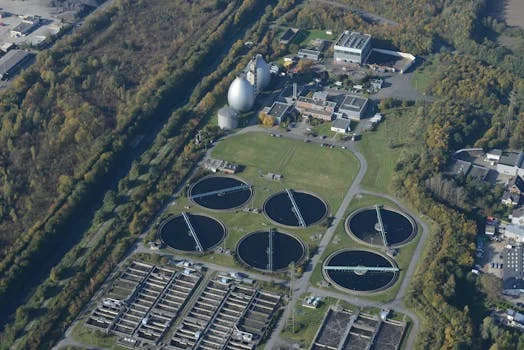
A multi-barrier train is the standard answer for LED recycling: pretreatment, heavy-metal removal, biological polishing, and membrane recovery. Each stage has a defined job, and skipping one usually shows up as fouling or permit excursions downstream.
Step 1: Pretreatment (Screening + pH Adjustment). Rotary drum screens cut 0.5–2 mm particles and remove about 90% of TSS before the stream hits the equalization tank. pH is then driven to 6–9 via a lime dosing for heavy metal removal circuit, which also conditions the water for precipitation and protects downstream membranes from acid attack.
Step 2: Heavy Metal Removal. Chemical precipitation with lime or sulfide lifts lead and copper removal above 95% at pH 9–11, which is the band where metal-finishing permit limits are met most reliably. Ion exchange can be added as a polishing step for the residual dissolved metals that precipitation leaves behind.
Step 3: Biological Treatment (MBR). MBR systems handle COD from TMAH and residual organics, removing 98% of COD from 50–500 mg/L influent streams. An MBR integrated wastewater treatment skid also drops TSS low enough to feed RO without pre-filtration headaches.
Step 4: Advanced Filtration (RO, NF). RO recovers 90–95% of incoming flow as permeate with TDS below 50 mg/L, suitable for rinsing, equipment cleaning, or cooling-tower makeup. NF is layered in front of RO when the feed carries divalent hardness or specific organic markers that would foul RO membranes prematurely.
Step 5: Sludge Dewatering. Precipitation and clarification produce a metal-laden sludge that has to be dried before disposal. Filter presses for LED wastewater sludge dewatering cut sludge volume 70–90% at 2–10 bar with 30–60 minute cycles, producing a cake that meets secure-landfill criteria or can feed a metal-recovery sidestream. A rotary drum screen handles the head of the train, an MBR integrated wastewater treatment system runs the biological stage, and an industrial reverse osmosis (RO) water treatment system closes the recovery loop.
Zero Liquid Discharge (ZLD) for LED Wastewater: Costs, Recovery Rates, and Compliance
ZLD targets 99%+ water recovery by crystallizing the final brine into solid salts, which removes liquid discharge from the equation entirely. Freshwater intake drops 80–90%, which is decisive in water-stressed districts. CapEx runs $1.2–5 million for 50–500 m³/day plants, with OPEX of $0.75–1.50 per cubic meter at 2025 benchmarks. A 2024 TFT-LCD retrofit in Taiwan cut ZLD cost roughly 30% by pairing solar-powered evaporation with advanced crystallizers.
| System Type | Typical Water Recovery Rate | Discharge Status | Estimated CapEx (per 100 m³/day) | Estimated OPEX (per m³) | Primary Benefit |
|---|---|---|---|---|---|
| RO (Partial Recovery) | 90–95% | Liquid discharge (treated effluent) | $300,000 - $800,000 | $0.30 - $0.70 | Significant freshwater reduction, reduced discharge volume |
| ZLD (Full Recovery) | 99%+ | No liquid discharge (solid salts only) | $1,000,000 - $3,000,000 | $0.75 - $1.50 | Zero discharge compliance, maximum water reuse, elimination of discharge risk |
RO alone is the right answer where discharge permits are achievable and water stress is moderate. ZLD earns its premium where fines, production halts, or freshwater scarcity make any residual discharge a business risk. Comparable ZLD economics for adjacent fabs are detailed in the TFT-LCD wastewater recycling systems blueprint.
What limits ZLD reclaim recovery scaling?
Scaling limits on ZLD reclaim recovery usually come from hardness, fluoride, and silica in the RO brine, not from the crystallizer nameplate alone. Plants that push past 95% without NF or brine softening see rapid RO flux decline and evaporator fouling. Match antiscalant dose and pretreatment to the actual brine chemistry before raising the recovery target.
How to Select the Right LED Wastewater Recycling System: A Decision Framework
Selection works best as a five-step filter: characterize the stream, set the recovery target, compare technologies, decide modular versus custom, then run the ROI.
Step 1: Define Wastewater Profile. Measure flow (m³/day or GPD), key contaminants, pH range, and TSS variability. Match the stream against the composition table above before sizing anything.
Step 2: Determine Recovery Goals and Compliance Requirements. Decide whether partial reuse meets the permit or whether ZLD is mandatory, and list every local limit for Pb, Cu, TSS, and COD that the system has to hit on a daily basis.
Step 3: Compare Technologies. Use the table below to weigh removal efficiency, footprint, and OPEX for each unit operation.
| Technology | Primary Function | Typical Removal Efficiency | Footprint | Approx. OPEX per m³ | Suitability for LED Wastewater |
|---|---|---|---|---|---|
| Chemical Precipitation | Heavy Metal Removal | 95%+ (Pb, Cu) | Moderate | $0.10 - $0.30 | Essential for initial heavy metal reduction |
| MBR (Membrane Bioreactor) | Organic Removal (COD, BOD), TSS Removal | 98%+ (COD) | Compact | $0.20 - $0.50 | Effective for organic solvents, produces high-quality effluent |
| RO (Reverse Osmosis) | Water Recovery, TDS Reduction | 90–95% (Water Recovery), < 50 mg/L TDS (Permeate) | Moderate | $0.30 - $0.70 | High-purity water for reuse, polishes effluent |
| ZLD (Zero Liquid Discharge) | Full Water Recovery, Solidification of Brine | 99%+ (Water Recovery) | Large | $0.75 - $1.50 | Ultimate compliance and water security, highest cost |
Step 4: Evaluate Modular vs. Custom Systems. Modular skids trim CapEx 20–30% and compress delivery timelines, which is useful for pilot runs and rapid expansions. Custom builds win when the waste mix is unusual or the site is footprint-constrained.
Step 5: Calculate Return on Investment (ROI). Combine CapEx, OPEX, avoided freshwater purchases, and avoided fines. A 100 m³/day ZLD at $0.85/m³ OPEX and $2.05/m³ freshwater cost returns roughly $120,000 per year in water savings alone, before counting penalty avoidance. Modular packaging considerations are covered in the modular sewage treatment systems guide.
Selection Checklist for LED Wastewater Plants
- Influent flow (m³/day) and diurnal peaking factor documented
- Heavy metal and TMAH speciation confirmed by recent lab analysis
- pH range and acid/alkali consumption estimated for reagent budgeting
- Target recovery rate set (90–95% RO versus 99%+ ZLD)
- Discharge limits and permit renewal timeline verified with local authority
- Sludge handling route and disposal cost identified
- ROI model includes freshwater cost, OPEX, and avoided penalties
Who This Is For / Who Should Look Elsewhere
This blueprint fits fabs and display-panel plants producing 50–500 m³/day of metal-bearing wastewater under tightening discharge rules. Small job shops below 20 m³/day with non-hazardous rinses usually do fine with a packaged chemical-precipitation unit; the ZLD economics do not pencil out for them.
For a project review, send your influent data and target recovery to request a tailored LED wastewater recycling quotation.
Frequently Asked Questions
What are the primary heavy metals found in LED manufacturing wastewater?
The primary heavy metals are lead (Pb), arsenic (As), and copper (Cu), with typical concentrations of 5–50 mg/L for lead, 1–10 mg/L for arsenic, and 20–200 mg/L for copper. These levels exceed what municipal plants are designed to handle, so on-site precipitation plus polishing is the standard response.
What are the discharge limits for lead in LED wastewater?
China GB 31573-2015 sets total lead at 0.5 mg/L at the workshop wastewater outlet. U.S. metal-finishing limits under 40 CFR 433 set lead at 0.69 mg/L daily maximum and 0.43 mg/L monthly average; 40 CFR 401.15 lists lead as a toxic pollutant but does not set a numeric 0.1 mg/L effluent cap. The EU Industrial Emissions Directive (2010/75/EU) is often cited at 0.5 mg/L in sector practice. Plants shipping to multiple regions usually design to the strictest applicable local limit.
What water recovery rate can an MBR plus RO system deliver on LED wastewater?
Combined MBR and RO trains typically achieve 90–95% overall recovery, with RO producing the bulk as permeate under 50 mg/L TDS. Pushing past 95% usually requires adding NF pretreatment or a brine-concentration stage to control scaling on the RO membranes.
How does ZLD differ from standard wastewater treatment for LED plants?
ZLD targets 99%+ recovery and crystallizes the final brine into solid salts, eliminating liquid discharge entirely. Standard treatment aims only to meet effluent limits on a liquid stream, so it leaves a residual discharge and ongoing permit exposure that ZLD removes.
What are the main challenges in treating organic solvents like TMAH in LED wastewater?
TMAH drives high COD and can foam in biological reactors if loading is not controlled, which is why MBR is preferred over conventional activated sludge. For influent TMAH above about 3%, an advanced oxidation stage ahead of the MBR keeps the biological section within its design envelope.
How can trace precious metals be recovered from LED wastewater?
Recovery of gallium and indium at 0.1–1 mg/L is technically possible with specialized ion exchange or electrowinning, but economics only work at large flow rates with high metal prices. Most plants treat these as a sludge-side credit rather than a primary revenue line. For comparable recovery work on other microelectronics streams, see the microelectronics chromium wastewater treatment blueprint.