Confirm Whether the Existing Plant Can Still Serve Growth
Existing sewage plant upgrade is credible only when the operator can document that the site has usable assets, hydraulic and treatment capacity, and enough permit and land headroom for the projected service area. For sewage plant refurbishment for secondary cities, separate process deterioration from inadequate capacity: a biological reactor may need rehabilitation while pumping, solids handling, disinfection, controls, or reuse treatment requires a different intervention.
Start with a current asset-condition and performance audit. The municipal operator should provide verified average and peak flows, the design horizon, asset register, remaining useful life, compliance history, maintenance backlog, and available land. The treatment contractor should identify treatment bottlenecks, while the local authority should confirm discharge limits, reuse obligations, and permit conditions. The wastewater infrastructure due-diligence checklist is useful for assigning ownership to each missing record.
Growth makes staged capacity more important because wastewater volumes fluctuate as population and economic activity change. Goveyra’s article on metropolitan growth identifies variable wastewater volumes as a reason to use adaptable treatment processes and notes that limited land can make conventional centralized expansion impractical. For a secondary city, that supports staged procurement rather than selecting a route from current flow alone.
| Screening input | Evidence required | Owner | Decision implication |
|---|---|---|---|
| Flow | Verified average, peak and forecast flows | Municipal operator | Confirms hydraulic and treatment capacity |
| Assets | Condition, remaining life, bottlenecks and maintenance history | Operator and treatment contractor | Tests whether refurbishment has technical value |
| Compliance and reuse | Permit limits, monitoring history and reuse obligations | Local authority or permit holder | Defines required performance and residual treatment |
| Land and resilience | Usable footprint, access, flood exposure and expansion space | Municipality and site surveyor | Tests central, WSZ and decentralized MBR options |
Compare Refurbishment, WSZ and MBR Routes
Refurbishment is the leading route when existing assets retain useful life, the site can accommodate required works, and the upgraded process can remain within the attainable permit envelope. The selected route must provide the best delivered life-cycle outcome rather than the lowest initial quotation. Expensive process rehabilitation can be a false economy if it does not remove the hydraulic, solids-handling or reuse constraint driving the investment.
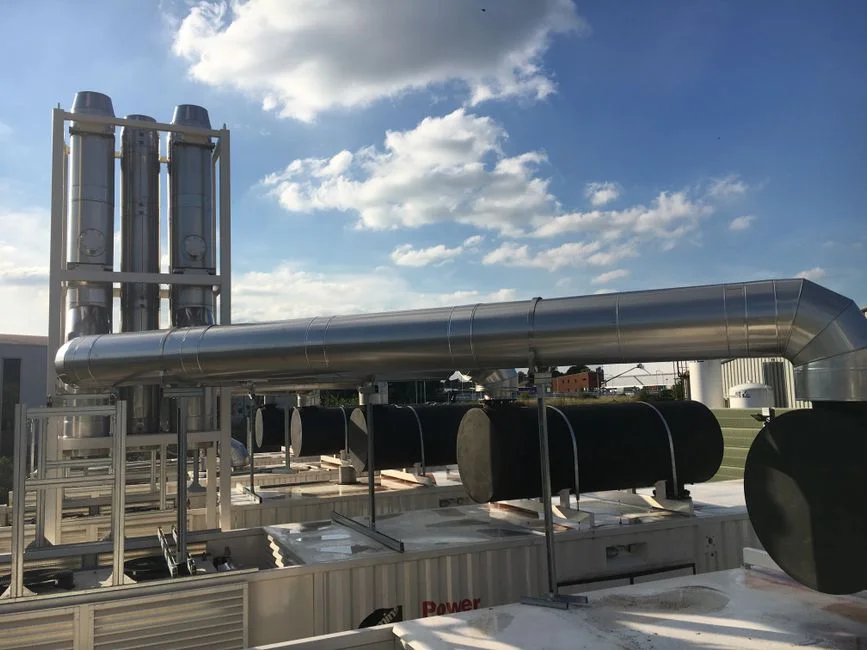
A WSZ underground package sewage treatment plant is relevant where the service area calls for decentralized treatment, a below-grade installation, or a trailer-mounted package arrangement. The HydropureWater product catalog states that the WSZ integrates anoxic/aerobic biological contact oxidation, sedimentation, and disinfection in one buried unit. Its catalog capacity is 1–80 m³/h, and it is fully automated and requires no operator.
An integrated MBR membrane bioreactor system is relevant where compact installation or higher-quality non-potable effluent is central to the project. The HydropureWater catalog states that the system operates at 10–2,000 m³/day, provides filtration below 1 μm, and uses 60% less footprint than conventional systems. These figures describe catalog capability; they do not establish guaranteed performance at an unidentified city site without a compliant design basis.
Neither equipment type should be presented as potable reuse by implication. Earthday.org’s August article describes Goreangab’s drinking-water reclamation as an intensive 10-step filtration and disinfection process. A device marketed for irrigation, cooling, or toilet flushing therefore does not by itself establish eligibility for direct or indirect potable reuse.
| Criterion | Refurbishment | WSZ | MBR |
|---|---|---|---|
| Strongest fit | Usable assets, available site capacity and recoverable permit headroom | Decentralized or land-constrained installation with a defined collection arrangement | Compact capacity or a defined higher-quality non-potable reuse need |
| Catalog capacity | Not established by supplied product data | 1–80 m³/h | 10–2,000 m³/day |
| Principal liabilities | Unknown condition, disruption and hidden civil-work cost | Collection, pumping, solids handling and site integration | Process controls, membrane maintenance, power and redundancy |
| Permit issue | Confirm compliance after rehabilitation | Confirm package discharge and site-specific reuse envelope | Confirm membrane-dependent performance and reuse destination |
Choosing between these technologies requires a direct assessment of site-specific infrastructure costs.
Test the Route Against Land, Reuse and Resilience Needs
Land availability, population density, and jurisdictional boundaries determine whether a central upgrade or distributed treatment architecture is feasible. Goveyra identifies these as central constraints and explains that decentralized MBR units can be installed in neighborhoods, commercial districts, or industrial areas. Record the usable footprint for each service area, access for construction and maintenance, ownership boundaries, and the area that must be served before comparing land-efficient equipment claims.
Define the reuse destination before selecting the process. Is the intended effluent for discharge, irrigation, industrial cooling, street cleaning, toilet flushing, or another non-potable use? Goveyra identifies irrigation, industrial cooling, and toilet flushing as suitable applications for high-quality MBR effluent. These uses are not interchangeable: each destination requires its own quality envelope, monitoring, distribution arrangement, and permit basis.
Evaluate resilience as part of the system architecture. Goveyra states that decentralized MBR operations can maintain treatment and reclaimed-water supply if one unit encounters a problem because other units remain operational. A single larger plant may offer operational simplicity, but it also concentrates the consequence of an outage. The appropriate response is to define acceptable service continuity and require the bidder to explain redundancy, isolation, bypass, and recovery arrangements.
Use the global reuse examples as boundary conditions, not local approval. Earthday.org describes Goreangab’s 10-step reclamation train, while NBC News, reporting in its article on wastewater recycling, explains that drinking-water reuse involves additional purification and must meet applicable drinking-water standards. A supplier should state the proposed reuse quality envelope, test regime, redundancy, and operating-control scope. “Reuse-ready” without a defined end use and acceptance criteria is incomplete.
Build the Procurement and Due-Diligence Pack
A municipal treatment procurement should compare routes through one fillable schedule, with unresolved inputs clearly assigned rather than silently priced as assumptions. Require bidders to enter the same design basis, cost structure, and evidence schedule for refurbishment, WSZ, and MBR alternatives.
- Complete the site-input matrix: design flow, peak factor, effluent quality, land, power, sludge handling, reuse destination, operator hours, installation constraints, and expected service life.
- Define acceptance evidence: guaranteed process duty, hydraulic testing, disinfection validation, controls demonstration, alarm response, spare parts, training, and commissioning records.
- Separate priced scope: civil work, equipment, power, sludge handling, commissioning, controls, training, and lifecycle support.
- Mark provisional allowances where site surveys, utility connections, or permit outcomes remain unresolved.
Frame the decision as a multi-year investment case because wastewater infrastructure needs extend across asset categories. Statista’s wastewater treatment plant cost breakdown notes that the U.S. wastewater sector has capital needs from 2022 through 2041, categorized by investment type; it does not provide a price for the unspecified secondary city. Obtain local quantities and current quotations instead of transferring another jurisdiction’s cost figures.
Data ownership should be explicit. The municipality provides flow and asset records; the local authority or permit holder confirms discharge and reuse requirements; bidders provide equipment guarantees, electrical demand, and site-work boundaries. Require a priced alternative for every shortlisted route so the authority can compare like-for-like outcomes without concealing unresolved assumptions.
| Procurement schedule field | Refurbishment entry | WSZ entry | MBR entry |
|---|---|---|---|
| Design flow and peak factor | Hydraulic audit and staged capacity | Package duty and collection response | Process duty and redundancy |
| Land and installation | Works footprint and shutdown plan | Burial, access and utilities | Plant layout and maintenance access |
| Effluent and reuse | Permit and reuse envelope | Package quality and reuse destination | Filtration claim and reuse envelope |
| Operating resources | Staff, power, sludge and controls | Automation, maintenance and solids route | Attendance, membrane maintenance and power |
| Commercial response | Priced works, duration and guarantee | Delivered price and package boundaries | Delivered price and guarantee boundaries |
Frequently Asked Questions
How should wastewater plant refurbishment cost be compared with new equipment?
Compare total delivered cost over the same planning period, with separate entries for civil works, equipment, power, sludge handling, commissioning, controls, training, and lifecycle support. No valid project price can be given until the municipality confirms flow, asset condition, land, utilities, effluent requirements, and site-work boundaries. Request a priced alternative for each shortlisted route and identify every provisional allowance.
Which treatment capacity should a secondary city select?
Select from verified design flow, peak demand, land, effluent quality, reuse requirements, and operating resources—not the largest catalog capacity. The HydropureWater catalog lists WSZ at 1–80 m³/h and MBR at 10–2,000 m³/day. These are catalog ranges; require the bidder to state the selected duty, reference conditions, peak response, and guarantee boundary.
How should a supplier be selected for a decentralized treatment package?
Require a site-specific performance guarantee, electrical demand, installation boundary, reference conditions, test protocol, operator requirements, redundancy, spare-parts scope, permit-support responsibilities, and commissioning evidence. A general “reuse-ready” statement should trigger a request for the proposed reuse quality envelope and applicable acceptance tests.
Does an MBR package qualify for drinking-water reuse?
Equipment type alone does not determine suitability for drinking-water reuse. Separate discharge compliance, non-potable reuse eligibility, and drinking-water reuse. Earthday.org describes Goreangab’s potable reuse as an intensive 10-step filtration and disinfection process, while NBC News reports that drinking-water recycling must meet drinking-water standards. The permit holder must confirm the local legal route; the supplied research does not establish limits for an unspecified secondary city.