Define the mountain-city wastewater investment objective
Mountain City’s wastewater investment must be defined by measurable growth and resilience outcomes before selecting a plant or contract model. The town was awarded $22.5 million for wastewater infrastructure improvements that support regional industrial growth and resilience following Helene in 2024, according to WCYB’s report on the award. That award does not establish a universal design basis for other mountain cities; the buyer still needs project-specific flow, loading, site and regulatory data.
Separate sanitary sewage, industrial wastewater and infiltration/inflow in the project brief. Each stream should have a measured baseline, seasonal range, forecast and responsible owner. Combining them into one average flow can conceal both wet-weather peak demand and concentrated industrial loads.
State which outcomes the project must deliver: permit compliance, industrial growth, reclaimed-water supply, storm resilience or a defined combination. Attach a measurable acceptance basis to each objective. Compliance needs applicable discharge limits and demonstration tests; growth needs verified hydraulic and treatment-loading checks; reuse needs a specified end use and water-quality acceptance test; resilience needs operating tests under the event conditions included in the contract.
The brief should also request site-specific geotechnical information, climate records, access constraints, power availability, drainage conditions and discharge details. The supplied research does not establish general mountain-city conditions, so the city must obtain these inputs rather than assume them.
Choose sewer discharge or onsite treatment
Public-sewer discharge should remain the comparison baseline because it can avoid duplicating treatment infrastructure when a receiving utility has adequate capacity and a suitable connection is available. Onsite treatment becomes the stronger route when no reliable discharge point exists, a discharge restriction is credible, industrial pretreatment remains necessary, or local reuse justifies owning the treatment assets.
Confirm the governing institution before fixing the route: the relevant authority may be a publicly owned treatment works, municipal utility or environmental regulator. The supplied research does not identify the governing route for any particular mountain city. For industrial contributors, obtain written discharge criteria, sampling requirements, prohibited substances and monitoring obligations before selecting the treatment train.
Document the choice as an interface decision rather than an equipment preference. Record the receiving point, available capacity, required pretreatment, utility responsibilities, redundancy provisions, land requirements and the consequence of a discharge restriction. Further application guidance is available in the public sewer versus package plant decision and the industrial effluent treatment plant selection.
| Decision input | Public-sewer route | Onsite treatment route |
|---|---|---|
| Discharge interface | Connection and discharge authorization must be confirmed with the receiving utility. | The buyer must establish the treatment, reuse or disposal route and its regulatory status. |
| Industrial wastewater | Obtain the receiving system’s pretreatment and monitoring criteria. | Define industrial wastewater pretreatment, equalization and final treatment responsibilities. |
| Capacity and redundancy | Verify available receiving capacity and the consequence of restrictions. | Size and provide treatment redundancy within the project design basis. |
| Future expansion | Confirm the utility’s ability to accept future flow and loading. | Reserve space, connections and treatment modules for expansion. |
| Land and utilities | Usually limits the city’s permanent land commitment but creates a continuing utility dependency. | Requires treatment-site land, power, drainage and operating access. |
Compare A/O package treatment and MBR
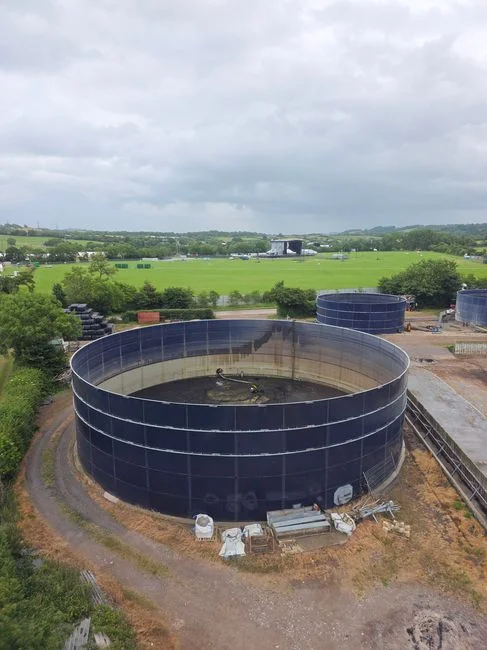
The A/O package and MBR routes should be compared against the same flow, loading, footprint, reuse and operating conditions; neither should win from average flow alone. The underground A/O package wastewater plant combines A/O biological contact oxidation, sedimentation and disinfection in a buried unit. Its published capacity is 1–80 m³/h, and its stated application range includes smaller community, hospitality, industrial and rural projects.
The integrated MBR wastewater treatment system combines activated sludge with submerged PVDF membrane filtration. Its published filtration performance is below 1 micrometre, its footprint is stated to be 60% smaller than conventional systems, and its stated capacity range is 10–2,000 m³/day.
Eagle Mountain provides a useful loading-led case rather than a generic equipment comparison. The city reported in October 2026 that its existing 2.4 MGD plant was limited by loading and had reached its loading limit at about 1.5 MGD. Its expansion upgrades the existing plant and adds a 6 MGD membrane bioreactor facility, with reclaimed water intended for irrigation and other non-potable uses.
| Selection factor | A/O underground package | MBR | Procurement test |
|---|---|---|---|
| Published capacity | 1–80 m³/h | 10–2,000 m³/day | Check the proposed design against measured and forecast conditions. |
| Treatment configuration | A/O biological contact oxidation, sedimentation and disinfection in a buried unit. | Activated sludge with submerged PVDF membrane filtration. | Require performance evidence at the agreed design load. |
| Physical footprint | Buried deployment is the defining configuration. | Published footprint is 60% smaller than conventional systems. | Confirm the site envelope, access routes and future expansion area. |
| Separation performance | Use the project’s specified solids and disinfection criteria. | Published filtration performance is below 1 micrometre. | Evaluate against applicable discharge or reuse requirements. |
| Preferred fit | Buried deployment, simpler configuration and verified package flow range suit the project. | Tighter solids separation, loading flexibility or reuse quality justifies added process complexity. | Record the decision and the evidence supporting it. |
Select A/O package treatment when buried installation and its verified flow range fit the project; select MBR when separation, loading or reuse requirements justify the additional process complexity. The design basis must still test peak hydraulics, organic and nutrient loading, industrial variability, temperature and discharge requirements. The A/O package plant versus MBR comparison provides a useful starting structure, but project measurements—not the route’s average flow alone—must control selection.
Build the design basis and procurement scope
A contractor-ready scope converts the selected route into a register of verified inputs, allocated risks, deliverables and tests. The Asian Development Bank’s User Guide for Design–Build–Operate Contracts for Water and Wastewater Greenfield Infrastructure Projects supports procurement through single-stage two-envelope or two-stage bidding and provides a methodical approach to evaluating and selecting a DBO contractor. The guide also references the FIDIC Conditions of Contract for Design, Build, and Operate Projects, 2008, providing a recognized starting point for risk allocation.
The design-basis register should cover flow and loading data, industrial discharge characteristics, geotechnical and climate information, access, power, drainage, treatment objectives, sludge handling, reuse requirements and permit conditions. Identify the source, date and owner of each input. Where information is missing, state who must obtain it and what design decision depends on it.
Allocate design responsibility clearly. Specify who supplies inaccurate data, who corrects affected designs, who obtains approvals and who carries operating performance risk. Require the bidder to identify assumptions, exclusions, interface limits and design margins.
| Scope package | Required bidder deliverable | Buyer review point |
|---|---|---|
| Design | Design basis, calculations, drawings, process guarantees, permits register and risk register. | Verify hydraulic and treatment-loading checks against the agreed inputs. |
| Construction | Work plan, site logistics, temporary works, testing plan, quality records and interface schedule. | Review access, drainage, power, weather constraints and constructability before award. |
| Commissioning | Protocols, witnessed tests, calibration records, operator training, as-built documents and contingency procedures. | Define witness points and reject incomplete evidence before handover. |
| Operation | Staffing, maintenance, laboratory or sampling support, spares, remote monitoring and reporting. | Confirm competence, availability commitments, spares strategy and regulatory interface. |
| Performance | Guarantees for effluent quality, capacity, availability, energy use, sludge handling and reuse output. | Make each guarantee measurable against the design basis. |
Hold a pre-tender review before finalizing bids. Test site access, constructability, winter or extreme-weather operating risks, operator competence, spare-parts strategy, regulatory interfaces and the effect of future industrial loading. The A/O package plant versus MBR comparison can inform the technology assumptions, but the issued scope must remain neutral enough for DBO contractor selection.
Set acceptance criteria before awarding the DBO contract
Acceptance criteria should connect each contractual promise to the agreed design basis and a documented verification event. A design guarantee is insufficient if it states capacity without separating hydraulic capacity from treatment-loading capacity: a plant can pass a flow test while lacking treatment capacity for concentrated wastewater.
Define commissioning evidence before award, including test methods, sampling points, durations, witnessing roles, calibration requirements and treatment of failed tests. Handover documentation should include as-built drawings, operating procedures, operator training records, approved manuals, critical spares and remote-monitoring arrangements. Defect-correction duties and response periods should continue beyond initial handover.
Where reclaimed water supports the business case, identify the intended non-potable use and its acceptance tests in the contract. Eagle Mountain’s October 2026 expansion announcement identifies irrigation and other non-potable uses, but each buyer must define the applicable quality and operational requirements for its own reuse application.
| Stage | Acceptance evidence | Decision consequence |
|---|---|---|
| Design approval | Approved calculations, drawings, guarantees and permit-compliance matrix tied to the design basis. | Reject design assumptions unsupported by the issued inputs. |
| Construction completion | Inspection records, test results, as-built drawings, training and operating documentation. | Do not accept handover with unresolved material defects or missing records. |
| Performance commissioning | Witnessed hydraulic and loading tests, effluent results, availability, energy and sludge-handling evidence. | Require correction and repeat testing for failed criteria. |
| Reuse acceptance | Quality and delivery tests matched to the specified non-potable use. | Do not place reuse supply in service without applicable acceptance evidence. |
| Post-startup review | Operating data compared with growth forecasts, discharge requirements and industrial loading. | Trigger corrective action or agreed expansion planning if performance diverges. |
Frequently Asked Questions
What inputs are needed to estimate the cost of a DBO wastewater plant?
Request a capital-and-operating cost breakdown tied to the agreed design basis. The estimate should identify civil works, treatment equipment, power and drainage connections, sludge handling, reuse equipment, commissioning, operator staffing, maintenance, spares, monitoring and disposal requirements. No universal price is supportable from the supplied research; the buyer must provide the flow, loading, site, treatment and reuse inputs needed for a project-specific quotation.
How should a buyer size an A/O package plant or MBR system?
Provide measured flow and loading records, peak conditions, industrial variability, temperature, discharge limits and reuse requirements. Then request separate hydraulic and treatment-loading checks against the proposed package capacity. Do not accept sizing based only on average daily flow or the published capacity range.
What should be checked when selecting a DBO contractor?
Check relevant experience with the selected treatment route, proposed team, site-access and constructability plan, commissioning evidence, operator competence, spare-parts support and allocation of design and performance risks. The Asian Development Bank guide supports a methodical evaluation of DBO contractors using single-stage two-envelope or two-stage bidding.
Which compliance risks should be addressed before contract award?
Obtain the applicable permit and discharge requirements, industrial pretreatment rules, sampling obligations and reuse approvals. Name the party responsible for each approval, monitoring task and corrective action, and make permit-compliance evidence part of commissioning and continuing performance reporting.