Separate the Wastewater Streams Before Choosing Equipment
An Essen data center needs two wastewater streams designed separately: a cooling-tower blowdown train and a sanitary-sewage train. Blowdown should be characterized for conductivity, pH, temperature, hardness, chloride, sulfate, silica and treatment chemicals before selecting cooling optimization, UF pretreatment, RO, controlled precipitation or discharge. The cooling water balance must start with at least one year of hourly or monthly make-up data. Domestic sewage should be sized independently using measured fixture demand and either a packaged MBR or a controlled sewer connection. Final equipment capacity, reuse targets and discharge limits must be confirmed with Essen’s competent authority and current site data.
Blending the streams by default would mix a concentrated, chemically conditioned cooling water with sanitary wastewater. It would enlarge the biological treatment duty, increase the dissolved-salt load and remove the buyer’s ability to compare reuse with controlled discharge as separate commercial options.
The cooling configuration must also be identified. The U.S. Department of Energy’s Cooling towers: a bibliography covers natural-draft and mechanical-draft systems using wet, dry or combined wet-dry cooling, but its references were compiled during January–December 1980; it is a system-identification aid, not a source of current Essen requirements (U.S. Department of Energy, 1980).
Confirm the receiving route with Essen’s competent sewer or wastewater authority. Neither that bibliography nor the supplied commercial recovery sources establishes an Essen discharge permit, reuse condition or numerical limit.
| Design stream | Primary inputs | Initial route decision | Authority confirmation required |
|---|---|---|---|
| Cooling-tower blowdown | Make-up records, loop chemistry, blowdown analysis, cooling configuration, treatment chemicals | Cooling optimization, reuse pretreatment, RO with an agreed concentrate route, or discharge | Discharge route, reuse conditions, monitoring and residual handling |
| Sanitary sewage | Occupancy, fixture flow, peak factors, wastewater characteristics | Controlled sewer connection or independently sized MBR | Connection acceptance, discharge conditions, sludge or residual handling |
Build the Essen Water Balance from Real Operating Data
The design flow should come from reconciled site operating records, not from the facility’s cooling-water flow. The regional reference recommends starting with at least one year of hourly or monthly make-up data and comparing it with cooling-system evaporation and blowdown estimates (HydropureWater, 2026 Frankfurt guide).
For a simplified evaporative cooling balance, the regional reference defines blowdown as make-up water divided by cycles of concentration minus one. Its reference calculations give blowdown at 25% of make-up at 4 CoC and 20% at 6 CoC (HydropureWater, 2026 Frankfurt guide). These are sensitivity cases, not Essen design values: changing CoC can have less effect than assumptions about occupancy, cooling load, makeup management or operating variability.
The same regional reference combines approximately 1.3 L/kWh WUE, 4 CoC and a 30 MW case to estimate 8,000–10,000 m³/month of blowdown (HydropureWater, 2026 Frankfurt guide). An Essen estimate must be recalculated from local make-up and load data.
- Extract make-up, evaporation and blowdown records for at least one year.
- Reconcile the balance and document operating ranges, missing data and assumptions.
- Sample source water, cooling-loop water and blowdown separately.
- Record temperature, treatment chemicals, cooling configuration, existing WUE and operating CoC.
- Evaluate cooling optimization before finalizing treatment-plant capacity.
Cooling optimization and treatment should be assessed together because improved CoC can reduce both blowdown and chemical consumption (HydropureWater, 2026 Frankfurt guide).
| Water-balance input | Required record or test | Use in design |
|---|---|---|
| Make-up water | At least one year of hourly or monthly records | Establish duration-based inflow and operating variability |
| Cooling operation | Evaporation, blowdown, cooling configuration, load and CoC | Reconcile measured and calculated flows |
| Water quality | Separate source-water, loop-water and blowdown analyses | Identify scaling, fouling and reuse constraints |
| Treatment inputs | Chemical products, dosing and temperature | Assess membrane compatibility and residual effects |
Select the Cooling-Blowdown Treatment Route
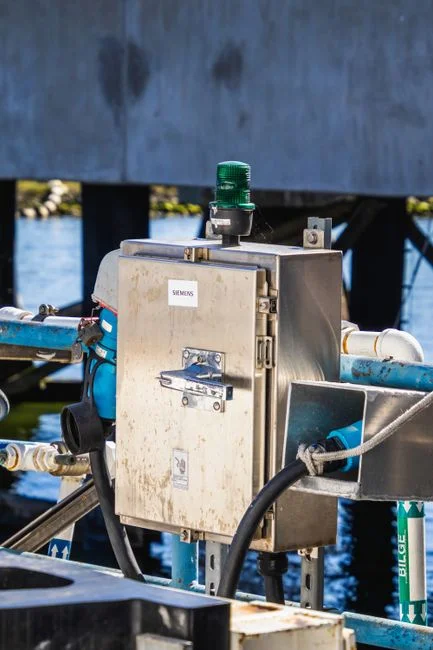
The first decision is the intended outcome: higher cycles of concentration, reduced freshwater withdrawal, a controlled discharge route or a combination. Until that objective and the receiving route are defined, comparing equipment on recovery alone is premature.
Cooling-tower blowdown is a brackish, scale-prone stream containing concentrated salts such as silica, calcium carbonate and calcium sulfate (IDE Technologies, 2026). Conventional brackish-water RO commonly reaches about 75–80% recovery before scaling becomes unmanageable; higher recovery requires additional controls and concentrate management (IDE Technologies, 2026).
An integrated RO and controlled salt-precipitation route can produce make-up-quality permeate while withdrawing scaling salts as a dense solid stream. IDE describes an industrial configuration operating at around 95% recovery, with permeate silica reduced to about 1 mg/L (IDE Technologies, 2026). That is a supplier-specific configuration, not established performance for an Essen installation.
For the reuse pretreatment objective, the regional reference lists silica at or below 1 mg/L and conductivity below 50 µS/cm for cooling-tower make-up; verify those values against the actual Essen loop specification (HydropureWater, 2026 Frankfurt guide). If the outlet will be discharged rather than reused, the responsible route must be agreed with the competent authority after source, loop and blowdown analyses (HydropureWater, 2026 Frankfurt guide).
Pilot-test actual or representative Essen blowdown because source chemistry and cooling chemicals determine membrane fouling, scaling and concentrate quality (HydropureWater, 2026 Frankfurt guide). The reverse-osmosis system and hollow-fiber UF pretreatment system should therefore be evaluated against the confirmed feed and permeate specifications.
| Route | Principal benefit | Principal risk or unresolved condition |
|---|---|---|
| Cooling optimization | Reduces source demand before treatment capacity is added | Cooling performance, WUE and chemical use must be verified together |
| UF followed by RO | Produces permeate suitable for evaluation as cooling make-up | Conventional RO recovery is constrained by scaling |
| RO with controlled precipitation | Can support higher overall recovery and separate salts as solids | More complex solids handling and process control |
| Controlled discharge | May be viable where reuse is not feasible | Requires an authority-approved receiving route and known site chemistry |
Design UF Pretreatment for Stable Membrane Operation
UF belongs upstream of RO when suspended solids, colloids, bacteria or organic particles threaten downstream membrane performance; it is pretreatment rather than the main dissolved-salt removal step (Saltworks Technologies, n.d.).
The supplied hollow-fiber UF pretreatment system uses 0.03 μm PVDF membranes, handles 2,000–40,000 L/h, accepts turbidity up to 300 ppm and provides automatic backwash and air scour (HydropureWater product catalogue, 2026). These are catalogue limits, not a selected Essen duty.
Specify UF from measured feed turbidity, SDI or an equivalent fouling indicator, flow variability and required recovery. The supplied research gives no Essen UF capacity or dosage, so neither should be inferred from the catalogue range. Ask suppliers to state how their feed assumptions compare with the Essen analysis and how the selected operating point affects backwash frequency and recovery.
Pilot testing should include actual blowdown, treatment chemicals and the selected cleaning strategy because these affect fouling and membrane life (HydropureWater, 2026 Frankfurt guide). Confirm materials compatibility, monitoring requirements and the effect of cleaning on net recovery. The RO design guide for high-TDS wastewater can support the broader pretreatment review, but it cannot replace site testing.
Verify permeate against the intended cooling make-up specification, not a generic reuse claim (HydropureWater, 2026 Frankfurt guide).
| Design parameter | Evidence available | Buyer action |
|---|---|---|
| Membrane pore size | 0.03 μm PVDF in the supplied catalogue | Confirm compatibility with actual particles and operating chemistry |
| Flow range | 2,000–40,000 L/h catalogue range | Select a duty from the reconciled Essen water balance |
| Feed turbidity | Up to 300 ppm catalogue acceptance | Compare with measured and pilot-test conditions |
| Fouling indicator and dosage | No Essen value supplied | Request pilot results and supplier assumptions |
| Permeate criterion | Silica at or below 1 mg/L and conductivity below 50 µS/cm in the regional reference | Confirm against the actual loop specification |
Size the Domestic-Sewage Train Independently
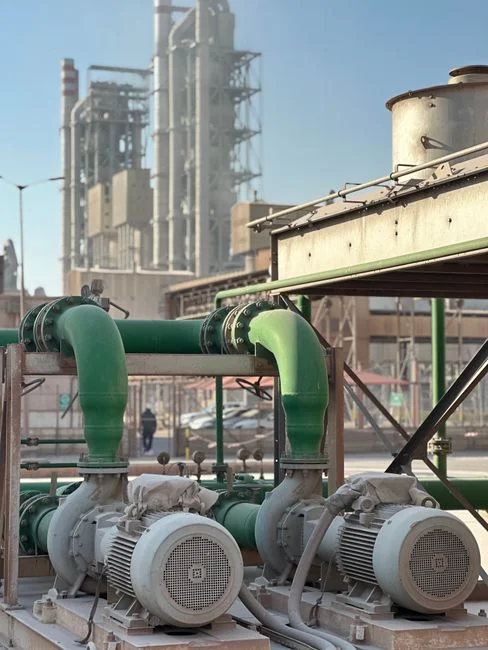
The sanitary train must be sized from occupancy, fixture flow, peak factors and wastewater characteristics, not from cooling-water flow (HydropureWater, 2026 Frankfurt guide). Keeping this train isolated also allows the cooling-blowdown route to change without redesigning biological treatment.
The regional reference architecture assigns domestic sewage to an isolated packaged MBR rather than blending it with cooling-tower blowdown (HydropureWater, 2026 Frankfurt guide). The supplied integrated MBR wastewater treatment system combines activated sludge with submerged PVDF membrane filtration below 1 μm and covers 10–2,000 m³/day (HydropureWater product catalogue, 2026). The catalogue range is not an Essen capacity recommendation.
Build the flow model first:
- Record building occupancy by use and operating period.
- Measure or obtain fixture flow and discharge characteristics.
- Apply site-relevant peak and variation factors.
- Check the selected route against the authority’s connection and discharge conditions.
Use a controlled sewer connection where permitted and hydraulically appropriate; otherwise evaluate the packaged MBR (HydropureWater, 2026 Frankfurt guide). Before ordering, confirm the discharge route, permit conditions, sludge or residual handling and commissioning tests with the competent authority.
| Sizing input or decision | What the buyer must establish |
|---|---|
| Occupancy and demand | Building uses, occupants and operating periods |
| Fixture flow | Measured or documented sanitary discharge data |
| Peaks | Site-specific peak and variation factors |
| Route | Authority-approved sewer connection or independently sized MBR |
| Residuals | Sludge, screenings and other handling requirements |
| Equipment capacity | Selected from the sanitary model, not the cooling-water balance |
Compare the Treatment Options by Recovery and Risk
Cooling optimization comes first because it can reduce both source demand and the treatment flow that must be handled; however, verify cooling performance, water use and chemical consumption rather than assuming the nominal CoC will persist (HydropureWater, 2026 Frankfurt guide). UF then provides solids, colloid and bacteria removal before RO, but it does not by itself remove the dissolved-salt load (Saltworks Technologies, n.d.).
Conventional RO delivers high-quality permeate, but scaling constrains recovery: IDE cites a typical 75–80% ceiling for conventional brackish-water RO (IDE Technologies, 2026). RO with controlled precipitation can manage silica and other sparingly soluble salts as solids and support higher overall recovery, but it introduces more complex solids handling (IDE Technologies, 2026).
Controlled discharge remains an option only after the competent authority has approved the receiving route and the site’s chemistry and flow are known (HydropureWater, 2026 Frankfurt guide). Its bid comparison must include treatment, transport and residual-handling assumptions rather than presenting a zero-recovery system as automatically cheaper.
The cited 2026 lifecycle preprint found treatment energy explained roughly 80% of the GWP difference between its wastewater and freshwater scenarios (Cartagena Vaca, Weir, Wyatt, Alrassan and Kang, 2026). Energy demand therefore belongs in every route’s comparison, alongside concentrate disposal and chemical consumption.
| Option | Scope | Main procurement question |
|---|---|---|
| Cooling optimization | Demand reduction before treatment | What verified reduction in make-up, blowdown and chemical use is achieved? |
| UF pretreatment | Suspended solids, colloids and bacteria removal | How is fouling, backwash and net recovery controlled with actual blowdown? |
| Conventional RO | Dissolved-salt separation and permeate production | Which scaling limit controls the guaranteed recovery? |
| RO with precipitation | Higher-recovery salt separation with a solid residual | What solids handling, chemical control and operating modes are required? |
| Controlled discharge | Authority-controlled receiving route | What route, permit conditions and residual costs apply? |
Convert the Design into a Procurement and Acceptance Package
Comparable bids require duration-based flows, complete source-water and blowdown analyses, cooling chemistry, cycles of concentration, WUE, discharge route, reuse criteria, utility requirements, residual handling and acceptance tests (HydropureWater, 2026 Frankfurt guide). A capacity stated without the corresponding feed chemistry is not a comparable offer.
Require every supplier to state:
- Design feed chemistry, flow profile and operating temperature.
- Recovery target and its calculation boundary.
- Pretreatment requirements, cleaning method and membrane compatibility.
- Concentrate or residual route.
- Redundancy, monitoring scope and utility demand.
- Commissioning and performance tests tied to confirmed reuse or discharge conditions.
Require pilot evidence using actual or representative Essen blowdown; a literature performance claim alone is insufficient (HydropureWater, 2026 Frankfurt guide). Make final acceptance conditional on the confirmed reuse specification and permitted discharge route (HydropureWater, 2026 Frankfurt guide).
Use the DOE bibliography to identify the cooling-system type and modern site data to select equipment. The bibliography covers natural-draft and mechanical-draft, wet, dry and combined cooling configurations, but its sources relate to January–December 1980 (U.S. Department of Energy, 1980). For salinity and concentrate considerations, the high-salinity RO engineering guide is a supporting reference, not a substitute for Essen pilot evidence.
| Procurement package | Minimum information required | Bid response required |
|---|---|---|
| Design basis | Measured flows, analyses, cooling configuration, CoC and WUE | Stated design assumptions and calculation method |
| Route and permits | Confirmed reuse or discharge pathway | Compliance narrative and monitoring scope |
| Performance | Pilot evidence and target permeate or discharge quality | Guaranteed recovery, quality and acceptance method |
| Operations | Cleaning, redundancy, utilities and residuals | Documented operating strategy and waste route |
Frequently Asked Questions
How much should an Essen data center budget for cooling-blowdown and sewage treatment?
No supplied source provides an Essen quotation, so a defensible budget cannot yet be calculated. Request duration-based flows, feed analyses, cooling configuration, reuse targets, discharge route, utility requirements, residual handling and pilot results from each bidder. Compare bids on capital cost, energy, chemicals, membrane replacement, routine cleaning, residuals and expected recovery over the same operating boundary.
Should cooling blowdown and domestic sewage be treated in one plant?
No. The regional reference architecture isolates cooling-tower blowdown from office, security-gate and shift-staff domestic sewage and assigns the sanitary stream to an isolated packaged MBR (HydropureWater, 2026 Frankfurt guide). Keep the streams hydraulically separate unless a site-specific design demonstrates that combining them provides a measurable benefit and satisfies the relevant authority.
What capacity is needed for an Essen data center MBR and UF system?
Size the MBR from occupancy, fixture flow, peak factors and wastewater characteristics, not cooling-water flow (HydropureWater, 2026 Frankfurt guide). Size UF from the reconciled blowdown flow, measured turbidity or equivalent fouling indicators, variability and required recovery. The supplied catalogue ranges—10–2,000 m³/day for the MBR and 2,000–40,000 L/h for UF—cannot establish an Essen capacity without those site inputs (HydropureWater product catalogue, 2026).
How should a supplier be selected for high-recovery blowdown treatment?
Ask each supplier to identify its design feed, recovery boundary, scaling controls, pretreatment, concentrate route, cleaning regime, redundancy and monitoring scope. Require pilot evidence with actual or representative Essen blowdown because source chemistry and cooling chemicals determine fouling, scaling and concentrate quality (HydropureWater, 2026 Frankfurt guide). Do not select on the supplier’s highest stated recovery without checking the corresponding test conditions and residual route.
Which discharge and reuse conditions must be confirmed with the local authority?
Confirm the receiving route, discharge conditions, reuse acceptance criteria, monitoring, permit constraints, residual handling and commissioning tests with Essen’s competent sewer or wastewater authority. The supplied sources do not establish current Essen limits. The regional values of silica at or below 1 mg/L and conductivity below 50 µS/cm are cooling-tower make-up reference criteria, not a substitute for an approved reuse specification (HydropureWater, 2026 Frankfurt guide).