Which treatment should a Cullman factory choose?
For Cullman mining and metals factories, choose dissolved air flotation (DAF) when wastewater contains fine, colloidal, oily, or low-density solids that require rapid separation in a compact footprint. Choose a lamella clarifier when the stream is dominated by heavy, predictably settleable solids and simpler operation is the priority. A hybrid—lamella clarification followed by DAF—can handle streams containing both heavy sediment and residual floatable contaminants. Do not select from flow rate alone: characterize hydraulic peaks, settleability, oils and grease, and required effluent or reuse targets first.
DAF Corp states that considerable study and supporting information must be analyzed before selecting a wastewater solution and that a comprehensive wastewater study is often warranted. For a Cullman plant, that study should connect four inputs: average and peak flow; the suspended-solids and settleability profile; oil, grease, and colloid content; and the receiving-water, sewer, pretreatment, or process-reuse requirement.
The final target must come from the applicable local utility, Alabama environmental authority, and factory pretreatment permit; no permit condition should be assumed. Use the broader 2026 DAF versus clarifier guide for mining wastewater as a companion reference while developing the site-specific decision.
How the two separation mechanisms handle mining wastewater
Difference the two processes by what they physically remove: DAF uses buoyant microbubbles to lift conditioned solids, while a lamella clarifier uses gravity to settle them. Wastewater Machinery states that DAF removes suspended solids, fats, oils, greases, and non-soluble organics by dissolving air into pressurized water. Pressurized, air-saturated recycle water is released into the wastewater, creating fine bubbles that attach to flocs. The aggregate floats, is scraped from the surface, and clarified water is collected below.
A lamella clarifier also relies on chemical conditioning before separation. Coagulation and flocculation prepare the solids, while inclined plates increase the effective settling area. Settled sludge is withdrawn from the bottom rather than skimmed from the surface.
Wastewater Machinery describes the DAF sequence as chemical treatment, air injection and contact, separation, floating-sludge removal, and clarified-water collection. The industrial DAF system for mining wastewater therefore depends on successful floc formation, adequate bubble-to-floc contact, and reliable surface sludge removal.
Neither technology is inherently a selective heavy-metal-removal process. Heavy metals generally need controlled chemical precipitation and subsequent separation of the resulting solids; DAF and clarification can then assist with removing the managed solids fraction. This distinction matters because a DAF purchase does not eliminate the need to define metal-loading conditions, precipitation chemistry, sludge handling, and final compliance sampling.
DAF can outperform gravity separation when particles have insufficient settling velocity or must be recovered rapidly. A lamella clarifier is less dependent on bubble contact but remains sensitive to feed distribution, solids inventory, settling characteristics, and withdrawal practice.
Compare performance, footprint, and operating demands
The correct comparison is not “DAF removes more TSS”; it is which mechanism can meet the Cullman plant’s solids profile and operating constraints on a consistent basis. Supplier performance figures use different equipment, wastewater, and test conditions, so they are screening references rather than interchangeable guarantees.
| Criterion | Dissolved air flotation | Lamella clarifier |
|---|---|---|
| Best-fit solids | Fine, colloidal, oily, or low-density material | Predominantly heavy, settleable solids |
| Oil and grease | Strong fit when conditioned flocs can attach to bubbles | Not the primary mechanism for floatable contaminants |
| Footprint | Generally compact; appropriate where floor area is constrained | Requires plate area and sludge-handling space |
| Conditioning | Chemical coagulation and flocculation are needed for effective flotation, according to Clearwater Industries/SigmaDAF | Coagulation and flocculation prepare solids for settling |
| Bubble or settling control | Clearwater Industries/SigmaDAF states that its systems use 30–50 micron microbubbles | HydropureWater states surface-loading rates of 20–40 m/h for its lamella systems |
| Hydraulic sensitivity | Needs recycle flow, saturation performance, contact zone, and adequate float-collection capacity | Depends on feed distribution, plate area, solids inventory, and sludge withdrawal |
| Sludge withdrawal | Surface float is skimmed; heavier material can accumulate below | Settled sludge is withdrawn from the bottom |
| Recovery | DAF Corp states its FC Maximizer is used in closed-loop recycling | Clarified water may be reused when its quality and downstream demands support that use |
| Maintenance | Adds air-generation and recycle-pump duties plus skimmer and bubble-system checks | Generally simpler mechanical duty, with attention to drive, sludge, and distribution systems |
| Supplier-stated performance | DAF Corp states 92%–98% TSS removal for FC Maximizer and 85%–90% for RC UniMax | Ecologix describes an illustrative mining case with 90% solids reduction at lower cost after selecting a clarifier |
Clearwater Industries/SigmaDAF also states that proper coagulation and flocculation are necessary because conditioning increases particle size and contact with microbubbles. HydropureWater separately claims chemical-consumption reductions of up to 30% for its lamella systems; this is a supplier claim, not a universal comparison with DAF.
DAF Corp’s removal ranges apply to its named equipment. Ecologix’s mining example is also vendor-published and illustrates a heavy-sediment case; it does not establish a Cullman guarantee or prove that a clarifier will always cost less.
Match each wastewater stream to the right equipment
Match the separation method to the dominant fraction in the stream, not simply the industry description. The same TSS number can represent heavy grit, clay-like fines, emulsified oil, or floatable solids, and those materials require different mechanisms.
| Scenario | Primary selection | Reason and validation focus |
|---|---|---|
| Metal finishing wastewater | DAF, often after source control or equalization | Oily, emulsified, or low-density material favors flotation. Confirm oil loading, emulsion condition, chemical demand, and float removal. |
| Mineral processing wastewater | Lamella clarifier when heavy solids dominate; DAF for residual fines | Test settleability and particle-size distribution before deciding whether gravity separation is sufficient. |
| Aggregate production wastewater | Clarifier for predominantly mineral sediment | Evaluate grit, wash-water variability, solids inventory, and downstream filtration needs. |
| Tailings or process-water reuse | Compare DAF and clarifier against the reuse target | Obtain the required water quality, recycle rate, and downstream membrane or polishing constraints before selecting. |
| Mixed or variable stream | Hybrid: lamella clarification followed by DAF | Use the clarifier for the heavy fraction and DAF for residual floatable material; verify that the added stage is justified. |
For every scenario, request a solids characterization that separates settleable, fine, and floatable fractions rather than relying only on total TSS. That data should drive jar testing, chemical selection, hydraulic loading, and the need for source oil recovery or equalization. If an oil-rich stream would overload flotation, pretreat it before comparing equipment performance.
A chemical dosing system for pretreatment should be evaluated with the separation equipment because conditioning is part of the process, not an accessory added after selection.
Size the system from test results, not peak flow alone
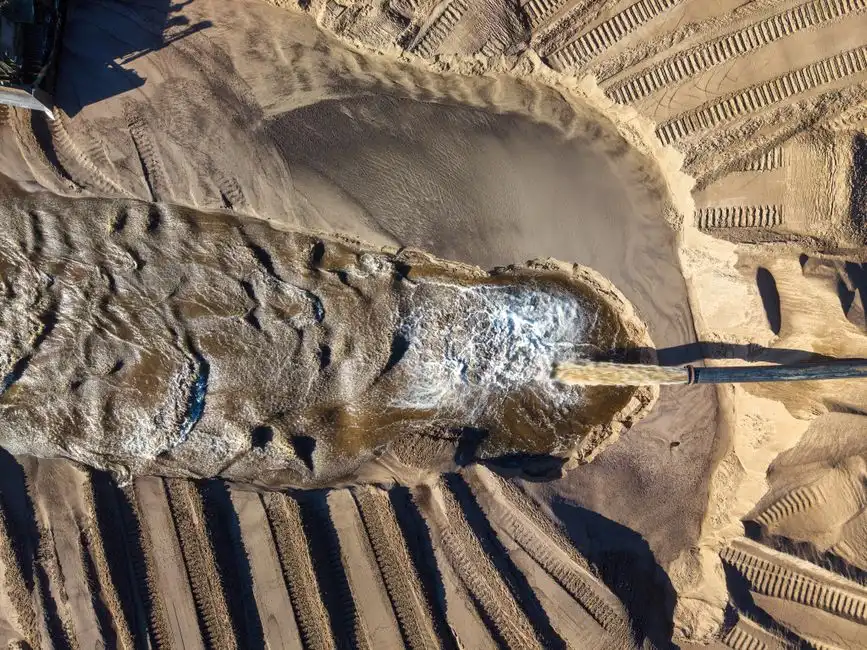
Equipment capacity must be tied to the tested water matrix and production cycle, including average, peak, cleanup, and shutdown conditions. Representative sampling should cover TSS, settleable solids, particle-size distribution, oils and grease, pH, metals, and flow variability. Sampling only during a steady production period can conceal batch dumps, washdown, or chemical dump conditions.
| Sizing input | DAF review | Lamella clarifier review |
|---|---|---|
| Available supplier envelopes | DAF Corp states FC Maximizer flows of 10–11,000 gpm and RC UniMax flows of 10–1,000 gpm; HydropureWater lists 4–300 m³/h across 13 standard DAF models | Verify the proposed plate area and stated surface-loading rate against the actual solids and flow |
| Hydraulic performance | Recycle flow, saturation pressure, saturation efficiency, bubble quality, flocculation practice, and hydraulic loading | Plate settling area, surface-loading rate, feed distribution, solids inventory, and sludge recirculation |
| Peak-flow strategy | Equalization, recycle capacity, and float-storage behavior under peak load | Equalization, hydraulic distribution, and solids capacity during peak production |
| Reliability | Standby power, pump redundancy, controls, and recycle-system failure response | Standby power, drive arrangement, sludge withdrawal, and bypass prevention |
DAF Corp’s capacity ranges are equipment examples, not recommended operating points. For DAF review, Wastewater Machinery recommends saturation pressure of at least 5 bar and a variable-frequency drive on the recycle pump. Ask each bidder to document how those controls respond to changes in flow and wastewater composition.
For a lamella clarifier, verify sludge-recirculation performance, plate settling area, loading rate, feed distribution, and solids inventory. A lamella clarifier for heavy settleable solids should be selected around those duties, not simply around the largest quoted flow.
Before assigning capacity, specify the peak-flow treatment strategy, equalization volume, bypass prevention, standby power, controls, and effects of production changes. The selected duty must represent worst-case flow and composition without assuming that equalization will always eliminate variability.
Evaluate operating costs, sludge, and recovery value
Compare bids on total operating cost and downstream solids handling rather than comparing purchase price alone. Include coagulants and flocculants, recycle pumping, compressed air, power, maintenance, wear parts, operator attention, sludge treatment, and disposal. DAF generally adds air-generation and recycle-pumping duties, while a lamella clarifier usually has a simpler mechanical duty; the proposed equipment and site utilities must confirm the actual burden.
DAF Corp states that its technology can produce thickened sludge consistency of 2%–4% and total suspended solids removal to below 20 ppm of filterable solids. These are supplier-specific examples, not assumed outcomes for every DAF installation. They demonstrate why the purchase specification should define how sludge will be conditioned, dewatered, and measured.
Water recovery can change the economic comparison, but it should be calculated from a site water balance. DAF Corp states that its FC Maximizer is used in closed-loop recycling; that claim does not establish the value of reuse at a Cullman plant. Compare recovered-water quantity, quality, energy, downstream treatment, and the consequences of production interruption.
Sludge is part of the treatment result, not a disposal afterthought. Compare solids concentration, chemical residuals, settleability, filterability, and whether the selected mechanism creates float, settled sludge, or both. A plate and frame filter press for sludge dewatering may be a downstream option, but it should be sized and priced from representative sludge—not an assumed percentage.
Ask suppliers to identify wear items, operator tasks, maintenance intervals, spare-parts lead times, and any consumable costs excluded from the quotation. That information is needed for a lifecycle comparison even when no reliable Cullman price can be stated without site data and a defined scope.
Build a low-risk 2026 procurement plan
A defensible purchase follows seven steps from wastewater characterization to final acceptance, with each gate preventing an untested assumption from becoming a commercial commitment.
- Characterize the wastewater. Sample representative production and cleanup cycles and identify the receiving sewer, surface-water, or reuse target.
- Run jar or bench tests. Establish coagulant and flocculant response, settleability, and expected float or sludge behavior.
- Run an on-site pilot. DAF Corp explicitly offers laboratory feasibility analysis and on-site pilot feasibility studies; compare that test with any clarifier pilot basis.
- Prepare the mass and hydraulic balance. Include equalization, recycle, chemical storage, sludge removal, controls, utilities, and maintenance access.
- Compare bids on equivalent scope. Evaluate performance guarantees, stainless-steel material options, automation, local service capability, warranty, installation, commissioning, and lifecycle support.
- Verify the design duty. Confirm that the selected equipment reflects worst-case flow and wastewater composition rather than average conditions.
- Define acceptance and compliance evidence. State sampling points, analytical methods, test conditions, guaranteed parameters, remedies, and required documentation.
Clearwater states that its DAF equipment is manufactured under SigmaDAF control, with standard 304 stainless-steel construction and 316 stainless steel or other materials available on request. Treat this as a supplier specification to verify in the quotation, not proof of compatibility with Cullman wastewater.
Use the mining and metals wastewater pretreatment compliance guide to structure permit-interface and evidence requirements. Supplier claims should enter the bid as proposed design criteria or testable guarantees; they should not be copied into the final performance commitment without site-specific validation.
Frequently Asked Questions
Should a Cullman metals plant choose DAF or a lamella clarifier?
Choose DAF when the stream contains oily, emulsified, fine, colloidal, or low-density solids that need rapid flotation. Choose a lamella clarifier when heavy, settleable solids dominate and simpler operation is more important. Use a hybrid only when testing shows a heavy fraction and residual floatable contaminants that justify two stages.
How should the equipment be sized for variable mining wastewater?
Size it from representative sampling and pilot results, not average flow alone. Submit average, peak, cleanup, and shutdown flows together with TSS, settleable solids, particle-size distribution, oils and grease, pH, and metals. Ask bidders to document the selected hydraulic loading, recycle conditions, feed distribution, solids capacity, and peak-flow strategy. See the mining plant sewer-limit planning guide for treatment of variable-flow documentation.
Which option has the lower operating cost?
A lamella clarifier generally has the simpler mechanical duty, while DAF adds recycle-pumping and compressed-air requirements and usually depends on chemical conditioning. Request itemized estimates for power, air, chemicals, maintenance, wear parts, operator labor, sludge treatment, and disposal using the proposed site duty. No defensible Cullman price or cost total can be given without those inputs.
What should be required from a DAF or clarifier supplier?
Require wastewater analysis, a defined test protocol, pilot-test scope, representative performance data, and a guarantee tied to the specified feed and effluent conditions. Ask where claims come from and whether they describe laboratory, pilot, or full-scale operation. Do not accept a TSS-removal percentage without the wastewater basis, operating conditions, and acceptance method.
How does heavy-metal pretreatment affect equipment selection?
Establish precipitation chemistry and the resulting sludge characteristics before selecting a separator. DAF and lamella clarification can remove metal-bearing solids after treatment, but neither is an inherent selective heavy-metal process. Confirm target limits with the applicable authority and utility, then test the combined precipitation-and-separation sequence against those limits.