What treatment does a Chunian data center actually need?
A Chunian data center should segregate sanitary wastewater, humidification/process drain and cooling-tower blowdown before selecting equipment. A practical 2026 design is a separate sanitary package plant, DAF or equivalent pretreatment for process drain, and side-stream filtration followed by RO for cooling-tower blowdown reuse. At 4 CoC, theoretical blowdown is 25% of makeup water; at 6 CoC it is 20%. Conventional brackish-water RO generally tops out around 75–80% recovery, so higher recovery may require crystallisation. Final permit limits, water analysis, flow data and discharge route must be confirmed locally before sizing.
The sanitary train should remain independent of industrial cooling-water treatment because biological loading, discharge destinations and reuse requirements differ. The supplied research supports a buried anoxic/oxic package plant for sanitary and cafeteria flows, while a dissolved-air flotation machine for solids separation can protect downstream biological or membrane treatment of humidification and process drain. An MBR system for data-center process wastewater becomes relevant where the reclaimed stream requires a tighter specification.
Cooling-tower blowdown needs its own chemistry-driven train: filtration, RO and controlled scaling management. An industrial RO system for cooling blowdown reuse should not be specified from recovery percentage alone; feed composition, temperature, scaling propensity, concentrate fate and operating competence determine the defensible design. Controlled precipitation or crystallisation should be assessed when freshwater conservation, discharge reduction or zero-liquid-discharge objectives justify it.
No supplied research establishes Chunian-specific flows, water chemistry, groundwater availability, discharge rules or permit conditions. Those are feasibility-stage gaps, not values to be filled with generic design allowances. The Islamabad material is a useful screening reference, but it is not evidence of a Chunian approval pathway.
Chunian site inputs that determine the treatment design
Treatment capacity cannot be defended until the site water balance and receiving-water requirements are measured rather than inferred from IT load. The buyer should obtain at least one full cooling season and one hot-season record of makeup-water flow, evaporation, blowdown, chemical dosing and operating cycles of concentration.
Testing should cover conductivity, pH, suspended solids, silica, calcium, hardness, sulfate, alkalinity, chloride, total dissolved solids and residual treatment chemicals in both makeup and blowdown. These parameters determine whether side-stream filtration and RO alone are sufficient, or whether silica and calcium control must precede membrane separation. Equipment media and valves should be selected only after the chemistry and control strategy are defined; the treatment parts, valves and media selection page can support that specification exercise.
| Required input | Decision supported | Acceptance basis |
|---|---|---|
| Cooling-water flow log | Peak, average and shutdown blowdown; expansion loading | Measured operating records, including hot-season operation |
| Makeup and blowdown analysis | Filtration, RO, precipitation and pretreatment selection | Representative samples with residual chemicals identified |
| Source and tariff information | Freshwater-cost and reuse business case | Current utility tariff and source constraints |
| Discharge-route and ownership record | Sewer pretreatment or surface-discharge design | Named authority, route and applicable current conditions |
| Groundwater evidence | Water-supply resilience and withdrawal assumptions | Local source assessment; no generic availability claim |
| Site and operations constraints | Plant footprint, staffing and backup arrangement | Available power, operators, footprint and expansion area |
Permit diligence must identify the authority that issues and renews an industrial discharge or reuse approval, the sewer owner and any pretreatment requirements. The Islamabad Provincial SDU framework in the supplied 2026 HydropureWater article must not be represented as a Chunian permit. The project should also document permitted discharge temperature, sampling requirements, reuse restrictions and the consequence of non-compliance.
Build the water balance before sizing the equipment

Blowdown must be calculated from the operating cooling-tower cycles of concentration, not from a generic percentage of data-center water use. Genesis Water Technologies reports the relationship as blowdown ratio = 1/(CoC−1), giving 25% at 4 CoC and 20% at 6 CoC. The reduction is five percentage points, or 20% of the 4-CoC blowdown volume—not a 50% improvement (Genesis Water Technologies, 2026).
Water usage and consumption must also remain separate. Genesis Water Technologies (2026) defines consumption as water permanently removed through evaporation or incorporation, while usage includes water withdrawn, used and returned to the source, potentially after treatment. A reused blowdown stream may therefore remain within site intake metrics even when it displaces some freshwater demand; the project needs both a water-use accounting method and a freshwater-displacement calculation.
| Water-balance component | Method | Equipment or commercial implication |
|---|---|---|
| Theoretical blowdown | Apply 1/(CoC−1) to the relevant makeup-water basis | Initial estimate only; not a peak-flow guarantee |
| Operating blowdown | Use metered records and account for unmeasured losses and emergency dumps | Size filtration, RO and treatment from observed peak demand |
| Future demand | Add planned IT load and expansion scenarios | Check footprint, power, recovery and redundancy before procurement |
| Freshwater displacement | Subtract accepted reuse from externally supplied water | Supports tariff and freshwater-saving calculations |
Genesis Water Technologies (2026) reports that actual blowdown can exceed theoretical calculations by 15–30% because of unmeasured losses and emergency dumps. This range supports a measured design basis, not a blanket capacity allowance. Include peak, average and shutdown flows and the future expansion case; an average flow is not a sufficient sizing parameter.
IDE (2026) gives up to 2 million litres per day for a 100 MW facility, but that is a high-level industry benchmark, not a Chunian design flow. Equipment selection should also account for multi-media filtration performance under the actual blowdown chemistry rather than inferring capacity from the facility’s nominal IT rating.
Treat each wastewater stream with a purpose-built train
Each stream requires a distinct destination and quality specification. Blending them prematurely increases biological load, membrane fouling and chemical demand while making reuse less predictable. The following trains should be assessed independently before any common collection system is introduced.
- Sanitary and cafeteria wastewater: Use a dedicated buried anoxic/oxic package treatment plant, outside the industrial cooling-water train. HydropureWater (2026) reports a WSZ series capacity range of 1–80 m³/h, combining anoxic/aerobic treatment, sedimentation and disinfection in an automated package suitable for facilities without continuous operators. The relevant design flow is the sanitary load, not the data-center IT load.
- Humidification or process drain: Begin with DAF for solids, oil and grease, and colloidal separation, then add biological or membrane treatment where discharge or reuse quality requires it. HydropureWater (2026) lists 13 DAF models from 4 to 300 m³/h, but the selected capacity must follow Chunian flow and contaminant records.
- Cooling-tower blowdown: Use side-stream filtration to remove suspended solids and protect RO, then polish with RO. IDE (2026) describes conventional brackish-water RO as reaching approximately 75–80% recovery before scaling becomes unmanageable; silica, calcium carbonate and calcium sulfate must therefore be checked against the actual feed.
- Near-reuse-quality process water: Consider an MBR process-wastewater treatment system. HydropureWater (2026) reports MBR capacity from 10 to 2,000 m³/day and filtration below 1 micrometre. Those specifications describe equipment capability, not a Chunian duty or guaranteed effluent quality.
- High recovery or closed-loop cooling: Evaluate controlled salt precipitation or a fluidised-bed crystalliser. IDE (2026) describes removing silica, calcium carbonate and calcium sulfate as solids before recycling the remaining brine, thereby separating scaling control from conventional RO recovery limits.
- Disinfection: Use chlorine dioxide where the treatment train and receiving-water requirements justify it. HydropureWater (2026) lists configurations from compact manual units at 50 g/h to automated industrial systems at 20,000 g/h; final capacity and dosage require feed chemistry and contact-time criteria.
| Stream | Primary treatment | Polishing or disposal decision | Critical design issue |
|---|---|---|---|
| Sanitary and cafeteria | Buried anoxic/oxic package plant | Disinfection and approved disposal or reuse route | Separate hydraulic and biological loading |
| Humidification/process drain | DAF | Biological or membrane treatment as quality requires | Oil, solids, residual chemicals and surge flow |
| Cooling-tower blowdown | Side-stream filtration and RO | Reuse, controlled discharge or crystallisation | Silica, calcium salts, recovery and concentrate fate |
The underground integrated sewage-treatment option, industrial RO treatment system and chlorine dioxide generator should therefore be evaluated against separate stream duties rather than assembled into one default package.
Choose reuse, controlled discharge or high-recovery treatment
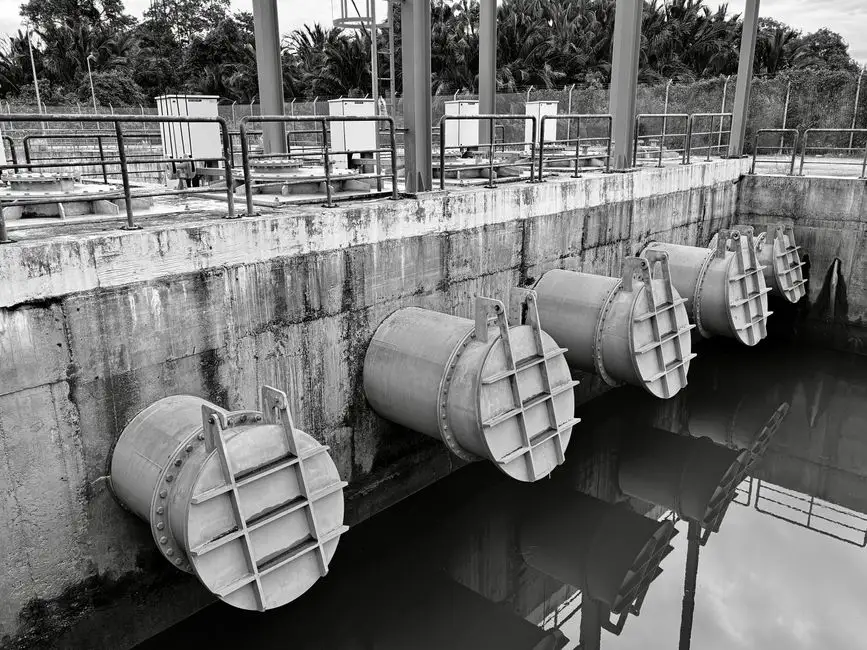
The treatment objective should determine the train before a vendor proposes equipment. Physical separation may be sufficient when CTBD is reused only for non-critical duties such as washdown or humidification, but water quality and reuse approval must support that route. Filtration and RO become appropriate when CTBD must return to service as cooling-tower makeup. Controlled precipitation or crystallisation should be added only when the permitted discharge route, freshwater value or closure objective supports the additional solids handling and operating burden.
| Option | Applicable objective | Main design benefit | Principal risk or limitation |
|---|---|---|---|
| Physical separation and targeted reuse | Non-critical washdown or humidification | Lowest treatment complexity | Reuse quality, health controls and approval remain unresolved |
| Filtration plus RO | CTBD reuse as cooling-tower makeup | Reduces freshwater demand and discharge volume | Recovery is constrained by feed chemistry, scaling and concentrate disposal |
| RO with precipitation or crystallisation | High recovery or closed-loop operation | Separates salt recovery from conventional membrane limits | More equipment, solids handling, controls and operating competence |
HydropureWater (2026) reports industrial RO systems with recovery rates up to 95%, but this is equipment capability rather than a guaranteed Chunian duty. Final recovery must be established through feed-water analysis, temperature correction, scaling calculations and vendor design.
The supplied Islamabad study proposes total site flow above 200 m³/day as a reuse screening threshold and says a data center often crosses that threshold at roughly 5 MW of IT load because humidification drain and CTBD are combined (HydropureWater, 2026). Use this only as an Islamabad-derived screening assumption. Chunian requires measured stream flows and a permit review.
For preliminary comparison, the same 2026 Islamabad source gives a cross-walked envelope of BOD₅ at no more than 50 mg/L, COD at no more than 200 mg/L, TSS at no more than 50 mg/L, free chlorine below 1 mg/L and total chromium at no more than 0.5 mg/L, verified through 24-hour composite sampling. These are not Chunian permit terms. The receiving sewer’s pretreatment conditions and the current authority’s sampling requirements must be obtained before discharge design.
Where permitted discharge remains part of the case, filter-press selection for pre-RO or crystalliser solids should be based on measured solids generation and cake-performance testing.
Compare energy, cost and implementation risk
Life-cycle comparison should include energy, chemicals, membranes, labour, solids and logistics rather than nominal equipment price or recovery alone. HydropureWater (2026) reports energy consumption of 0.8–1.6 kWh/m³ for an MBR-equipped plant and 0.4–0.9 kWh/m³ for a DAF-only scope. These figures support relative screening, but the applicability of either scope depends on the selected Chunian treatment train.
The available cost benchmark is narrower: HydropureWater (2026) cites $250,000–$500,000 installed CAPEX and $1.50–$3.00/kgal OPEX for a 50,000 GPD RO-polishing CTBD deployment in Islamabad. It is not a Chunian quotation. The buyer should request site-specific pricing covering civil works, installation, commissioning, controls, membranes, chemicals, labour, sludge removal, concentrate disposal and contingency.
| Cost or risk element | Evidence available | Chunian procurement action |
|---|---|---|
| CTBD RO capital and operating cost | Islamabad 50,000 GPD benchmark from HydropureWater (2026) | Obtain a flow-specific installed and operating-cost quotation |
| Treatment energy | MBR and DAF operating benchmarks from HydropureWater (2026) | Require guaranteed power demand for the selected duty |
| Electricity price | HydropureWater (2026) describes WAPDA industrial tariffs as a directional 1.5–3× band versus lower-tariff markets | Obtain the current Chunian industrial tariff and demand charges |
| Freight and installation | The Islamabad study describes Karachi-port clearance and more than 1,500 km of overland haul | Request a separate logistics quotation; do not carry the uplift over unchanged |
| Solids handling | HydropureWater (2026) lists plate-and-frame presses from 1 to 500 m² filtration area | Size from measured solids and cake-performance tests |
| Membrane and media replacement | No Chunian-specific cost evidence supplied | Request local pricing, stock policy and replacement assumptions |
The RO and UF membrane-element supply plan should include local certification, installation requirements, operator training, spare-parts strategy and long-term media availability. Any crystalliser or pre-RO solids stream must also be included in sludge dewatering and secure-disposal planning.
Procurement and commissioning checklist
Procurement should begin with a water-balance and influent-characterisation request for information, not a fixed treatment package. Give bidders the measured stream flows, water analyses, operating CoC, reuse destinations, discharge route, current permit conditions, available footprint and expansion plan.
- Require guaranteed design flow, recovery, permeate quality, concentrate quality, chemical consumption, energy consumption, equipment availability and expected sludge generation.
- Request references using comparable cooling-tower blowdown chemistry and CoC, not generic industrial RO installations.
- Verify local certification, installation requirements, operator training, commissioning support and a long-term membrane, media and critical-spares supply plan.
- Define a 24-hour composite-sampling plan, process-control instrumentation, alarms, bypass restrictions and a permit-compliance responsibility matrix.
- Hold performance testing against agreed feed-water conditions, with procedures for chemistry excursions and rejection of off-specification feed.
Equipment specification should align with the chemical dosing and control scope. The supplier should state which measurements trigger each chemical addition, how inhibitor carryover affects downstream RO, and which operator actions are required when the cooling system changes CoC.
Frequently Asked Questions
How much does cooling blowdown treatment cost for a Chunian data center?
No Chunian-specific quotation can be made from the supplied evidence. The only published benchmark is $250,000–$500,000 installed CAPEX and $1.50–$3.00/kgal OPEX for a 50,000 GPD RO-polishing CTBD deployment in Islamabad (HydropureWater, 2026). Ask suppliers for separate equipment, freight, civil works, installation, energy, chemicals, membrane replacement, labour, sludge handling and concentrate-disposal prices using the Chunian water balance and confirmed logistics route.
Should a Chunian data center buy an MBR, RO or crystallisation package?
Buy against the reuse destination and feed chemistry. Use an MBR system for data-center process wastewater where the required process-water quality justifies biological and membrane treatment; use RO where treated CTBD must meet cooling-makeup requirements; assess crystallisation only for high-recovery or closed-loop objectives with a defined solids-disposal route. An industrial RO system for cooling blowdown reuse should be guaranteed against the measured feed, not a catalogue recovery claim.
What water analysis should be required from a treatment supplier?
Require representative makeup, process-drain and blowdown analyses covering conductivity, pH, suspended solids, silica, calcium, hardness, sulfate, alkalinity, chloride, total dissolved solids and residual treatment chemicals. Add temperature because it affects biological and membrane performance. The supplier should issue a feed-water envelope, scaling calculation, recovery recommendation, concentrate-quality prediction and operating-control basis.
Can the Islamabad discharge envelope be used for permitting in Chunian?
No. It can support preliminary scenario comparison, but it must not be represented as a Chunian permit. Identify the authority that issues and renews the discharge or reuse approval, obtain current sewer and surface-discharge conditions, and confirm the required sampling protocol. The Islamabad figures remain an imperfect benchmark because the supplied research identifies enforcement through Provincial SDUs and does not establish Chunian-specific limits (HydropureWater, 2026).
How should critical spares and membrane supply be planned?
Require the supplier to state lead time, local stock, approved alternatives and commissioning-support arrangements for membranes, media, chemicals and control spares. Request a RO and UF membrane supply plan tied to the guaranteed recovery and cleaning assumptions. Do not adopt a delivery window from the Islamabad logistics example without a Chunian-specific freight quotation and confirmed site readiness.