How DAF and clarifiers separate mining wastewater solids
Dissolved air flotation separates solids by reducing their effective specific gravity with pressurized air, whereas gravity sedimentation separates solids that settle to the bottom of a basin. EPA HERO states that fine bubbles attach to suspended solids in DAF, causing the material to float; Wastewater Digest describes the resulting surface material as floc that can be removed by skimming. In sedimentation, settled solids are withdrawn from the bottom. For mining and metals wastewater, the practical question is not simply which unit has the higher removal rate. It is whether the target fraction can be conditioned into a floatable floc, settles reliably, or remains dissolved and therefore needs a different treatment process.
Wastewater Digest identifies minerals and metals among the pollutant groups for which DAF has been used in the mining industry. It also notes that DAF can treat suspended solids, organic matter, hydrocarbons and particulate matter. Those broader application lists do not establish universal performance for any Manchester wastewater, however. The supplied sources do not provide site-specific removal efficiencies for a Manchester plant.
Coagulation and flocculation may be required before flotation because suspended and colloidal particles otherwise need to aggregate into a form that can be floated and skimmed. Clarification relies primarily on gravity separation. A lamella clarifier for mining wastewater adds inclined plates to shorten the settling path, while the described configuration also incorporates flocculation and sludge recirculation. Those features should be evaluated against the actual solids behavior and residuals route rather than assumed to suit every wastewater.
Equipment options described in the supplied material include an industrial dissolved air flotation system and a lamella clarifier for mining wastewater. Their presence in a catalog does not establish suitability for a specific plant; the duty data and performance evidence still need to be checked.
The 2026 decision path for a Manchester mining or metals plant
The selection sequence should begin with characterization, not with a chosen machine. The sequence below links the physical wastewater fraction, treatment objective and downstream route to the equipment decision, while keeping current performance evidence as a final gate.
- Characterize the stream. Request flow variability, total suspended solids, settleable solids, particle-size distribution, relevant mineral or metal content, pH, oil and grease where present, and chemical-conditioning needs from operating records and representative sampling.
- Define the treatment objective. Separate solids clarification from dissolved-metal removal. Wastewater Digest supports DAF applications involving minerals and metals, but the supplied research does not establish universal dissolved-metal removal performance.
- Test the solids behavior. Determine whether the target material floats after conditioning, settles under gravity, or requires neither mechanism because it is dissolved.
- Confirm the residual route. DAF produces surface float for skimming, while clarification produces bottom solids. Check whether either residual fits the plant’s collection and sludge-dewatering arrangements.
- Screen operating constraints. DAF requires compressed air and air-release control. Clarification brings different requirements involving basin area, sludge handling and, for the described lamella configuration, sludge recirculation.
- Validate the selected duty. EPA report 832-R-12-011, dated March 2013, states that current information should be collected when evaluating technology performance, cost and results.
| Decision question | Evidence required | Engineering consequence |
|---|---|---|
| Which fraction must be removed? | TSS, settleable solids, particle-size distribution and constituent data | Target floatable/flocculable material or settleable material rather than assume one mechanism fits the whole stream |
| What must the water achieve? | Defined treatment objective and required clarified-water quality | Clarification is not automatically equivalent to dissolved-metal removal |
| Where can residuals go? | Float and sludge characteristics plus available handling route | Select the process that produces a manageable residual for the site |
| Can the utilities support the duty? | Flow, operating schedule, compressed-air availability and footprint constraints | Compare DAF air demand with the plant and maintenance demands of clarification |
| Will the claim hold on this stream? | Current site data, pilot results and supporting operating evidence | Do not rely on generic or manufacturer-derived performance alone |
Where chemical dosing is part of the proposed process, specify the required chemicals, dose range, mixing conditions and control response in the enquiry. An automatic chemical dosing system can then be assessed against that duty rather than treated as a predetermined solution.
DAF versus clarifier: performance, operating demands and residuals
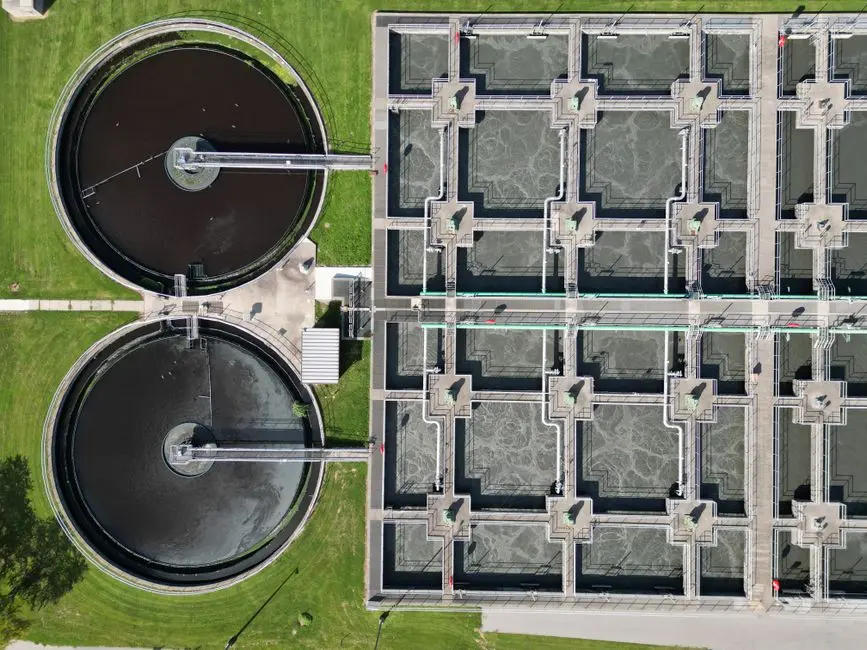
DAF has the stronger process case when the required solids can be made into a robust floatable floc, while clarification has the stronger process case when the target fraction settles reliably and the site can manage bottom sludge. That distinction is physical; the purchasing decision then depends on conditioning, utilities, residual handling and evidence quality.
| Comparison point | Dissolved air flotation | Clarification or lamella clarifier |
|---|---|---|
| Separation mechanism | Pressurized air forms fine bubbles that attach to solids and carry them to the surface for skimming | Gravity sedimentation collects solids at the bottom; the described lamella configuration uses inclined plates with flocculation and sludge recirculation |
| Best-fit material | Floatable floc, including conditioned suspended or colloidal solids | Predominantly settleable solids |
| Chemical use | Wastewater Digest identifies coagulants or flocculants for aggregating suspended and colloidal solids; polymers may be included when floc is fragile | Conditioning may be needed to improve settling, but the supplied research does not establish one chemical regime for all clarifiers |
| Energy demand | Wastewater Digest states that DAF uses more energy than sedimentation because air must be compressed | Does not require the same DAF air-compression duty; actual site energy depends on the selected clarification configuration |
| Residual solids | Surface float is skimmed; chemicals or solids that do not float may settle into sludge requiring removal | Concentrated settled solids are withdrawn from the bottom |
| Site fit | Needs compressed-air supply, saturation and release control, plus a skimming mechanism | Needs basin area and sludge management; the described lamella arrangement includes sludge recirculation |
| Performance evidence | Generic process descriptions and vendor literature alone do not prove project performance | Generic process descriptions and vendor literature alone do not prove project performance |
Wastewater Digest provides the clearest process-level comparison: DAF removes flocculated particles and suspended solids from the surface, whereas sedimentation removes settled solids from the bottom. Its mining and metals application examples should nevertheless be treated as application context, not guaranteed outcomes for a particular discharge.
EPA report 832-R-12-011 also provides the key procurement warning. Its preface states that some technology information was supplied by manufacturers or vendors, could not be verified or supported by full-scale case studies, and that some cost data were based on estimated savings without actual field data. The same report says current and up-to-date information should be collected. A 2026 decision should therefore require evidence tied to the proposed wastewater and operating conditions.
Residual handling can change the practical result. A skimmable DAF float may be easier to remove than dispersed sludge, but non-floating material can still create a bottom-sludge burden. Conversely, a clarifier concentrates settleable material at the bottom but does not convert dissolved contaminants into recoverable solids. Any comparison must therefore include the route for each residual. A plate and frame filter press may be one dewatering option for compatible sludge, but it should be selected only after the residual characteristics and available route are established.
What data the supplier needs before sizing DAF or a clarifier
A quotation is defensible only when the supplier has been given enough information to define the treatment duty, the design basis and the residual route. Without that package, a rated flow or catalog loading rate is only a starting point for discussion, not a final selection.
| Required input | Why it affects DAF or clarifier selection | Status before design |
|---|---|---|
| Average and peak wastewater flows and operating schedule | Establishes hydraulic duty and whether treatment must remain available during variable plant conditions | Supply plant records and sampling basis; do not infer flow from generic application material |
| TSS, settleable solids, particle-size distribution and target fraction | Distinguishes flocculable or floatable material from naturally settleable solids | Provide representative current results and sampling method |
| Mineral or metal content, pH and oil and grease where present | Identifies treatment constraints and informs chemical selection and compatibility | Define which constituents are included in the treatment objective |
| Required effluent objective and clarified-water destination | Clarifies whether the next process needs solids, colloids or dissolved contaminants reduced | State the applicable requirement without assuming a Manchester discharge limit |
| Residual route and available sludge-dewatering method | Determines whether float or bottom sludge can be handled at the plant | Provide storage, transport and dewatering constraints |
| Controls, maintenance access and abnormal-condition requirements | Defines operability and the consequences of chemical, flow or utility deviations | Require these items in the supplier’s technical offer |
The supplied catalog ranges are useful as selection inputs, not final sizing. HydropureWater states DAF capacities of 4–300 m³/h across 13 models and lamella clarifier surface loading rates of 20–40 m/h. Those figures identify the offered equipment envelope; they do not establish the duty, safety factor or guaranteed performance for a Manchester installation. Require the supplier to show how its proposed operating point follows from the wastewater data, pilot evidence and design calculations.
Also ask each bidder to identify the design flow and operating assumptions, chemical consumption, compressed-air or recycle-pump requirements, control philosophy, maintenance provisions, safety factors and proposed performance guarantees. Where a guarantee is offered, require it to state the tested parameter, influent condition, operating point and acceptance method. Otherwise, a broad statement that the equipment “meets requirements” is not a measurable procurement commitment.
How to compare quotations and de-risk the final selection
Quotations should be normalized against the same wastewater characterization, required flow, treatment objective and residual assumptions before their prices are compared. If each bidder uses a different influent or excludes a required duty, the commercial comparison may reflect scope differences rather than equipment value.
For each offer, separate the mechanical package from the complete operating system. Compare compressor, recycle pump, mixer, skimming or sludge withdrawal, chemical dosing, controls, maintenance access and any required building or utility work. For a DAF package, include compressed-air demand. For the described lamella clarifier configuration, include sludge recirculation and its associated equipment. Purchase price alone will not show which quotation carries the greater operating or compliance burden.
Require each supplier to explain the evidence behind its proposed performance. Ask whether the supporting result came from full-scale operation, pilot testing or manufacturer-supplied information, and whether it used a comparable wastewater. This follows the warning in EPA report 832-R-12-011, dated March 2013, that some technology information and cost data were not supported by full-scale case studies or actual field data.
Request a control narrative and operator checkpoints covering chemical dosing, air saturation where applicable, solids removal, float or sludge withdrawal and abnormal conditions. The supplier should also identify which values are calculated design assumptions and which are warranted operating results.
Manchester-specific permitting, sewer or discharge requirements must be confirmed with the relevant authority; the supplied research does not establish applicable limits. Use the mining wastewater pretreatment compliance guidance to structure that authority check, and consult the broader DAF and clarifier selection guide for an expanded mechanism comparison. The final recommendation should follow current site characterization and test evidence, not a generic catalog claim.
Frequently Asked Questions
When should a Manchester metals plant choose DAF over a clarifier?
Choose DAF when the target fraction can be aggregated into floc that floats and can be skimmed, particularly where suspended or colloidal material is the treatment objective. Require coagulation and flocculation testing to establish that condition. If the fraction is predominantly dissolved, neither DAF nor conventional solids clarification should be presented as a demonstrated dissolved-metal removal solution.
When is clarification more appropriate than DAF?
Clarification is generally more appropriate when the target material settles reliably under gravity and the plant can handle bottom solids. The decision should include particle-size and settleable-solids data, available footprint, sludge withdrawal and residual dewatering. Chemical conditioning may change the balance between the two mechanisms and therefore needs confirmatory testing.
What inputs are required for final DAF or clarifier sizing?
Provide average and peak flow, TSS, settleable solids, particle-size distribution, relevant constituent analyses, pH, oil and grease where present, treatment objectives, effluent destination, utilities, controls requirements and the residual route. HydropureWater’s catalog lists DAF capacities of 4–300 m³/h across 13 models and lamella clarifier surface loading rates of 20–40 m/h, but the supplier must demonstrate that the proposed equipment and operating point fit the actual duty.
How should DAF and clarifier costs be compared without inventing a price?
Request an itemized quotation on the same design basis and include operating utilities, chemical use, maintenance, controls, building requirements and residual handling. The supplied research provides no comparable Manchester capital-cost or total-cost figures, so it supports only a qualitative energy distinction: Wastewater Digest states that DAF uses more energy than sedimentation because air must be compressed. Do not convert that statement into a site-specific saving without current utility and duty data.
What evidence should a supplier provide before the equipment is selected?
Ask for the evidence behind every performance claim, including the wastewater used, operating conditions, test method and whether results came from full-scale operation, pilot testing or manufacturer-supplied material. EPA report 832-R-12-011, dated March 2013, warns that some information lacked full-scale case-study support and calls for current data. Supplier selection should therefore combine technical fit, transparent operating assumptions, controls and maintenance detail, and site-specific validation rather than relying on a generic claim of suitability.