Why Brazil Needs Site-Specific Domestic Sewage Treatment Planning
Brazil’s national sanitation averages conceal major regional and municipal differences in collection, treatment and disposal infrastructure. The 2023 peer-reviewed review Path toward Sustainability in Wastewater Management in Brazil, using SNIS data published in 2022, reports that 3,206 municipalities—57.5% of the total—had wastewater collection services, while 2,013 municipalities, or 36.1%, treated sewage. A project therefore cannot be selected from a national coverage statistic alone.
The same review reports average national collection of 55.8% of generated wastewater, with regional population coverage ranging from 80.5% in the Southeast to 13.1% in the North. It also reports that 26.4% of the 2,013 sewage-treating municipalities performed secondary treatment in 2020. Buyers must verify the required treatment level, receiving destination and locally applicable permit conditions rather than assume that collection implies adequate treatment.
| Planning question | National-context evidence | Site decision required |
|---|---|---|
| Is dependable sewer access available? | Average national collection was 55.8% of generated wastewater. | Map the connection, easements, invert levels and receiving utility’s requirements. |
| What treatment level is required? | In 2020, 26.4% of the 2,013 treating municipalities performed secondary treatment. | Confirm applicable authority conditions and the final effluent destination. |
| Is decentralized treatment the appropriate route? | The review describes decentralized systems as potentially more feasible for individual properties or small groups. | Assess land, groundwater, flooding, soil, access, approvals and residual disposal. |
A decentralized sistema de esgotamento descentralizado can serve a hotel, residence community, commercial property or industrial campus where sewer extension is unavailable or impractical. It is not a substitute for municipal sewerage where that infrastructure exists. Further domestic sewage treatment buyer guide material can support a broader site assessment, while site-specific wastewater treatment planning in Brazil should still account for local infrastructure, effluent destination and groundwater.
Define the Domestic Sewage Design Basis
A defensible sewage treatment proposal must begin with measured and documented loading conditions, not population alone. Average flow establishes the biological capacity; peak-hour flow governs equalization, hydraulic retention and transfer capacity; peak-day loading tests biological resilience. Growth, operating schedules and future expansion must also be explicit.
The 2023 Path toward Sustainability in Wastewater Management in Brazil review estimates 2020 domestic wastewater production at approximately 122 L per capita per day, based on 152.1 L per-capita water consumption and an assumed 80% wastewater-generation fraction. Use that value only for preliminary screening. It is not a design flow because occupancy, water use, infiltration, commercial processes and seasonal variation can materially change the actual load.
| Input | Information to obtain | Why it affects selection |
|---|---|---|
| Hydraulic load | Average flow, peak-hour flow, peak-day factor, operating hours, growth and expansion. | Defines reactor, equalization, separation and piping capacity. |
| Wastewater characterization | BOD, COD, total suspended solids, oil and grease, pH, temperature, nutrients, surfactants and relevant salinity. | Establishes biological loading, pretreatment, aeration and separation duties. |
| Non-domestic contributions | Industrial, healthcare or food-service discharges and their operating schedules. | May require separate pretreatment or process capacity. |
| Site conditions | Inlet levels, sewer slope and diameter, groundwater intrusion, flooding, soil, footprint and maintenance access. | Determines hydraulics, civil works, installation method and redundancy. |
| Outputs | Effluent destination and reuse target; sludge collection, storage and disposal route. | Defines treatment objectives and residual-management obligations. |
Document the inlet arrangement and whether flow equalization is necessary. Specify how the rotary mechanical bar screen fits the inlet, and whether solids from any upstream plate-frame filter press can be dewatered and removed. The supplier should state in writing the design-flow basis, process and duty assumptions, redundancy, standby-power strategy, control-system scope and performance guarantees.
Compare Conventional, Packaged A/O and MBR Treatment
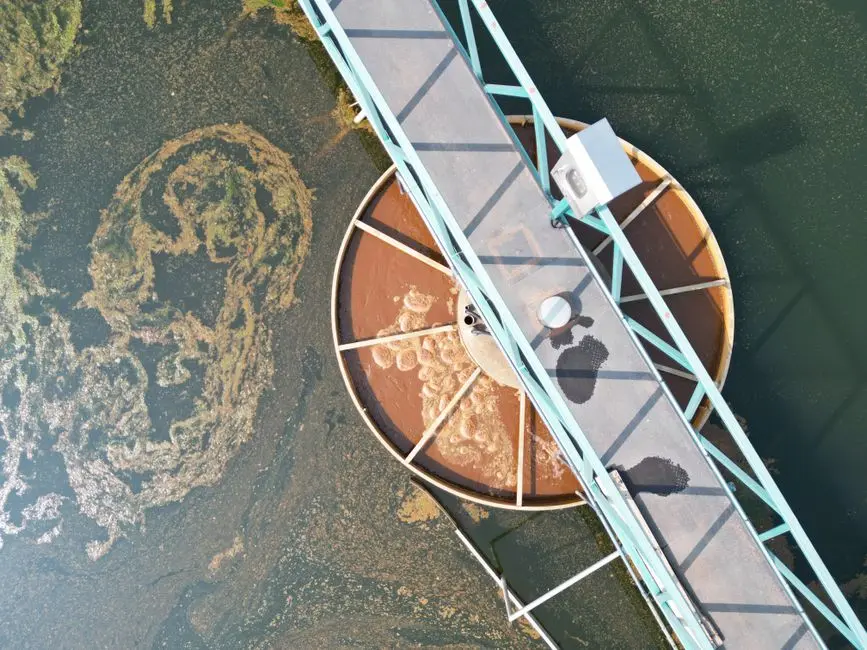
Conventional biological treatment, packaged anoxic/aerobic treatment and MBR differ in solids separation, footprint, controls, operating demands and reuse potential. The correct comparison starts with the site’s flow, land, effluent use, maintenance capability and residual-handling constraints—not a claim that one process is universally superior.
| Decision factor | Conventional biological treatment | Packaged A/O treatment | MBR |
|---|---|---|---|
| Physical arrangement | Usually several civil process units with site infrastructure. | Integrated package; suitable for constrained decentralized sites. | Integrated biological and membrane system. |
| Solids separation | Conventional clarification. | Sedimentation within the package. | Submerged membrane filtration provides stronger solids separation. |
| Controls and operation | Depends on plant configuration and available staff. | Package catalog describes automated operation without an operator. | Requires membrane, aeration and cleaning-system control. |
| Primary selection driver | Scale, available civil infrastructure and operating capability. | Compact installation, constrained land and decentralized deployment. | Effluent separation quality and potential reuse requirements. |
| Main buyer checks | Civil scope, staffing, redundancy and residual handling. | Burial conditions, access, power and performance basis. | Fouling control, cleaning, aeration, membrane replacement and guarantees. |
The HydropureWater product catalog describes the underground package sewage treatment plant as integrated anoxic/aerobic contact oxidation, sedimentation and disinfection in one buried unit. It states a capacity of 1–80 m³/h, optional trailer mounting and fully automated operation without an operator. These are catalog specifications, not a guarantee of site performance or regulatory compliance.
An MBR membrane bioreactor wastewater treatment system can suit applications requiring stronger solids separation or water reuse, but buyers must address membrane fouling, aeration, cleaning and replacement. If reuse is the objective, request a site-specific comparison because the needed quality depends on the intended end use.
Use a clear rule: prioritize a compact buried package where land and sewer access are constrained; assess MBR where effluent separation or reuse justifies added membrane controls; and consider conventional treatment where scale, local infrastructure and qualified operating staff support it. Compliance depends on the receiving sewer or water body, applicable Brazilian requirements, the reuse destination and authority permit conditions.
Select the Treatment Process Using Brazilian Operating Evidence
An integrated anaerobic-aerobic treatment train should be evaluated as an interacting hydraulic and biological system. The practical sequence is characterization and screening, equalization where required, anaerobic treatment, aerobic treatment, solids separation, disinfection, effluent handling and sludge management. Each transfer, recirculation and solids-removal decision affects the duty imposed on the next stage.
A Brazilian pilot study published in Environmental Technology on 23 September 2026 tested integrated anaerobic-aerobic systems using UASB reactors and anaerobic filters, followed by activated-sludge reactors and submerged aerated biofilters treating typical domestic sewage. Effluent recirculation was tested at 0%, 50% and 100%. The results show why recirculation should not be chosen as an arbitrary commissioning setting: higher recirculation increased hydraulic loading and promoted LAS desorption in anaerobic units during some stages.
The study’s influent LAS concentrations ranged from 2.55 ± 0.34 to 3.43 ± 1.31 mg L⁻¹. This range describes the pilot study’s influent; it is not a universal Brazilian sewage limit. Aerobic units reached peak LAS removal of 75 ± 17%, while overall system removal was 68 ± 38% at 50% recirculation, according to the same 2026 study.
The study attributed anaerobic removal primarily to adsorption in sludge and aerobic positional-isomer removal to biodegradation. It therefore supports pilot or performance testing when a project has unusual surfactant loads.
For process development, compare the hydraulic configuration with the flat-sheet MBR module only on verified operating duties. Where biological or solids separation problems are the issue, IFAS troubleshooting guidance can help distinguish operational deficiencies from process-capacity limits.
Build a Procurement Specification That Reduces Project Risk
A comparable quotation should expose every major assumption and boundary. Ask each supplier to identify the inlet-flow basis, process configuration, tank or module materials, biological loading assumptions, aeration, sedimentation, disinfection, controls, valves, access covers and instrumentation. State whether redundant equipment, duty/standby arrangements and automatic control are included.
Request separate priced line items for civil works, foundations, bypasses, power supply, standby power, installation, commissioning, operator training, preventive maintenance and performance testing. This structure allows the buyer to distinguish equipment price from the installed project cost. Specify valves and filter media by duty and material, and identify any automatic chemical dosing system included for disinfection or process control.
For underground decentralized plants, require confirmation of burial depth, buoyancy control, access requirements, odor management, flood tolerance, groundwater effects and maintenance access. Ask how the supplier will handle groundwater ingress, floatation, access-cover loading and maintenance during peak flows. Drawings and written assumptions should be part of the technical offer rather than informal sales commentary.
The performance schedule should define guaranteed hydraulic throughput, specified process-performance parameters, compliance assumptions, test methods and acceptance criteria. Also obtain spare-parts availability, remote-support scope, response times, warranty terms and exclusions.
Do not treat an unsupported equipment price as the project budget. Obtain comparable quotations with the same scope and identify freight, taxes, import logistics, civil works, commissioning, utilities, sludge handling and the projected operating plan. Any omitted item can otherwise become a change order after award.
Plan Operation, Maintenance and Effluent Reuse
Reliable operation requires named responsibilities before commissioning. Assign routine tasks for influent screening, aeration, sludge withdrawal, sedimentation, disinfection, controls, power, odor control and housekeeping. Define alarm responses, escalation contacts, attendance criteria and what happens during power failure, equipment breakdown or an exceeded discharge limit.
The 2023 Path toward Sustainability in Wastewater Management in Brazil review discusses nutrient recovery, biogas, algae cultivation and water reuse as resource-recovery opportunities. Those possibilities should not be treated as automatic project benefits. A business case must use the site’s actual effluent quality, receiving conditions, energy costs, market demand and regulatory route. It also needs a defined alternative when recovery or reuse cannot be sustained.
If reúso de efluente is required, name the end use: irrigation, process makeup, toilet flushing or another activity. Each requires a separate water-quality and treatment review rather than a single generic reuse claim. Confirm whether additional treatment, monitoring, distribution equipment or user controls are needed.
Plan lodo de esgoto and chemical residuals before commissioning. Identify their source, storage method, dewatering or collection approach, transport route, destination and responsible party. Clarify whether the supplier or the site operator will manage each step, and how disposal will be documented.
The same review states that decentralized systems can be 20%–50% cheaper than conventional systems, with maintenance costs 5%–25% lower. Use these figures only as comparative screening evidence. Actual savings depend on civil work, maintenance, power, sludge handling and site-specific capital costs. Sedimentation performance, as discussed in the context of a high-efficiency sedimentation tank, remains a site-specific design issue, while energy-reduction decisions can be assessed against the approach in water-reclamation energy strategies.
Frequently Asked Questions
How much does a sewage treatment plant cost in Brazil?
There is no defensible site-specific equipment price in the supplied research. The 2023 Brazil wastewater-management review gives comparative ranges of 20%–50% lower capital cost and 5%–25% lower maintenance cost for decentralized systems than conventional systems, but it does not quote a current Brazilian plant price. Request comparable quotations covering equipment, freight, taxes, import logistics, civil works, power, commissioning, utilities, sludge handling and the projected maintenance plan.
What size system does a hotel or residence community need?
Size the plant from average and peak-hour flow, peak-day loading, growth, wastewater characteristics, reuse goals and local permit conditions. Do not apply a universal flow multiplier or rely only on population. The 2023 review’s approximate 122 L per-capita daily wastewater estimate is useful for screening only; the supplier should identify its actual design-flow basis and operating assumptions in the technical offer.
How do I verify a supplier’s claim of Brazilian regulatory compliance?
Ask the receiving sewer utility or environmental authority which requirements apply to the discharge, treatment level and end use, then require the supplier to map its proposed process and guarantees to those conditions. Product literature alone cannot establish site compliance. Include permit assumptions and acceptance criteria in the contract.
Should the project select packaged A/O treatment or MBR?
Choose packaged A/O when a compact buried system fits the site constraints and the required effluent quality can be demonstrated by the process design. Consider MBR where stronger solids separation or a defined reuse application justifies membrane fouling control, aeration and cleaning obligations. Compare the underground package sewage treatment plant and MBR membrane bioreactor wastewater treatment system against flow, land, reuse, maintenance capability, power, redundancy and sludge-handling constraints.