Where RO Fits in a Casting Wastewater Treatment Train
An RO system for casting wastewater normally serves as the final polishing and reuse stage after solids, oil, grease and colloids have been removed. Die-casting wastewater can contain oils, hydrocarbons, heavy metals, silicones, detergents and surfactants, so treating it directly with RO risks membrane fouling and poor separation performance. A robust train typically combines equalization and chemical control, DAF or equivalent oil removal, UF or fine filtration, RO, and controlled concentrate management. In the Lester field demonstration, 500 gallons of fresh die-lube wastewater was tested, and true RO was identified as the most appropriate polishing step; the final train and recovery must therefore be selected from site-specific wastewater analysis, reuse targets and disposal constraints.
RO is a pressure-driven membrane process that separates ions and dissolved contaminants from water while retaining them in a concentrate stream. It is not interchangeable with dissolved air flotation. DAF pretreatment for casting wastewater removes suspended material, free oil, grease and colloidal matter before the water reaches RO; RO then removes the dissolved salts and fine contaminants that remain.
The normal process train is:
- Collection, equalization and segregation of production, cleaning and upset streams.
- Oil, grease and solids control, normally using DAF with chemical conditioning where required.
- UF or another validated fine-particle barrier before RO.
- RO polishing, followed by any necessary post-treatment for the intended reuse.
- Controlled handling of the RO concentrate.
The Lester report, published by SpinTek, documented oils, hydrocarbons, heavy metals and silicones, along with solids, detergents, surfactants and specific organic chemicals. It concluded that a true reverse-osmosis membrane was most appropriate for polishing; the proposed nanofiltration step produced only slight concentration of metal ions in that test. That finding supports RO as a candidate final barrier, but not a universal configuration for every casting site.
Characterize the Wastewater Before Sizing RO
A defensible RO design starts with representative wastewater, not production volume or a clean-water sample. Request samples across normal production, shutdown, cleaning and upset conditions, then document how each sample relates to the casting cycle. The sampling record should identify die-lube chemistry, detergents, surfactants, hydraulic oils, recirculation ratio and anticipated concentration cycles.
The analytical package should cover suspended solids, turbidity, oil and grease, COD, conductivity or TDS, hardness, metals, silica, pH and temperature. These parameters determine whether the dominant barriers are particles, emulsified oil, organics, dissolved salts or mineral scaling. Define the intended endpoint—such as cooling or washdown reuse—and any process constraints on residual conductivity, hardness, silica, organics or oil.
The UF pretreatment for industrial RO product specification provides a useful selection reference: it lists 0.03 micron PVDF membranes, automatic backwash and air scour, a flow range of 2,000–40,000 L/h and feed turbidity up to 300 ppm. These are equipment-selection boundaries, not casting-specific performance guarantees.
| Design input | Why it matters | Evidence needed from the site |
|---|---|---|
| Flow profile | Establishes hydraulic and recovery duties | Representative flow record across production, shutdown, cleaning and upset periods |
| Oil, grease and solids | Controls fouling load before RO | Representative concentrations and emulsion characteristics |
| COD, silica, hardness and metals | Identifies organic fouling and scaling risks | Full analytical report with sampling dates and operating conditions |
| Conductivity or TDS and temperature | Supports osmotic-pressure and flux calculations | Site measurements rather than a generic feed-water assumption |
| Reuse target | Defines permeate quality and post-treatment | Written process specification, including concentration limits and monitoring requirements |
| Concentrate route | Constrains recovery | Discharge, treatment or reuse option with acceptance criteria |
Ask the supplier to state which parameters were measured, how samples were taken and which design values are assumptions. Related pretreatment components and instruments should also be included in the quotation through the supplier’s treatment-valves and filter-media scope.
Select Pretreatment That Protects the RO Membrane

Pretreatment should be selected by the contaminant barrier it removes, then contracted through measurable RO-feed criteria. The DAF pretreatment for casting wastewater product range covers 4–300 m³/h across 13 standard models. DAF is appropriate where free oil, grease, metalworking-lubricant residues and suspended solids must be removed before membrane separation.
UF adds a defined fine-particle barrier where the RO feed must be protected from colloids and fine solids. The referenced UF specification uses 0.03 micron PVDF membranes. It should be selected only after checking the actual feed condition, desired flow and required outlet quality; the catalog limit of 300 ppm turbidity is an equipment boundary, not evidence that every casting wastewater at that turbidity is suitable for RO.
| Decision condition | Applicable barrier | Contractual evidence |
|---|---|---|
| Free oil, grease, lubricant residues or suspended solids are present | DAF with chemical conditioning | Measured feed range and required oil, grease and solids performance at the DAF outlet |
| Fine solids or colloids remain after DAF | UF or validated fine filtration | Required particle or turbidity limit, flux and backwash or cleaning sequence |
| Analysis indicates mineral scaling risk | pH correction and antiscalant control | Chemical recommendation based on feed chemistry, concentration cycles and control limits |
| Variable feed requires controlled chemical addition | Automatic dosing | Duty/standby arrangement, calibration method, interlocks and chemical inventory |
Use automatic chemical dosing for RO pretreatment where coagulant, flocculant, pH adjustment or specialty chemicals must be metered consistently. The multi-media filtration option may support staged solids control, but it does not replace an oil-removal barrier where free oil or grease is present.
Direct RO treatment would expose membranes to the oil, hydrocarbon, silicone, detergent and colloidal load documented by SpinTek in the Lester example. Require contractors to specify pretreatment effluent quality, sampling locations, test methods and automatic actions for out-of-limit feed. That converts “adequate pretreatment” into an enforceable acceptance condition.
Compare RO, Nanofiltration and Hybrid Treatment
RO is the appropriate polishing choice when the reuse specification requires strong rejection of dissolved salts and residual contaminants. Nanofiltration may be considered only when it has been demonstrated against the actual casting-water matrix and meets the required permeate quality with an acceptable operating and concentrate strategy.
In the Lester field trial, nanofiltration polishing provided only slight concentration of metal ions, and SpinTek concluded that true RO was the most appropriate polishing step. That result is application-specific: it does not establish that NF is unsuitable for every casting reuse application.
The 2026 RSC Advances study by Bouzidi, BenSlimene and Saleh supports a different design lesson: model-guided operation can help manage variable industrial feeds. Its optimized models reported R² = 0.879 for metal-ion permeate concentration, R² = 0.998 for organic-pollutant permeate concentration and R² = 0.983 for salt permeate concentration. The work concerns modified polyamide nanofiltration and a portable treatment unit; it supports monitoring and operating-guidance concepts, not a claim that one membrane or unit fits every casting site.
| Polishing option | Best-fit objective | Key selection question | Evidence to request |
|---|---|---|---|
| RO | Strong reduction of dissolved salts and residual contaminants | Does the permeate meet the reuse specification after pretreatment? | Site or pilot membrane data, projected recovery and concentrate composition |
| Nanofiltration | A demonstrated compromise between salt rejection and operating conditions | Has NF been tested on this casting wastewater? | Representative-feed results and comparison with RO |
| Hybrid UF–RO | A fine-solids barrier followed by high-quality polishing | Does UF reliably meet the contracted RO-feed condition? | UF effluent limits, flux, backwash and cleaning requirements |
| Model-assisted operation | Guidance where feed composition changes rapidly | Which measurements will feed the control model? | Validated inputs, response time and operator interface |
Where composition changes rapidly, trend pressure, flow and conductivity. Data-assisted guidance is more defensible than fixed operating conditions, but the model must be validated for the selected membrane and casting wastewater. Review the available RO and UF membrane elements against the feed chemistry rather than choosing by nominal rejection alone.
Design Recovery, Monitoring and Concentrate Management
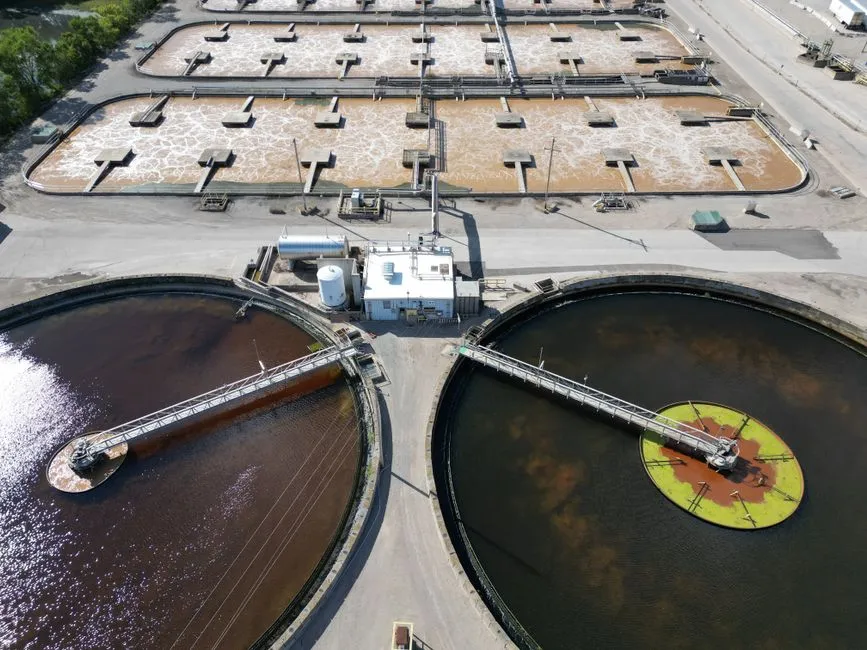
Recovery, membrane protection and concentrate disposal must be evaluated as one design. HydropureWater’s industrial RO specification states recovery up to 95%; use that as a product-level reference, not an operating guarantee. Require the supplier to define feed, permeate and concentrate flows, test conditions and the feed-water basis supporting the proposed recovery.
Monitor permeate and concentrate conductivity, differential pressure, normalized permeate flow, pH and temperature. Rising differential pressure or falling normalized flow is a signal to inspect pretreatment and membrane fouling. If automatic PLC control and continuous permeate output are operational requirements, include them in the functional specification rather than treating them as optional automation.
| Design item | Information to specify or request | Acceptance focus |
|---|---|---|
| Recovery | Feed flow, permeate flow, concentrate flow, test conditions and feed-water basis | Calculated and demonstrated mass balance |
| Monitoring | Conductivity, differential pressure, normalized flow, pH and temperature | Alarm and data-trend functions |
| Controls | PLC sequence, automatic control, continuous permeate output and operator interface | Function demonstrated during commissioning |
| Concentrate | Volume and projected composition, including metals, oil or detergent carryover | Approved treatment or disposal route |
| Cleaning | Cleaning triggers, chemicals, frequency basis and recovery verification | Documented operating procedure |
Evaluate concentrate as a predictable waste stream, not as an automatic discharge route. Account for volume, metal content, residual oil or detergent, applicable discharge requirements and the effect of concentration cycles. An industrial RO system for casting wastewater remains incomplete if the concentrate has no lawful and technically viable destination.
The 2026 nanofiltration research by Bouzidi, BenSlimene and Saleh also integrated machine-learning-guided operating regimes into a portable unit with a web-based predictive interface. For casting applications, the transferable idea is to use operating data under variable feed conditions. Energy-recovery devices, automatic CIP and condition-based cleaning should be considered only after reviewing feed chemistry, flow variability and maintenance capability.
Build a Site-Specific Procurement and Acceptance Checklist
The proposal request should contain the wastewater characterization, reuse specification, feed-flow profile and concentrate route. Without those inputs, competing equipment quotations are not technically comparable because they may assume different feed qualities, recoveries and disposal costs.
Require each bidder to identify every pretreatment stage, membrane type, high-pressure pump, control instrument, cleaning provision and reuse endpoint. Request a mass-balance calculation showing feed, permeate and concentrate flow, together with the design basis for recovery and energy consumption.
| Procurement stage | Minimum submission | Acceptance or decision record |
|---|---|---|
| Characterization | Representative analytical package and sampling history | Approved design basis and list of assumptions |
| Pilot or trial | Representative production wastewater, not an idealized laboratory matrix | Permeate quality, flux, recovery and concentrate observations |
| Equipment proposal | Process flow, membranes, pumps, controls, pretreatment and cleaning system | Supplier technical compliance response |
| Mass balance | Feed, permeate and concentrate flows with recovery and energy basis | Independent engineering review |
| Commissioning | Performance test, membrane-flux verification and permeate-quality tests | Signed acceptance record |
| Handover | Operator training, procedures, monitoring tools and maintenance plan | Documented acceptance and operating baseline |
The 500-gallon feed used in the SpinTek field demonstration supports using representative casting wastewater in any trial. Require maintenance coverage for pretreatment inspections, membrane differential-pressure trends, cleaning triggers, chemical inventory and spare-part strategy. Spare membranes or critical parts should be linked to the proposed treatment-valves and filter-media strategy, with the required membrane-element selection clearly identified.
Exclude suppliers that quote equipment performance without a feed basis, omit the concentrate route, or define pretreatment only by equipment name. The technical proposal should state what the water contains, how the equipment handles it, what water is produced, how fouling is detected and where the concentrate goes.
Frequently Asked Questions
Can RO treat die-casting wastewater directly?
No. The Lester example documented oils, hydrocarbons, heavy metals, silicones, detergents, surfactants and solids. Pretreatment should remove the principal fouling and separation barriers before RO, with measurable feed-quality limits in the purchase specification.
How much does an RO system for casting wastewater cost?
The supplied research provides no defensible price for this application. Ask each supplier for a priced mass balance and separate quotations for pretreatment, RO, post-treatment, controls, chemicals, energy, maintenance and concentrate management. Request the assumed feed analysis, flow, reuse specification and recovery before comparing budgets.
Should I buy a standard RO skid or a custom treatment train?
A standard skid may suit a clearly defined duty. Mixed casting wastewater with variable oils, colloids and dissolved metals generally calls for a process-engineered train based on representative site data. Require the bidder to identify the pretreatment sequence and measurable RO-feed condition rather than relying only on the skid description.
How do I size an RO system for casting wastewater?
Base sizing on representative flow and contaminant profiles, the required permeate quality, validated pretreatment performance, recovery and the concentrate route. Do not size from production output alone. Use the engineering method for sizing industrial RO as a framework, then replace generic inputs with site measurements.
Can RO eliminate all concentrate?
No. RO separates contaminants into a concentrated stream. The proposal must quantify that stream, identify its likely composition, assess applicable disposal requirements and secure a technically viable management route before recovery is accepted.