Separate the Data Center’s Waste Streams Before Choosing Equipment
A Dharavi data center needs a source-separated treatment strategy, not one machine for every waste stream. Cooling-tower blowdown is the priority because it can contain 1,200–6,000 mg/L TDS, 10–50 mg/L suspended solids and concentrated treatment chemicals (Genesis WaterTech, 2026). The practical train is generally side-stream filtration, industrial UF and BWRO, with permeate reused as cooling-tower makeup and a controlled residual discharge. Design must confirm local supply chemistry, cooling cycles, permitted limits and reuse targets. Full ZLD is normally justified only where discharge is prohibited or freshwater is unavailable.
Prepare four separate flow diagrams: cooling-tower blowdown, sanitary sewage, process wastewater, and equipment or floor washdown. Do not combine these streams simply because they eventually meet at the property boundary. Their contaminant profiles, treatment objectives and permit routes are different.
Cooling-tower blowdown is the leading recovery candidate because IDE-Tech (2026) identifies it as a practical starting point for internal reuse. Genesis Water Tech (2026) reports that a cooling tower operating at 4 cycles of concentration sends approximately 25–30% of makeup water to blowdown. This does not mean that all blowdown can be recovered: recovery depends on the feed chemistry, cooling treatment chemicals, cooling configuration and the permitted residual discharge.
Sanitary sewage requires its own biological treatment assessment because organic load, suspended solids and biological treatment requirements are not equivalent to cooling blowdown. Process wastewater needs stream-specific characterization, while equipment and floor washdown may contain cleaning chemicals, hydrocarbons, suspended solids or other contaminants that make uncontrolled reuse unsafe. Keep these flows physically and hydraulically separate until testing demonstrates otherwise.
Ask the project team for a signed water balance covering the makeup-water source, cooling configuration, evaporation, drift, blowdown, domestic demand, process demand and intended reuse points. The applicable consent route should also be checked against the India industrial wastewater discharge standards; that reference is a starting point, not a substitute for the current Dharavi and Maharashtra consent conditions.
| Separate stream | Characteristic issue | Treatment and permit path |
|---|---|---|
| Cooling-tower blowdown | Concentrated salts, silica, suspended solids, corrosion products and treatment chemicals | Filtration, UF, BWRO and cooling-makeup reuse; treat residual discharge under the site consent |
| Sanitary sewage | Organic load, suspended solids and biological treatment requirements | Dedicated sanitary treatment and reuse or disposal route |
| Process wastewater | Stream-specific contaminants and flow variability | Characterization, source control and a dedicated treatment train |
| Equipment or floor washdown | Cleaning chemicals, grit, oil and variable contamination | Segregated collection and treatment or disposal; prohibit automatic cooling reuse until verified |
Build a Dharavi Water Balance and Chemistry Basis
The Dharavi design basis must be measured at the site; Mumbai-area chemistry can screen options but cannot replace local data. Obtain at least one complete seasonal campaign for TDS, conductivity, silica, calcium, magnesium, chloride, sulfate, alkalinity, suspended solids, turbidity, temperature, pH and residual cooling chemicals. The campaign should span the operating conditions that produce the highest cycles of concentration and the highest concentration of treatment chemicals.
Use Mumbai-area material as preliminary screening only. HydropureWater’s Mumbai guide (2026) reports municipal makeup of 200–600 mg/L TDS, cooling-tower blowdown of 800–2,400 mg/L at 4 cycles, and 1,200–6,000 mg/L at 5–6 cycles. The same guide reports makeup silica of 10–25 mg/L and blowdown silica of 30–80 mg/L at 5–6 cycles. These values are not automatic Dharavi acceptance criteria: the project must establish its own supply composition and seasonal variability.
Silica requires particular attention because it can limit membrane recovery and foul the concentrate. IDE-Tech (2026) identifies silica as a major high-recovery constraint, particularly when calcium carbonate and calcium sulfate also concentrate. Request the applicable Dharavi and Maharashtra consent conditions, discharge destination and sampling frequency during design. Do not assume that the Mumbai benchmarks cited in the research apply automatically to a Dharavi site or to a particular receiving drain.
Then map the proposed permeate blend into the cooling-water chemistry model. Confirm conductivity, hardness, silica, alkalinity and treatment-chemical compatibility before fixing the recovery target. If the permeate is blended with freshwater or another source, the blend must be assessed at the actual tower makeup point rather than judged only on permeate TDS. This also lets the buyer test whether higher cycles of concentration will reduce blowdown without increasing scaling, corrosion or biological risk.
| Design input | Why it changes the treatment decision | Buyer action |
|---|---|---|
| Makeup-water source and seasonal chemistry | Sets feed salinity, silica, hardness and chloride | Obtain source-specific seasonal test data |
| Cooling configuration and cycles of concentration | Determines blowdown volume and concentrate saturation | Obtain the signed water balance and cooling model |
| Cooling treatment chemicals | Concentrated phosphonate, biocide or corrosion inhibitors can affect membranes and discharge | Request product and active-dose data |
| Permitted discharge route | Sets residual-flow quality and monitoring requirements | Obtain current site consent and regulator correspondence |
| Permeate blend point | Determines final makeup chemistry, not just permeate quality | Require a mixed-makeup calculation and compatibility review |
Use Side-Stream Filtration and UF to Protect Membrane Treatment
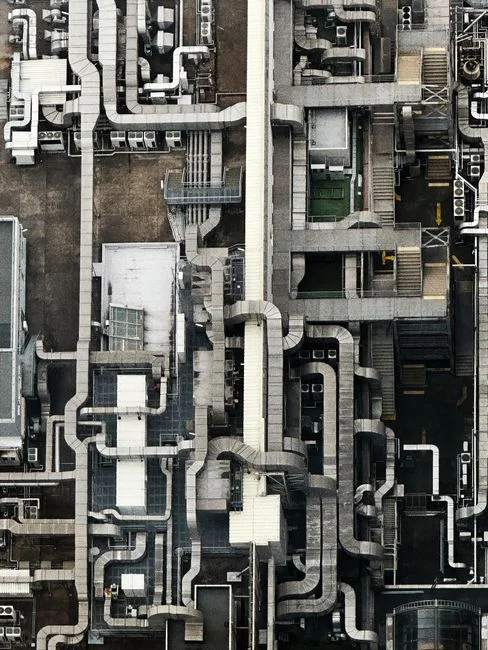
Side-stream filtration and industrial UF protect the downstream membranes from particles, colloids and biological solids. Genesis Water Tech (2026) recommends side-stream filtration at approximately 1–5% of circulation flow, depending on water quality and objectives. The equipment should remove corrosion products, biofilm fragments and airborne particulates before they concentrate in the blowdown stream.
Use UF as the membrane-protection stage, not as a substitute for controlling scaling chemistry. Genesis Water Tech (2026) reports that 0.01–0.1 µm UF operates at 10–30 psi and can achieve 90–95% recovery. The hollow-fibre industrial ultrafiltration system specified in the HydropureWater Mumbai reference uses 0.03 µm PVDF membranes, accepts turbidity up to 300 ppm and includes automatic backwash and air scour. Those are vendor specifications to verify against the actual Dharavi feed and cooling treatment programme.
HydropureWater’s Mumbai guide (2026) gives preliminary CTBD targets of below 1 mg/L TSS and below 3 SDI for the membrane feed. Treat these as screening benchmarks, not guaranteed acceptance criteria. Require the supplier to state the test methods, feed envelope and guaranteed values in the technical offer.
Add multimedia or cartridge filtration where iron, manganese, colloids or elevated turbidity could compromise UF. The multi-media filter for upstream solids removal should be evaluated where the measured feed indicates a need, rather than added as an automatic cost item.
The pretreatment scope should also include chemical-dosing interlocks, permeate turbidity instrumentation and a defined backwash-waste route. Confirm whether backwash is returned to the cooling loop or directed to a separate treatment or disposal stream. Without that decision, the apparent UF recovery will overstate whole-system recovery.
| Pretreatment element | Reported benchmark or specification | Design verification required |
|---|---|---|
| Side-stream filtration | Approximately 1–5% of circulation flow (Genesis Water Tech, 2026) | Flow basis, solids loading, differential-pressure strategy and waste route |
| UF pore size and pressure | 0.01–0.1 µm and 10–30 psi (Genesis Water Tech, 2026) | Actual feed, temperature and flux conditions |
| UF system specification | 0.03 µm PVDF, turbidity up to 300 ppm, automatic backwash and air scour (HydropureWater, 2026) | Compatibility with site chemistry and chemical programme |
| RO-feed targets | TSS below 1 mg/L and SDI below 3 (HydropureWater, 2026) | Define test methods and contractual guarantees |
Treat Blowdown for Cooling-Makeup Reuse Before Chasing Maximum Recovery
Use BWRO as the baseline desalination stage because the published Mumbai case points to 75–80% recovery for standard cooling-blowdown treatment. Genesis Water Tech (2026) gives a broader 50–85% range for standard blowdown RO systems. Recovery must be selected from the actual feed chemistry, not simply set to the top of that range.
Genesis Water Tech (2026) reports permeate TDS of 10–50 mg/L for cooling-tower makeup. Use that as a preliminary quality benchmark, then confirm the required purity with the cooling-system supplier and the site chemistry model. The industrial RO system for cooling-tower blowdown reuse should be sized around the permeate flow required at the selected reuse point, not only around the gross blowdown flow.
Add antiscalant and pH control with automatic PLC-controlled dosing. HydropureWater’s Mumbai reference (2026) states that conductivity swings make manual adjustment unsuitable. Chemical selection must account for the existing cooling programme because phosphonate, biocide and corrosion-inhibitor carryover affects membrane compatibility and the permitted discharge chemistry. The automatic chemical dosing package should therefore be specified with interlocks, duty/standby arrangement, tank-level alarms and dose monitoring.
Where higher recovery is required, evaluate silica and hardness control rather than adding complexity by default. IDE-Tech (2026) describes a high-salinity industrial case operating at around 95% recovery with permeate silica of about 1 mg/L. That case supports evaluation of controlled salt removal, not a blanket assertion that a Dharavi data center needs the same configuration. The local silica, hardness, alkalinity and recovery targets determine whether fluidized-bed precipitation or another control step is justified.
Whole-system energy and carbon impacts must be included. Open Engineering Inc. (2026) reports that the wastewater-reuse scenario had about twice the global warming potential of the freshwater case, with treatment energy responsible for roughly 80% of the difference. The same study reports an indirect water penalty of approximately 0.93 L/m³; this was less than 0.1% of the direct displacement benefit, but energy and chemical demand still affect project economics. Recovery should therefore be optimised for whole-system value rather than headline percentage alone.
| Decision point | Evidence-led position | Engineering action |
|---|---|---|
| Baseline RO recovery | 75–80% in the Mumbai design case; 50–85% broader standard range (HydropureWater, 2026; Genesis Water Tech, 2026) | Model silica, hardness and osmotic pressure at the actual feed |
| Permeate quality | 10–50 mg/L TDS preliminary benchmark (Genesis Water Tech, 2026) | Confirm blended makeup chemistry and cooling-manufacturer limits |
| Higher recovery | Around 95% recovery and approximately 1 mg/L permeate silica in one industrial case (IDE-Tech, 2026) | Evaluate silica and hardness control against local data |
| Life-cycle impact | Reuse scenario had about twice the GWP; treatment energy explained roughly 80% of the difference (Open Engineering Inc., 2026) | Compare energy, chemicals, water and disposal at system level |
Choose Between Reuse, Compliant Discharge and ZLD
Choose the treatment objective before selecting the equipment: cooling-makeup reuse, compliant discharge, high-recovery reuse or full zero liquid discharge. A reuse package usually combines source-segregated sanitary treatment with UF plus BWRO for the blowdown stream. High-recovery reuse adds silica or hardness control when the chemistry model demonstrates the need. Full ZLD adds thermal concentration and solid handling and should be reserved for a site-specific constraint.
For cooling-makeup reuse, HydropureWater’s Mumbai guide (2026) gives a 50,000 GPD blowdown RO installation at $250,000–$500,000 installed globally and states that UF plus BWRO can scale to Rs 4.5–11 crore with Mumbai EPC multipliers and a fluidized-bed polisher. These are benchmark references, not a Dharavi quotation. The buyer must provide the actual blowdown flow, recovery, pretreatment scope, civil works, power backup, redundancy and solids-disposal route before a comparable project price can be produced.
Genesis Water Tech (2026) cites an operating-cost benchmark of $1.50–$3.00 per 1,000 gallons for a 50,000 GPD blowdown RO system, including energy, chemicals, membrane replacement and maintenance. A Dharavi budget should convert that benchmark using current local power, chemical, labour, membrane, disposal and service inputs, then state whether it covers pretreatment, reject treatment and residuals.
For discharge compliance, include the full train needed to meet the actual consent envelope. HydropureWater’s Mumbai reference (2026) cites inland limits of TDS below 1,500–2,100 mg/L, chloride below 600 mg/L, sulfate below 1,000 mg/L and pH 6.5–8.5. These are Mumbai benchmarks; site-specific Maharashtra conditions must be confirmed. Chemical polishing alone is not a substitute for establishing how each contaminant will be removed or controlled.
For ZLD, Genesis Water Tech (2026) reports 95–98% MVC recovery from RO concentrate, distillate below 10 mg/L TDS and energy demand of 15–25 kWh per 1,000 US gallons. This route is justified where discharge is prohibited, freshwater is unavailable or another confirmed site constraint makes it necessary. It should not be selected merely because ZLD is technically possible.
| Procurement pathway | Equipment fit | Capital and operating exposure | When justified |
|---|---|---|---|
| Cooling-makeup reuse | Side-stream filtration, UF, BWRO, chemical dosing and blend controls | Medium capital; energy, chemicals, membrane replacement and maintenance | Permeate can meet the actual cooling-water chemistry and reduces freshwater draw |
| High-recovery reuse | UF, BWRO plus silica or hardness control and a managed solids stream | Higher capital and process-control burden | Local chemistry limits standard RO recovery or the project has a verified high-recovery requirement |
| Compliant discharge | Treatment train matched to each site consent parameter, including residual-flow monitoring | Cost depends on separation needs and required pollutant removal | Discharge is permitted and reuse does not provide sufficient technical or economic value |
| Full ZLD | RO concentration, MVC or equivalent evaporation, crystallisation and solid disposal | Highest capital and energy exposure | Prohibited discharge, unavailable freshwater or a confirmed site constraint |
Issue a Vendor Enquiry That Produces a Defensible Design
A defensible vendor enquiry starts with a stream-by-stream water balance, not a requested recovery percentage. Require the flow basis, cooling configuration, evaporation, drift, blowdown, domestic demand, process demand and intended reuse points. The bidder must also provide the membrane-sizing calculation and predicted permeate and concentrate chemistry.
Require a complete mass balance covering UF backwash, RO reject, chemical drains, sludge and final discharge. A vendor should not quote “overall recovery” without showing where the unrecovered water and solids go. This check exposes whether the proposed recovery belongs to UF, BWRO, the treatment island or the whole facility.
Require performance guarantees for flow, permeate quality, overall recovery, availability, cleaning frequency and chemical consumption. Each guarantee must state the feed-water and cooling-operating envelope, including cycles of concentration, temperature, silica, hardness, TDS and residual treatment chemicals.
Ask bidders to define monitored-data acceptance criteria, PLC and SCADA scope, redundancy for critical equipment, membrane-cleaning strategy, spare parts and local service support. For membrane systems, request the cleaning chemistry, expected frequency, acceptance tests and membrane warranty exclusions. For reuse, require the blend-control logic and limits that prevent an incompatible permeate from entering the cooling loop.
The permit basis must identify which values come from the current site consent and which are preliminary benchmarks. Ask each bidder to list assumptions, exclusions, sampling obligations and permit interfaces. This lets the procurement team compare bids on performance, life-cycle cost and compliance risk rather than headline recovery alone.
| Enquiry document | Mandatory content | Reason for requiring it |
|---|---|---|
| Water and mass balance | All source flows, recoveries, backwash, reject, sludge and final discharge | Prevents overstated plant recovery and hidden waste routes |
| Membrane sizing calculation | Flux, pressure, recovery, scaling projection and cleaning basis | Makes the proposed capacity auditable |
| Performance guarantees | Flow, quality, recovery, availability and chemical use under a stated envelope | Defines what the supplier is accountable to deliver |
| Controls and reliability scope | PLC/SCADA, interlocks, redundancy, alarms and local support | Connects equipment performance to facility operations |
| Permit and compliance schedule | Current consent values, preliminary assumptions and compliance responsibilities | Separates confirmed requirements from marketing benchmarks |
Frequently Asked Questions
How much should a Dharavi data center budget for cooling-blowdown treatment?
Do not budget from a generic per-litre rate. HydropureWater’s Mumbai guide (2026) gives $250,000–$500,000 installed for a 50,000 GPD blowdown RO system globally and Rs 4.5–11 crore for UF plus BWRO with Mumbai EPC multipliers and a fluidized-bed polisher. Ask vendors for an itemised Dharavi quotation covering pretreatment, membranes, tanks, dosing, controls, electrical work, civil works, residuals, commissioning and local service. Separately ask for operating cost using current power, chemical, labour, membrane and disposal prices; Genesis Water Tech (2026) cites $1.50–$3.00 per 1,000 gallons for the benchmark system.
Is UF plus BWRO sufficient, or does the site need fluidized-bed softening, MVC and a crystallizer?
UF plus BWRO is the baseline when measured chemistry and the cooling model support standard recovery. Add silica or hardness control when the feed would otherwise exceed the membrane scaling envelope; IDE-Tech (2026) describes an industrial case at around 95% recovery with approximately 1 mg/L permeate silica. Reserve MVC and crystallisation for confirmed prohibited discharge, unavailable freshwater or another site-specific constraint. Require a scaling calculation before accepting either the baseline or the expanded train.
How should a supplier be selected for a Dharavi data-center wastewater package?
Select on guaranteed performance under the measured Dharavi feed envelope, not on equipment capacity or headline recovery. Request a water balance, membrane-sizing calculation, predicted concentrate chemistry, membrane cleaning plan, PLC/SCADA scope, redundancy, local service support and reference projects with comparable silica and scaling conditions. Require the bidder to identify permit assumptions and exclusions. These checks expose lifecycle and compliance risks before commercial evaluation.
What discharge parameters should be verified with Maharashtra regulators before equipment selection?
Request the current site consent, discharge destination, permitted flow, TDS, chloride, sulfate, pH, temperature, sampling frequency and monitoring obligations from the relevant Maharashtra authority. HydropureWater’s Mumbai guide (2026) cites inland limits of TDS below 1,500–2,100 mg/L, chloride below 600 mg/L, sulfate below 1,000 mg/L and pH 6.5–8.5, but these are not a substitute for Dharavi’s consent. Confirm whether any zero-discharge condition applies and what documentation is required at commissioning.
How much treated water can realistically be returned to the cooling tower?
The answer depends on blowdown flow, feed chemistry, pretreatment and whether the plant recovery or whole-facility recovery is being asked for. HydropureWater’s Mumbai guide (2026) places the standard Mumbai design at 75–80% BWRO recovery, while Genesis Water Tech (2026) reports a broader 50–85% range for standard systems. Require the bidder to state both membrane recovery and whole-system recovery, including UF backwash and RO reject, then verify the mixed permeate quality at the cooling-makeup connection.