Determine Which Sewer Discharge Rules Apply
Pharmaceutical preparations plants near Norwich, United States, meet pretreatment limits by identifying the applicable federal, categorical and receiving-POTW requirements; characterizing every wastewater stream; treating pH, solids, oil and grease, and other regulated or locally controlled pollutants as required; and verifying compliance at the point of connection to the POTW collection system. EPA states that local limits are site-specific and may be numeric or narrative. Pharmaceutical manufacturing is also addressed by 40 CFR Part 439, but the correct subcategory, production process and receiving sewer agreement must be confirmed before selecting equipment or discharge criteria.
EPA separates pretreatment standards—pollutant discharge limits applying to industrial users—from pretreatment requirements, which include substantive and procedural obligations. Local limits are not a substitute for either the federal baseline or an applicable categorical standard. They address the receiving POTW’s operational, sludge and receiving-water concerns and may be numeric or narrative, including best management practices (EPA, “Pretreatment Standards and Requirements—Local Limits,” accessed 2026).
The control point is the industrial user’s end-of-pipe discharge, meaning the point of connection to the POTW collection system. Before purchasing equipment, obtain the current sewer permit, local-limit ordinance, industrial discharge permit, sewer agreement and any applicable permit language from the receiving authority near Norwich. The supplied research does not establish a Norwich-specific numeric limit.
| Requirement layer | What it controls | Decision use |
|---|---|---|
| Federal pretreatment baseline | General prohibitions, substantive and procedural requirements for industrial users | Screen prohibited discharges and baseline duties |
| 40 CFR Part 439 | Categorical requirements for the applicable pharmaceutical manufacturing subpart | Confirm process eligibility and applicable limitations |
| POTW local limits | Site-specific numeric or narrative requirements protecting the receiving authority | Establish the controlling site-specific treatment objectives |
| Permit and sewer agreement | Monitoring, reporting, sampling, operating conditions and authorized discharge point | Define the proof and reporting protocol |
For additional decision context, compare the chemical-plant pretreatment guide for Rockland with the Iowa Falls chemical-plant compliance guide. Use those as workflow references, not as substitutes for Norwich permit documents.
Map Pharmaceutical Wastewater by Production Stream
WaterTechOnline identifies five pharmaceutical-manufacturing categories for 40 CFR Part 439: fermentation products, extraction products, chemical synthesis products, mixing/compounding and formulation, and research. The plant should map its manufacturing operations against those categories, then determine which subcategory actually governs the proposed discharge rather than treating all pharmaceutical production as one category (WaterTechOnline, “Wastewater disposal requirements for pharmaceutical manufacturing,” accessed 2026).
Build a wastewater mass balance with a separate line for each materially different stream:
- Washing and cleaning water;
- Mother liquor and process residuals;
- Solvent-bearing streams;
- Product-contact rinse water;
- Equipment and floor washing;
- Laboratory and quality-control drains.
For every stream, record flow, batch size, production schedule, cleaning frequency, material inventory and known holdups. Record whether the stream is continuous, batch-derived, intermittent or diverted for separate treatment. This is the connection between manufacturing operation, waste generation and the eventual treatment duty.
WaterTechOnline notes that pharmaceutical active ingredients, reaction by-products, reactants and solvents can be present in wastewater requiring treatment before direct or indirect discharge. That means inventory review must extend beyond conventional bulk parameters: identify active ingredients, solvents, cleaning chemicals and process additives that may affect treatment compatibility or create a permit concern.
EPA’s process-based self-assessment tool is also useful as a planning reference. WaterTechOnline describes the 1997 tool as containing three modules and eight appendices, with modules covering process-unit assessment and wastewater-treatment operations. Although it predates current operations, its structure remains useful for connecting process units, waste treatment and compliance responsibilities. The pharmaceutical wastewater treatment guide provides another reference for the pharmaceutical treatment context, while the pharmaceutical RO system design guide addresses membrane design considerations; neither replaces site characterization.
Characterize the Wastewater Before Choosing Equipment

Equipment selection should follow a representative sampling plan, not a single routine grab sample. The plan must cover normal production, maximum production, cleaning, batch dumps and campaign changes. The supplied research contains no Norwich sampling frequency, so the receiving POTW’s permit must supply the required monitoring frequency, sample type, preservation and analytical methods.
Screen for pH, suspended solids, oil and grease, BOD5 and COD. Add pharmaceutical active ingredients, solvents or reaction by-products when the permit, chemical inventory or prior analytical results identify them as relevant. For each event, document flow, concentration and discharge duration so mass and load can be calculated; a concentration result alone does not establish the treatment duty.
WaterTechOnline explains that the federal BOD calculation under 40 CFR 439.12 distinguishes raw load from the load remaining in the treatment system. It defines the long-term average daily BOD5 load as the average daily load during a calendar month over 12 consecutive months within the most recent 36 months, including one or more maximum-production periods. Any calculation for a 439.12 discharge must therefore use the prescribed production and load basis.
The Pubtexto source titled A Simple Spectrophotometric Determination of Lidocaine Hydrochloride in Environmental Wastewater Samples and Pharmaceutical Preparations is password-protected, and its full method was not accessible in the supplied research. It may identify an analytical approach to investigate, but it does not establish a Norwich limit, a plant condition or a mandatory monitoring method.
| Characterization input | Question the data must answer | Use in equipment selection |
|---|---|---|
| Flow and discharge duration | What flow and load must the system handle? | Sizing, equalization and hydraulic residence requirements |
| pH | Does the permit require adjustment before discharge? | Chemical dosing and control range |
| TSS and FOG | Which solids and oily fractions require removal? | Screening, clarification and solids handling |
| BOD5 and COD | What conventional organic load remains after treatment? | Biological, chemical or polishing objectives |
| Pharmaceuticals, solvents and by-products | Which regulated or locally controlled substances are present? | Source control, compatible treatment and monitoring |
Require a written characterization report and mass balance, reviewed by the process engineer, treatment supplier and compliance contact before final sizing. The Bolivar plastics and rubber pretreatment workflow illustrates the same evidence-first sequence used for industrial streams.
Match Treatment Methods to the Compliance Risk
Match each unit process to the contaminant and the permit condition it must control. A generic “pharmaceutical treatment system” is not a defensible sizing basis. The minimum design train should reflect the verified flow, load, stream variability and endpoint demonstrated in the characterization report.
Use an automatic chemical dosing and pH control system when pH adjustment, coagulation or flocculation is required. The supplied equipment description supports PLC-controlled injection of coagulants, flocculants, pH adjusters and specialty chemicals. Chemical demand must be based on wastewater characteristics and the proposed operating envelope rather than a generic dose.
Use a DAF pretreatment system for suspended solids and FOG where suspended solids, oil and grease or colloidal matter are principal targets. The catalog states a treatment range of 4–300 m³/h across 13 standard models and automatic skimming (HydropureWater product catalog, accessed 2026). These are equipment specifications, not a Norwich operating guarantee; the selected model must be checked against the verified plant flow and duty.
The high-efficiency sedimentation tank is an alternative where flocculation, sludge recirculation and inclined-plate separation fit the wastewater. Its catalog states surface loading rates of 20–40 m/h and chemical-consumption reduction of up to 30% (HydropureWater product catalog, accessed 2026). Those figures support preliminary comparison, not final selection without hydraulic and solids-loading checks.
Use the rotary mechanical bar screen ahead of downstream treatment where rags, plastics, fibrous debris or other suspended solids require continuous removal. The supplied specification describes it as a continuous-duty fine-screening system. It removes debris; it does not establish pH, dissolved pollutant or oil-removal performance.
Treat reverse osmosis or ultrafiltration as polishing or reuse stages only when the characterization and treatment objective justify them. The industrial RO product is marketed for pharmaceutical applications. The UF product accepts up to 300 ppm turbidity and is positioned for RO pretreatment (HydropureWater product catalogs, accessed 2026). Neither value replaces membrane design, scaling analysis or pretreatment verification.
| Verified compliance risk | Candidate treatment | Required design evidence |
|---|---|---|
| pH outside permit condition | Automatic chemical dosing | Influent range, chemical demand, control response and discharge endpoint |
| Suspended solids, FOG or colloidal matter | DAF | Flow, solids and oil loading, skimming, sludge handling and model selection |
| Flocculable solids | High-efficiency sedimentation | Surface loading, recirculation, sludge withdrawal and operating range |
| Rags, plastics and fibrous debris | Rotary mechanical bar screen | Screen selection, solids capture, extracted-screen handling and duty basis |
| Residual dissolved contaminants or reuse objective | UF or RO | Feed chemistry, scaling, membrane compatibility, recovery and final monitoring |
Provide a documented contingency for power loss, equipment failure and off-specification batches. The supplied research emphasizes process control and pretreatment performance but gives no guaranteed Norwich operating envelope. Additional comparison methods appear in the DAF-versus-clarifier guide for Orange and the Conover plastics and rubber comparison.
Verify Compliance at the Point of Sewer Connection
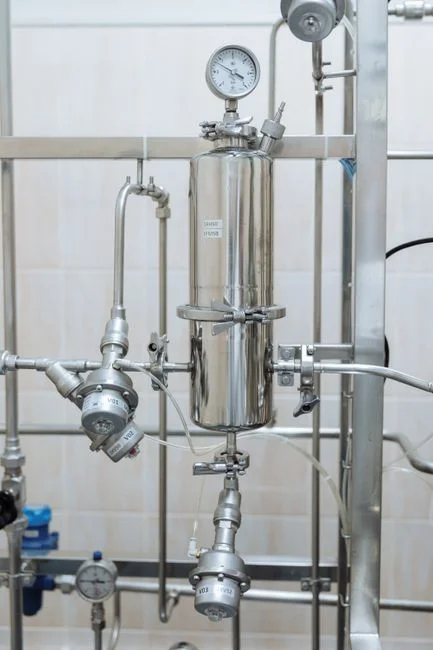
Installed treatment becomes defensible compliance evidence only when the monitoring program can connect operating conditions to the permitted discharge point. Develop a process flow showing segregated collection, equalization, each treatment stage, flow measurement, sampling, final monitoring and the permitted connection to the POTW collection system.
Calibrate or verify critical instruments. Maintain chemical-use and maintenance logs, and retain treatment-system operating data beside every laboratory result. For each monitored parameter, identify the exact permit condition, analytical method, averaging period and reporting requirement. Do not infer an allowed concentration or averaging period from general guidance.
A practical monitoring record links:
- The batch or operating condition represented by the sample;
- Sample date, time, location and handling;
- Flow and load calculations;
- Analytical results and laboratory identification;
- Corresponding pH, chemical dose, differential pressure, solids removal or other treatment conditions;
- The comparison with the applicable requirement;
- Any deviation, hold, investigation and corrective action.
Retain the current permit, wastewater characterization, equipment calculations, commissioning results, monitoring data, deviation records and corrective-action evidence. Establish an escalation process before a failed sample or process upset: retain or divert the affected batch, investigate the cause, verify return to compliance and document corrective action before further discharge.
The Nokomis petroleum-plant pretreatment guide provides a useful reference for linking operating logs, sampling and corrective action even though its process context differs.
Apply the Cited Federal Effluent Guidelines Correctly
The numeric examples in WaterTechOnline apply only after the plant identifies the applicable subpart within 40 CFR Part 439. They must not be transferred automatically to another pharmaceutical manufacturing category or to a different discharge condition.
For 40 CFR 439.12, WaterTechOnline states that the BPT BOD limitation reflects no less than 90% reduction in the long-term average daily BOD5 load of raw, untreated process wastewater, multiplied by a variability factor of 3.0. The raw-load calculation excludes applicable separable mycelia and solvents, subject to the regulation’s recovery or separate disposal provisions (WaterTechOnline, “Wastewater disposal requirements for pharmaceutical manufacturing,” accessed 2026).
The same source states that the 439.12 TSS limitation is calculated as 1.7 times the BOD5 limitation. It also reports COD limitations of 1675 ppm maximum daily load and 856 ppm maximum monthly average for the cited subpart. These values retain the scope stated by the source; they are not evidence of a Norwich local limit or a determination that 439.12 governs the facility.
Local limits can be more stringent than federal requirements. EPA describes local limits as site-specific and enforceable when properly developed and approved, and states that POTWs impose them at the industrial user’s end-of-pipe discharge (EPA, “Pretreatment Standards and Requirements—Local Limits,” accessed 2026).
| Federal example | Stated basis and value | Required caution |
|---|---|---|
| 40 CFR 439.12 BOD5 | No less than 90% reduction of the specified long-term average daily raw BOD5 load, multiplied by 3.0 | Confirm subpart, production basis and excluded load provisions |
| 40 CFR 439.12 TSS | 1.7 times the BOD5 limitation | Calculate only from the applicable BOD5 limitation |
| 40 CFR 439.12 COD | 1675 ppm maximum daily load; 856 ppm maximum monthly average | Apply only within the cited subpart and stated averaging basis |
| POTW local limit | Site-specific numeric or narrative requirement | Obtain the current Norwich authority document and permit |
The pharmaceutical plant wastewater due-diligence guide is useful for separating inherited wastewater conditions from regulatory obligations during acquisition review.
Plan Equipment Procurement and Compliance Handover

A comparable bid requires a common process and compliance basis. Issue each bidder the wastewater characterization, applicable limits, analytical methods, flow range, operating schedule, treatment objectives and constraints on batch dumps and off-specification discharges. State where the Norwich permit, production schedule or chemical inventory remains incomplete rather than inviting each bidder to invent its own assumptions.
Require suppliers to submit:
- Wastewater and contaminant mass balances;
- Equipment-sizing calculations and stated design assumptions;
- Materials of construction and chemical compatibility;
- Controls, alarms, redundancy and utility requirements;
- Sludge or waste-handling provisions;
- Commissioning and performance-test scope;
- Exclusions, assumptions and operator-training requirements.
Compare lifecycle issues such as chemical consumption, sludge generation, maintenance access and operator workload. The supplied research provides no pharmaceutical-specific costs for this application, so any budget estimate must come from a documented site model and vendor quotation. Require quotations to identify whether equipment, installation, controls, civil work, chemicals, start-up, training, performance testing and ongoing maintenance are included.
Make final acceptance conditional on the applicable permit requirement and analytical method, not a generic equipment-performance claim. Define what will be tested, which operating condition will govern the test, how the sample will be collected and what deviation triggers correction or retesting. The legacy ETP due-diligence checklist provides a useful structure for identifying inherited equipment, documentation and compliance gaps during procurement review.
Frequently Asked Questions
What should a pharmaceutical preparations plant obtain first from the receiving sewer authority?
Request the current POTW local-limit ordinance, industrial discharge permit, sewer agreement and permit conditions. EPA states that local limits are site-specific and imposed at the industrial user’s end-of-pipe discharge. The supplied research establishes no universal Norwich-specific numeric limit, so equipment should not be sized against an assumed value.
What information is required to size pretreatment equipment?
Request representative characterization data, measured flow and load information, production and cleaning variability, the required treatment endpoint and the permit’s monitoring method. Concentrations alone are insufficient because the mass discharged also depends on flow and duration. Stream segregation and batch-dump controls must also be included.
How should buyers compare suppliers and avoid accepting a noncompliant system?
Require each bidder to state its sizing assumptions, mass balance, performance endpoint, analytical method, commissioning test and exclusions. A supplier quotation is not a compliance guarantee. Contractual acceptance should be tied to the documented permit condition and test method; the pharmaceutical wastewater treatment guide can support that technical review.
Can the cited 40 CFR Part 439 values be applied to every pharmaceutical facility?
No. First identify the manufacturing activity and applicable subpart. The cited BOD, TSS and COD values belong to the scope of 40 CFR 439.12 as described by WaterTechOnline. They must then be compared with applicable categorical requirements, current POTW local limits and permit or sewer-agreement conditions.