What treatment does a Paranaque data center actually need?
A data center in Paranaque City generally needs separate treatment for cooling tower blowdown, RO reject, oily generator or equipment cooling water, floor-wash and stormwater, and sanitary sewage. The primary reuse opportunity is blowdown, but tropical humidity raises concentration cycles and scale risk, while saline makeup can produce 1,200–6,000 mg/L TDS blowdown at 4–6 CoC. A practical train normally starts with side-stream filtration, followed by UF and brackish RO for 50–85% recovery; UF, RO, and NF suit hardness-limited reuse, while RO with MVC is the 95–98% recovery ZLD option. Final design must follow current DENR DAO 2021-19 requirements, the receiving-water classification, Paranaque discharge routes, and any LLDA or PEOS/EIS conditions.
Separate the project by wastewater source and final destination. A membrane skid serving cooling-tower reuse should not receive sanitary sewage, oily water, or runoff carrying uncontrolled solids. Sanitary sewage needs biological treatment; oily streams need oil-and-solids removal; floor wash and stormwater require variable-flow treatment; and RO reject needs its own mass balance because it can concentrate the load discharged from other processes.
Three objectives should be settled before selecting equipment: raise cycles of concentration, produce water with a defined reuse quality, or satisfy a site-specific discharge route. Internal reuse, permitted discharge, and zero liquid discharge are different design bases. The PVDF ultrafiltration pretreatment system and industrial reverse osmosis system provide the central treatment benchmark: a modular UF-plus-RO train can recover 50–85% of blowdown and produce permeate at 10–50 mg/L TDS (HydropureWater, 2026).
| Stream | Primary treatment decision | Potential destination |
|---|---|---|
| Cooling tower blowdown | Filtration, UF, then RO for dissolved-salt removal | Cooling makeup, reuse, or permitted discharge |
| RO reject | Separate flow and chemistry assessment; blending or concentration | Recovery train or permitted discharge |
| Oily generator or equipment cooling water | DAF or equivalent oil-and-solids pretreatment | Treatment train or permitted discharge |
| Floor wash and drain runoff | Variable-flow solids and contamination control | Reuse or permitted discharge |
| Stormwater | Runoff assessment and event-based treatment | Controlled outlet, reuse, or discharge |
| Sanitary sewage | WSZ A/O biological package or MBR | Reclaimed water or sewer route |
Why Paranaque's climate and source water change the design
Paranaque’s tropical operating conditions make blowdown salinity, scaling, and measured flow more important than a dry-climate water balance. The Metro Manila cooling blowdown treatment guide reports PAGASA mean annual relative humidity of 78–85%, dry-season surface-intake TDS of 300–600 mg/L, and blowdown TDS of 1,200–6,000 mg/L at 4–6 CoC (HydropureWater, 2026). These conditions affect how often the cooling loop must reject water and which salts may concentrate at the membrane surface.
The blowdown fraction is calculated as:
Blowdown as a fraction of makeup = 1 ÷ (CoC − 1)
At 4 CoC, that fraction is 25%; at 6 CoC, it is 20%. Moving from 4 to 6 CoC therefore reduces blowdown by 5 percentage points, or 20% relative to the 4-CoC discharge—not 50% (Genesis Water Technologies, 2025-12). The same source warns that scaling, fouling, microbiologically influenced corrosion, and chemical complexity can outweigh the nominal reduction beyond 5–6 CoC. Chemical additives also add to the dissolved-solids load presented to downstream membranes.
Measured blowdown can exceed theoretical calculations by 15–30% because of unmeasured losses and emergency dumps (Genesis Water Technologies, 2025-12). Design flow should therefore be based on calibrated makeup and blowdown meters, operating logs, storm events, and a verified mass balance—not only on the nominal CoC formula. The Metro Manila cooling blowdown treatment guide also supports salinity-aware antiscalant selection, hardness and silica monitoring, and source-water testing before membrane recovery is fixed.
Characterize each stream before selecting equipment
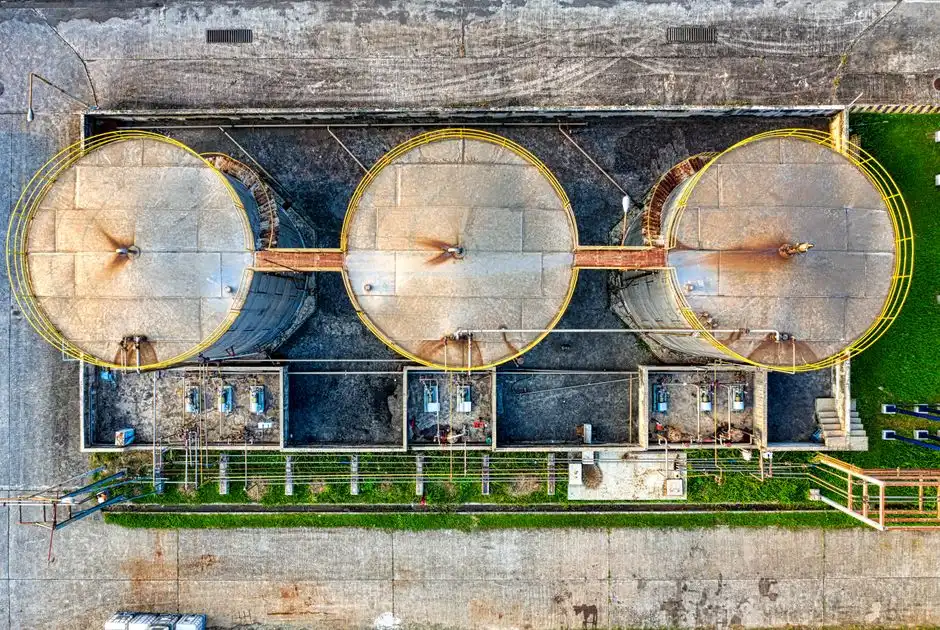
Equipment selection should follow stream-by-stream sampling because equal flow does not mean equal treatment difficulty. Cooling blowdown is continuous and salinity-controlled, RO reject is concentrated, oily cooling water can be intermittent, floor wash and runoff fluctuate with operations and rainfall, and sanitary sewage is governed by biological loading rather than cooling chemistry.
For cooling blowdown, the 2026 Metro Manila guide characterizes TDS at 1,200–6,000 mg/L and suspended solids at 10–50 mg/L, with residual biocides, scale inhibitors, and corrosion products. The same source advises that membrane fouling is the dominant tropical-service failure mode, making upstream solids removal and biocide management part of the membrane design rather than optional accessories.
Oily streams need oil-and-grease characterization and DAF or equivalent pretreatment before membrane treatment. The DAF oil and solids pretreatment can remove the free oil and floatable material that would otherwise foul downstream equipment, but the RFQ must define the measured contaminant load and the required pretreatment performance.
Sanitary sewage should be evaluated as a biological stream. A packaged integrated MBR treatment system or a WSZ integrated sewage treatment system is a more appropriate basis than sending sewage through a blowdown membrane train.
| Stream | Flow and contaminants to characterize | Sampling point | Design implication |
|---|---|---|---|
| Cooling blowdown | Flow variability; TDS; suspended solids; hardness; silica; chloride; sulfate; residuals | Tower basin and calibrated blowdown line | Filtration, antiscalant, UF and RO basis |
| RO reject | Flow; TDS; hardness; silica; ionic composition | RO concentrate outlet | Separate blending or concentration decision |
| Oily cooling water | Oil and grease; suspended solids; temperature | Generator or equipment cooling drain | DAF or equivalent before membranes |
| Floor wash and drain runoff | Flow; solids; cleaning chemicals; oil and grease | Floor drains and collection sump | Storage and variable-flow treatment |
| Stormwater | Runoff flow; solids; oil and grease; seasonal contaminants | Drain inlet and discharge sump | Event-based capacity and outlet controls |
| Sanitary sewage | Flow; organic load; nutrients; peak demand | Building sewer and treatment inlet | Biological package or MBR sizing |
Before final sizing, request measurements of hourly and daily flow, conductivity, TDS, pH, suspended solids, silica, hardness, chloride, sulfate, oil and grease, temperature, and chemical residuals. These inputs determine pretreatment, storage, recovery, membrane area, and dosing requirements.
Set the reuse target before choosing the treatment train
Reuse quality must be specified as an operating envelope, not as a general statement that treated water will be “recycled.” The 2026 Metro Manila guide gives cooling-makeup targets of TDS 500–1,500 mg/L, suspended solids 10–25 mg/L, pH 6.5–8.5, and silica below 150 mg/L to maintain manageable scaling risk at 4–6 CoC.
The destination determines the required process. Toilet flushing or equipment washing may require a lower-grade treated stream, provided the facility’s water balance, public-health requirements, and equipment compatibility support that use. Cooling-tower makeup is more restrictive because hardness, silica, conductivity, corrosion chemistry, and residual biocide concentration affect the cooling loop. Tighter reuse quality can justify NF polish or further demineralization; the EDI polishing system is relevant only where ion removal remains necessary after the selected primary train.
Water usage and consumption must also be reported separately. Genesis Water Technologies (2025-12) defines consumption as water permanently removed through evaporation or incorporation, while usage includes water returned to the source after treatment. Treated blowdown can support irrigation, toilet flushing, outdoor equipment washing, and—after advanced treatment—cooling-tower makeup, but the recovery claim should distinguish water returned from water permanently consumed.
| Reuse objective | Quality to establish | Treatment implication |
|---|---|---|
| Toilet flushing or suitable washing | Site-approved quality, temperature and storage requirements | Degree of treatment demonstrated by the facility water balance |
| Cooling-tower makeup | TDS 500–1,500 mg/L; suspended solids 10–25 mg/L; pH 6.5–8.5; silica below 150 mg/L | Filtration, UF, RO; NF or further polishing when hardness or silica binds |
| Permitted discharge | Current limit for the actual receiving water and outlet | Compliance-based train and monitoring |
Set the metered reuse target from annual measured blowdown availability, seasonal cooling demand, storage capacity, and conservative measured supply. A design based on theoretical blowdown alone overstates recoverable water.
Choose among filtration, UF plus RO, NF polish, and ZLD
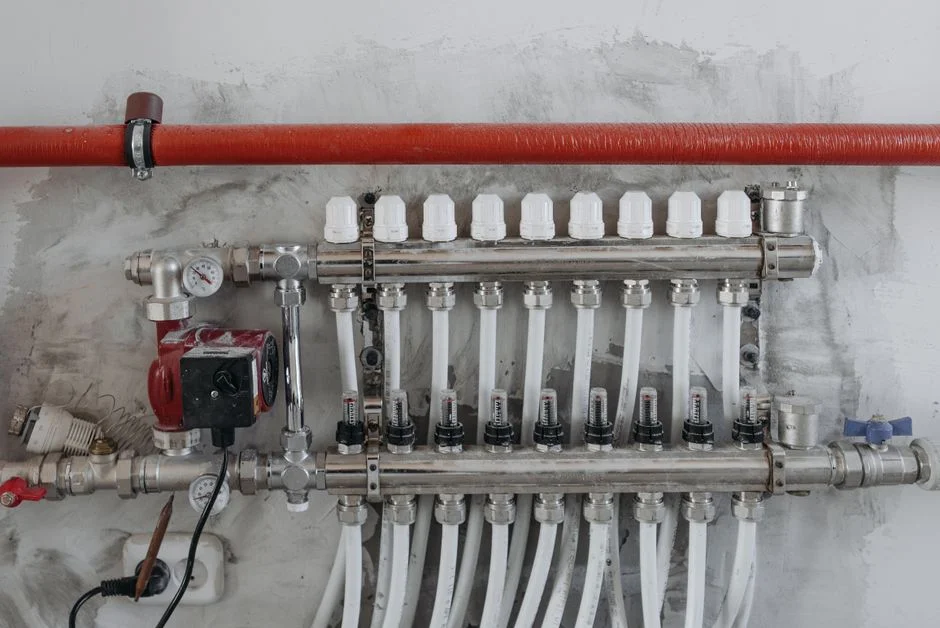
The least complex train that satisfies both reuse quality and the permitted outlet should be selected. The 2026 Metro Manila guide describes four options, each with a different recovery and salt-removal capability.
- Side-stream filtration: A 10–25 micron self-cleaning filter treating 1–5% of circulation flow can hold blowdown suspended solids below 15 mg/L. It supports higher CoC but does not remove TDS, so it cannot by itself resolve a dissolved-solids discharge limit (HydropureWater, 2026).
- UF plus brackish RO: This is the default brine-reuse train. The guide reports 50–85% blowdown recovery and permeate at 10–50 mg/L TDS. Membrane fouling is the dominant tropical-service failure mode, so a multi-media filtration system or side-stream filter should protect the PVDF ultrafiltration pretreatment system before the industrial reverse osmosis system.
- NF polish: Add NF where hardness is the binding constraint. Stage-specific NF recovery is reported at 70–85%, with NF permeate blended with RO permeate to raise reuse volume; that figure is not the recovery of the complete UF-plus-RO-plus-NF train (HydropureWater, 2026).
- RO plus MVC for ZLD: The guide reports 95–98% recovery, distillate below 10 mg/L TDS, and energy demand of 15–25 kWh per 1,000 gallons for the UF-plus-RO-plus-MVC option (HydropureWater, 2026). MVC requires power, heat integration, reliable brine handling, and operator capability beyond a conventional RO package.
For difficult high-salinity streams, controlled salt removal is an alternative to forcing conventional RO beyond its scaling limits. IDE’s 2026 industrial example combines cooling-tower blowdown, RO brine, and process wastewater at approximately 95% recovery and reports about 1 mg/L silica in the desalter permeate. That is evidence for the process principle, not a guaranteed Paranaque result. The high-salinity RO engineering and zero-fouling design explains the scaling and salt-precipitation considerations.
| Option | Recovery scope | Output | Best-fit decision |
|---|---|---|---|
| Side-stream filtration | No volume reduction; supports higher CoC | Suspended solids below 15 mg/L | Solids control only; TDS remains |
| UF plus BWRO | 50–85% of blowdown | Permeate at 10–50 mg/L TDS | Default internal brine reuse |
| UF plus RO plus NF | NF stage at 70–85%; overall recovery requires mass balance | Blended lower-hardness permeate | Hardness-controlled reuse |
| UF plus RO plus MVC | 95–98% | Distillate below 10 mg/L TDS | Restricted outlet or contractual ZLD |
Use UF for reliable solids pretreatment and industrial RO as the default brackish-water reuse train. Where microbial control is required, evaluate a UV disinfection system or an on-site chlorine dioxide disinfection system against the residual-management objective.
Confirm the Paranaque compliance and receiving-water pathway
Permit classification and the actual receiving-water route determine the required treatment performance. The 2026 Metro Manila guide identifies DENR DAO 2021-19 for industrial effluent quality, LLDA clearance for a site discharging into the Laguna Lake watershed, and PEOS/EIS requirements for hyperscale builds. None of these instruments alone establishes the final Paranaque outlet or numerical limit.
Confirm the applicable limits against the current DENR framework, the receiving-water classification, local permits, and the drainage basin. Do not rely on a generic 1,500 mg/L or 1,000 mg/L TDS ceiling reproduced in the cited material. Paranaque’s outlet could involve a sewer, a controlled drainage route, or another receiving water; each requires its own permitted pathway and technical confirmation.
- Map every source stream to its physical discharge point.
- Identify whether each treated stream may be reused internally, discharged to sewer, or sent to a controlled receiving-water route.
- Confirm the governing permit, receiving-water class, sampling requirements, and applicable local conditions.
- Define the monitoring plan before fixing treatment guarantees.
Commissioning and operating controls should monitor temperature, pH, TDS, chloride, sulfate, suspended solids, and chemical residuals. Source-water testing and permit confirmation are gating inputs, not assumptions to be closed during equipment procurement. The Metro Manila cooling blowdown treatment guide should be used as a technical starting point, then reconciled with the final Paranaque permit conditions.
Budget for capacity, lifecycle cost, and operating complexity
Early budgeting should use the 2026 Metro Manila benchmarks only as screening values. The guide gives an illustrative 50,000 GPD RO cost of $250,000–$500,000 and operating cost of $1.50–$3.00 per 1,000 gallons. It also gives a ZLD increment of $3–8 million and $5–15 per 1,000 gallons. These figures require a project-specific quotation after flow, analysis, storage, concentrate disposal, and utility conditions are defined.
The ZLD case must also be evaluated against the 15–25 kWh per 1,000 gallons reported for UF plus RO plus MVC (HydropureWater, 2026). That energy burden can change both operating economics and the facility’s power and cooling requirements.
| Cost element | What the supplier must price | Buyer check |
|---|---|---|
| Capital equipment | Filtration, UF, RO, NF or MVC, tanks, pumps, controls and pretreatment | Does the quotation match the selected duty and storage? |
| Power | Design-load consumption plus auxiliary loads | Are kWh per 1,000 gallons stated at the guaranteed operating point? |
| Chemicals | Antiscalant, biocide, coagulant and cleaning chemicals | Are doses tied to feed chemistry and recovery? |
| Membranes and filters | Replacement frequency, membrane inventory and cleaning chemicals | Are warranty terms and tropical-service assumptions explicit? |
| Residuals | Concentrate volume and chemistry, sludge or salt handling | Is there a confirmed receiving route and disposal cost? |
| Operations | Staffing, preventive maintenance, downtime and spares | Can the facility’s team support the proposed complexity? |
Include membrane replacement, antiscalant and biocide consumption, power, pretreatment, sludge or concentrate disposal, operator attention, and downtime in lifecycle cost. An automatic chemical dosing system should be priced as part of feed protection, while RO and UF replacement elements belong in the operating reserve.
Genesis Water Technologies (2025-12) recommends right-sizing modular treatment around facility scale and staff capability rather than importing hyperscale complexity into a smaller colocation site. Build payback around avoided freshwater, avoided discharge, chemical savings, and continuity value—not water savings alone.
Build an RFQ that engineers can compare
A comparable RFQ must define the process duty and performance envelope before asking vendors to price equipment. State the source-water analysis, destination, required recovery, concentrate route, and guarantee basis for every stream. Omitting these inputs makes technically different bids appear comparable.
| RFQ package | Required information | Comparable supplier response |
|---|---|---|
| Duty basis | Hourly and daily flow by stream; operating hours; storage; future expansion | Design flows, turndown, storage assumptions and sizing calculation |
| Process guarantee | Permeate flow and quality, recovery, concentrate volume and chemistry | Guaranteed values, test conditions and remedy for non-compliance |
| Operating guarantee | Energy use at design load; cleaning frequency; chemical demand | Measured consumption and maintenance assumptions |
| Equipment | Materials, PLC scope, instrumentation, backwash, dosing, pretreatment and disinfection | Technical datasheets, controls narrative and battery limits |
| Reliability | Redundancy, access, spares and service response | Single points of failure, critical spares and support plan |
| Engineering records | Mass balances, scaled drawings, P&IDs, FAT/SAT and warranties | Complete issue for review with the required supporting calculations |
| O&M | Staffing, routine tasks, cleaning, calibration and reporting | Workbook, task frequency and operator-training scope |
Ask for materials of construction, local-control scope, automatic backwash, dosing, pretreatment, disinfection, redundancy, maintenance access, membrane warranties, spare-parts lists, and O&M staffing assumptions. Include factory and site acceptance protocols and require the treatment parts, valves, and filter media schedule to identify wear items and compatible replacements.
Use the staged sequence proposed by Genesis Water Technologies (2025-12): establish measurement and the baseline, optimize the cooling system, review chemical control, implement treatment and reuse, then consider advanced integration. Every design value in the final proposal must be tied to current Paranaque permits, source-water testing, and the selected equipment duty.
Frequently Asked Questions
How much should a Paranaque data center budget for cooling blowdown treatment?
Use preliminary screening benchmarks, not a final quotation. HydropureWater’s 2026 Metro Manila guide gives $250,000–$500,000 for an illustrative 50,000 GPD RO train and $1.50–$3.00 per 1,000 gallons in operating cost. Its ZLD increment is $3–8 million, with $5–15 per 1,000 gallons in operating cost. Request itemized quotations for pretreatment, membranes, controls, chemical dosing, residuals, energy, maintenance, and disposal; confirm whether each figure includes commissioning, freight, taxes, storage, and startup consumables.
What flow data are needed to size the treatment train?
Size from measured peak and average flows for each segregated stream, not facility megawatts alone. Include operating hours, makeup and blowdown meters, storm runoff, storage, seasonal cooling demand, and the required recovery percentage. Source-water testing should cover conductivity, TDS, pH, suspended solids, silica, hardness, chloride, sulfate, oil and grease, temperature, and residual chemicals. Use conservative measured blowdown supply rather than the theoretical CoC result.
How should a buyer compare treatment suppliers?
Compare guaranteed process performance and lifecycle cost, not skid price alone. Require pretreatment and membrane-protection provisions, guaranteed permeate flow and quality, recovery, concentrate chemistry, design-load energy use, cleaning frequency, controls scope, redundancy, FAT/SAT protocols, warranty terms, spare parts, and O&M support. Ask each supplier to show that its proposed train meets the actual Paranaque permit conditions and the reuse target. If comparing RO with NF, use the RO versus NF decision framework to keep stage-specific recovery and overall system recovery separate.
Does discharge treatment, internal reuse, and ZLD require the same equipment?
No. Internal reuse requires water quality appropriate to the destination, including the 2026 guide’s cooling-makeup targets of TDS 500–1,500 mg/L, suspended solids 10–25 mg/L, pH 6.5–8.5, and silica below 150 mg/L. Discharge treatment must meet the limits for the confirmed outlet and receiving-water class. ZLD requires the higher-recovery RO-plus-MVC configuration and a defensible residual-management plan. Confirm the actual Paranaque permits before selecting any of these bases.
When is NF or additional polishing required for cooling-tower makeup?
Add NF when hardness is the binding reuse constraint, and consider further polishing when conductivity, ions, or silica remain outside the cooling-system acceptance envelope. NF stage recovery should not be presented as total-train recovery; the blend and overall water balance must be shown. Silica testing is especially important because high-salinity blowdown can concentrate sparingly soluble salts. The supplier’s guarantee should state the final blended water quality and the conditions under which polishing is required.
Related Equipment
- DAF oil and solids pretreatment — specifications, capacity range, and technical data