
What determines the right system for a Helsinki factory?
A Helsinki factory generally needs a dissolved air flotation (DAF) system when its wastewater contains recoverable oil, grease, suspended solids, or colloidal material, especially where these loads could interfere with later biological treatment. It needs a full industrial effluent treatment plant (ETP) when discharge also requires biological, nutrient, disinfection, or advanced polishing stages. In a refinery-type ETP, DAF can act as a secondary clarifier after an API separator, using coagulants to destabilise emulsions and micro-bubbles to lift residual oils and fine solids. The correct Helsinki system cannot be selected from location alone: obtain representative wastewater samples, peak and average flows, pollutant tests, reuse requirements, and applicable discharge or sewer conditions before choosing equipment.
Start with a representative sample rather than a generic factory profile. Test oil and grease, suspended solids, colloids, pH, COD, BOD, nutrients, conductivity, temperature, and any industry-specific contaminants. Record average flow, peak flow, batch-discharge events, storm-water contributions, operating hours, and anticipated production changes. A single composite sample may conceal short cleaning or production discharges, so sampling across operating states is more defensible.
Define the destination before selecting equipment. Direct environmental discharge, municipal sewer, internal reuse, or transfer to a central treatment plant creates different treatment duties. The ETP/DAF distinction is architectural: an ETP is an integrated treatment train, while DAF is one separation technology commonly used within that train.
Ensun’s 2026 Finland search identified local wastewater and water-treatment providers, but a listed company is only a starting point. Use the 2026 DAF selection and decision framework to structure the technical review; the factory’s wastewater profile, destination, and operating conditions must drive the final choice.
Choose DAF, a biological ETP, or a combined treatment train
The correct architecture follows from the dominant contaminant and the required effluent quality. Choose DAF as the primary physical or chemical step when free or emulsified oil, FOG, suspended solids, and colloidal material dominate the removable load. In the refinery example described in the Quora answer of July 15, an API separator first removes large free-floating oil and heavy sediment; DAF follows to capture residual emulsions and fine solids before biological treatment. Where stable emulsions are present, coagulation or flocculation destabilises them so that bubbles can lift the remaining oil and solids.
Choose biological treatment when biodegradable dissolved organics dominate and the receiving route requires BOD or COD reduction. The secondary-treatment definition in the same Quora source identifies aerobic and anaerobic biological options, but route selection still depends on the wastewater and receiving conditions. A combined ETP with tertiary treatment is appropriate when the factory needs DAF, biological treatment, and final clarification or disinfection rather than flotation alone.
Do not prescribe a universal arrangement for Helsinki. Finland’s industrial permits or sewer requirements, and the factory’s actual destination for the treated water, must be confirmed for the project. If the proposed solution includes a biological stage, review the integrated wastewater treatment configuration against the confirmed treatment objectives rather than treating equipment naming as proof of suitability.
| Observed wastewater or destination | Indicated treatment architecture | Selection question |
|---|---|---|
| Free or emulsified oil, FOG, suspended solids, or colloids dominate | DAF-based physical/chemical treatment, with coagulation or flocculation where required | Does flotation alone meet the final discharge or reuse objective? |
| Biodegradable dissolved organics dominate | Biological ETP, using aerobic or anaerobic treatment as process analysis indicates | What BOD, COD, nutrient, and receiving-route reductions are required? |
| Oil-bearing wastewater enters a biological process | Physical separation followed by DAF, then biological treatment | Will upstream emulsion and solids removal protect the biological stage? |
| Reuse or discharge requires additional quality | Combined ETP with the required clarification, filtration, disinfection, or other validated polishing | Which final treatment stage is validated for the actual wastewater? |
How the industrial DAF process removes oil and solids
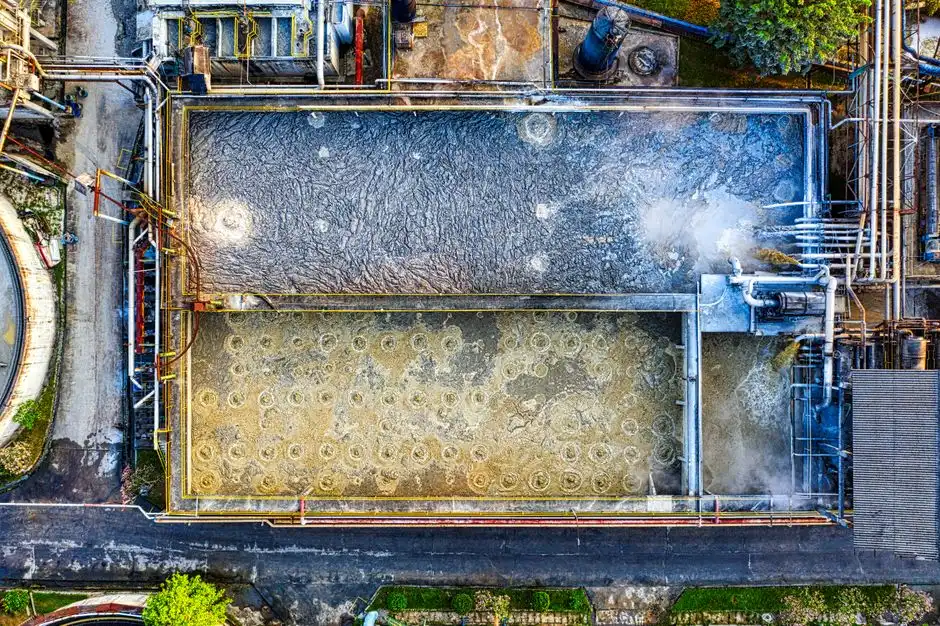
DAF separates oil and solids by attaching air bubbles to particles so they rise to the water surface. According to the July 15 Quora answer, a portion of clarified effluent is pressurised and saturated with air in a dedicated drum before being returned to the flotation tank. The pressure drop releases dissolved air as micro-bubbles; the same source gives a common bubble diameter of 10–100 microns.
Bubbles attach to suspended solids and tiny oil droplets, reducing the particles’ effective specific gravity so they rise rapidly to form a surface froth. A mechanical skimmer removes the accumulated froth into a sludge-holding tank, while clarified water leaves below an overflow weir. This arrangement makes the industrial DAF system suitable for separating floatable materials, provided the feed chemistry and contaminant form are compatible with flotation.
DAF is not a substitute for controlling incompatible influent or for removing contaminants that cannot be separated by flotation. A factory must examine the behavior of its own wastewater, including emulsions, temperature, pH, and any production chemicals that may interfere with separation. For higher-quality reuse or a downstream biological process, pair DAF with clarification, filtration, biological treatment, or another validated polishing stage required by the project.
The equipment specification should include not only the flotation tank but also feed and recycle arrangements, pressure-saturation equipment, air supply, chemical preparation, skimming, sludge transfer, controls, and the duty needed by any downstream process. Without those supporting details, a capacity statement for the tank alone is not a complete ETP design.
Size the DAF around peak flow and contaminant loading
DAF sizing must cover peak hydraulic demand, batch dumping, contaminant loading, and expected expansion; a daily average alone is not a sufficient design basis. HydropureWater lists 13 DAF models spanning 4–300 m³/h, but that catalogue range is not a recommendation for a Helsinki factory without site data. Confirm the selected model against measured flows and representative wastewater testing.
Check the wastewater’s oil, grease, suspended-solids, and colloidal load against the selected model’s permitted application envelope. Specify the required recycle, saturation, and flotation performance after process engineering. The supplied research supports no universal pressure, contaminant-loading rate, or removal rate for this project, so those values must come from the wastewater analysis, selected process design, and supplier’s process guarantee.
Plan chemical treatment where emulsions or unstable solids require destabilisation. The automatic chemical dosing system should be defined around the selected coagulant or flocculant, required dose range, mixing, duty controls, chemical storage, and operator safeguards. pH adjustment may also be required, but the required range must come from laboratory testing rather than a generic prescription.
Include sludge handling in the ETP sizing. Mechanically skimmable DAF sludge requires transfer, storage, odor control, and dewatering provision. A plate-and-frame filter press may be considered where the recovered sludge characteristics justify it, but the equipment decision should follow solids concentration, composition, retention requirements, and disposal route.
| Design input | Evidence required | Why it affects ETP sizing |
|---|---|---|
| Hydraulic demand | Average flow, peak flow, batch-discharge profile, and operating hours | Determines hydraulic capacity and surge or equalisation requirements |
| Contaminant loading | Representative oil, grease, suspended-solids, and colloid analyses across production states | Determines whether flotation alone is adequate and what separation performance is required |
| Process chemistry | pH, temperature, chemical use, and emulsion characteristics | Determines pretreatment, coagulant or flocculant dosing, and operating controls |
| Downstream duty | Confirmed biological, polishing, reuse, discharge, or sewer requirements | Determines whether DAF must be integrated into a wider treatment train |
| Residuals | Sludge quantity, characteristics, storage, odor, and disposal assumptions | Determines sludge collection, transfer, storage, and dewatering scope |
Specify controls, local support, and lifecycle requirements
A comparable quotation must define the complete operating envelope, not just the nominal treatment capacity. Request the feed conditions, guaranteed operating envelope, controls scope, utilities, recycle arrangement, sludge handling, and required accessories. Ask suppliers to base performance claims on representative wastewater rather than only clean-water or synthetic-sample results.
Confirm automatic controls, skid integration, electrical requirements, operator interface, remote monitoring, and availability of critical spare parts. For a Helsinki project, also establish the commissioning boundary, local engineering support, response arrangements, documentation language, training, and responsibility for resolving performance issues.
Ensun’s 2026 Finland search reported 41 matching manufacturers and 23 service providers and included Kemira, Solid Water, Veolia Water Technologies, Roxia, and FlooTech among the results. Use those entries to build a shortlist, not to infer technical performance. Ensun’s employee-count figures are directory metadata rather than evidence that a supplier can design, commission, or maintain a factory-specific treatment train.
Request lifecycle information for pumps, compressors, membranes or filtration elements if present, chemicals, energy, maintenance, and sludge disposal. Do not publish unsupported cost ranges. The industrial DAF supplier-selection guide and the 2026 DAF selection and decision framework can support the RFQ structure, but the supplier must state the proposed operating basis, exclusions, warranty boundaries, and acceptance method.
Build a Helsinki factory ETP and DAF procurement checklist
A defensible procurement starts with measured wastewater and flow data, not a product name. Obtain characterization and flow monitoring from multiple production states, including normal production, cleaning, and peak-discharge periods. Confirm the receiving route and applicable Finnish environmental or municipal sewer conditions with the responsible authority or receiving utility.
Issue the RFQ with the wastewater results, average and peak flow, reuse or discharge target, site constraints, utilities, automation requirements, and future-capacity assumptions. Require bidders to compare complete DAF and ETP configurations—not isolated equipment prices—so that pretreatment, biological, tertiary, sludge, controls, and commissioning items are visible.
Define performance acceptance tests, operator training, documentation, spare parts, warranty boundaries, and local commissioning support. Use the regional DAF engineering and supplier comparison guide as a technical reference during review, but verify every project-specific claim against Helsinki requirements and the actual wastewater.
| Stage | Required action | Output for the procurement file |
|---|---|---|
| Characterisation | Sample across production, cleaning, and peak-discharge states; measure flow and required pollutants | Signed wastewater analysis and flow profile |
| Destination confirmation | Confirm environmental, sewer, reuse, or central-treatment route with the responsible party | Applicable treatment and documentation requirements |
| Process selection | Compare DAF, biological ETP, and combined configurations against the measured duty | Selected process basis and treatment train |
| RFQ | Provide site data, utilities, controls, sludge, expansion, and acceptance requirements | Like-for-like complete-system quotations |
| Supplier review | Check representative-feed basis, operating envelope, local support, and lifecycle scope | Clarification record and technical compliance matrix |
| Acceptance | Agree test methods, sampling conditions, acceptance limits, training, and documentation | Signed performance test and handover plan |
Frequently Asked Questions
How much does an industrial DAF or ETP cost in Helsinki?
The supplied evidence provides no reliable Helsinki price range. Request itemised quotations using the factory’s measured flow, wastewater analysis, treatment objectives, civil works, automation, energy, chemicals, and sludge-disposal assumptions. Compare complete configurations and ask bidders to list exclusions, guarantees, commissioning costs, and lifecycle items separately.
Should a Helsinki factory choose DAF alone or a full ETP?
Choose DAF alone only when its physical and chemical separation duties meet the complete discharge or reuse objective. Add biological or tertiary stages when dissolved organics, nutrients, pathogens, or required effluent quality demand them. A refinery-type treatment train described in the July 15 Quora source uses DAF as a barrier before biological treatment, but that arrangement must be validated against
Frequently Asked Questions
How much does an industrial DAF or ETP system cost for a factory in Helsinki?
For a standard industrial facility in Helsinki, a Dissolved Air Flotation (DAF) unit typically ranges from €80,000 to €250,000, depending on throughput and stainless steel grade requirements. A complete Effluent Treatment Plant (ETP) involving chemical dosing, DAF, and biological treatment stages can cost between €300,000 and €1.5 million.
These figures exclude civil engineering, site-specific installation, and connection to municipal Helsinki Region Environmental Services (HSY) sewer networks, which can add 30-50% to the total capital expenditure.
Should our Helsinki factory choose DAF alone or a complete ETP?
The choice depends on whether your discharge meets the HSY sewer acceptance criteria. If your primary pollutants are fats, oils, and greases (FOG) or suspended solids, a DAF system is often sufficient for pre-treatment to avoid surcharges.
If your wastewater contains high levels of dissolved organic matter (measured as BOD or COD), nitrogen, or phosphorus, a DAF alone will not suffice. In such cases, a complete ETP integrating biological treatment (such as MBBR or MBR) is required to meet the strict Finnish environmental discharge standards.
What wastewater and flow data do DAF and ETP suppliers need for sizing?
Suppliers require a representative 24-hour flow profile, including peak and average hourly flow rates (m³/h). Critical water quality parameters must include pH, Total Suspended Solids (TSS), Chemical Oxygen Demand (COD), Biological Oxygen Demand (BOD), and FOG concentrations.
Additionally, information regarding temperature fluctuations and the presence of inhibitory substances, such as heavy metals or harsh cleaning chemicals, is essential to ensure the sizing of equalization tanks and the selection of appropriate chemical coagulants.
Can a DAF system protect downstream biological treatment from oily wastewater?
Yes, a DAF system is highly effective at protecting biological treatment processes by removing emulsified oils and greases that would otherwise coat biomass or clog aeration membranes. By reducing the FOG load by 80-95%, the DAF prevents the formation of an oil film that inhibits oxygen transfer in aerobic systems.
Properly operated DAF systems also reduce the organic loading (COD/BOD) on the biological stage, allowing for a smaller, more stable downstream footprint and preventing potential toxicity from high-strength oily surges.
What is the compliance risk of selecting industrial wastewater equipment using flow alone?
Selecting equipment based solely on flow rate creates a high risk of regulatory non-compliance and operational failure. Flow data does not account for pollutant mass loading, which dictates the sizing of chemical dosing systems, sludge handling capacity, and the retention time required for biological degradation.
If the pollutant concentration exceeds the design capacity of the equipment, the effluent will fail to meet Helsinki’s municipal discharge limits, leading to heavy non-compliance fines, potential sewer connection revocation, and environmental liability under Finnish water protection regulations.