Package Wastewater Treatment Plant Cost Bahrain by Installed Capacity
A package wastewater treatment plant cost Bahrain buyers can screen against is $1,200–$2,500 per m³/day for 100–2,000 m³/day units, against $3,000–$6,000 per m³/day for custom plants. Commissioning takes 6–12 months, not 3–5 years.
Units in the wider catalogue start near 10 m³/day and stop around 2,000 m³/day, and turnkey package CAPEX up to that size usually falls between $1.2 million and $5 million. Reuse specifications on Bahrain projects still read TSS <10 mg/L and BOD <10 mg/L. Teams that leave a one-off civil plant often book the change as reducing CAPEX by 30-40%, before duty and land. Most plants we size for compounds and light industry sit at the lower end of that band when the sewage is domestic.
The package wastewater treatment plant cost Bahrain screen of $1,200–$2,500/m³/day is a supply-and-install figure for 100 to 2,000 m³/day, not a whole-life price. Buyer notes from 2025 still average $1,200–$2,500/m³/day for turnkey installations in that band. Civil works, import duty and a year of operator training sit outside many quotations. Ask for those three lines in writing before you compare two bids on the same flow.
Package Sewage Treatment Plant CAPEX OPEX Bahrain
Package sewage treatment plant CAPEX in Bahrain for 100–2,000 m³/day is usually $1,200–$2,500/m³/day, while a custom plant above that size is usually $3,000–$6,000/m³/day. OPEX in this climate is led by power. Energy takes 40–50% of package-plant OPEX, chemicals 20–30%, labor 10–20%, and maintenance 10–15%. On jobs we price here, the energy share runs at the lower end only when the process is A/O, not MBR.
| Cost Category | Package Wastewater Treatment Plant (100-2,000 m³/day) | Custom Wastewater Treatment Plant (>2,000 m³/day) |
|---|---|---|
| CAPEX (per m³/day capacity) | $1,200 - $2,500 | $3,000 - $6,000 |
| OPEX Breakdown (Approximate % of total) | Energy: 40-50% Chemicals: 20-30% Labor: 10-20% Maintenance: 10-15% |
Energy: 30-40% Chemicals: 15-25% Labor: 20-30% Maintenance: 15-20% |
| Water Reuse Value (per m³) | $0.50 - $1.50 (vs. desalinated at $1.20 - $2.00) | $0.50 - $1.50 (vs. desalinated at $1.20 - $2.00) |
| Deployment Timeline | 6 - 12 months | 3 - 5 years |
| Land Requirement | 0.5 - 2 m²/m³/day (can be underground) | 5 - 10 m²/m³/day |
| Government Subsidies (for reuse) | Up to 30% for industrial projects | Up to 30% for industrial projects |
What Moves the Price After the Unit Rate
Reuse water on Bahrain projects is valued at $0.50–$1.50/m³ for irrigation or industrial duty. Desalinated water on the same comparison sits at $1.20–$2.00/m³. A subsidy of up to 30% is cited for industrial reuse projects, and non-compliance fines sit on the other side of that ledger. Most payback cases we review close only when the reuse offtake is contracted, not hoped for.
Hidden lines still move the award: land falls away when the tank is buried, import duty on non-GCC equipment is typically 5–10%, and operator training is a separate purchase from the skid. The Tubli STP Phase 4 expansion in 2023 cut CAPEX by 25% by using modular package units for tertiary treatment. Large plants borrow that pattern when a full custom rebuild is too slow.
Price these seven drivers before you award a package plant in Bahrain:
- Installed flow, in m³/day, including the peak day rather than the average day.
- Process choice, because MBR power sits above A/O power on the same flow.
- Salinity pretreatment once influent TDS climbs past the biological limit.
- Buried versus surface civil works, including traffic load over a lid.
- Import duty, typically 5–10% on non-GCC equipment.
- The reuse offtake price, set against desalinated water at $1.20–$2.00/m³.
- The local O&M contract, quoted at $0.10–$0.30/m³ treated.
Why Bahrain Projects Buy Decentralized Package Plants
A 2023 project note put Bahrain freshwater supply at 80% desalination and 20% groundwater, and put extraction at 300% of natural recharge. That imbalance is why reuse shows up on almost every new compound brief. The same notes described the National Water Strategy 2030 as a full wastewater-reuse mandate for irrigation and industrial processes. Package plants are the tool those notes name for flows that never justify a city works.
The Kingdom of Bahrain SDG portal, updated 5 July 2026, records that the Government approved the National Water Strategy 2030 in 2018, in line with the GCC Unified Water Strategy (2016–2035). The portal states the strategy's aim as effective management and a sustainable supply of the required quality, on three pillars: coordination, monitoring and awareness. It also reports that all wastewater in the Kingdom is safely treated, with sanitation and drinking-water services recorded as fully safely managed. Safely treated water is not the same claim as water reused on a farm or a cooling tower.
Madinat Salman, a development for 100,000 residents, uses treated wastewater for irrigation and was estimated to cut freshwater demand by 40%. A package plant up to 2,000 m³/day is quoted at $1.2 million to $5 million. A Tubli-scale custom works is quoted at $50 million-plus. Build time is the other gap: 6–12 months for a package plant, against 3–5 years for a custom works.
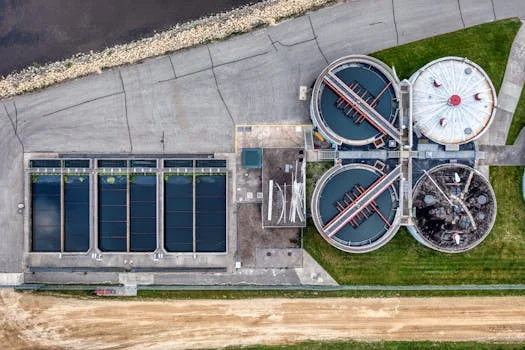
On island compounds we have reviewed, the buried package unit is chosen because the plot cannot spare 5–10 m²/m³/day. Modular steps also let the owner add capacity without rebuilding the headworks. That is the practical case for a package plant, not a general preference for small equipment.
Technical Specifications for Package Wastewater Treatment Plants in Bahrain
MBR, SBR and A/O trains are the three processes buyers compare for Bahrain package plants. MBR, including the train at Ma'Amir Sewage Treatment Plant, is specified for influent up to 10,000 mg/L TDS. SBR is the flexible choice when industrial flow swings through the week. An A/O train, including the HydropureWater's WSZ Series package plant for Bahrain's urban projects, holds nutrient removal at lower power but needs pretreatment once salinity passes 5,000 mg/L.
Footprint, Power and Sludge
Footprint for a package plant is about 0.5–2 m²/m³/day, against 5–10 m²/m³/day for a conventional custom plant. Modules step up in increments as small as 50 m³/day. Power is the OPEX driver: MBR systems typically consume 0.4–0.8 kWh/m³, while A/O systems run at 0.2–0.5 kWh/m³ (per 2024 EPA benchmarks). Reuse effluent targets used with these trains are TSS <10 mg/L, BOD <10 mg/L and TN <15 mg/L.
Sludge volume falls 70–80% when dewatering, often a plate-and-frame press, is built into the package. That cut matters because landfill space on the island is tight. Designers who need inlet numbers should use bahrain sewage treatment plant influent bod cod tss typical values from the design guide, then return here for cost. Membranes we specify on coastal sites foul faster in summer, so cleaning access is part of the layout, not a later extra.
| Technical Specification | MBR System (e.g., Ma'Amir STP) | SBR System | A/O System (e.g., HydropureWater WSZ Series) |
|---|---|---|---|
| Salinity Tolerance (Influent TDS) | Up to 10,000 mg/L | Up to 5,000 mg/L | Up to 5,000 mg/L (pretreatment for higher) |
| Footprint Requirement | 0.5 - 1.0 m²/m³/day | 1.0 - 1.5 m²/m³/day | 1.5 - 2.0 m²/m³/day |
| Energy Consumption | 0.4 - 0.8 kWh/m³ | 0.3 - 0.6 kWh/m³ | 0.2 - 0.5 kWh/m³ |
| Effluent Quality (BOD, TSS, TN) | BOD <5, TSS <5, TN <10 mg/L | BOD <10, TSS <10, TN <15 mg/L | BOD <10, TSS <10, TN <15 mg/L |
| Modularity/Scalability | High, 50 m³/day increments | Medium, 100 m³/day increments | High, 50 m³/day increments |
| Sludge Volume Reduction | 70-80% (integrated dewatering) | 60-70% (external dewatering) | 60-70% (external dewatering) |
For high-salinity reuse duty, see MBR systems for Bahrain's high-salinity wastewater and reuse goals. Where the plot is tight, an Underground Package Sewage Treatment Plant (WSZ Series) can sit below grade and leave the surface for parking or landscape. Pick the buried tank only after a groundwater and traffic-load check.
Biofouling on high-TDS membranes is handled with a dosing skid such as Chlorine dioxide generators to mitigate biofouling in Bahrain's high-salinity conditions. Do not size that skid from seawater TDS alone. Match the dose to the residual the reuse spec allows, then check the sea-discharge residual if any blowdown leaves the site.
Package WWTP Permitting and EIA Process Bahrain
Package WWTP permitting in Bahrain still takes a planning allowance of 6–12 months from application to commissioning. The Supreme Council for Environment issues the environmental decision. The Ministry of Works remains the sewerage counterpart on municipal ties. Files we see slip when the EIA scope expires before the study is filed.
Earlier notes tied environmental discharge limits to Environmental Law No. 21/1996 and quoted TSS <30 mg/L, BOD <25 mg/L and COD <125 mg/L. Ministerial Resolution No. 3 of 2021, published in the Official Gazette on 8 April 2021, repealed Decision No. 10 of 1999 on air and water standards. According to Table 1, Standards of Waste Water Discharged to Sea, the maximum is TSS 30 mg/L, BOD 25 mg/L and COD 150 mg/L. Monthly averages in that table are 20 mg/L TSS, 15 mg/L BOD and 100 mg/L COD.
Sea Discharge Limits and the Reuse Screen
Those sea limits are not the reuse limits. Unrestricted irrigation specs in current project notes still call for less than 10 E. coli/100 mL, with TSS and BOD held under 10 mg/L. According to the Supreme Council for Environment EIA Guideline (2025), Bahraini national standards come first, and WHO or US EPA references are used only where no national number exists. Keep the two tables apart when you write the performance limit.
The same sea table sets oil and grease at 8 mg/L as a monthly average and 10 mg/L as a maximum. Total Kjeldahl nitrogen is 5 mg/L monthly and 10 mg/L maximum. Ammoniacal nitrogen is 1 mg/L monthly and 3 mg/L maximum. Total coliforms are 1,000 MPN/100 mL monthly and 2,500 MPN/100 mL as the maximum, which is far looser than the 10 E. coli/100 mL reuse screen.
Table 1 also fixes pH at 6–9 and dissolved oxygen at a minimum of 4 mg/L. The default mixing zone is a circle 100 m across, centered on the discharge point. The executive president of the Council can change that radius when the outfall or the habitat requires it. Package plants that reuse every cubic metre never touch this sea table, but any overflow or blowdown does.
According to the Supreme Council for Environment EIA Guideline (2025), current procedure cites Law No. (7) of 2022. Ministerial Order No. (1) of 1998 still defines the EIA steps. Classification takes 10 working days, or 5 working days on the fast track, and scoping takes 30 working days, or 10 on the fast track. The approved scope is valid for 1 year only.
SCE review of a complete EIA study is 60 working days, or 30 working days on the fast track, and the clock stops if data are missing. The developer must appoint an accredited environmental consultant within 3 months of the notice. Decision No. (4) of 2014 sets consultancy-office accreditation, and Decision No. (4) of 2021 sets the Council's fees. The report also needs an executive summary in clear Arabic.
Resolution No. 3 of 2021 still points its penalties back to Decree-Law No. 21 of 1996. A non-compliant discharger has one month to correct the failed result. Plants already running when the resolution took effect had six months to file a compliance plan and three years to finish it.
An extension of up to four years was available if real work was already underway. A new package plant does not inherit that legacy window. Design the new plant to the 2021 sea table from the first submission.
Required documents remain an EIA, engineering drawings and an O&M plan. The Muharraq WWTP sludge-incineration line was specified against the EU Industrial Emissions Directive 2010/75/EU. Treat that directive as a project specification on that plant, not as Bahrain's sea-discharge law. Local content still shows up in awards, including WABAG's O&M contract extension on Madinat Salman.
Supplier Selection Checklist for Package Wastewater Treatment Plants in Bahrain
A supplier for a Bahrain package plant is scored on a written effluent limit, not on a brochure. Ask for contracted effluent quality at BOD <10 mg/L where the duty is reuse, plus a module step of 50–100 m³/day. WABAG's Madinat Salman plant and the Ma'Amir MBR are the local references buyers actually call. Bids we reject usually hide duty, civil works and a performance test.
Commercial terms should be turnkey, with installation, commissioning and staff training inside the price. Payment on these jobs is often 30–50% upfront, with the balance due at successful commissioning. Warranty practice is 2–5 years on equipment and 1 year on performance. Compare life-cycle cost, not the first invoice, because power will dominate the next decade.
Compliance paperwork on many bid lists is ISO 9001, ISO 14001 and OHSAS 18001, while the evaluation table also accepts ISO 45001 in place of the older safety mark. A Bahrain service bench, or a Bahraini distributor, is what gets a spare part onto the island in days rather than weeks. EIA support belongs in the bid if your team has not filed with the Supreme Council for Environment before. Local O&M contracts are quoted at $0.10–$0.30/m³.
Names that recur on Bahrain wastewater work include WABAG, Almar Water Solutions, local providers and suppliers such as Vikas Pump and HydropureWater. Almar Water Solutions is tied to the Muharraq wastewater treatment plant. A wider pass over commercial terms sits in the Wastewater Treatment Plant Supplier in Bahrain: 2026 Buyer's Guide. Red flags are no verifiable Bahrain reference, a performance commitment with no number behind it, and no local O&M support.
| Category | Evaluation Criteria | Notes/Considerations for Bahrain |
|---|---|---|
| Technical Capability | Proven track record (Bahrain/GCC) Effluent quality commitments Modular design & scalability Technology suitability (high salinity) |
Case studies: WABAG Madinat Salman, Ma'Amir MBR BOD <10 mg/L, TSS <10 mg/L, TN <15 mg/L 50-100 m³/day increments MBR, A/O systems for up to 10,000 mg/L TDS |
| Commercial Terms | Turnkey pricing (incl. installation, training) Payment schedule Warranty (equipment & performance) Life Cycle Cost (LCC) analysis |
Avoid hidden costs (import duties, land) 30-50% upfront, balance on commissioning 2-5 years equipment, 1 year performance Compare CAPEX, OPEX, maintenance costs |
| Compliance & Support | ISO certifications (9001, 14001, 45001) Local service center/partnership EIA & permitting support O&M training & contracts |
Ensures quality, environmental, safety standards Crucial for spare parts, rapid response Streamlines regulatory approval (6-12 months) Local O&M contracts ($0.10-$0.30/m³) |
Decision Framework: Package vs. Custom Wastewater Treatment Plants for Bahrain Projects
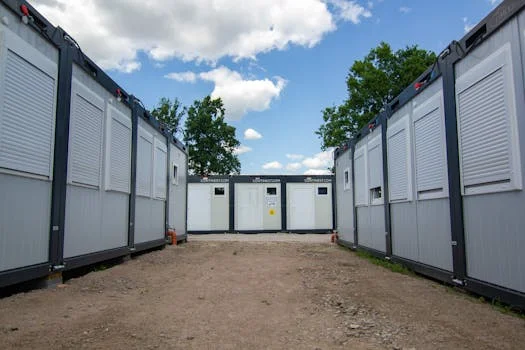
Package plants fit 10 to 2,000 m³/day, including hotels, factories, residential compounds and small communities. A new factory that only needs compliant discharge, or a remote housing cluster, is the usual package case. Custom plants fit municipal duty above 2,000 m³/day, the class of the Tubli STP expansion. Package awards we see are usually under $5 million, while a permanent custom works is bought for a life >10 years and a higher first cost.
Time is the third gate. A package plant is commissioned in 6–12 months. A custom plant takes 3–5 years. Reuse for irrigation or industry is inside package capability when salinity stays at or below 10,000 mg/L TDS. Potable reuse, or influent beyond 10,000 mg/L TDS, is where a custom process train still wins.
Projects we route to package plants clear all four gates below. Stop at the first no.
- Is project capacity <2,000 m³/day? If yes, go to budget. If the flow is >2,000 m³/day, study a custom plant such as the Tubli STP expansion.
- Is the CAPEX budget <$5 million? If yes, go to timeline. If the budget is >$5 million and the owner is chasing long-term OPEX, study a custom plant.
- Is the project timeline <12 months? If yes, a package plant is the fit. If the job can wait >12 months, a custom plant can be phased.
- Are reuse goals for irrigation or industrial processes, not potable water? If yes, a package plant is suitable. If the duty is potable reuse or extreme salinity, use a custom train.
Who Should Buy a Package Plant in Bahrain
This page is for engineers and buyers specifying 10 to 2,000 m³/day in Bahrain, with a CAPEX ceiling near $5 million and a reuse or sea-discharge duty. It is also for EPC estimators who need a unit rate before they open a full design. The reader who needs inlet concentration ranges should use the design-guide link above, then come back for cost.
Look elsewhere if the flow is above 2,000 m³/day, the product must be potable, or salinity sits beyond 10,000 mg/L TDS with no pretreatment budget. A custom plant is the honest answer on those duties. Oily process waste may also need a pretreatment step this cost page does not size.
Next step: send the design flow, the influent TDS and the discharge point, sea or reuse, and request a capacity-based quote against the $1,200–$2,500/m³/day band. One duty and one number are enough to price a first screen. Do not send a note that only says package plant.
Frequently Asked Questions
What is the typical lead time for a package wastewater treatment plant in Bahrain?
The typical lead time in Bahrain is 6 to 12 months, covering design, permitting and installation. Prefabricated units such as the WSZ Series shorten the site programme because the tank arrives built. SCE classification, scoping and review still sit on the working-day clocks in the 2025 guideline, and a late EIA scope can eat the fast end of that range. Most schedules we sign land nearer 9 months once the EIA is real.
How does Bahrain's high salinity affect package plant performance?
MBR trains, as demonstrated at Ma'Amir STP, handle salinity up to 10,000 mg/L TDS. A/O trains usually need pretreatment above 5,000 mg/L TDS, or nitrifiers drop off. Chlorine dioxide dosing slows biofouling on membranes in that salty water. Most membrane plants we review lose flux in the hottest months if cleaning is only annual, so a quarterly clean belongs in the O&M plan.
What are the financing options for package plants in Bahrain?
Government grants on industrial reuse projects are cited at up to 30% of project cost. Commercial loans for green infrastructure are quoted around 5–7% interest in buyer notes for this market. Some international suppliers, including WABAG, offer supplier finance or a design-build-operate contract that spreads payment across the operating term. Grants are not automatic, and most files we see still need the reuse offtake signed before a bank will treat the water as revenue.
Can package plants be installed underground in Bahrain?
Yes, package plants are installed underground in Bahrain where land or sightlines are tight. The WSZ Series is one train made for that buried layout, so landscaping or a light structure can sit above the lid. Check traffic load and groundwater before you bury a tank on reclaimed fill. Most buried units we review need a pump-out riser and a fan spec for summer heat, or the odor complaint arrives in the first August.
What are the maintenance requirements for package plants in Bahrain's climate?
In Bahrain's heat and dust, MBR plants need a quarterly membrane clean, monthly sludge removal and a biannual calibration of chemical dosing. Blowers and pumps need the same attention because ambient temperature runs high for much of the year. Local O&M contracts are quoted at $0.10–$0.30/m³ treated. Most plants we look after miss the quarterly clean first, and flux loss costs more than the service visit.