Why Hampstead Fabricated-Metals Plants Are Re-asking the DAF-vs-Clarifier Question in 2026
A Hampstead, NC fabricated-metals plant typically combines stamping and machining lubricants, water-based and straight cutting fluids, parts-washer rinses, alkaline cleaners, and occasional wash-bay runoff into a single equalized stream. That stream carries free oil, emulsified tramp oil, metal fines, and occasional cleaners all at once — the profile that vendor sources describe DAFs as targeting. Aries, for example, lists DAFs as effective for separating suspended solids, oils, greases, biochemical oxygen demand, and metal concentrations, with chemical pretreatment lowering each of those parameters before flotation (Aries, 2026).
The reason the decision is being re-litigated in 2026 is that older settling basins and API oil-water separators in many Pender County shops were designed around discharge rules that have since tightened on FOG, TSS, and certain heavy metals. Kemco's industrial overview treats DAF as the proven clarifier for streams that "specifically target oils, greases, and suspended solids" while producing water safe for sewer discharge or process reuse (Kemco, 2026). A conventional gravity or lamella clarifier is the competing default, and the wrong default means either a permit excursion or a unit operation the plant never needed.
For practical purposes, a DAF (dissolved air flotation clarifier) is a compact tank in which a sidestream of clarified effluent is pressurized with air and released at atmospheric pressure, generating micro-bubbles that attach to flocs and oil droplets and lift them to the surface for skimming. A gravity or lamella clarifier is an inclined-plate or conventional basin that relies on gravitational settling of heavier suspended solids, with the HydropureWater lamella envelope rated at 20–40 m/h surface loading and sludge recirculation designed to cut coagulant demand by roughly a third. The remainder of this guide works through how each technology actually treats a Hampstead metals stream, then maps both onto the flow band a small-to-mid plant realistically runs. The framing draws on the same vendor-documented parameters that the parallel East Hempfield, PA metals-fabrics buyer's guide uses, applied to Hampstead's POTW context.
What a DAF Actually Does to Oils, Fines and Metals
The DAF process for a metals stream is a chemistry-first operation, not just a bubble tank. According to Aries, coagulant is dosed in the influent pipe, then pH adjustment and a long-chain flocculant polymer are added in a flocculation section that uses either serpentine PVC piping or a variable-speed mixer to enhance mixing (Aries, 2026). SigmaDAF/Clearwater describe the same sequence with either serpentine flocculator mix tubes or chemical mix tanks, both supplied as part of the standard scope (SigmaDAF/Clearwater, 2026-04-27). Without that conditioning, micro-bubbles do not attach to fine emulsified oil or to colloidal metal-hydroxide floc, and the unit underperforms.
After floc formation, a recycle stream of clarified effluent is pressurized to roughly 100 psi to supersaturate it with air, then released into the flotation tank. Aries specifies micro-bubbles of approximately 30 µm forming at atmospheric pressure; SigmaDAF/Clearwater quote a 30–50 µm bubble band for their standard DAFs (SigmaDAF/Clearwater, 2026-04-27). The bubbles nucleate on flocs and oil droplets, and the resulting aggregate floats in minutes rather than settling over hours.
Skimming is mechanical and continuous. Aries specifies 304SS flights on a polymeric chain, driven by a Browning mechanical speed reducer through a roller chain and sprocket set, with chemical- and heat-resistant wipers that drag the float over a beach and into a sludge sump; the weight of the flight itself provides a squeezing effect that dewaters the float as it is carried over (Aries, 2026). SigmaDAF/Clearwater describe a paddle skimmer on their standard models and a bottom auger that removes heavier settled solids from the collection zone in the FPAC, FPBC, and FPHF families (SigmaDAF/Clearwater, 2026-04-27). The float then drops by gravity or is pumped under level control to a sludge holding tank, and from there to a filter press. A HydropureWater DAF system (4–300 m³/h) integrates the same sequence — flocculation, pressurized recycle, float skimming, and underflow auger — as a single pre-engineered package.
What a Gravity or Lamella Clarifier Does Instead
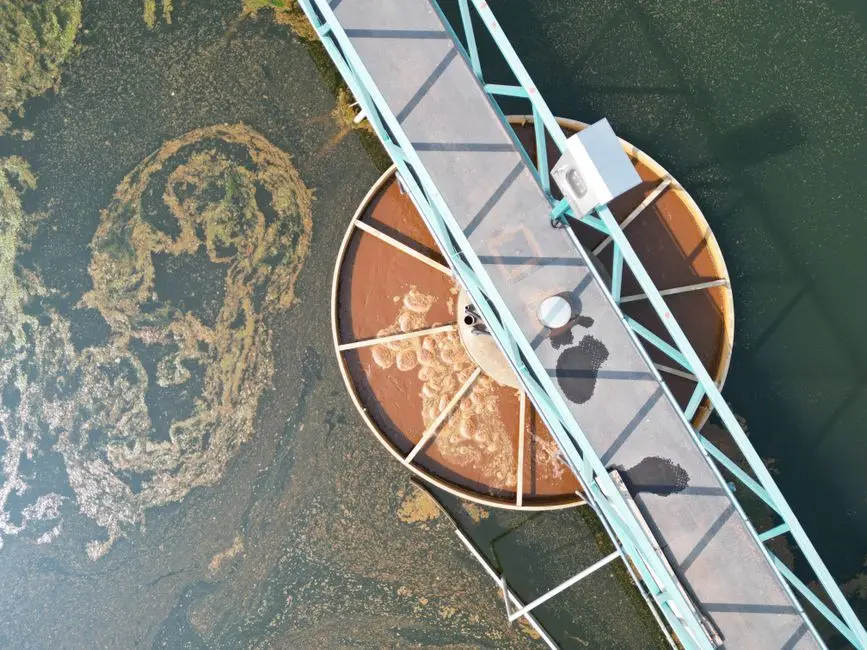
A conventional gravity clarifier or a lamella (inclined-plate) clarifier is a passive settling device. Water flows upward through a stack of inclined plates, and heavier suspended solids slide down the plate faces into a sludge hopper at the bottom. The HydropureWater lamella clarifier envelope is rated at 20–40 m/h surface loading, with sludge recirculation intended to reduce coagulant demand by roughly a third relative to a single-pass basin. That makes a lamella unit compact for its flow and competitive in capital cost when the influent is amenable to settling.
For Hampstead fabricated-metals streams, the limitation is chemistry-specific. Free oil and emulsified lubricants do not settle efficiently; they either pass through to the POTW or accumulate as a rag layer at the surface, where they have to be skimmed manually — a known failure mode in machine shops that try to use a settling basin as a primary oil-removal step. Even when coagulant is added, the resulting floc is typically low density and benefits more from being floated than from being settled. The micro-bubble flotation engineering specs deep-dive walks through why 30–50 µm bubbles are an order of magnitude more effective than inclined plates at capturing oil-wetted floc.
Where the lamella clarifier remains the right primary is the oil-free case: grinding swarf, shot-blast dust, and scale where the particles are dense mineral solids and the site footprint forces a high surface-loading design. In that narrow window — essentially no free or emulsified oil, mostly settleable TSS — a 20–40 m/h lamella is defensible. Outside that window, the operator is paying capital for a unit that does not address the parameter driving the discharge excursion.
Side-by-Side: DAF vs Clarifier for a Hampstead Metals Plant
The matrix below consolidates the vendor-documented parameters from Aries, SigmaDAF/Clearwater, Kemco, and the HydropureWater product envelope into a single table a plant manager can hand to a supplier or consultant. The numbers are drawn from the cited vendor sources; scopes match the source's actual envelope and date.
| Parameter | DAF (dissolved air flotation clarifier) | Gravity / Lamella Clarifier |
|---|---|---|
| Primary removal target | TSS, FOG, BOD, and metals via chemical conditioning (Aries, 2026; Kemco, 2026) | Settleable TSS; oil and emulsions not reliably removed |
| Mechanism | 30–50 µm micro-bubbles from ~100 psi recycle; flotation (Aries, 2026; SigmaDAF/Clearwater, 2026-04-27) | Gravity settling on inclined plates at 20–40 m/h surface loading (HydropureWater lamella envelope) |
| Typical hydraulic residence | Minutes — compact tank | Longer residence; larger plan area for fine metal fines |
| Oil and emulsion handling | Designed for free and emulsified oils (FOG) per Aries, 2026 and Kemco, 2026 | Cannot reliably remove emulsified oils; forms rag layer |
| Sludge character | Low-density oily float that dewaters well on a filter press | Heavier mineral underflow slurry |
| Automation | PLC-controlled dosing, skimmer speed, sludge discharge; COMPACT DAF single skid ≤66 GPM (SigmaDAF/Clearwater, 2026-04-27) | Periodic sludge blowdown; less process control |
| Standard materials of construction | Epoxy-coated mild steel, 304SS, 316SS, polypropylene, polyethylene (Aries, 2026; SigmaDAF/Clearwater, 2026-04-27) | FRP or coated carbon steel tanks with plate packs |
| Flow envelope (catalog) | HydropureWater DAF: 4–300 m³/h across 13 standard models | Lamella envelope: 20–40 m/h surface loading per HydropureWater product data |
For Hampstead plants, the row that drives the decision is the oil-handling row. A lamella can be added downstream as a polish step, but it cannot substitute for the primary oil-removal function that a DAF performs via micro-bubble attachment.
Sizing a Hampstead Plant: Where Each Option Fits in the 4–300 m³/h Range
The HydropureWater DAF catalog covers 4–300 m³/h across 13 standard models, which is the practical envelope for most Hampstead fabricated-metals operations. SigmaDAF/Clearwater package the low end as the COMPACT DAF — a single pre-assembled skid with chemical conditioning, sensors, instruments, and a PLC control screen that manages chemical dosing pumps, skimmer speed, and sludge discharge — for flows of 66 GPM or less, with a modular two-skid system for higher flows (SigmaDAF/Clearwater, 2026-04-27). A HydropureWater DAF system (4–300 m³/h) maps to the same envelope, with model selection driven by peak versus average flow and by influent solids and FOG loading.
The table below translates that envelope into the flow bands a Hampstead plant actually sees.
| Plant configuration | Typical Hampstead flow band | Realistic selection |
|---|---|---|
| Single stamping or machining cell, dedicated sump | Low third of the 4–300 m³/h envelope | Compact DAF, single skid ≤66 GPM (SigmaDAF/Clearwater, 2026-04-27) |
| Two to three cells combined at a central sump | Middle of the 4–300 m³/h envelope | Standard DAF, mid-catalog model with PLC-controlled chemical train |
| Plant-wide equalization serving wash bay, stamping, and finishing | Upper third of the 4–300 m³/h envelope | Larger DAF, often two-skid modular; consider lamella as polish if FOG load is variable |
| Oil-free, mineral-solids-only stream (e.g., shot-blast dust capture) | Any flow | Lamella clarifier at 20–40 m/h; DAF held in reserve |
Specify to the supplier: peak and average flow, influent TSS, FOG, and target metal concentrations, available footprint, ceiling height for the flight scraper, and the local POTW's discharge limits. Without that data, the supplier cannot defensibly size the unit, and any turnkey quote based on flow alone should be treated as a budgetary placeholder rather than a procurement number.
Total Installed Scope: Pretreatment, pH Control, and Sludge Dewatering
Either clarifier sits in the middle of a three-stage scope, not at the end of it. Upstream, Kemco specifies coarse filtration — either a hydrocyclone or a multi-stage shaker screen — to remove sand, lint, scale, and large objects before the DAF, because high-density solids damage skimmer wipers and upset the float layer (Kemco, 2026). Kemco also specifies automatic pH control as a separate stage: a treatment tank with a mixer, an in-tank pH sensor, in-tank level control, metering pumps for acid and caustic, an automated drain valve or pump, and a control panel — because discharge pH limits vary by region and the consequence of an out-of-spec discharge is a fine.
Coagulant, flocculant, and pH adjustment are delivered through a PLC-controlled coagulant and pH dosing skid that automates the chemistry Aries and SigmaDAF/Clearwater both treat as essential to DAF performance. Without that skid, the operator is hand-tuning pump speeds against a moving influent, which is the most common reason packaged DAFs underperform their jar-test results.
Downstream of the float, the realistic endpoint is a plate-and-frame filter press (1–500 m²) in manual, hydraulic, or PLC configurations. Kemco explicitly pairs DAF with filter press dewatering in their flowsheet and notes that filter presses "significantly reduce waste volume, lowering treatment, disposal and hauling costs" (Kemco, 2026). The filter press is what converts a wet float into a disposable cake and is the difference between hauling liquid sludge every week and hauling dry cake every few months. The 2026 DAF installation and commissioning protocol walks through how the three stages are tied together mechanically and electrically.
Decision Rule for Hampstead Fabricated-Metals Plants in 2026
For a Hampstead fabricated-metals plant, the buying decision collapses to two questions: does the stream carry free oil, emulsified cutting fluid, or tramp lubricant, and is the influent dominated by heavy mineral fines with little or no oil. If the answer to the first question is yes, specify a DAF as the primary clarifier, sized inside the 4–300 m³/h HydropureWater envelope with a PLC-controlled chemical train, and plan a filter press for the float. Aries documents DAFs as effective at lowering TSS, FOG, BOD, and metal concentrations when the chemical program is correctly designed (Aries, 2026).
If the stream is essentially oil-free and dominated by heavy mineral fines — a grinding or shot-blast capture water, for example — a lamella clarifier at 20–40 m/h surface loading is a defensible primary, with DAF held in reserve as a polish step if the local POTW tightens FOG limits. The lamella capital cost is lower in this narrow case, and the chemistry demand is lower.
Either way, plan for upstream pH and coagulant dosing and downstream filter-press dewatering. The DAF or clarifier is the middle of a three-stage scope, and a turnkey quote that excludes either side of it should be sent back for revision before the plant commits capital.
Frequently Asked Questions
How do I size a DAF or lamella clarifier for a Hampstead metals plant without an assumed budget number?
Give the supplier peak and average flow, influent TSS, FOG, and target metal concentrations, available footprint, and the local POTW's discharge limits, then ask for a selection against the HydropureWater 4–300 m³/h DAF envelope or the 20–40 m/h lamella surface-loading range. Without those inputs, any budgetary figure is a placeholder; Aries offers jar testing specifically to determine removal efficiencies and flotation characteristics before sizing (Aries, 2026).
What supplier-selection checks reduce compliance risk on a Hampstead POTW discharge?
Confirm the manufacturer offers PLC-controlled chemical dosing integrated with the DAF (SigmaDAF/Clearwater specify dosing pump, skimmer speed, and sludge discharge on a single PLC screen on the COMPACT DAF, 2026-04-27), request material-of-construction options that match the influent chemistry (Aries lists epoxy-coated mild steel, stainless steel, and polyethylene, 2026), and require the proposal to include the upstream pH control and downstream filter press as a single scope rather than three separate quotes (Kemco treats coarse filtration, pH control, DAF, and filter press as a standard integrated flowsheet, 2026).
Can a lamella clarifier remove emulsified oil if I dose polymer?
Polymer improves floc formation but does not change the underlying physics: emulsified oil and oil-wetted floc have low density and are more efficiently removed by flotation than by settling. Vendor sources describe DAF — not lamella — as the technology targeting oils, greases, and associated pollutants via 30–50 µm micro-bubbles from a ~100 psi recycle (SigmaDAF/Clearwater, 2026-04-27). A lamella polish step downstream of a DAF can capture carryover solids, but it is not a substitute for primary oil removal.
What footprint difference should I expect between a DAF and a lamella clarifier at the same flow?
DAFs separate oil and floc in minutes in a compact tank; SigmaDAF/Clearwater's COMPACT DAF packages the low end of the envelope on a single skid for flows ≤66 GPM (SigmaDAF/Clearwater, 2026-04-27). Lamella clarifiers achieve a higher surface loading rate (20–40 m/h per the HydropureWater envelope) but still need larger plan area than a DAF to settle fine metal fines. For an apples-to-apples footprint comparison, request a GA drawing from each vendor at the same design flow and the same influent TSS and FOG.