The Regulatory Stack a Brundidge Food and Beverage Plant Has to Clear
When a Brundidge-area plant receives a surcharge letter or a notice of tightening local limits, the first confusion is usually that "pretreatment limit" sounds like a single number. It is not. Three independent authorities each set constraints, and the most restrictive of those constraints is the number that actually governs the discharge. A plant engineer who understands the stack can ask each authority for the right document; a plant engineer who does not will keep getting blindsided by limits they did not know existed.
The federal floor is the EPA's 40 CFR Part 403 general pretreatment regulations, which establish baseline requirements for any industrial discharger into a publicly owned treatment works (S5). Part 403 covers prohibited discharges, categorical standards, local limits, and the right of the POTW to enforce them.
Above that floor sit the 40 CFR categorical standards. These depend on what the plant actually makes. Part 405 governs dairy products processing, Part 406 covers grain mills, Part 407 covers canned and preserved fruits and vegetables, Part 408 covers canned and preserved seafood, and Part 409 covers raw cane sugar and beet sugar processing (S2). Each subpart sets subcategory-specific effluent limits, and the categorical standard is what the EPA and the POTW will hold the plant to if it is more stringent than the general standard.
On top of federal regulation, the local POTW's sewer use ordinance typically applies limits that are stricter than the federal floor, and the actual numeric values vary by jurisdiction even between facilities in the same county (S5). In Alabama, the Alabama Department of Environmental Management (ADEM) administers the state NPDES program and pretreatment delegation alongside the POTW's own ordinance. The actual numeric caps a Brundidge plant is held to are the most restrictive of the three layers. The supplied research does not contain Alabama-specific numeric effluent caps, so the reader must request the exact local values from their POTW and ADEM rather than assume the federal floor applies.
Penalties escalate beyond fines. Documented outcomes of non-compliance include increased monitoring requirements, mandatory pretreatment system installation, permit revocation, and full production shutdowns when discharge problems threaten the POTW's own compliance (S5). Engineers designing pretreatment should plan for the worst-case local limit, not the average.
What Makes Brundidge-Area Food and Beverage Wastewater Hard to Treat
Food and beverage plants carry wastewater profiles that are an order of magnitude stronger than the domestic baseline a municipal plant is designed around. BOD and COD in food processing wastewater routinely run 10 to 20 times higher than typical domestic sewage, which is the core reason POTWs require pretreatment in the first place (S5). At those concentrations, discharging without pretreatment risks overwhelming the local POTW's biological processes and triggering surcharges or violations.
Beyond the headline strength, the sub-stream fingerprint varies dramatically by what the plant actually makes. Meat and poultry operations generate wastewater rich in fats, oils, and grease, which clog pipes and interfere with biological treatment if not removed upstream (S1). Beverage and confectionery operations produce wastewater high in sugars and starches, which are easily degradable and can cause rapid bacterial growth that spikes BOD loading (S1). Dairy and rendering operations discharge protein-rich wastewater, where proteins contribute to high BOD and can create foaming or odor issues during treatment (S1). Snack, bakery, and packaging plants carry suspended solids like pulp, seeds, and grain that demand clarification before discharge (S1). Clean-in-place (CIP) systems layer caustic and acidic cleaners on top, which swings pH and disrupts downstream biology (S1).
Peak flow surges during washdowns and shift changes can overwhelm systems sized for average conditions, so any treatment design has to be checked against peak instantaneous flow, not daily average (S5). A facility might discharge relatively little during production hours and then release a surge when sanitation crews come through, and a treatment program built around averages can fail at the moments that matter most.
Hydrogen sulfide is the dominant odor and corrosion compound in food and beverage wastewater. Uncontrolled H2S leads to corrosion of piping and concrete, odor complaints, worker safety risk, and in anaerobic digesters it can accumulate and impact biogas quality (S4). The wastewater composition is also variable from hour to hour: pH swings driven by product changeovers and CIP cycles, BOD swings driven by production schedules, and solids loads driven by cleaning frequency (S1, S5). Plants that treat their wastewater as a stable stream will under-design; plants that design for the worst-case composite will be compliant.
| Sub-stream | Dominant contaminant | Treatment implication |
|---|---|---|
| Meat and poultry | Fats, oils, grease (FOG) | DAF upstream of biology to prevent clogging and overload |
| Dairy and rendering | Proteins, milk fats, BOD | Coagulation + DAF, then biological polishing |
| Beverage and brewing | Sugars, starches | Equalization + MBBR or MBR to prevent biomass shock |
| Snack, bakery, grain | Pulp, seeds, grain solids | Screening and clarification carry more of the load |
| CIP effluent | Caustic and acidic cleaners | Equalization and pH neutralization before biology |
The Pretreatment Train Most Brundidge Plants End Up Running
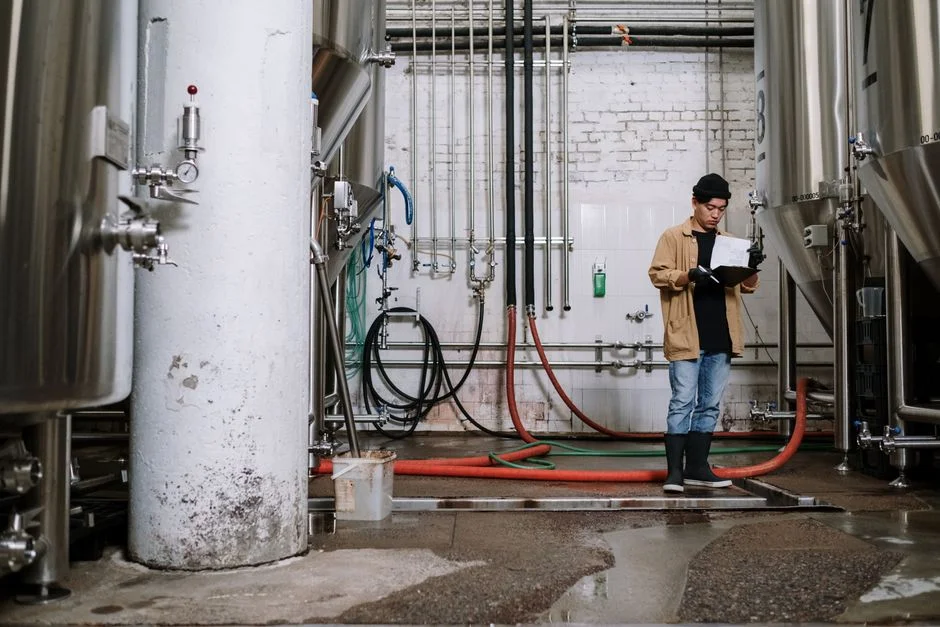
A compliant pretreatment train is a sequence of stages, each removing a specific class of contaminant. The exact order and the equipment selected vary by subcategory, but the backbone is consistent across food and beverage plants and follows the multi-stage approach described in industry guidance (S1).
Stage 1 — Screening and grit removal. A rotary bar screen at the headworks protects downstream pumps and biological stages from rags, plastics, and large food solids. Removing these materials at the front end keeps the rest of the train from choking on debris. Equipment such as the rotary mechanical bar screen is a typical first step.
Stage 2 — Flow equalization. Equalization basins or buffer tanks dampen peak flows from washdowns and CIP cycles and give downstream biology a steady loading rate (S5). Without equalization, peak-hour surges can blow through a biological stage designed for average conditions and trigger a permit excursion.
Stage 3 — pH adjustment. Caustic and acidic CIP flows are neutralized before biological treatment because extreme pH kills the microorganisms that make biological BOD removal work (S1, S5). An automatic chemical dosing system paired with a pH neutralization reactor handles the swing.
Stage 4 — Coagulation, flocculation, and dissolved air flotation (DAF). DAF is the workhorse for FOG, fine suspended solids, and colloidal matter common in meat, dairy, and snack plants (S1, S4, S5). A properly designed HydropureWater DAF system removes the bulk of FOG and TSS before the water reaches biology, dramatically reducing the load on downstream stages. For a deeper comparison of DAF against a clarifier in this kind of service, see DAF vs clarifier for food and beverage wastewater.
Stage 5 — Biological treatment. MBBR, IFAS, or MBR systems reduce residual BOD and, where required, ammonia and total nitrogen (S1, S2). MBBR is robust against load swings and is the common choice for high-strength streams; MBR produces a tighter effluent and is preferred where the local limit is tight on TSS or where the plant wants a polishing step built in.
Stage 6 — Polishing and disinfection. Clarifiers or membrane separation, sometimes followed by UV or chemical disinfection, meet final TSS and microbial limits before sewer discharge (S1, S2). Where nutrient limits apply, a denitrification stage may be inserted before the final clarifier.
Stage 7 — Sludge handling. A filter press, rotary vacuum drum, or dewatering screw reduces sludge volume for off-site disposal, which is itself a major operating cost (S1, S5). For a high-solids food or rendering application, filter press design for rendering and food plant sludge is a useful reference. The headline rule: haul less water, pay less tipping fee.
For a broader view of how these stages line up against current limits, the 2026 industrial effluent discharge guidelines overview is a useful cross-check.
Matching the Train to Your Subcategory: Dairy, Beverage, Meat, Snack
The standard train is a backbone, not a recipe. Each subcategory adds emphasis to the stages that handle its dominant contaminant and trims the stages that do not apply. Picking the right emphasis is how plants avoid both over-building and under-building.
Dairy plants. Proteins and milk fats drive high BOD, and CIP cycles cause wide pH swings. The emphasis is on coagulation plus DAF early to strip FOG and protein, then MBBR or MBR for residual organics. Dairy falls under 40 CFR Part 405, so the categorical standard is a federal requirement on top of the local POTW limits (S1, S2).
Beverage and brewing plants. Sugars and starches are the headline load, and they are easily biodegradable — they will cause rapid biological growth and oxygen depletion if untreated. Equalization plus biological treatment is the workhorse, and an MBR is often selected where space is tight or where a tight TSS limit makes the membrane's solids rejection valuable (S1, S2).
Meat and poultry plants. FOG is the dominant problem and will clog pipes and overload biological treatment if it reaches the biology stage intact. DAF is non-negotiable here, and operators often pair DAF with a high-efficiency sedimentation tank and a HydropureWater automatic chemical dosing system to hold coagulant feed on target as flow and load vary. The categorical standard for meat products is 40 CFR Part 432, and the plant should confirm the exact subpart applicable to its SIC code with its POTW.
Snack, bakery, and grain-based plants. Suspended solids from pulp, seeds, and grain drive the design. Screens and coagulation plus a high-efficiency sedimentation tank carry more of the load than in a beverage plant, and the biological stage can be smaller because the dissolved organic load is lower relative to the solids load (S1).
In every subcategory, the reader must request their own POTW and ADEM discharge limits to confirm the exact numeric caps before specifying equipment. The supplied research does not contain Brundidge- or Alabama-specific numeric effluent limits, and the federal categorical caps are the floor — not the ceiling — for what a local POTW will accept.
| Subcategory | Headline contaminant | Train emphasis | Categorical subpart |
|---|---|---|---|
| Dairy | Proteins, milk fats, BOD | Coagulation + DAF, then MBBR/MBR | 40 CFR Part 405 |
| Beverage / brewing | Sugars, starches | Equalization + MBBR or MBR | Confirm with POTW and ADEM |
| Meat / poultry | FOG, proteins | DAF essential, then biology | 40 CFR Part 432 |
| Canned fruit / vegetable | Suspended solids, sugars, pH swings | Screening + DAF + biology | 40 CFR Part 407 |
| Snack / bakery / grain | Pulp, seeds, grain solids | Screens + sedimentation + bio polish | Confirm with POTW and ADEM |
What a Brundidge Plant Should Do Before Sizing Any Equipment
Step 1. Get the actual sewer use ordinance from the local POTW and identify the BOD, TSS, pH, FOG, and ammonia limits written into the permit. The federal floor is not the limit the plant will be held to (S5). Without the local numbers in hand, any equipment sizing is a guess.
Step 2. Identify which 40 CFR categorical subpart applies to the plant's SIC or NAICS code. The categorical standard may set limits tighter than 40 CFR Part 403 alone, and the POTW will enforce whichever is more stringent (S2).
Step 3. Pull 12 months of production and discharge data — flow, BOD, TSS, FOG, pH — including peak events during sanitation cycles. The data drives equalization volume, biological stage sizing, and DAF sizing, and it is the only way to avoid designing for averages that fail at peak.
Step 4. Request the POTW's monitoring and reporting requirements. Some Alabama POTWs require 24-hour composite sampling at frequencies tighter than the EPA default, and the sampling protocol shapes how the plant's own monitoring budget should be set (S5).
Step 5. Decide between on-site treatment and hauling high-strength streams off-site. For batches that cannot be safely treated on-site, off-site hauling through a permitted waste services provider is a real but expensive option, and the supplied research flags it as a legitimate tool for high-strength streams that would otherwise destabilize the on-site train (S5). A HydropureWater MBR system paired with a plate-frame filter press for sludge is a common all-on-site configuration for plants that decide to treat the full stream themselves.
Frequently Asked Questions
What does a food and beverage pretreatment system cost in Alabama?
The supplied research does not contain Brundidge- or Alabama-specific equipment pricing, and any number a vendor quotes without a wastewater characterization and a flow profile is not reliable. A buyer should request line-item pricing for each train stage, sized to the plant's actual peak flow and load, and should require the vendor to warranty the effluent quality at the local limit — not at a generic design number. Hauling and sludge disposal are typically the largest operating line items, so any cost comparison should include them on an annual basis.
How do I pick the right pretreatment supplier for a food and beverage plant?
The right check is whether the supplier will commit to a guaranteed effluent at the plant's local POTW and ADEM limits after a documented pilot or characterization, not whether the supplier offers a generic skid. Ask for at least two reference installations in the same subcategory (dairy, beverage, meat, or snack) and ask each reference whether the supplier's actual installed performance matched the bid-stage effluent guarantee. Also confirm the supplier handles ADEM and POTW reporting documentation, because compliance failures in Alabama have escalated beyond fines to permit revocation and production shutdowns (S5).
How long does it take to design, build, and start up a pretreatment system?
The supplied research does not quote lead times for Brundidge-area projects, and lead time depends on whether the train is a standard packaged system or an engineered build with site-specific equalization basins and concrete work. A buyer should request a written schedule that locks the wastewater characterization milestone, the equipment fabrication window, the installation window, and the commissioning and shakedown period separately — and should ask the supplier to identify the longest-path item on that schedule before signing.
What is the most common compliance failure mode for food and beverage plants?
The most common failure is treating the wastewater stream as stable when it is not, and then under-sizing the equalization and biological stages for peak sanitation flows (S5). The second most common is failing to confirm the local POTW and ADEM numeric limits before specifying equipment, which leads to a system that meets the federal floor but violates the local cap. Both failures are preventable with a 12-month wastewater profile and a copy of the local sewer use ordinance in hand before the first skid is ordered.