Who Regulates Domestic Sewage Treatment in Ajman
Ajman Sewerage Private Company Limited (ASPCL) is the statutory authority for wastewater services in the Emirate of Ajman and operates the network through its operating company, Moalajah. The contract scope awarded to Veolia runs for 27 years and covers commissioning, operations and maintenance, customer billing, trade-effluent control and customer service for the whole emirate.
For a consulting engineer or facilities manager, the practical consequence is that no on-site domestic sewage treatment plant can be commissioned, connected or discharged from without ASPCL involvement, even if the unit meets generic UAE federal specifications. ASPCL acts as the trade-effluent control authority; therefore, any non-domestic or pre-treated flow entering the municipal network must be monitored and approved against ASPCL's discharge criteria. Design submissions should be routed to ASPCL at the concept stage, rather than only when a connection application is filed.
The Ajman Municipal Network at a Glance
The reference plant at Ajman has a treatment capacity of 75,000 m³/day, fed by 10,500 connections, 310 km of gravity sewer, 30 km of rising mains and 21 pumping stations whose individual capacities range from 10 l/s up to 1,000 l/s, as documented in the Veolia/ASPCL case study. The network serves about 250,000 inhabitants across 90,000 clients and 110,000 properties, providing a useful benchmark for designers checking per-capita flow assumptions for a villa compound or labor camp.
The primary stage is a UASB (Upflow Anaerobic Sludge Blanket), selected because it is more efficient at high COD and high temperature. The original submerged aerated filters could not achieve the required BOD removal because of a high H₂S load after the UASB, so Veolia retrofitted those cells into an activated sludge stage; performance tests on that retrofit were completed in summer 2013. Moalajah has since conducted capital investment planning studies to add treatment capacity and reduce energy use, which defines the direction of future compliance tightening.
| Parameter | Value (ASPCL reference) |
|---|---|
| Treatment capacity | 75,000 m³/day |
| Connections | 10,500 |
| Gravity sewer | 310 km |
| Rising mains | 30 km |
| Pumping stations | 21 (10 l/s to 1,000 l/s each) |
| Population served | ~250,000 inhabitants |
| Clients / properties | 90,000 / 110,000 |
| Primary stage | UASB |
| Secondary stage (post-2013) | Activated sludge retrofit |
Sites located outside the gravity catchment must still aim for the same BOD/COD quality the municipal plant targets, as this is the benchmark ASPCL uses when evaluating trade-effluent applications.
Process Options for On-Site Domestic STPs in Ajman
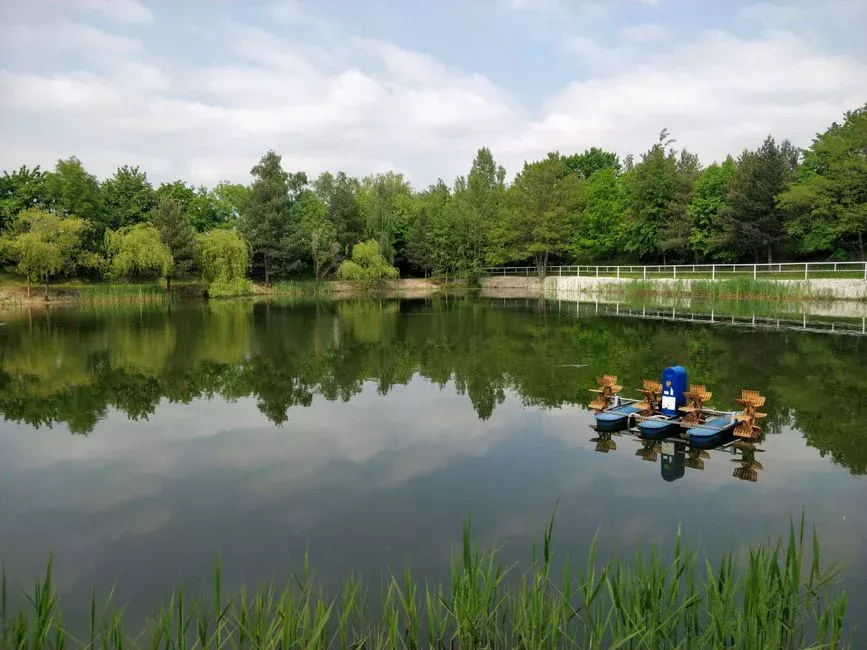
Four process families are viable for small-to-mid domestic sites. UASB is the primary workhorse used in the Ajman reference plant; it is energy-efficient on warm, high-COD sewage but almost always requires a polishing stage to meet reuse standards. Activated sludge is the standard secondary stage for BOD removal once the influent is low-strength or post-UASB; the retrofit at Ajman serves as the working example. MBR (membrane bioreactor) combines activated sludge with submerged membranes to produce near-reuse-quality effluent in a smaller footprint, at the cost of stricter aeration control and membrane maintenance. Buried package A/O plants combine anoxic/aerobic biological contact oxidation with sedimentation and disinfection in a single buried unit, suited to sites with limited surface footprint and landscaped or paved above-grade areas.
The selection depends on influent strength, the reuse target (landscape irrigation, toilet flushing, cooling), available footprint, and whether sludge can be hauled to ASPCL within the current 120-tanker/day discharge cap. For sites with no reuse obligation and limited operator staffing, a buried package A/O sewage treatment plant in the 1–80 m³/h class is usually the lowest-friction option. Where reuse quality matters, an integrated MBR system is the realistic alternative.
| Process | Typical flow class | Effluent quality | Footprint | Operator skill |
|---|---|---|---|---|
| UASB (primary) | Municipal scale | Needs polishing for reuse | Large | Medium |
| Activated sludge (post-UASB) | Municipal / mid-site | Meets BOD limits with polishing | Medium–large | Medium |
| Buried package A/O (WSZ-class) | 1–80 m³/h | Suitable for landscape irrigation | Small (buried) | Low–medium |
| MBR | 10–2,000 m³/day skid | Near-reuse, sub-µm suspended solids | Compact | Medium–high (membrane care) |
Sizing a Domestic STP for an Ajman Site
Defensible sizing inputs include design population, per-capita flow (aligned to ASPCL trade-effluent expectations), peak factor, influent loadings, and target effluent quality. Per-capita flow assumptions should be benchmarked against the Ajman data of approximately 250,000 inhabitants served through 10,500 connections on a 75,000 m³/day plant, which provides an order-of-magnitude reference.
For a buried package A/O unit, the equipment class commercially available in this region covers roughly 1–80 m³/h, which maps to small communities, hotels, hospitals, labor camps, factories and rural clusters, as described in the verified buried package A/O sewage treatment plant specification. For an MBR skid, flows are typically engineered from 10 m³/day up to 2,000 m³/day with sub-1 µm effluent suitable for reuse. Hydraulic peaks, not average flow, drive equalization and pump station design; if a tie-in is planned, the peak factor must be confirmed with ASPCL because the receiving network is sized for the pumping station range documented in the Veolia/ASPCL case study. Always reserve capacity for future occupancy, as real-estate growth in the Emirate of Ajman was flagged as a planning risk in the Veolia/ASPCL concession document.
Tanker Discharge, Sludge Haul-Off and ASPCL Coordination
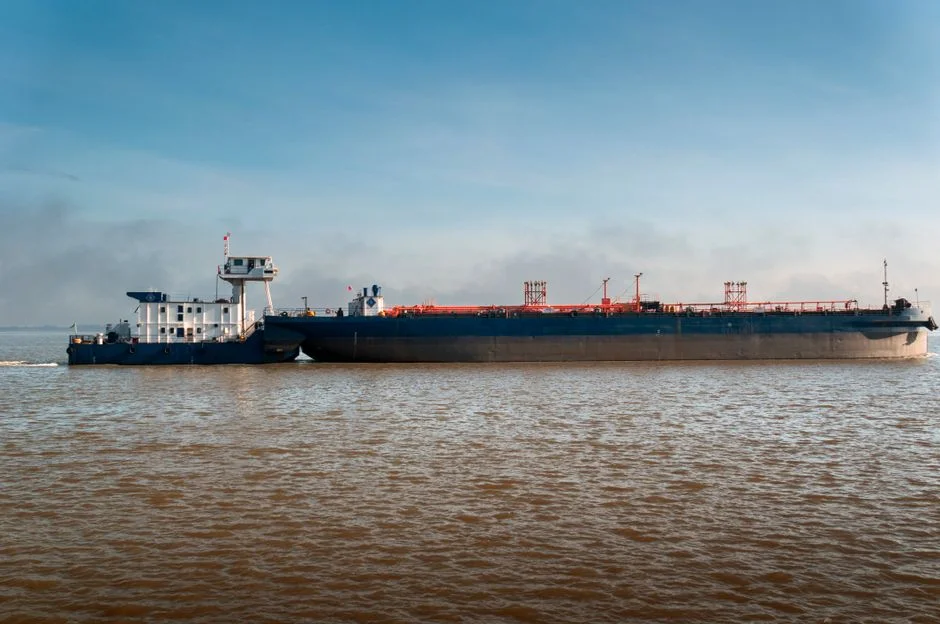
ASPCL implemented a dedicated tanker discharge facility at the municipal plant following regulatory changes. According to the Veolia/ASPCL case study, the number of tankers recorded at the WWTP rose from fewer than 5 per day to an average of about 400 per day, after which ASPCL imposed a cap of 120 tankers per day. That cap is now the binding operational constraint for any site that depends on haul-off rather than a gravity tie-in.
Designers should minimize sludge production, size sludge storage for the realistic booking window at the ASPCL facility, and confirm before procurement that a licensed hauler can obtain a discharge slot. On-site sludge dewatering with a plate and frame sludge dewatering filter press reduces volume and can make haul-off economics viable, but the acceptance criteria and dewatered-cake limits must be discussed with ASPCL/Moalajah before the unit is ordered.
Choosing Between a Buried Package Plant, an MBR, and an ASPCL Tie-In
The decision is based on three go/no-go questions. Choose a buried package A/O sewage treatment plant (WSZ-class, 1–80 m³/h) when there is no nearby ASPCL gravity sewer, the surface footprint is limited, operator staffing is low, and reuse is restricted to landscape irrigation. Choose an integrated MBR system, typically paired with a submerged MBR flat-sheet membrane module for higher-end reuse (toilet flushing, cooling, higher-grade irrigation) when footprint is constrained and skilled operators are available for membrane care. Choose a tie-in to the ASPCL network when a gravity connection is feasible, tanker logistics are unreliable inside the 120-tanker/day cap, and on-site treatment is not economically justified.
For a broader procurement view across the Northern Emirates, the UAE package wastewater treatment plant buyer's guide covers compliance and supplier checks. For Sharjah-adjacent projects, the containerized MBR STP sizing guide for Sharjah walks through the same MBR logic, while the containerized MBR STP sizing guide for Dubai covers the Dubai baseline. Whichever path is selected, the discharge criteria for BOD, COD, TSS and residual chlorine are set by ASPCL at the discharge point and must be confirmed with trade-effluent control before procurement.
Frequently Asked Questions
Which authority sets the discharge and reuse rules for a domestic STP in Ajman?
Ajman Sewerage Private Company Limited (ASPCL), operating through Moalajah under a 27-year concession, sets and enforces discharge and reuse rules for any wastewater entering its network or hauled to its tanker discharge facility, including the 120 tankers/day cap documented in the Veolia/ASPCL case study.
What size package STP is appropriate for a villa compound, labor camp or small hotel in Ajman?
For a buried package A/O plant, the available equipment class covers roughly 1–80 m³/h, which maps to small communities, hotels, hospitals, labor camps, factories and rural clusters; for an MBR, the typical engineered range is 10–2,000 m³/day. The right size is driven by design population, per-capita flow, peak factor and target effluent quality, so the buyer should request a sizing calculation tied to those inputs rather than a generic flow number.
How does the 120-tanker/day discharge cap affect on-site STP design?
ASPCL accepts a maximum of 120 tankers per day at the municipal plant; therefore, any site that depends on haul-off must minimize sludge production, size sludge storage for realistic booking windows, and confirm with a licensed hauler that a discharge slot can be obtained. On-site dewatering, for example with a plate and frame filter press, reduces hauled volume, but the dewatered-cake acceptance limits must be confirmed with ASPCL before procurement.
Should we install an on-site STP or apply for an ASPCL network tie-in?
Apply for a tie-in when a gravity connection is feasible inside the ASPCL catchment, tanker logistics are unreliable inside the 120-tanker/day cap, and the on-site economics do not justify a private plant. Install an on-site STP—a buried package A/O unit for low-grade reuse or an MBR for higher-grade reuse—when the site is outside the gravity network, the footprint is constrained, or the reuse target requires on-site treatment. In every case, the final choice must be confirmed with ASPCL trade-effluent control before procurement, because the BOD, COD, TSS and residual chlorine acceptance criteria are set at the discharge point.