Why Retrofitting a 20–30 Year-Old Pump Station Is a Different Problem
Smith & Loveless, a long-established pump-station OEM, observes that "a 20-30 year-old pump station that's running perfectly still requires an upgrade due to increased flow" — and that observation is the most common retrofit trigger on the books (Smith & Loveless, 2026). In a greenfield project the civil works are designed around the pump; in a retrofit the pump family has to be selected to fit the existing wet well, dry pit, baseplate, and suction piping. That inversion is why "best pump on the market" is the wrong question.
Owners retrofit rather than rebuild for four recurring reasons: load growth that pushes the existing duty point beyond its original hydraulic envelope, deteriorated civil structure (corroded dry well, cracked wet well lid), obsolete controls that no longer carry spares or supported firmware, and efficiency or energy-upgrade mandates driven by utility rules. The common thread is constraint, not aspiration: the existing envelope is fixed and the new equipment has to live inside it.
The academic and standards sources surveyed for this article — two Mark Allen Group papers and a Water Environment Research modeling paper — returned 404 and CAPTCHA pages and could not be used. The guidance below is built on OEM retrofit practice and engineering judgement rather than primary studies, and buyers should validate any specific threshold against their own as-built data.
Site Survey: Measure the Building Before You Touch the Pump Curve
A pump selection made before the as-built survey is complete is a pump selection made in the dark. The site survey should be ordered so each step feeds the next decision.
- Record the existing pump nameplate. Capture manufacturer, model, serial, impeller diameter, rated head, rated flow, motor kW, RPM, voltage, and service factor. The OEM datasheet becomes the baseline for any reuse decision and the reference point for the new duty point.
- Measure the baseplate envelope. Footprint, anchor bolt pattern, and shaft centerline height dictate whether a close-coupled replacement pump can drop onto the existing grout without civil work. If the envelope is wrong, the retrofit budget quietly doubles.
- Measure the wet well for submersible retrofits. Diameter or plan dimensions, depth, floor-to-invert distance, working volume between lead and lag level, and access hatch size for crane-in. The hatch is the single dimension most often missed until the new pump is on the floor.
- Measure the dry well for dry-pit retrofits. Floor area, headroom for motor lift, suction pipe diameter and entry angle, and the distance from the wet well wall to the pump suction flange. A short suction run with one elbow is forgiving; a long, tortuous one is not.
- Record the control panel and instrumentation. Panel model, I/O count, level sensor type, flow meter, and pressure transmitters. The control-retrofit decision is scoped in parallel with the pump decision, not after it.
Where the supplied research did not supply numeric thresholds, the right move is to record the as-built value and hold a 10–15% margin against it when specifying the new pump. Fabricated tolerance numbers are a worse guide than the surveyor's tape.
Three Compact Pump Architectures for Retrofit
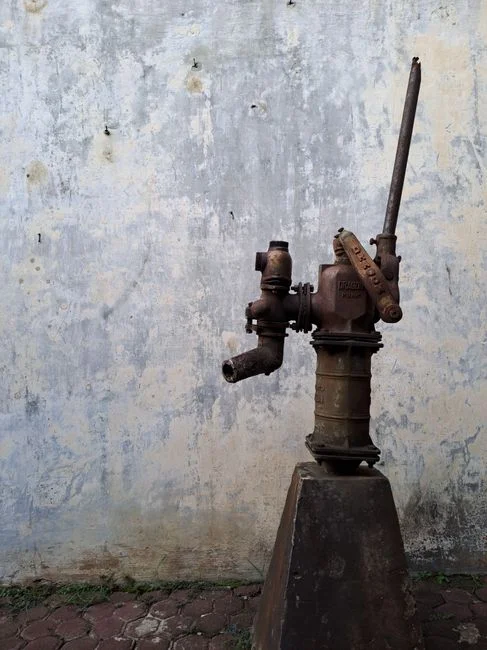
Each of the three credible compact architectures relaxes some site-survey constraints and tightens others. The choice is made by the building, not by the pump curve.
Submersible pumps are lowered into the existing wet well through the existing access hatch, so the dry well becomes irrelevant. Cooling is provided by the surrounding fluid, which removes the need for a motor cooling fan or water jacket. The trade-off is vulnerability to ragging in untreated wastewater and the need for a means of lifting — chain hoist, gantry, or davit — for service. A rotary mechanical bar screen for headworks protection upstream reduces ragging risk and is often paired with this architecture.
Close-coupled dry-pit pumps sit in the existing dry well on a replacement baseplate, with the motor and pump sharing a shaft. Smith & Loveless describes exactly this scope for above-grade stations: "we can provide a new baseplate, piping and hood — simply reuse the rotating assemblies and control panel" (Smith & Loveless, 2026). The dry-pit path requires a suction pipe that is geometrically compatible with the new pump's suction flange and a positive suction head or a properly sized suction run.
Self-priming pumps are mounted at floor level with a short suction pipe into the wet well, which eliminates the dry well entirely. That is decisive when the existing dry well is structurally suspect, has flooded, or carries a confined-space entry risk the owner wants to retire. Self-primers introduce a priming cycle that must be matched to the duty cycle — short-cycle applications suit them, long idle periods followed by a single prime-and-run event do not.
| Architecture | Civil impact | Existing wet well | Existing dry well | Best fit when |
|---|---|---|---|---|
| Submersible | Lowest | Reused as-is | Can be abandoned | Wet well is sound, dry well is the weak link |
| Close-coupled dry-pit | Medium (new baseplate, reworked suction) | Unchanged | Reused | Above-grade station with reusable rotating assemblies is already in place |
| Self-priming | Medium (suction pipe, no dry well) | Reused | Retired | Dry well is structurally suspect or flooded |
Submersible vs. Dry-Pit vs. Self-Priming: A Retrofit Decision Matrix
The matrix below maps each architecture to the site-survey findings, so the shortlist can be defended to a manager in one page. Scoring is qualitative (Low / Medium / High change required) because the supplied research did not provide retrofit-specific hydraulic thresholds.
| Criterion | Submersible | Close-coupled dry-pit | Self-priming |
|---|---|---|---|
| Change to existing wet well | Low | None | None |
| Change to existing dry well | None (can be abandoned) | Low (new baseplate, reworked suction) | None (dry well retired) |
| Baseplate change required | None | High | Low (floor-mounted skid) |
| Suction piping change | Low (discharge only) | High (must match new pump) | Medium (short new suction run) |
| Civil works required | Low | Medium | Low to medium |
| Access for maintenance | Medium (lift required) | High (dry floor) | High (dry floor) |
| Suitability for rag-prone wastewater | Medium (ragging risk) | High (dry-pit pumps tolerate rags better) | High |
| Reuse rotating assembly possible | Low | High (Smith & Loveless path) | Low |
The matrix is read from the bottom up to determine the most common retrofit pattern.
Reuse the Rotating Assembly or Replace It Entirely?
Smith & Loveless's published retrofit offer for above-grade stations is the canonical partial-reuse path: "we can provide a new baseplate, piping and hood — simply reuse the rotating assemblies and control panel" (Smith & Loveless, 2026). This is a viable option, but it is conditional on the rotating assembly passing an independent condition assessment: bearing life remaining, impeller wear versus original trim, shaft runout within OEM tolerance, seal faces within service limits, and motor insulation resistance test results. A reused assembly that fails any of those checks is a liability transferred into the new piping.
Replacement is the right call when flow growth exceeds the original pump's hydraulic envelope — the same "increased flow" trigger Smith & Loveless identifies — when spare parts for the existing OEM are no longer available, or when the existing motor's efficiency class is unacceptable against current energy rules. The decision is a cost-and-risk question: reuse lowers capex and outage time but transfers wear risk; replacement raises capex but lets the new pump be trimmed for the new duty point.
The supplied research did not include retrofit cost figures, so the best approach is to request both a partial-reuse quote and a full-replacement quote on the same enquiry. The comparison is only apples to apples when the same surveyor has walked the same wet well and the same bidder has quoted against the same as-built survey.
Don't Forget the Controls: PLC, Touchscreen, and the Reuse Decision
Smith & Loveless explicitly offers a control-retrofit ladder for the same station, from "basic PLC controls" to "state-of-the-art touch-screen displays" (Smith & Loveless, 2026). The choice is driven by operator skill, SCADA integration requirements, and alarm-handling expectations, not by the pump selection above it. Treating controls as an afterthought is the most common reason a retrofit pump station underperforms on day one.
Reuse the original control panel when it is mechanically sound, the I/O count still matches the new pump and instrumentation, and the existing level, flow, and pressure sensors are still supported. Replace the panel when it has reached end-of-life, when variable-frequency drives are added for soft-start or duty sharing, or when the utility requires modern remote-monitoring and event-logging capability. Variable-frequency drives are the natural pairing for a retrofit that also wants an energy-efficiency gain, and they should be specified together with the pumps.
Control-panel cost data was not present in the supplied research, so the responsible move is to request both a panel-reuse scope and a panel-replace scope from the same integrator. For broader context, the 2026 wastewater pump energy efficiency comparison covers how VFD pairing shifts pump operating cost, and the 2026 pump control technologies for extreme rainfall events covers control architectures under peak-flow conditions.
Putting It Together: A Retrofit Specification That Survives Procurement

The site survey, the architecture decision, the rotating-assembly decision, and the control decision only become useful when they are folded into a procurement document. The RFQ should be structured in five sections so the bidder cannot dodge the retrofit-specific questions.
- Existing station survey. Include nameplate data, baseplate envelope, wet well and dry well dimensions, suction piping, and the existing control panel I/O list. The bidder needs the as-built geometry to confirm fit.
- Hydraulic duty point. Specify the new rated flow and head, plus the maximum and minimum operating points the station must cover. State the inflow scenario (current average, peak wet-weather, design horizon) so the bidder can trim the impeller correctly.
- Preferred pump architecture with one named alternative. Name the primary architecture and a fallback so the bidder prices both, and so a wet well problem during commissioning does not collapse the schedule.
- Scope of new versus reused equipment. List exactly what is new (baseplate, suction piping, hood, control panel, cabling) and what is reused (rotating assemblies, existing instrumentation if retained), and require a written condition report on every reused assembly.
- Commissioning and performance test plan. Require a witnessed performance test at the new duty point before handover, with vibration, bearing temperature, current, and flow and head recorded. Retrofit stations are routinely handed over without this step, and it is the cheapest insurance against early failure.
Require bidders to confirm fit against the existing baseplate bolt pattern, suction flange, and access envelope — this is the single biggest reason retrofit pumps fail to install on the day they arrive. Where the supplied research did not provide commissioning thresholds, require the bidder to quote the test procedure and acceptance criteria rather than leaving them implicit. For plants considering a parallel wastewater train during the outage, a compact underground package sewage treatment plant can carry flows while the existing station is rebuilt.
Frequently Asked Questions
How do I know if my pump station should be retrofitted rather than rebuilt?
Retrofit is the right call when the existing civil envelope — wet well, dry well, baseplate, suction piping — is structurally sound and the trigger is hydraulic growth, control obsolescence, or efficiency mandate. Rebuild is the right call when the civil structure has failed, the envelope is too small for any credible pump family, or the site requires a process change the existing layout cannot accommodate. A written condition survey of the civil works is the gate between the two paths.
What does a compact wastewater pump retrofit typically cost in 2026?
The supplied
Frequently Asked Questions
How do I know if my pump station should be retrofitted rather than rebuilt?
A retrofit is generally recommended if the existing wet well structural integrity remains intact and the hydraulic capacity meets current peak flow requirements. If the existing pump station exceeds its design life of 20 to 25 years, experiences frequent cavitation, or requires energy consumption reductions of 15% or more, a retrofit using high-efficiency compact submersible pumps is often more cost-effective than a total civil rebuild.
If the station requires a change in hydraulic grade line, structural concrete failure is present, or the existing piping diameter is undersized for current regulatory peak flow standards, a complete rebuild is typically mandatory to ensure long-term operational compliance.
What does a compact wastewater pump retrofit typically cost in 2026?
In 2026, a standard compact wastewater pump retrofit for a municipal or industrial site ranges from $15,000 to $45,000 per pump unit. This estimate accounts for the pump acquisition, adaptive mounting hardware, and basic electrical integration with existing control panels.
Total project costs, including labor, specialized rigging for confined spaces, and potential variable frequency drive (VFD) upgrades, typically fall between $60,000 and $120,000 for a dual-pump station. Costs vary significantly based on the need for custom baseplate fabrication to match legacy bolt patterns.
Can I reuse the existing pump's rotating assembly with a new baseplate?
It is rarely recommended to reuse an existing rotating assembly when installing a new baseplate, as modern compact pumps are designed with integrated impellers and volutes that provide optimal non-clog performance and hydraulic efficiency. Mixing legacy rotating assemblies with new mounting hardware often voids the manufacturer's warranty and fails to address the mechanical wear typically found in the old shaft and bearing housing.
Retrofitting with a complete "drop-in" pump unit ensures compatibility with current NEMA or IEC motor standards and guarantees the manufacturer’s specified performance curve, which is critical for meeting local discharge regulations.
What is the lead time for a compact wastewater pump retrofit in 2026?
As of 2026, standard off-the-shelf compact wastewater pumps have a lead time of 4 to 8 weeks. However, if the project requires a custom-engineered adapter plate to interface with legacy piping and base anchors, lead times extend to 12 to 16 weeks to account for CAD design, CNC fabrication, and factory testing.
Suppliers recommend placing orders at least 16 weeks prior to the scheduled outage to account for supply chain fluctuations in specialized cast iron components and seals required for high-head wastewater applications.
Do I need a permit to retrofit a pump station inside an existing building?
Yes, retrofitting a pump station inside a building requires a mechanical and electrical permit, as it involves modifications to plumbing systems and power distribution. You must ensure the installation complies with NFPA 820 (Standard for Fire Protection in Wastewater Treatment and Collection Facilities) regarding the classification of hazardous locations and ventilation requirements.
Additionally, if the retrofit involves changing the pump’s horsepower or flow rate, you may need to submit updated hydraulic calculations to local building authorities to confirm the facility remains in compliance with existing wastewater discharge permits and electrical load capacity limits.