How Japan Treats Wastewater for Small Communities in 2026
At the end of FY2024, domestic wastewater treatment in Japan served 116,126,000 of 124,483,000 people — a coverage rate of 93.7%, up from 93.3% at the end of FY2023 (Ministry of the Environment, 2025-12). The 7,838,000 people still unserved (6.3%) live predominantly in dispersed rural and peri-urban settlements where piped sewerage remains uneconomic. The system that reaches them is not a single national grid; it is three parallel delivery tracks, each owned by a different ministry:
- Johkasou (onsite units): managed by the Ministry of the Environment (MOE) — 11,746,000 people (9.5%) at end of FY2024.
- Municipal sewage: managed by the Ministry of Land, Infrastructure, Transport and Tourism (MLIT) — 101,397,000 people (81.8%).
- Rural community sewerage: managed by the Ministry of Agriculture, Forestry and Fisheries (MAFF) — 2,835,000 people (2.3%).
The three-track architecture is the result of two legal anchors: the Water Pollution Control Act of 1970, which set effluent standards for all public-water discharges, and the Johkasou Act of 1983 (enforced 1985), which mandated decentralised treatment wherever a flush toilet is installed without sewerage access. Where population density is high, MLIT's piped sewerage wins on per-PE cost; where density is below roughly 50 PE per hectare, the MOE's Johkasou model and MAFF's village-scale plants are the only economically rational choices.
The Johkasou Model: Decentralised Units for 5–50 PE Households
A Johkasou is a buried, factory-built tank that combines black water (toilet) and gray water (kitchen, bath, laundry) in a single treatment train, discharging effluent to a public water body or soil trench (MOE, 2025-12). Two physical configurations exist: a cylindrical unit for the small range (5–50 PE, ≤10 m³/day) and a box-shaped unit for medium and large installations (51+ PE, >10 m³/day). Both achieve effluent quality comparable to municipal sewage treatment plants when properly maintained.
At the end of December 2024, more than 4 million Johkasou units were installed in Japan, serving 11,746,000 people (MOE, 2025-12). The older Tandoku-shori (black-water-only) configuration was prohibited for new installation in 2000; only the combined Gappei-shori type is now permitted, with BOD removal as a baseline and nitrogen and/or phosphorus removal available as upgrades. Typical effluent targets are BOD ≤20 mg/L, T-N ≤20 mg/L, and T-P ≤1 mg/L for advanced units. The unit is normally buried, leaving only a manhole and a control panel visible.
| Parameter | Small Johkasou (5–50 PE) | Medium/Large Johkasou (51+ PE) |
|---|---|---|
| Typical flow | ≤10 m³/day | >10 m³/day |
| Physical form | Cylindrical, factory-built | Box-shaped, often site-assembled |
| Installation | Buried on homeowner's lot | Buried on building or campus lot |
| Black+gray water | Yes (Gappei-shori) | Yes (Gappei-shori) |
| Typical effluent BOD | ≤20 mg/L | ≤20 mg/L |
| Operator required | Maintenance vendor only | Certified Johkasou Operator (80 hrs training) |
Rural Community Sewerage and Small Public Sewage Plants
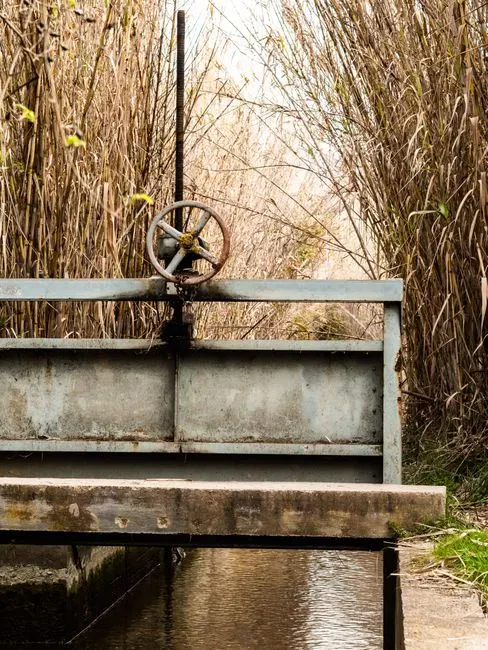
Rural community sewerage is MAFF's village-scale alternative: a small collection network feeding a single treatment plant at the edge of a settlement, intended for a single or grouped rural community not yet covered by municipal sewage. About 3,900 facilities are in operation nationwide, serving 2,835,000 people (2.3%) at end of FY2024 (MOE, 2025-12). This model operates in tandem with MLIT-managed municipal infrastructure to ensure comprehensive coverage.
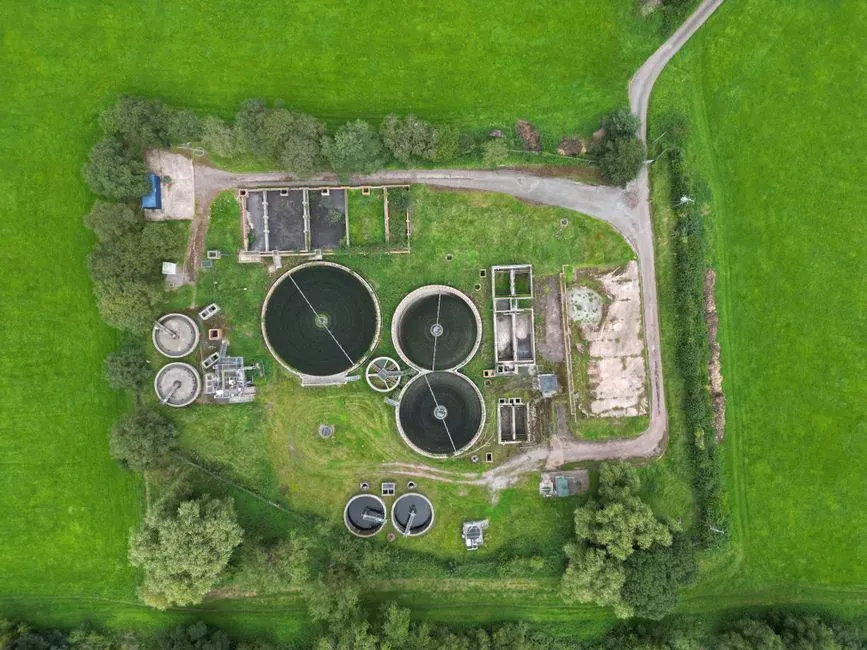
On the MLIT side, 1,049 small public sewage plants treating ≤5,000 m³/day were in operation at end of FY2004, of which approximately 70% use the oxidation ditch process — a low-cost, robust variant of activated sludge well suited to small flows and variable loadings (wepa-db.net). The oxidation ditch's slow rotor aeration tolerates diurnal flow swings that would destabilise a conventional plug-flow plant, which is why it dominates the small-plant segment in Japan. For comparison, FY2006 national coverage stood at 82.4%; the rise to 93.7% by FY2024 reflects accelerated Johkasou and rural-community-sewerage deployment in unsewered areas, not expansion of large municipal plants. The built-form distinction matters: a Johkasou is buried on the homeowner's lot with no collection network, whereas a rural community sewerage plant uses a shared collection grid and a single surface-level or buried treatment plant.
Johkasou Act 1983 and the Inspection Cadence Every Operator Must Follow
The Johkasou Act was enacted in 1983 and enforced from 1985 (MOE, 2025-12). Its purpose is the decentralised treatment of black water plus gray water to defined effluent standards, with installation required whenever a flush toilet is added under the Building Standard Law unless the building is connected to a public sewer. The Act's practical effect on any replication project is the inspection cadence, which differentiates the system from looser overseas standards.
- Article 7 legal inspection: visual, water-quality, and document checks performed 3–8 months after start-up by a prefecture-designated inspection agency.
- Article 11 annual legal inspection: visual, water-quality, and document checks once per year by the prefecture-designated inspection agency.
- Maintenance visits: at least 3 per year by a prefecture-licensed Johkasou maintenance vendor, covering sludge accumulation, water quality, mechanical apparatus, and disinfectant replenishment.
- Desludging: at least once per year by a municipality-registered desludging vendor.
At end of FY2024, the municipal Johkasou Installation Program covered 6,220 units and the Installation and Maintenance Program covered 4,708 units (MOE, 2025-12). Two national qualifications anchor the workforce: the Johkasou Installation Worker (37 hours of training plus a 2-hour examination) and the Johkasou Operator (80 hours of training plus a 2-hour examination). The Operator qualification is mandatory for medium and large units (51+ PE). Without an equivalent inspection cadence, effluent quality typically drifts within 2–3 years, as noted during the 2019 tightening of the Act, which strengthened prefecture authority to convert legacy Tandoku-shori units to Gappei-shori.
2026 Deployment Scale: Japan Domestic and Overseas
Domestically, more than 4 million Johkasou units are installed across Japan, serving 11,746,000 people at end of FY2024 (MOE, 2025-12). Overseas, the technology is used in 64,272 units across 56 countries as of December 2024, of which 61,409 are small (5–50 PE) and 2,863 are medium/large (51+ PE), according to the Johkasou System Association (cited in MOE, 2025-12). The largest overseas fleets are concentrated in Asia–Pacific and the Middle East.
| Country | Small (5–50 PE) | Medium/Large (51+ PE) |
|---|---|---|
| China | 30,641 | 18 |
| USA | 15,137 | 36 |
| Australia | 11,194 | 62 |
| Vietnam | 996 | 528 |
| Myanmar | 866 | 282 |
| India | 175 | 990 |
| Sri Lanka | 533 | 390 |
The Japan International Cooperation Agency (JICA) transferred Johkasou technology to China from 2001 to 2006, establishing a structured program for international replication (wepa-db.net). Current distribution suggests Johkasou has transitioned to routine procurement in at least seven overseas markets.
Choosing the Right System for a Small Community Outside Japan
The selection logic for a foreign engineer mirrors the Japanese institutional split. If the population is dispersed at 5–50 PE per cluster and piped sewerage is uneconomic, replicate the Johkasou model with buried packaged units; if 50–500 PE sit on a single village grid, evaluate a rural-community-sewerage-style collection network plus a small oxidation-ditch or MBR plant. For a foreign engineer who needs a packaged, buried, automated plant, an integrated A/O package plant such as the WSZ underground integrated sewage treatment plant maps directly onto the small-Johkasou flow range, while an MBR system for tighter effluent targets covers nitrogen and phosphorus limits that BOD-only Johkasou cannot meet. For a useful cross-jurisdictional benchmark, see the comparative Portugal small-community guide, the comparative Ireland small-community guide, and the Newfoundland municipal sewage plant guide.
Three spec rules follow from the Japanese experience. First, always size screening, disinfection, and sludge handling into the package; Japanese Johkasou relies on contracted desludging vendors, so any replication must define who removes sludge off-site. Second, anchor compliance to a national Johkasou-Act-equivalent regulation; without a legal inspection cadence, effluent quality drifts. Third, require national qualifications for installers and operators; the 37-hour and 80-hour training curricula set the professional standard.
Frequently Asked Questions
What is a Johkasou?
A Johkasou is a buried, factory-built decentralised wastewater treatment unit that treats black water (toilet) and gray water (kitchen, bath, laundry) in a single combined tank. Small units serve 5–50 PE at ≤10 m³/day in cylindrical form; medium and large units serve 51+ PE at >10 m³/day in box form (MOE, 2025-12).
How is a small community wastewater system in Japan regulated?
Two laws anchor the framework: the Water Pollution Control Act of 1970, which sets effluent standards, and the Johkasou Act of 1983 (enforced 1985), which mandates decentralised treatment. Delivery is split across three ministries: MOE (Johkasou), MLIT (municipal sewage), and MAFF (rural community sewerage).
What percentage of Japan is served by Johkasou vs. public sewage?
At end of FY2024, public sewage served 101,397,000 people (81.8%), Johkasou served 11,746,000 (9.5%), and rural community sewerage served 2,835,000 (2.3%), for a combined 93.7% coverage of Japan's 124,483,000 population (MOE, 2025-12).