Why Aeration Blowers Are the First Target in Any Plant Energy Program
A blower energy efficiency upgrade at the secondary-treatment blower room is the single largest OPEX lever in a conventional activated-sludge plant, because aeration accounts for 50–60% of total plant electricity at most 5–50 MGD facilities (typical range, per industry audits). At the Victor Valley Wastewater Reclamation Authority (VVWRA), a 13 MGD activated-sludge plant in Victorville, California, replacing aging engine-driven units cut annual energy use by 928,500 kWh and operating cost by roughly $98,000 in the first year of operation, with a 2.11-year simple payback after a $45,220 incentive from SCE's Customized Solutions program. Two consecutive installations brought total system savings to 1,105,000 kWh/year and approximately $125,000/year, a 40% reduction in aeration energy (source: U.S. DOE Better Plants / Compressed Air Best Practices, 2015-08).
Retrofit is unavoidable at many sites for three engineering reasons. First, legacy positive-displacement and single-stage centrifugal units were specified decades ago at fixed speed and base-load profile, then forced to vent air when seasonal loading dropped, wasting 10–20% of input energy as heat. Second, those units typically cannot turn down to the lower flow / higher pressure points required by modern nutrient-removal limits (ammonia-nitrogen and total nitrogen), so operators over-aerate to stay in compliance. Third, the units were not designed for the variable nutrient loads seen in plants receiving industrial contributions; they hold a single operating point, and process variability has grown around them.
The policy backdrop reinforces the case in 2026. The U.S. DOE Better Plants program now reports more than 160 partner organizations with cumulative savings of roughly 320 trillion BTU and $1.7 billion (per the program's published 2024 partner summary), and the program explicitly expanded to water/wastewater agencies. Plants certified to ISO 50001 — a 2026 baseline expectation for many municipal utilities — use the same energy-review process that frames a blower upgrade as a documented, repeatable energy-management project rather than a one-off capex request.
How a Blower Energy Efficiency Upgrade Actually Works
An aeration blower retrofit is sold as a system because the savings only materialize when three hardware layers and two process layers work together. The hardware layers are: (1) the blower itself — typically a high-speed turbo or integrally geared centrifugal unit; (2) a variable frequency drive (VFD) on each blower; and (3) an integrated controller that sequences blowers, manages lead/lag, and exposes setpoints to the plant SCADA. The two process layers are: (4) a dissolved oxygen (DO) probe feedback loop that closes the aeration control loop on a 1.5–2.0 mg/L setpoint at the end of the aeration tank, and (5) high-efficiency fine-bubble membrane diffusers that convert more of the supplied air into dissolved oxygen per scfm.
The VVWRA scope is the clearest worked example. Three engine-driven blowers were replaced by two 400-hp high-speed turbo units — a Piller PillAerator MP12000 installed in 2011 and a PillAerator LP14000 installed in 2013. The new units trimmed to 3,000–8,700 scfm at 8 psig across the plant's seasonal nutrient-loading window, compared to a wider and less efficient output range on the legacy engine-driven equipment (per the VVWRA energy audit, U.C. San Diego, 2011). The VFD exploits the blower's affinity curves: as airflow demand drops, rpm drops, and wire-to-air efficiency stays on the design curve instead of sliding down it as it would on a throttled fixed-speed unit.
Wire-to-air efficiency — the ratio of useful pneumatic energy output to electrical energy input — is the metric that separates the technology classes. Rotary-screw and integrally geared centrifugal units land in the 65–72% wire-to-air band at design point; high-speed turbo units with active magnetic bearings land at 75–82% and stay above 70% across a 3:1 turndown when paired with a VFD (manufacturer-published performance curves). For a peer engineering review, sizing the blower against the post-diffuser-retrofit airflow requirement — not the legacy duty — is what unlocks the smaller-hp unit and the under-3-year payback. For a primer on how the same activated-sludge plant maintains its secondary-process pumps, see this activated-sludge pump maintenance schedule.
Blower Technology Comparison: PD, Single-Stage Centrifugal, and High-Speed Turbo
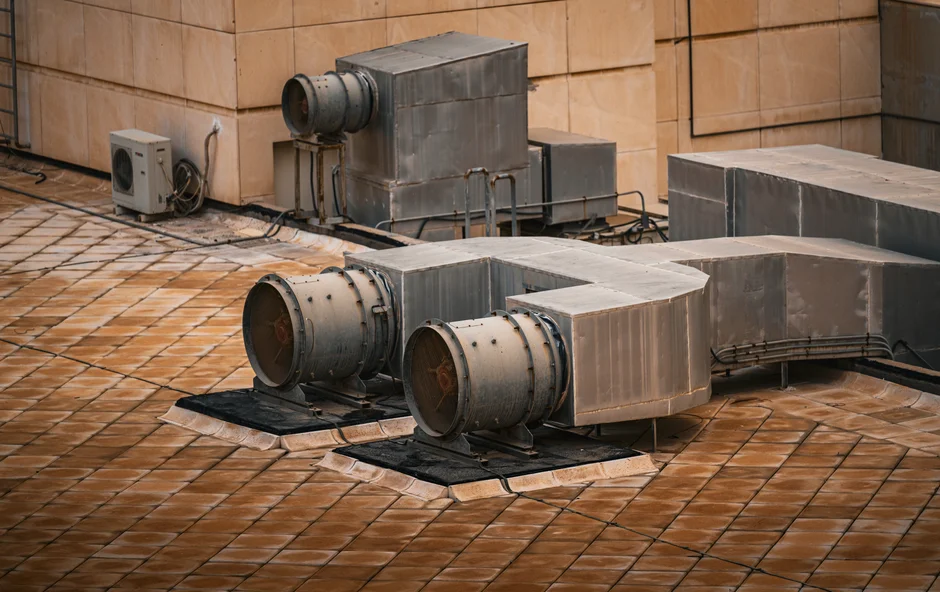
Three technology classes compete for the same duty in municipal aeration. The choice is not "which is best" — it is which profile matches the plant's flow/pressure window, turndown requirement, and existing maintenance capability. Modern rotary-screw, centrifugal, and turbo classes can each cut energy use by up to 35% versus the legacy units they typically replace, per an industry technology review (h2oglobalnews.com / Atlas Copco, 2025-09). The 40% headline figure used in the VVWRA case includes diffuser and control retrofits on top of the blower change; do not attribute the full 40% to the blower swap alone.
| Parameter | Positive-displacement (variable-speed rotary screw / lobe) | Single-stage centrifugal, integrally geared (IGV + variable diffuser vanes) | High-speed turbo (VFD, active magnetic bearings) |
|---|---|---|---|
| Typical turndown ratio | 3:1 to 5:1 | 2:1 to 3:1 (with IGVs); ~1.5:1 without | 3:1 to 4:1 with VFD |
| Wire-to-air efficiency at design point | 65–70% | 70–75% | 75–82% |
| Efficiency at 50% flow | 62–68% | 55–65% (without IGVs, drops fast) | 70–78% |
| Footprint relative | Largest (1.5–2.0x) | Reference (1.0x) | Smallest (0.4–0.6x) |
| Pressure capability | Up to ~15 psig, pressure independent of flow | Rises with flow; narrow efficient band | 8–12 psig typical for aeration |
| Maintenance hours/year (typical) | 30–50 (oil change, filter, bearing) | 20–40 (bearing, IGV service) | 8–20 (air filter, bearing inspection) |
| Best-fit application | High-pressure, narrow turndown, fouling risk, or variable depth tanks | Relatively stable load, narrow turndown, new construction | Variable nutrient loads, 3,000–10,000 scfm, energy-driven design |
Selection rule of thumb: if your aeration duty varies more than 2:1 across seasons and your unit cost is above $0.10/kWh, a high-speed turbo on a VFD is almost always the lowest lifecycle-cost option. If your plant is small and your loads are steady, an integrally geared centrifugal with inlet guide vanes may match it on cost with a simpler controls architecture. Reserve positive-displacement units for sites with high backpressure variability, fouling risk from industrial inputs, or where oil carryover is a non-issue and parts commonality with existing PD equipment is an operational priority.
Controls and Diffuser Pairing: The Half of the Project Everyone Underestimates
A blower swap without DO-based aeration control and modern diffusers leaves 10–30% of the achievable savings on the table, because the new blowers will run base-loaded to satisfy an over-aerated tank. The DO feedback loop is what unlocks the VFD: one or two probes in the last cell of the aeration tank feed a PID controller that raises or lowers blower speed to maintain a setpoint of 1.5–2.0 mg/L, the standard band for nitrification/denitrification in BNR plants. At VVWRA, that loop was the difference between hitting the 40% number and missing it.
The diffuser effect is large and quantifiable. At VVWRA, the planned switch to membrane diffusers reduced required airflow by 30% versus the existing sock-style diffusers, which is what allowed the engineering team to specify two 400-hp turbo units instead of larger units and still meet an 18 MGD future capacity target (per the U.C. San Diego energy audit, 2011). Standard fine-bubble membrane diffusers deliver 2.5–3.5 lb O₂/hp-hr at standard aeration efficiency (SAE) versus 1.0–1.5 lb O₂/hp-hr for coarse-bubble sock diffusers — a roughly 2:1 oxygen-transfer advantage that translates directly into smaller blowers and lower horsepower.
The failure mode is consistent across the industry: a plant installs a new high-speed turbo blower but leaves 15-year-old coarse-bubble diffusers in service, then complains the new blower "doesn't save as much as advertised." The diffuser scope must travel with the blower scope. Two further engineering notes: oil-free blower classes (most high-speed turbo units) eliminate oil aerosol contamination risk, which simplifies compliance audits for food, beverage, and pharma effluent streams; and pairing the controls upgrade with the blower change keeps the SCADA points count, alarm philosophy, and operator HMI changes inside one commissioning window.
Payback Math: How to Build a 2026 Capex Case That Survives Review
The VVWRA economics translate cleanly into a template. Total project cost was $660,000. After the first blower was installed, VVWRA measured 928,500 kWh/year saved and roughly $98,000/year saved. With the second blower online, the fully built system was expected to save 1,105,000 kWh/year and approximately $125,000/year, with a $45,220 incentive from SCE's Customized Solutions program layered on top. Simple payback = $660,000 ÷ ($125,000 + $45,220/10-yr life) ≈ 2.11 years using the program's 10-year-life averaging convention (per Compressed Air Best Practices, 2015-08).
Translate the per-kWh economics to your own tariff: a 1,000,000 kWh/year blower retrofit at $0.10/kWh yields $100,000/year in saved energy; at $0.13/kWh (typical industrial U.S. tariff in 2026, up from 2024 levels of ~$0.11/kWh), the same project yields $130,000/year. Stack a utility custom incentive of $30,000–$75,000 for a mid-size 400-hp unit, and most 2,000–8,000 scfm retrofits land in the 2.0–3.0-year simple-payback band, with sub-2.0-year cases on sites with above-average tariffs or generous state-level programs.
Second-order benefits that strengthen the capex narrative: avoided natural-gas use (VVWRA redirected biogas to combined-heat-and-power generation once blowers were electrified), reduced maintenance hours (high-speed turbo units typically run 8–20 hours/year versus 30–50 hours/year on PD units), and avoided expansion capex when the existing blowers could not meet future load. For 2026 internal reviews, lead the narrative with kWh and $/kWh saved (defensible, auditable), then attach ISO 50001 / Better Plants reporting value and the utility custom-incentive line as separate rows. Reviewers will sign off on a project that has a one-page payback worksheet faster than they will sign off on a paragraph of adjectives.
From Audit to Commissioning: A Five-Step Upgrade Sequence
- Obtain an independent energy audit. VVWRA used a U.C. San Diego audit funded by a U.S. EPA grant to baseline kWh, confirm the diffuser interaction, and identify the right blower class. For plants without grant access, the U.S. DOE Industrial Assessment Centers (IACs) offer free one-day audits to qualifying small and medium-sized manufacturers, and most state-level industrial energy programs maintain an equivalent list.
- Assess blower options on a structured scorecard. Capital cost, turndown, wire-to-air efficiency, footprint, maintenance, and rated lifespan should all be evaluated in writing before sizing. The audit is the right place to require the vendor to publish wire-to-air curves at 100%, 75%, 50%, and 25% flow — not just at design point.
- Size against the post-diffuser duty. New membrane diffusers cut airflow 25–35% versus legacy diffusers. Sizing the blower against the legacy duty locks in oversized equipment and erodes the payback. VVWRA sized 400-hp units specifically because the diffuser retrofit was part of the same project scope.
- Apply for the utility incentive before PO release. Most utility custom-incentive programs (SCE Customized Solutions, PG&E Customized Retrofit, NYSERDA, Mass Save C&I, Energize Connecticut, and similar) require pre-approval to lock the incentive. Retroactive applications are routinely denied. Budget 60–120 days for the application cycle.
- Commission with closed-loop DO control and verify. Sequence the new blowers with DO-probe feedback, run a 30-day performance verification period, and report measured kWh against the audit baseline. Document the result for Better Plants or ISO 50001 reporting — the same dataset satisfies the utility incentive final paperwork.
Frequently Asked Questions
How much energy can a blower upgrade save?
Most documented municipal retrofits land in the 30–40% aeration-energy range, with the higher figure requiring the full system scope (blower + VFD + DO control + diffuser retrofit). The VVWRA case reached 1,105,000 kWh/year and a 40% reduction across the two-blower build-out (source: U.S. DOE Better Plants, 2015-08).
What is a realistic payback period?
Two to three years simple payback is realistic for 400-hp class retrofits at U.S. industrial tariffs ($0.10–$0.13/kWh) when utility custom incentives are layered in. Sub-2-year cases are achievable on sites with above-average tariffs or generous state programs; above-4-year cases usually indicate that the diffuser or DO-control scope was omitted.
High-speed turbo vs centrifugal — which is better for variable load?
For a load that varies more than 2:1 across seasons, a high-speed turbo blower on a VFD will typically beat an integrally geared centrifugal with inlet guide vanes on both wire-to-air efficiency at part load and turndown ratio. For steady loads with narrow turndown, the integrally geared centrifugal can match the turbo on efficiency with a simpler controls architecture.
Do I have to change diffusers at the same time?
Not strictly, but expect to leave 10–30% of the blower savings on the table if you do not. Fine-bubble membrane diffusers deliver roughly twice the oxygen-transfer efficiency of legacy coarse-bubble sock diffusers, which is what enables the blower downsizing that drives the under-3-year payback (per the VVWRA audit, 2011).
Are there 2026 incentives or compliance drivers?
Yes. The U.S. DOE Better Plants program continues to enroll water and wastewater agencies and reports more than $1.7 billion in cumulative partner savings (per published 2024 partner data). ISO 50001 certification is now a 2026 baseline expectation for many municipal utilities. Utility custom-incentive programs in California, New York, Massachusetts, and Connecticut typically fund 30–75% of project cost for qualifying retrofits; check with your state energy office for the current cycle.
Related Equipment
- integrated MBR system with submerged aeration — specifications, capacity range, and technical data
- rotary mechanical bar screen for headworks — specifications, capacity range, and technical data