Why 40 CFR 437 Shapes the DAF-vs-Clarifier Decision in Graniteville
For Graniteville mining and metals facilities planning 2026 capex, 40 CFR 437 — the EPA's Ore Mining and Dressing Point Source Category — is the regulation every clarifier and DAF unit will be measured against. Subpart B governs active ore mining and dressing; Subpart J covers facilities processing kaolin, fuller's earth, ball clay, bentonite, and similar minerals, which maps directly onto Graniteville-area kaolin and aggregate operations. The category sets monthly-average TSS limits that commonly sit at 30 mg/L for many Subpart B subcategories, holds pH to 6.0–9.0, and imposes total-recoverable metals ceilings for iron, aluminum, and manganese depending on subcategory and discharge volume (per 40 CFR 437). 40 CFR Part 440 (Ore Mining and Dressing) may apply alongside the state NPDES permit administered by the South Carolina Department of Health and Environmental Control (SCDHEC) for facilities discharging to state waters.
The technology that hits these limits at the lowest 20-year total cost of ownership wins — and that decision is not made on equipment brochure claims, it is made on whether a unit can consistently deliver sub-30 mg/L TSS on a feed that swings between 0.2% and 2% solids. A standard circular DAF delivers 92–98% TSS removal (DAF Corp), a rectangular DAF 85–90% (DAF Corp), and a well-designed clarifier on heavy mineral slurry 90% (Ecologix mining case study, 2026 update). The table below maps the regulation to each technology's realistic effluent envelope.
| 40 CFR 437 Parameter | Typical Limit | DAF Achievable Effluent | Clarifier Achievable Effluent |
|---|---|---|---|
| TSS (monthly avg) | 30 mg/L (Subpart B, varies) | 5–25 mg/L (92–98% removal, DAF Corp) | 30–80 mg/L (90% removal on heavy slurry, Ecologix) |
| pH | 6.0–9.0 | 6.0–9.0 with coagulant control | 6.0–9.0 with coagulant control |
| Total Recoverable Iron | Subcategory-specific (often 1–4 mg/L) | Float hydroxide flocs; meets limit with lime/NaOH | Partial co-removal; often needs polish step |
| Total Recoverable Aluminum | Subcategory-specific | Float hydroxide flocs at pH 6.5–7.5 | Partial; chemistry-dependent |
| Oil & Grease (where applicable) | 10–15 mg/L monthly avg | 3–10 mg/L (95% removal, Ecologix) | 15–30 mg/L (70% removal, Ecologix) |
How a DAF System Treats Mining and Metals Wastewater
DAF treats mining and metals wastewater by attaching fine air bubbles to flocculated particles and floating them to the surface, rather than waiting for gravity to settle heavy solids. Pressurized, air-saturated recycle water — saturation pressure ≥5 bar per the Wastewater Machinery selection criteria — is released into the flocculated feed stream through proprietary air-release nozzles, generating bubbles in the 20–40 micron range that bond with suspended solids, oils, and metal-hydroxide precipitates (S3, Wastewater Machinery). The bubble-floc aggregates rise to the surface, form a thickened float layer, and are skimmed by a counter-current surface scraper; clarified water exits from the bottom of the tank with a portion recycled to the saturation vessel (S3).
Manufacturer performance figures from Wastewater Machinery place TSS reduction at up to 97%, COD removal at 60–80%, and harmful-component removal above 90% (S3). For Graniteville feeds, the practical takeaway is that DAF excels precisely where settling fails — chemically precipitated metal-hydroxide flocs at low density, oil-contaminated stormwater from wash bays, and fine sub-100-micron clay particles. The non-negotiable upstream requirement is chemical pretreatment: a coagulant (typically ferric sulfate, polyaluminum chloride, or lime) followed by a flocculant (anionic polyacrylamide, 0.5–3 mg/L typical dose). Without proper flocculation, fine-bubble contact efficiency collapses and removal rates fall off sharply. DAF Corp explicitly recommends full wastewater characterization before sizing, and offers bench- and pilot-scale feasibility testing on process water to confirm chemistry and hydraulic surface loading rate (S5).
How a Clarifier Handles Heavy Mining Solids
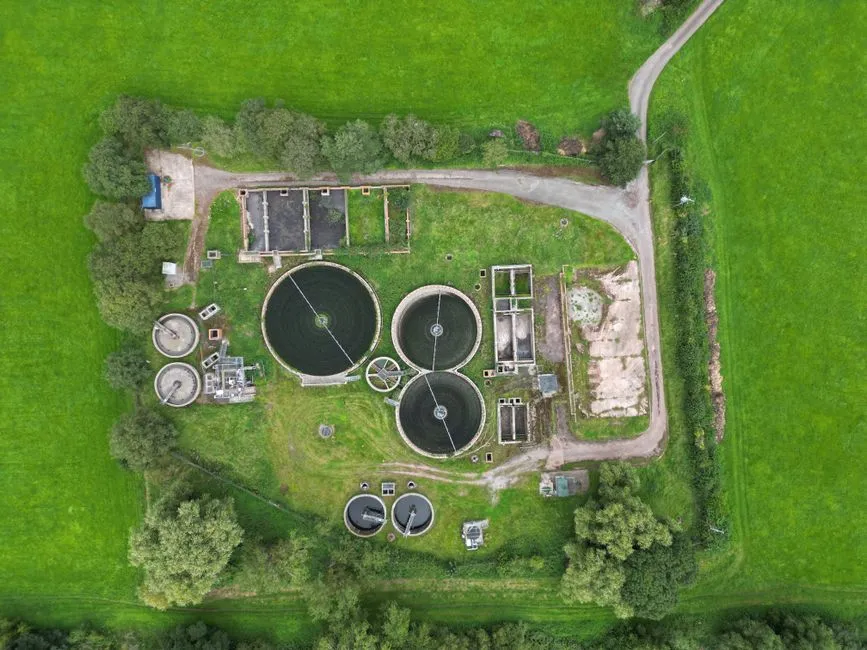
Clarifiers separate solids by gravity, settling heavier particles to the bottom of a circular or rectangular tank where a rotating rake mechanism moves them to a central underflow hopper for removal as sludge (S1, Ecologix). In Graniteville applications, the technology remains the lowest-capex workhorse for kaolin wash water, aggregate thickener overflow, and tailings water where the bulk solids fraction is dense enough to settle within a 2–4 hour retention window. Ecologix's mining case study documented a 90% solids reduction on a heavy-sediment mining stream at lower cost than a comparable DAF installation (S1, 2026 update).
Lamella or inclined-plate clarifiers compress the footprint by stacking multiple settling surfaces at 55–60° within a single tank, achieving effective surface loading rates of 20–40 m/h versus roughly 1–2 m/h for a conventional circular clarifier. For a facility constrained on pad space but still needing gravity separation, a HydropureWater lamella clarifier typically delivers 60–80% TSS removal in a footprint one-fifth to one-tenth of an equivalent circular unit. Sludge consistency from a conventional clarifier runs 1–3% dry solids depending on rake design and underflow pumping; a well-designed DAF can deliver 2–4% sludge consistency, which directly reduces downstream dewatering volume (S5, DAF Corp). On feeds with significant grit, sand, or high-density mineral particles above ~1% solids, gravity still wins on operating cost per gallon treated.
Graniteville Mining Conditions: Which Technology Fits Which Stream
Graniteville-area operations do not face a single feed stream — they face a portfolio of streams that need to be matched to the right unit operation. The decision framework below maps the four most common Graniteville feed conditions to the technology that hits 40 CFR 437 Subpart B and J limits most reliably.
| Stream Type | Typical Solids / Character | Recommended Primary Step | Recommended Polish / Compliance Step | Regulatory Driver |
|---|---|---|---|---|
| Kaolin wash water & clay suspensions | 0.5–2% sub-10-micron clays, high turbidity | Lamella clarifier or thickener | DAF (92–98% removal) for TSS to <30 mg/L | 40 CFR 437 Subpart J |
| Hard-rock fines (granite, pegmatite, gold) | >1% dense mineral slurry, abrasive | Gravity clarifier or thickener | DAF only if feed thinned below ~1% TSS | 40 CFR 437 Subpart B |
| AMD / metal-bearing runoff (Fe, Al, Mn flocs) | Low-density hydroxide flocs at pH 6.5–8.5 | Neutralization + DAF | Sand filter or membrane if metals limit tight | 40 CFR 440 + state metals limits |
| Oily stormwater / wash bay runoff | 50–500 mg/L FOG, intermittent flow | DAF (95% FOG removal, Ecologix) | Not required for FOG; polish for TSS if needed | NPDES oil & grease limit (SCDHEC) |
Two stream behaviors drive most Graniteville sizing calls. First, metal-hydroxide flocs formed during AMD neutralization are low-density and resist gravity settling — DAF floats them efficiently, while a clarifier passes a large fraction through the effluent weir. Second, kaolin wash water and hard-rock fines behave very differently: kaolin particles are platy and low-density, often requiring a flocculant to settle at all; hard-rock fines are dense and settle readily but create abrasive wear on DAF nozzle and pump internals. The Ecologix benchmark of 95% FOG removal for DAF versus 70% for a clarifier on the same stream (S1) is the closest published analog to the oily stormwater case, even though the original case study was food-processing — the flotation mechanism behaves identically on light hydrocarbons.
Variable feed swings the choice further toward DAF. A DAF unit's 15–30 minute hydraulic retention recovers to compliance in roughly one-tenth the time of a 2–4 hour clarifier, which matters when a storm event or batch discharge forces rapid recovery to the NPDES discharge envelope.
DAF vs Clarifier: Head-to-Head Selection Matrix
The matrix below distills the cited manufacturer data (S1, S3, S5) into a procurement-ready comparison. Use it to shortlist within the first minute of vendor evaluation.
| Parameter | DAF (Circular, FC-class) | DAF (Rectangular, RC-class) | Gravity / Lamella Clarifier |
|---|---|---|---|
| TSS removal efficiency | 92–98% (DAF Corp) | 85–90% (DAF Corp) | ~90% on heavy slurry (Ecologix mining case) |
| Footprint (relative) | Small | Small | Large; lamella is small |
| Capex direction | Higher (S1) | Higher (S1) | Lower (S1) |
| Opex direction | Higher (S1); chemistry-driven | Higher (S1); chemistry-driven | Lower (S1) |
| Sludge consistency | 2–4% DS (DAF Corp) | 2–4% DS (DAF Corp) | 1–3% DS typical |
| Response to flow surges | Fast (15–30 min retention) | Fast (15–30 min retention) | Slow (2–4 h retention) |
| Suitability for metal-hydroxide flocs | High (floats low-density flocs) | High | Low–Medium (chemistry-dependent) |
| Suitability for heavy mineral slurries >1% | Poor without upstream thickener | Poor without upstream thickener | High |
| 40 CFR 437 TSS compliance margin | High (effluent typically 5–25 mg/L) | Medium (effluent typically 30–60 mg/L) | Medium (effluent typically 30–80 mg/L) |
Hybrid Trains: When Graniteville Plants Use Both
The smartest 2026 answer for a Graniteville facility handling multiple feed streams is rarely a single unit — it is a hybrid DAF + clarifier train. Ecologix's selection guide explicitly notes that hybrid configurations address complex wastewater by combining flotation's oil and fine-solids removal with sedimentation's heavy-solids capacity (S1). The typical 2026 configuration for a Graniteville kaolin or hard-rock operation is a primary lamella clarifier or thickener that takes the bulk feed from 1–2% solids down to 200–500 mg/L TSS, followed by a DAF that polishes to the 40 CFR 437 limit, captures residual oil and grease, and floats the metal-hydroxide flocs that survive neutralization.
For a facility dealing with both NPDES TSS limits and visible-oil sheen on stormwater, a hybrid train also buys operational margin. The clarifier handles steady-state bulk flow; the DAF handles shock loads and any sheen events that would otherwise trigger an SCDHEC noncompliance. Pairing a HydropureWater DAF system with a lamella clarifier upstream gives a procurement engineer a defensible answer to both the regulator and the operations manager. Pilot testing both steps on actual site water before committing capex is standard practice on 2026 hybrid installations.
Sizing and Sourcing Checklist for 2026 Procurement
Run a full wastewater characterization — TSS, FOG, total recoverable metals, pH, temperature, and particle size distribution — before sizing either unit (S5, DAF Corp). Confirm the applicable subcategory under 40 CFR 437 and pull the individual NPDES permit limits from SCDHEC, not the federal default. Decide on hybrid versus single-step based on feed variability; a site with multiple distinct streams is almost always a hybrid. Specify SS316 wetted parts, a PLC with effluent TSS monitoring, and saturation pressure ≥5 bar in the DAF skid (S3, Wastewater Machinery). Request bench- or pilot-scale DAF feasibility testing from the vendor — DAF Corp and most metallurgical DAF vendors offer this as a paid service, and it typically saves more than it costs on a 2026 capex of this size. Plan for sludge handling downstream of either unit: the 2–4% DAF float or 1–3% clarifier underflow will need a plate and frame filter press for dewatering to 25–35% cake, paired with an automatic chemical dosing system for consistent polymer conditioning. Cross-reference a comparable engineering decision in the Catlettsburg mining DAF vs clarifier guide and the filter press sizing guide for sludge-handling cost benchmarks. For adjacent regional context, the Mexico City industrial wastewater compliance guide covers non-US regulatory frameworks, and the Bicknell mining wastewater comparison covers a non-Southeast US analog.
Frequently Asked Questions
Does a DAF system meet 40 CFR 437 TSS limits on a Graniteville mining feed?
Yes — a circular DAF unit at 92–98% TSS removal (DAF Corp) typically delivers 5–25 mg/L effluent from a 200–500 mg/L TSS feed, comfortably under the 30 mg/L monthly average that applies to most 40 CFR 437 Subpart B subcategories. SCDHEC site-specific permit limits should always be confirmed against the federal default.
When is a gravity clarifier still the right choice over DAF for a Graniteville facility?
When the feed exceeds ~1% total suspended solids and the particles are dense mineral fines — granite wash water, aggregate thickener overflow, or hard-rock tailings — a gravity clarifier or lamella delivers 90% removal (Ecologix mining case) at lower capex and opex than a DAF, which would require an upstream thickener to handle the same loading (S1).
How long does a DAF system need to recover to compliance after a flow surge?
A DAF unit recovers to steady-state effluent quality in 15–30 minutes because the hydraulic retention is short and the float layer forms continuously; a conventional clarifier takes 2–4 hours. For a Graniteville site with storm-driven or batch discharge variability, this is the single biggest compliance-margin argument for putting DAF after primary settling.
Can a DAF and a clarifier be combined in a single treatment train for 40 CFR 437 compliance?
Yes — hybrid DAF + clarifier trains are standard for Graniteville operations handling both heavy mineral slurries and metal-bearing or oily streams (S1, Ecologix). The clarifier handles bulk solids removal; the DAF polishes TSS, captures residual FOG at 95% removal, and floats low-density metal-hydroxide flocs before NPDES discharge.