The Three-Layer Compliance Frame for a Claycomo Assembly Plant
An EV or assembly plant discharging to the sanitary sewer in the Claycomo, Missouri area is bound by three overlapping regulatory layers that all have to be cleared at the same time, and the federal floor applies even before KC Water issues a single piece of paper. Under 40 CFR 403.5(a), pretreatment standards are pollutant limits that apply to any industrial user discharging to a publicly owned treatment works (POTW), and the EPA states explicitly that these standards apply whether or not the POTW has an approved program and whether or not a control mechanism has been issued; there is no silent exemption waiting on a local permit. KC Water's Regulatory Compliance Division (RCD), operating under Kansas City Municipal Code Chapter 60 Article IV, regulates all industrial users served by KC Water and requires significant industrial users (SIUs) to participate in the Industrial Pretreatment Program (IPP).
The categorical subparts that govern an automotive body and paint shop are 40 CFR Part 433 (Metal Finishing) and 40 CFR Part 442 (Transportation Equipment Cleaning), and KC Water's IPP page lists both as the applicable federal categories for the kind of operations a Claycomo-class plant runs. On top of those, the always-on general prohibition in 40 CFR 403.5(a) forbids any discharge that causes "pass-through" — defined at 40 CFR 403.3(p) as a discharge that exits the POTW into waters of the U.S. and is a cause of an NPDES permit violation — or "interference," defined at 40 CFR 403.3(k) as a discharge that inhibits or disrupts the POTW, its treatment processes, or its sludge use or disposal. The legal pivot is the receiving plant's effluent and biosolids quality, not what the assembly plant thinks it is sending down the sewer.
For SIU threshold context, the City of Independence's Industrial Pretreatment Program — a peer POTW in the Kansas City metro — defines an SIU as any user subject to categorical pretreatment standards or any user discharging at least 25,000 gallons per day of industrial process wastewater. A typical automotive body-and-paint train clears that floor easily. KC Water is also aligning its monitoring to the EPA's 2024 PFAS MCLs for PFOA, PFOS, and four other compounds, which is a new monitoring layer that did not exist on prior permit cycles and that will show up as a special condition on the next permit renewal. A related reference point for the same regulatory frame applied to a different industry segment is the Houston refinery pretreatment compliance guide, which lays out the same 40 CFR 403.5(a) logic for a different process wastewater mix.
What the Wastewater Stream Inventory Actually Looks Like
A body shop, paint shop, and EV battery hall each produce a different pollutant fingerprint, and the design of the treatment train is meaningless until those streams are inventoried at the unit-operation level rather than lumped into a generic "industrial wastewater" bucket. The stream inventory is also what KC Water's RCD will request in the wastewater survey required of all new industrial users before any discharge starts.
The stamping and body shop side is dominated by draw lubricants, mill oils, phosphate or nanoceramic pretreatment rinse water, and weld flux residue. These streams load the sewer with emulsified oil, TSS, zinc and nickel from phosphate baths, and suspended solids from flux and grinding swarf. They are typically the highest oil and grease contributors in the plant and are the stream that drives the design of the front end of the train. The paint shop adds e-coat rinse water, paint detackifier overflow, and booth scrubber blowdown, which run high in COD and color and have historically carried hexavalent chromium from older pretreatment baths. Final assembly and trim contribute floor wash, parts washer effluent, and sealer and adhesive residues, which are lower in flow but tend to discharge intermittently and are a classic slug source.
The EV battery hall is the stream category that is growing in relevance as the electrification of Ford's Claycomo operations continues. Cell winding, formation, and electrolyte handling generate electrolyte wash water with NMP solvent traces, fluoride from electrolyte salt breakdown (LiPF₆ hydrolysis), and trace lithium. Cooling-tower and boiler blowdown are utility streams that round out the inventory: cooling-tower blowdown historically carries hexavalent chromium in older plants, and boiler blowdown adds TDS — both are typical quarterly metals parameters on an SIU permit. The full stream map, not the categorical label alone, is what has to be sent through the train.
The Five-Stage Treatment Train Sized for Auto/EV Flow
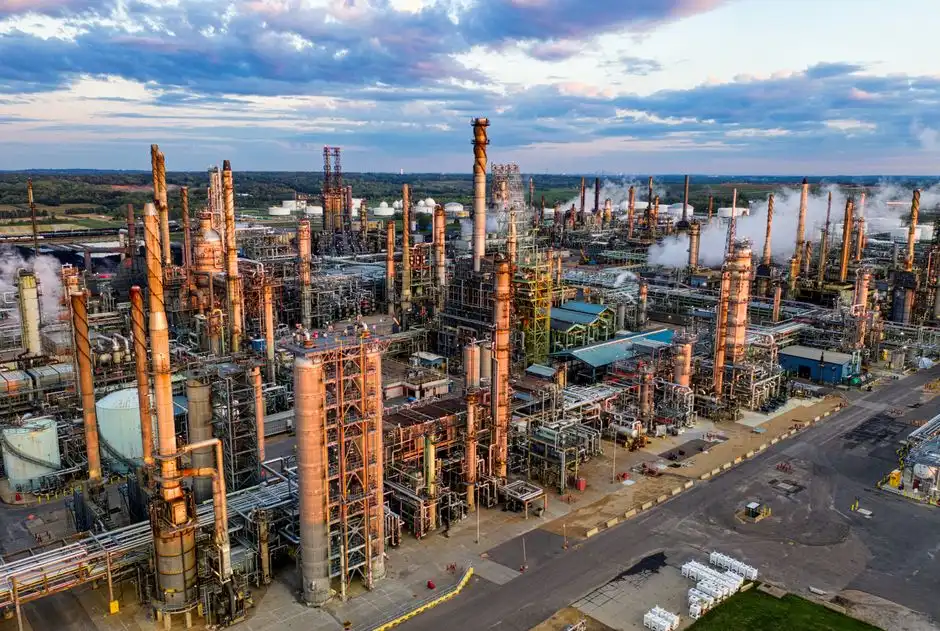
The unit-operation sequence between the plant's process sewer and the KC Water manhole is consistent across the auto/EV segment, even though the equipment is scaled differently from a petroleum refinery. The five stages and their parameter bands are the ones an engineer can put into a basis-of-design and defend in front of the RCD.
Stage 1 is an API separator or corrugated-plate interceptor (CPI) that takes free oil out by gravity. A well-operated API separator typically leaves 100–200 mg/L of oil and grease in the water phase, and a CPI hits a similar band in a much smaller footprint; either way, this stage sets the floor for emulsified-oil load on Stage 2 (Hydropure 2026 guide). Stage 2 is a dissolved air flotation (DAF) unit, sized in the 4–300 m³/h capacity band typical of oily industrial wastewater, with an air-to-solids ratio in the 0.02–0.06 range, hydraulic retention of 15–30 minutes, and saturator recycle rates at 20–50% of forward flow. A DAF in this duty brings oil and grease down to roughly 15–30 mg/L, which clears the 50–100 mg/L KC Water local ceiling with margin before any biological polishing is asked to clean up oil. For a DAF specified to this duty, the HydropureWater dissolved air flotation (DAF) system covers this capacity band, and the sizing logic is laid out in a DAF process flow diagram walkthrough for the basis-of-design step.
Stage 3 is equalization and neutralization in a basin sized for 8–24 hours of hydraulic retention, with pH trimmed to 6–9 before the biological stage. This is the single most important control point for preventing interference events from a spent-phosphate or solvent slug, and it is the EQ basin that KC Water's 2024 Significant Noncompliance list shows the agency is actually enforcing on (Hydropure 2026 guide). Stage 4 is biological polishing, and the choice is between an MBBR — robust to the 200–800 mg/L COD swing from a paint-shop upset — and an MBR that adds a flat-sheet PVDF membrane barrier at 0.1 μm, holds biomass at 8,000–12,000 mg/L MLSS, and produces a polished effluent with <5 mg/L TSS and <1 NTU turbidity in roughly 60% of the footprint an equivalent CAS basin would need. MBR is the default for space-constrained plant expansions, and a skid-mounted HydropureWater integrated MBR membrane bioreactor or a HydropureWater DF series PVDF flat-sheet membrane module retrofit covers the MBR side of this stage. Stage 5 is a multimedia filter plus an online oil-in-water analyzer with a 10–20 mg/L alarm setpoint, plus pH and conductivity probes feeding the control room, and every analyzer on Stage 5 maps to either a pass-through risk (oil, TSS, ammonia) or an interference risk (pH swings, slug flows) defined in 40 CFR Part 403. A comparable five-stage frame for a different industry segment is laid out in the transportation equipment pretreatment guide for Spirit Lake.
| Stage | Unit Operation | Key Parameter / Setpoint | Primary Pollutant Targeted |
|---|---|---|---|
| 1 | API separator or CPI | Effluent O&G 100–200 mg/L | Free oil |
| 2 | DAF (4–300 m³/h) | A/S 0.02–0.06, HRT 15–30 min, recycle 20–50%; effluent O&G 15–30 mg/L | Emulsified oil, colloidal TSS |
| 3 | EQ + neutralization basin | HRT 8–24 h, pH 6–9 | Slug load, pH swing |
| 4 | MBBR or MBR (PVDF 0.1 μm) | MLSS 8,000–12,000 mg/L (MBR); effluent TSS <5 mg/L, turbidity <1 NTU | COD, sulfides, phenols, ammonia, residual metals |
| 5 | Multimedia filter + online analyzers | O/W alarm 10–20 mg/L; pH and conductivity interlocks | Final barrier, pass-through early warning |
Parameter vs. Local Limit: The Engineering Anchor Table
The table below is the one-page process summary that survives a KC Water audit. It maps each auto/EV pollutant of concern to a typical inlet band, a typical KC Water local limit, the unit operation that does the primary removal, and the polishing or verification step that protects the permit. The numbers describe the engineering bands seen in practice; the specific number in a Claycomo plant's permit is set by KC Water's RCD and is routinely more stringent than the federal categorical number, so the design margin should be built around the local limit, not 40 CFR Part 433 or Part 442 alone (Hydropure 2026 guide).
| Pollutant | Typical Auto/EV Inlet Band | Typical KC Water Local Limit | Primary Removal Stage | Polishing / Verification Step |
|---|---|---|---|---|
| Oil & Grease | 200–1,000 mg/L (body shop) / 50–300 mg/L (final assembly) | 50–100 mg/L | DAF (Stage 2) | Multimedia filter; online O/W analyzer |
| TSS | 200–800 mg/L | 100–200 mg/L | DAF (Stage 2) + EQ (Stage 3) | MBR flat-sheet 0.1 μm barrier |
| Sulfides (total) | 5–50 mg/L (paint detackifier, sealer residues) | 1–10 mg/L | EQ basin + biological sulfide oxidation (Stage 4) | MBBR/MBR polishing; online S²⁻ probe |
| Phenols | 1–20 mg/L (paint shop, parts washer) | 0.5–5 mg/L | Biological oxidation (Stage 4) | MBR or GAC if required; quarterly sampling |
| BTEX | 0.1–1 mg/L (sealer, adhesive residues) | Quarterly compliance sampling | Biological oxidation (Stage 4) | GAC polishing; quarterly GC/MS |
| Ammonia (as N) | 10–60 mg/L | 10–30 mg/L | MBBR/MBR nitrification (Stage 4) | MBR flat-sheet modules; online NH₃ probe |
| pH | 4–11 (slug events) | 6–9 (instantaneous) | EQ + neutralization (Stage 3) | Online pH trim with interlock to sewer shutoff |
| Hexavalent Chromium | 0.05–2 mg/L (cooling-tower blowdown, legacy baths) | Quarterly compliance; local limit often 0.1–0.5 mg/L | Reduction to Cr(III) + precipitation (pre-Stage 4) | Sand/multimedia filter; quarterly metals sampling |
The Documentation Playbook KC Water Actually Enforces
The treatment train is the engineering side; the documentation side is where most KC Water and EPA enforcement actions actually land, and the 2024 Significant Noncompliance list is a direct read on which paperwork items the RCD is citing right now. Five steps, repeated every reporting cycle, cover the paper trail.
Step 1 — SIU classification and control mechanism. The plant submits a wastewater survey to the RCD, is classified as an SIU under Kansas City Municipal Code Chapter 60 Article IV, and receives a discharge permit that lists the local numerical limits, monitoring schedule, and reporting cadence. Until that document is in hand, the plant is still on the hook under 40 CFR 403.5(a) but without a defined sampling schedule, so the permit is the document the plant is judged against.
Step 2 — Self-monitoring. Twenty-four-hour flow-weighted composite sampling, monthly for oil and grease, TSS, sulfides, phenols, and ammonia, and quarterly for metals, BTEX, and hexavalent chromium. Results are reported on a DMR or the KC Water equivalent, and exceedances trigger accelerated monitoring. The 2024 KC Water SNC list shows oil-and-grease A/V exceedances and failed O&G monitoring as two of the most common administrative citations (KC Water IPP page).
Step 3 — Slug-control plan. Written, current, and trained out. Covers loading racks, tank transitions, batch discharges, and any operation that can put a 30,000+ gallon slug of process water into the sewer. The 2024 KC Water SNC list shows unpermitted slug discharges of 30,000+ gallons as an active enforcement priority, with cease-and-desist and notice-of-violation actions attached.
Step 4 — Accidental-discharge reporting. Notify the RCD within 24 hours when a slug escapes, and follow up with a written report describing the cause, corrective action, and revised prevention measures. Late reporting over 45 days is a separately cited violation on the 2024 SNC list.
Step 5 — Auditable records. BMPs, restricted-chemical inventory, and operator training; chain of custody for every composite sample; calibration logs for the online oil-in-water analyzer; and DAF/EQ/biotreater operator training records. The paper trail is what turns a "no pass-through" claim into a defensible one (Hydropure 2026 guide).
Frequently Asked Questions
Which federal categorical standards apply to an EV/auto plant near Claycomo discharging to KC Water?
Body and paint shop operations are covered by 40 CFR Part 433 (Metal Finishing) and 40 CFR Part 442 (Transportation Equipment Cleaning), both listed on KC Water's IPP page. Battery hall streams may also touch 40 CFR Part 461 (Battery Manufacturing) for fluoride and trace metals, and the always-on pass-through and interference prohibition at 40 CFR 403.5(a) applies regardless of category.
What is the typical oil and grease local limit at KC Water, and how is it cleared?
Typical KC Water local oil and grease limits sit in the 50–100 mg/L range. The DAF stage (Stage 2 of the train) brings O&G to 15–30 mg/L on its own, and an online oil-in-water analyzer on the final effluent alarms at 10–20 mg/L to give the operator hours of warning before the permit number is at risk (Hydropure 2026 guide).
What does KC Water actually cite in its 2024 enforcement actions against industrial users?
The 2024 KC Water Significant Noncompliance list shows oil and grease exceedances, unpermitted slug discharges of 30,000+ gallons, late reporting over 45 days, and failure to follow cease-and-desist orders as the most common SNC triggers, with notice-of-violation and administrative fine as the typical response (KC Water IPP page).
How does a Claycomo plant start the KC Water SIU permitting process?
Submit a wastewater survey to the KC Water Regulatory Compliance Division at 7300 Hawthorne Rd, Kansas City, MO 64120, attention Matt Lary, Environmental Compliance Manager. Once the application is returned, the RCD drafts a permit and accompanying fact sheet for review, and compliance is required under Kansas City Municipal Code Chapter 60 Article IV from the first day of discharge (KC Water IPP page).