What Does SBR Maintenance Actually Cost in 2026?
SBR (Sequencing Batch Reactor) maintenance cost in 2026 averages $0.05–$0.18 per m³ treated for industrial and small-municipal plants in the 50–5,000 m³/day range, or roughly $18,000–$65,000 per year for a 1,000 m³/day facility at 90% utilization. The largest line items are energy (35–45%, mainly intermittent aeration), sludge handling (25–35%), and mechanical servicing of the decanter and valves (10–15%). A modern 4-phase SBR with automatic decanter, variable-speed blowers, and IoT monitoring runs 20–40% below the OPEX of a basic timer-controlled unit.
That benchmark places SBR between conventional activated sludge ($0.07–$0.22/m³) and membrane bioreactors ($0.12–$0.35/m³) on operating cost (per Water Environment Federation OPEX benchmarks, 2024-11). The spread within the SBR band is wide because influent load, effluent permit, and degree of automation swing the numbers more than the reactor geometry does. A food-processing SBR running 4,000 mg/L COD influent with manual decanter sits near the top; a packaged 4-phase SBR with VFD blowers and online DO control sits near the bottom. The scope of the figure above covers maintenance, energy, consumables, and routine service — capital depreciation and full-time labor are itemized separately below where they apply.
SBR Cost Structure: Where the Money Goes
Energy from aeration and mixing dominates SBR operating cost at 35–45% of the OPEX dollar. Because SBR cycles between aerobic and anoxic/anaerobic phases rather than running continuously, blower runtime is typically 30–45% lower than an equivalent continuous-flow activated sludge basin running at the same loading. A standard cycle is 4–6 hours ON in an 8-hour total cycle, so the blower is idle or at low speed for the remainder.
Sludge handling sits at 25–35% of the dollar and is the line most operators underestimate. Wasting rates of 0.5–1.5% of influent flow keep MLVSS in the 3,000–5,000 mg/L band, but the dewatering cost downstream is what drives the bill: $30–$80 per dry ton through a plate-and-frame or screw press. A 1,000 m³/day plant generating 200–400 kg DS/day will spend $2,200–$11,700 per year on dewatering consumables and polymer alone, and another $4,000–$9,000 on press maintenance. Pairing the basin drain with a sludge dewatering campaign through a plate and frame filter press for SBR sludge dewatering cuts mobilization cost and keeps polymer dose tight.
Mechanical service on the decanter, valves, and actuators accounts for 10–15%. Decanter seal and grease service runs $800–$2,500 per basin per year; automated valve actuators add $200–$600 each in annual service. Chemicals (defoamer, polymer, cleaning agents) take 5–10%, and instrumentation — DO, pH, MLSS probes — adds another 3–5%, with membrane-DO probes at $1,200–$2,200 each on a 4–6 year replacement cycle. Labor in a modern automated SBR is 0.5–1.5 hours of operator attention per basin per day, which lands at 10–15% of total OPEX when fully loaded.
| OPEX Category | Share of Total | 2026 Unit Reference |
|---|---|---|
| Energy (aeration + mixing) | 35–45% | $0.06–$0.12/kWh; blower on 30–45% of cycle time |
| Sludge handling & dewatering | 25–35% | $30–$80 per dry ton dewatered |
| Mechanical service (decanter, valves, actuators) | 10–15% | $800–$2,500/basin/year decanter |
| Chemicals (defoamer, polymer, cleaner) | 5–10% | $2–$6/kg active polymer typical |
| Labor | 10–15% | 0.5–1.5 hr operator/basin/day |
| Instrumentation (DO, pH, MLSS) | 3–5% | $800–$2,200 per DO probe, 4–6 yr life |
Component-by-Component Maintenance Schedule and Cost
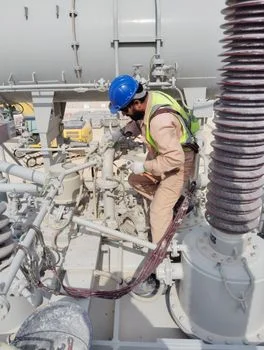
Fine-bubble disc or tube diffusers are the most replaced consumable in the aeration grid. Inspect annually for fouling and weeping, clean chemically every 2–3 years (typically acid wash plus peroxide soak), and budget full replacement every 5–8 years at $150–$400 per diffuser installed. A 1,000 m³/day basin usually holds 60–150 diffusers depending on floor coverage and airflow rate. Standard EPDM membranes handle municipal wastewater; silicon or polyurethane is specified for industrial streams above 40 °C or with high oil/grease.
Floating or sliding decanters are the single most expensive mechanical service item. Grease bearings quarterly, replace seals and wear plates every 2–4 years, and budget full decanter replacement every 7–10 years at $8,000–$25,000 per basin. Stainless steel units in industrial effluent routinely hit 12–15 years before replacement. Blowers (positive-displacement lobe or turbo) need oil changes every 1,500–3,000 hours, bearing service every 3–5 years, and full replacement every 10–15 years. VFD-equipped variable-speed blowers cost 30% more upfront but recover 25–35% of aeration energy versus constant-speed machines. Submersible mixers need seal replacement every 3–5 years and full unit replacement every 8–12 years at $3,500–$9,000 each. Instrumentation: membrane-DO probes last 2–4 years ($800–$1,800), pH probes 1–2 years ($300–$600), MLSS sensors 3–5 years ($2,500–$5,000), and automatic samplers need annual service at $400–$900. Control valves and electric actuators: annual service, full replacement every 5–8 years at $1,200–$3,500 each — specify stainless steel bodies for industrial effluent to extend service life.
| Component | Service Interval | Replacement Interval | 2026 Cost (USD) |
|---|---|---|---|
| Fine-bubble diffusers | Inspect annually; chemical clean every 2–3 yr | 5–8 yr | $150–$400/diffuser installed |
| Floating/sliding decanter | Grease quarterly; seal service 2–4 yr | 7–10 yr | $8,000–$25,000/basin full unit |
| Blower (PD or turbo) | Oil change 1,500–3,000 hr; bearing 3–5 yr | 10–15 yr | $15,000–$60,000; VFD adds 30% |
| Submersible mixer | Seal replace 3–5 yr | 8–12 yr | $3,500–$9,000 each |
| DO probe (membrane) | Calibrate monthly | 2–4 yr | $800–$1,800 |
| pH probe | Calibrate monthly | 1–2 yr | $300–$600 |
| MLSS sensor | Wipe clean weekly | 3–5 yr | $2,500–$5,000 |
| Auto sampler | Annual service | 5–8 yr | $400–$900 service; $3,000–$6,000 replace |
| Control valve + actuator | Annual service | 5–8 yr | $1,200–$3,500 each |
7 Ways to Cut SBR Maintenance Cost 20–40%
- Install variable-speed blowers with VFD on a real-time DO signal. Cuts aeration energy 25–35% with 18–30 month payback at $0.10/kWh (per US DOE industrial motor systems efficiency data, 2024-09). The DO setpoint band — typically 1.5–2.0 mg/L aerobic, <0.3 mg/L anoxic — replaces the fixed ON/OFF timer.
- Switch from timer to online DO- and ORP-based cycle control. Reduces aeration over-runs by 15–25% and stabilizes effluent against shock loads. A 2024 municipal SBR retrofit case (WaterOnline, 2024-08) reported $0.04/m³ OPEX reduction and a 22% drop in effluent TSS variance.
- Add membrane-DO probes in place of galvanic units. Lower drift, fewer manual calibrations, and 0.3–0.5 hr/basin/day of labor recovered. Galvanic probes drift 5–10% per week; optical/membrane units hold calibration 30–60 days.
- Right-size sludge wasting to keep MLVSS at 3,000–4,000 mg/L and SVI at 80–120 mL/g. This single change reduces downstream polymer dose 20–30% and improves settling in the settle phase, cutting suspended solids carryover into the decanter.
- Add a screw press or optimize the plate press cycle. Sludge dewatering cost drops from $60–$80 to $30–$45 per dry ton — roughly 40% saved on a line item that represents a quarter of total OPEX. Pair the press campaign with the basin drain to share mobilization.
- Deploy IoT remote monitoring for 24/7 visibility. Reduces unplanned site visits by 30–50% and catches decanter and diffuser faults before they cascade into a permit excursion. See the full IoT sensor cost and selection for SBR monitoring guide for hardware budgets.
- Bundle decanter service with the annual basin drain. Saves one mobilization per year — $1,500–$3,000 per basin — and ensures seals and wear plates are inspected while the basin is empty and accessible.
SBR vs MBR vs Oxidation Ditch: 2026 Maintenance Cost Comparison
SBR at $0.05–$0.18/m³ is the most operationally flexible of the three: intermittent aeration, no membranes, and 1–2 hours of operator attention per basin per day on a modern automated unit. MBR runs $0.12–$0.35/m³, with membrane replacement every 5–8 years ($80–$180 per m² of membrane area) and chemical CIP every 1–2 weeks driving the line. The MBR premium buys reuse-quality effluent (typically <5 mg/L TSS) and roughly half the footprint. Oxidation ditch sits at $0.04–$0.16/m³ (see the full oxidation ditch maintenance cost 2026 OPEX breakdown), with continuous aeration, simpler rotor or disc aerator mechanics, and lower automated-control demand — but more land and tighter flow stability requirements.
Decision rule: choose SBR for 50–5,000 m³/day with intermittent flow, batch discharges from upstream processes, or constrained sites; choose MBR when water reuse or tight effluent TSS/NH₃ is the binding constraint; choose oxidation ditch for stable municipal flows above 10,000 m³/day where land is available and the load is uniform. For a head-to-head against AAO specifically, see the SBR vs AAO process comparison.
| Parameter | SBR | MBR | Oxidation Ditch |
|---|---|---|---|
| 2026 OPEX ($/m³) | $0.05–$0.18 | $0.12–$0.35 | $0.04–$0.16 |
| Dominant cost driver | Aeration energy + sludge | Membrane replacement + CIP | Continuous aeration energy |
| Operator attention | 1–2 hr/basin/day | 2–3 hr/basin/day (CIP logistics) | 0.5–1.0 hr/basin/day |
| Membrane replacement | None | Every 5–8 yr, $80–$180/m² | None |
| Typical effluent TSS | 15–30 mg/L | <5 mg/L | 15–30 mg/L |
| Best-fit flow range | 50–5,000 m³/day | 100–20,000 m³/day | >10,000 m³/day |
How to Budget SBR Maintenance for a New Plant in 2026
Build the 5-year budget in three tranches. Year 1 is full operating cost — energy, chemicals, routine labor — with minimal scheduled service spend because everything is under warranty; budget at the top of the OPEX range ($0.15–$0.18/m³) until you have 6 months of actuals. Years 2–3 absorb the first decanter seal/grease service and the first diffuser inspection; add $2,000–$4,000 per basin for that maintenance visit. Years 5–6 carry the first membrane-DO probe replacement, decanter wear plate replacement, and the first major instrument calibration cycle.
Years 7–8 are the heavy years. Budget the decanter full replacement line at $8,000–$25,000 per basin and the diffuser replacement at $9,000–$45,000 per basin depending on count and type. For a two-basin 1,000 m³/day SBR, the combined mid-life overhaul peaks at $50,000–$140,000 in a single year. The standard planning move is to build a 5-year sinking fund equal to 8–12% of initial CAPEX, capitalized annually, so the mid-life spend does not require a supplemental budget request.
Frequently Asked Questions
Q1: What is the average annual maintenance cost of an SBR system?
A: $18,000–$65,000 per year for a 1,000 m³/day plant in 2026, dominated by energy (35–45%) and sludge handling (25–35%) (HydropureWater field data, 2026).
Q2: How often do SBR diffusers need to be replaced?
A: Fine-bubble diffusers every 5–8 years; chemical cleaning every 2–3 years; annual visual inspection for fouling and weeping.
Q3: Is SBR cheaper to maintain than MBR?
A: Yes — typically 40–60% lower OPEX because SBR has no membranes to clean or replace. The trade-off is effluent quality: SBR typically achieves 15–30 mg/L TSS, while MBR routinely delivers <5 mg/L.
Q4: What is the main cause of high SBR maintenance cost?
A: Oversized or constant-speed blowers driving excess aeration energy, and over-wasting of sludge from poor MLSS control. Both are addressable with VFD blower retrofits and online DO/MLSS instrumentation, typically recovering 20–40% of the OPEX line.
Q5: How long does an SBR decanter last?
A: 7–10 years for a floating or sliding decanter with annual seal and grease service; stainless steel units in industrial effluent reach 12–15 years before full replacement is required.
Related Equipment
- GX series rotary bar screen for SBR headworks protection — specifications, capacity range, and technical data