Solar Cell Wastewater ZLD: 2025 Hybrid System Design with 99.9% Recovery & Solar Integration Costs
Solar cell wastewater zero liquid discharge (ZLD) systems achieve 99.9% recovery by combining reverse osmosis (RO), mechanical vapor recompression (MVR) evaporators, and crystallizers—reducing brine volume to near-zero. Solar integration cuts grid energy consumption by 40-60%, with CAPEX ranging from $2.5M–$8M for a 100–500 m³/day PV plant (2025 data). Hybrid ZLD systems are now mandatory for compliance with China’s GB 31573-2015, which sets strict limits for fluoride (<10 mg/L), arsenic (<0.1 mg/L), and copper (<0.5 mg/L).
Why Solar Cell Plants Need ZLD: Compliance, Water Scarcity, and Cost Pressures
China’s GB 31573-2015 standard enforces a maximum fluoride limit of 10 mg/L, arsenic at 0.1 mg/L, and copper at 0.5 mg/L for photovoltaic (PV) manufacturing wastewater, necessitating advanced treatment beyond traditional precipitation. Solar cell production is water-intensive, typically generating 3–5 m³ of wastewater for every megawatt (MW) of module capacity. This effluent is characterized by high salinity, with total dissolved solids (TDS) ranging from 5,000 to 50,000 mg/L, alongside significant concentrations of hydrofluoric acid (HF), nitric acid, and heavy metals like nickel and chromium. Failure to manage these contaminants results in severe regulatory and financial consequences.
In 2023, a 1 GW PV manufacturing facility in Jiangsu province incurred $1.2M in environmental fines due to repeated fluoride exceedances in its discharge. While the CAPEX for a 500 m³/day ZLD system was estimated at $4.5M, the plant’s projected ROI was accelerated by avoiding these fines and saving approximately $3M annually in industrial water procurement and discharge fees. In water-stressed hubs like Xinjiang and parts of northern China, ZLD is no longer optional; it is a prerequisite for operating permits. the Chinese government currently offers green technology subsidies covering up to 30% of the CAPEX for ZLD installations that demonstrate high recovery rates and energy efficiency.
The global regulatory environment is also tightening. While 2025 compliance standards for solar cell wastewater vary by region, the trend toward "Zero Liquid Discharge" is becoming a global benchmark for ESG-conscious manufacturers. The following table compares the discharge limits that PV plants must navigate today.
| Contaminant | China GB 31573-2015 | US EPA (Effluent Guidelines) | EU Industrial Emissions Dir. |
|---|---|---|---|
| Fluoride (F-) | < 10 mg/L | < 20 mg/L | < 15 mg/L |
| Arsenic (As) | < 0.1 mg/L | < 0.5 mg/L | < 0.15 mg/L |
| Copper (Cu) | < 0.5 mg/L | < 2.0 mg/L | < 0.5 mg/L |
| TDS | Varies by Province | < 500 mg/L (Secondary) | Site-Specific BREF |
Hybrid ZLD System Design for Solar Cell Wastewater: Process Flow and Contaminant-Specific Treatment
A robust ZLD system for PV wastewater requires a multi-stage approach to handle the complex chemistry of hydrofluoric acid and heavy metal ions. The process begins with advanced pre-treatment using a DAF system for pre-treatment of solar cell wastewater, which removes up to 95% of suspended solids and residual fats/oils from the wafer cutting process. This stage is critical to prevent the rapid fouling of downstream membranes. Following DAF, chemical precipitation using calcium hydroxide (lime) is employed to reduce fluoride levels through the formation of calcium fluoride (CaF₂) sludge.
The secondary stage utilizes high-recovery RO systems for PV wastewater treatment. In a typical two-pass RO configuration, the system achieves 90–95% water recovery. To prevent silica and sulfate scaling—common in solar cell effluent—automated pH adjustment and specialized antiscalant dosing are integrated. The permeate from this stage typically reaches a TDS of less than 50 mg/L, making it suitable for reuse in cooling towers or as feedwater for ultrapure water (UPW) systems.
The concentrated brine from the RO stage, now containing 5% to 8% TDS, is fed into a Mechanical Vapor Recompression (MVR) evaporator. MVR technology is significantly more efficient than traditional thermal evaporation, consuming only 0.02–0.04 kWh per kg of water evaporated, compared to 0.1–0.15 kWh for multi-effect evaporators. The MVR unit concentrates the brine to approximately 25% TDS, reducing the volume by a further 80%. Finally, a forced-circulation crystallizer processes the remaining concentrate into solid salt cakes, achieving 99.9% total water recovery. Specific arsenic removal technologies for PV wastewater, such as ferric chloride coagulation or specialized ion exchange resins, are often integrated before the evaporation stage to ensure the recovered solids are manageable or potentially recyclable.
| Treatment Stage | Primary Contaminant Focus | Removal/Recovery Rate | Technology Employed |
|---|---|---|---|
| Pre-treatment | TSS, FOG, Fluoride | 95% TSS / 90% Fluoride | DAF + Chemical Precipitation |
| Membrane Stage | TDS, Heavy Metals | 90-95% Water Recovery | Two-Pass Brackish Water RO |
| Evaporation | Brine Concentration | 80% Volume Reduction | MVR Evaporator |
| Crystallization | Solid Salt Recovery | 99.9% Total Recovery | Forced-Circulation Crystallizer |
Solar Integration for ZLD: How Photovoltaic Power Cuts Energy Costs by 40–60%
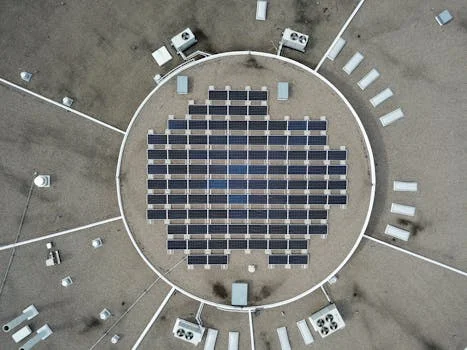
The primary barrier to ZLD adoption has historically been its high energy intensity, with traditional systems requiring 15–30 kWh/m³ of treated water. However, by leveraging the very product these plants manufacture—photovoltaic modules—operators can significantly offset these costs. A 1 MW solar PV installation can provide enough energy to offset 30–50% of the demand for a 200 m³/day ZLD plant. In regions with high solar irradiance, such as Xinjiang or the Southwestern United States, hybrid solar-grid systems allow the facility to run high-energy MVR units during peak solar production hours, utilizing grid power only for baseline operations.
Solar thermal integration offers an even more direct efficiency gain. Parabolic trough collectors can be used to preheat the ZLD feedwater to 80°C before it enters the MVR evaporator. This reduces the electrical load on the MVR compressor by approximately 20–30%. When combined with thermal storage systems, such as molten salt or high-capacity insulated tanks, the system can maintain 24/7 evaporation cycles even after sunset. This hybrid approach is particularly effective for large-scale operations where the land area for solar collectors is available.
As of 2025, the CAPEX for integrating solar PV ranges from $0.8M to $1.2M per MW, while solar thermal systems cost between $1.5M and $2.5M per MW. Despite the higher initial investment, the reduction in OPEX—often the largest component of ZLD lifecycle costs—results in a significantly more attractive total cost of ownership. Battery energy storage systems (BESS) are also becoming a standard component of 2026 hybrid ZLD system designs for photovoltaic plants, smoothing out the intermittency of solar power and ensuring the crystallizer maintains the steady temperatures required for salt formation.
| Integration Type | Energy Offset Range | CAPEX (per MW) | Primary Benefit |
|---|---|---|---|
| Solar PV (Electric) | 30–50% | $0.8M – $1.2M | Powers RO pumps & MVR compressors |
| Solar Thermal | 20–30% | $1.5M – $2.5M | Preheats feedwater; reduces MVR load |
| Hybrid (PV + BESS) | 50–70% | $1.8M – $2.4M | Enables 24/7 solar-powered ZLD |
CAPEX, OPEX, and ROI: Cost Breakdown for Solar Cell Wastewater ZLD Systems
For a standard 200 m³/day hybrid ZLD system, the total CAPEX is approximately $3.5M. This includes $800,000 for the RO stage, $1.2M for the MVR evaporator, $600,000 for the forced-circulation crystallizer, and $900,000 for a 1 MW solar PV array. Without solar integration, the OPEX typically hovers between $0.80 and $1.20 per cubic meter of treated water, with energy accounting for 60% of that cost. By integrating solar PV, the energy component of OPEX can be slashed by nearly half, bringing the total OPEX down to roughly $0.55–$0.75/m³.
The ROI for these systems is driven by three main factors: water reuse savings, avoided discharge fees/fines, and resource recovery. A 500 m³/day plant can save over $1M annually just by reusing its permeate as process water, given the high price of industrial water in manufacturing hubs. Additionally, the crystallizer can recover valuable byproducts. In PV wastewater, copper recovery rates exceed 98% through ion exchange and crystallization, while calcium fluoride solids can often be sold back to the chemical industry. When factoring in a 30% government subsidy (common in China), the payback period for a solar-grid hybrid system is typically 5 to 7 years, whereas a grid-only system may take 8 to 10 years due to rising electricity tariffs.
| Cost Category | Grid-Only ZLD (500 m³/day) | Solar-Hybrid ZLD (500 m³/day) |
|---|---|---|
| Total CAPEX | $4.8M | $6.2M |
| Annual OPEX | $1.4M | $0.85M |
| Annual Savings (Water + Fines) | $2.1M | $2.1M |
| Net Annual Cash Flow | $0.7M | $1.25M |
| Payback Period | 6.8 Years | 4.9 Years |
Choosing the Right ZLD System for Your Solar Cell Plant: A Decision Framework
Selecting a ZLD system requires a precise understanding of the plant’s wastewater profile and long-term production goals. The following framework assists engineering teams in navigating the selection process:
- Step 1: Wastewater Characterization: Conduct comprehensive lab testing using ICP-OES for heavy metals (As, Cu, Ni) and ion chromatography for fluoride and chloride levels. Understanding the seasonal fluctuation in TDS is vital for sizing the MVR evaporator.
- Step 2: Scale and Modularity: For plants treating <100 m³/day, containerized ZLD units offer the fastest deployment. For 100–500 m³/day, modular skid-mounted systems are preferred for scalability. Custom-engineered, site-built systems are necessary for massive 500+ m³/day facilities.
- Step 3: Energy Source Evaluation: If the plant is located in a high-insolation area (e.g., >1800 kWh/m²/year), a solar-grid hybrid system is the most cost-effective choice. In low-sunlight regions, focus on high-efficiency MVR units with heat recovery exchangers.
- Step 4: Compliance Mapping: Ensure the system is designed to meet the strictest applicable standard, usually China GB 31573-2015 or the EU’s Industrial Emissions Directive, to future-proof the investment against regulatory changes.
- Step 5: Vendor Technical Audit: Compare vendors based on their specific experience with PV wastewater. A vendor that only understands generic desalination may fail to account for the unique scaling challenges of hydrofluoric acid.
| Feature | HydropureWater ZLD Systems | Generic Industrial ZLD |
|---|---|---|
| Fluoride Handling | Dedicated CaF₂ precipitation stage | Standard RO (High scaling risk) |
| Energy Source | Integrated Solar PV/Thermal skids | Grid-dependent only |
| Arsenic Removal | 99%+ via specific coagulation | Variable (Secondary focus) |
| Automation | AI-driven scaling prediction | Manual/Timer-based cleaning |
Frequently Asked Questions

What is the biggest challenge in treating solar cell wastewater with ZLD?
The primary challenge is the high concentration of fluoride and silica, which causes rapid scaling in RO membranes and evaporator heat exchanger tubes. Successful systems must use calcium salt precipitation for fluoride removal and specific antiscalants to keep silica in solution until it reaches the crystallizer. HydropureWater field data from 2025 shows that proper pre-treatment maintains 99.9% fluoride removal and extends membrane life by 40%.
How much energy does a solar-powered ZLD system save compared to grid-only?
Solar integration typically reduces grid energy consumption by 40–60%. For a medium-sized plant, this translates to a reduction in OPEX of approximately $0.30–$0.45 per cubic meter. Case studies from high-insolation regions like Spain and Northwest China show payback periods for the solar components as short as 4.5 years.
Can ZLD systems recover valuable metals from solar cell wastewater?
Yes. Through selective ion exchange and controlled crystallization, ZLD systems can recover copper and nickel with purity levels exceeding 98%. These metals can be sold to industrial recyclers, providing an additional revenue stream that offsets annual operating costs.
What are the maintenance requirements for a hybrid ZLD system?
RO membranes require Clean-In-Place (CIP) procedures every 3–6 months depending on pre-treatment efficiency. MVR evaporators require annual inspections of the vapor compressor and heat exchanger tubes. Solar PV panels require quarterly cleaning to maintain efficiency, especially in dusty industrial environments.
Are there any government incentives for installing ZLD systems in solar cell plants?
Yes, many regions offer significant incentives. China provides up to 30% CAPEX subsidies for ZLD projects in the electronics and PV sectors. In the United States, the Inflation Reduction Act (IRA) offers a 30% Investment Tax Credit (ITC) for the solar integration portion of the wastewater treatment facility.
Related Equipment
- ClO₂ generators for disinfecting ZLD permeate — view specifications, capacity range, and technical data
Need a customized solution? Request a free quote with your specific flow rate and pollutant parameters.