Semiconductor fabs typically generate 200-1,000 m³/day of acidic wastewater containing 50-500 ppm hydrofluoric acid (HF) and up to 1 M sulfuric acid (H₂SO₄). Meeting fluoride and metal discharge limits while securing reuse water pushes many sites toward semiconductor zero liquid discharge trains. Hybrid forward osmosis-nanofiltration (FO-NF) systems commonly deliver >90% copper ion rejection and 95%+ water recovery at 5-15 kWh/m³. Thermal evaporator-crystallizer trains handle high-TDS brines but usually consume 3-5× more energy. This guide compares 2026 engineering specs, cost bands, and selection rules for fab wastewater compositions and site constraints.
Why Fabs Adopt Semiconductor Zero Liquid Discharge
Semiconductor fabs adopt zero liquid discharge when fluoride or metal limits leave little discharge margin and recycled water must backstop UPW makeup. Typical trains recover 90-99% of process wastewater, leave a salt cake, and hold fluoride below site 4-10 ppm caps. FO-NF hybrids suit lower-TDS acidic streams at 5-15 kWh/m³; thermal trains suit high-TDS brines at 50-100 kWh/m³.
According to U.S. EPA (2022), Subpart A semiconductor ELGs emphasize in-plant precipitation of concentrated fluoride streams and toxic organics control. Many fluoride caps fabs actually face come from local POTW pretreatment limits (EPA-821-R-22-005). Earlier EPA development work for the category proposed fluoride BAT values around 32 mg/L daily maximum and 17.4 mg/L monthly average for related electronic-crystal streams (U.S. EPA, 1982). EU Industrial Emissions Directive 2010/75/EU likewise drives BAT-based fluoride permitting, often in the 5-10 ppm band. Taiwan permits commonly cite about 5 ppm fluoride. Earlier enforcement reporting cited a $14 million U.S. fine tied to fluoride violations at an Intel facility in 2022; fabs still treat that class of exposure as a real budget risk.
Water scarcity compounds the permit risk. Taiwan's 2021 drought cut estimated fab output by about 15%. Arizona continues to face groundwater and Colorado River allocation pressure. Singapore's NEWater program already treats advanced recycling as baseline infrastructure. Earlier project reporting cited roughly $100 million of Arizona fab water/ZLD infrastructure for long-term supply security. Large fabs now treat high recycle ratios as an operations continuity control, not only an ESG metric.
| Region/Authority | Key Contaminant | Typical Discharge Limit (ppm) | Impact on Fabs |
|---|---|---|---|
| EPA (USA, e.g., Arizona) | Fluoride (F⁻) | 4-10 | Risk of significant fines, operational shutdowns |
| EU Industrial Emissions Directive | Fluoride (F⁻) | 5-10 | Strict permitting, Best Available Techniques (BAT) compliance |
| Taiwan EPA | Fluoride (F⁻) | 5 | High water scarcity, mandates for water reuse/ZLD |
| Singapore (PUB) | TDS, Metals | Stringent (ZLD encouraged) | NEWater mandates, high water costs, operational resilience |
| Global (Industry Best Practice) | Copper (Cu²⁺) | <0.1 | Metal recovery potential, environmental impact |
Semiconductor Wastewater Composition: Key Contaminants and Treatment Challenges
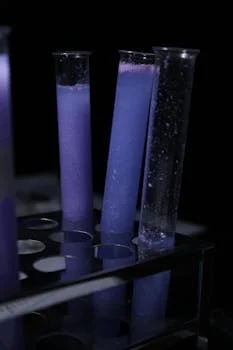
Semiconductor process wastewater is defined by HF, sulfuric acid, metals, and organics that each stress a ZLD train differently. Typical etching and cleaning streams carry 200-500 ppm F⁻, 0.1-1.0 M H₂SO₄, and 50-200 ppm Cu²⁺. TOC from photoresists and developers often spans 100-1,000 ppm. CMP slurries add high TDS and 10-100 ppb PFAS. Acidic lines usually sit at pH 2-5; alkaline cleans run pH 8-10, so blended feed almost always needs controlled neutralization before membranes or evaporators.
Copper is both a compliance pollutant and a recovery target. FO studies on HF-bearing fab feeds have concentrated Cu²⁺ more than three-fold in the reject while rejecting over 90% of copper ions from the permeating water path. Most plants we size for etching-dominated loads still start with coagulation, precipitation, or oxidation before the ZLD core. Upstream electrocoagulation for metal removal in semiconductor wastewater often cuts dissolved metals and suspended solids enough to protect membranes. Where TOC dominates, MBR systems for organic removal before ZLD reduce fouling load before FO-NF or thermal concentration.
| Fab Process | Typical Contaminants | Concentration Range | Regulatory Limit (Example F⁻) | Treatment Challenge |
|---|---|---|---|---|
| Etching | HF, HNO₃, F⁻, NH₄⁺ | 200-500 ppm F⁻ | 4-10 ppm | Fluoride precipitation, complexation |
| Cleaning/Drying | H₂SO₄, H₂O₂, IPA, Metals | 0.1-1.0 M H₂SO₄, 50-200 ppm Cu²⁺ | <0.1 ppm Cu²⁺ | Acid neutralization, metal recovery |
| Lithography | Photoresists, Developers, Solvents | 100-1,000 ppm TOC | Low BOD/COD | Organic removal, biodegradability |
| CMP | Slurries, Metals, PFAS | High TDS, 10-100 ppb PFAS | Emerging limits for PFAS | Particulate removal, PFAS destruction |
Hybrid FO-NF Systems: Engineering Mechanics and Performance Data
Hybrid FO-NF trains recover water from semiconductor acidic wastewater by driving osmotic transfer in FO, then polishing the diluted draw solution with nanofiltration. In a common configuration, HF wastewater at pH 3-5 is the FO feed and a neutralized 1.0 M Na₂SO₄ stream is the draw. Water moves into the draw, diluting Na₂SO₄ by more than 55% in reported trials while rejecting over 50% of total ionic contaminants and over 90% of copper ions from the HF feed path. The copper-rich FO concentrate then becomes a candidate for metal recovery rather than dilute sewer discharge.
The diluted draw proceeds to two-stage NF. NF passes water and much of the monovalent load while rejecting divalent sulfate and larger organics, supporting overall water recovery above 95% of the NF feed in well-tuned designs. Membrane energy for the NF stages typically lands at 5-15 kWh/m³, far below thermal ZLD. Permeate is often reused as cooling or UPW-makeup feed after polishing on semiconductor-grade RO systems for ZLD pretreatment. Fouling and scaling remain the main failure modes. Upstream filtration, pH/metal precipitation via an automatic chemical dosing system, and scheduled CIP keep flux in the 5-15 LMH FO and 15-30 LMH NF windows most plants actually run.
| Parameter | Forward Osmosis (FO) Stage | Nanofiltration (NF) Stage |
|---|---|---|
| Feed Stream | HF Wastewater (pH 3-5) | Diluted Na₂SO₄ Draw Solution |
| Draw Solution | 1.0 M Neutralized Na₂SO₄ | N/A (Permeate & Concentrate) |
| Water Flux (Typical) | 5-15 LMH (L/m²/hr) | 15-30 LMH |
| Cu²⁺ Rejection | >90% (in FO feed) | >95% (divalent ions) |
| Ionic Contaminant Rejection | >50% (total ionic) | >90% (divalent), 30-70% (monovalent) |
| Water Recovery Rate | 55%+ (of draw solution volume) | 95%+ (of NF feed) |
| Energy Consumption (Overall) | Low (primarily pumping) | 5-15 kWh/m³ (for NF stages) |
| Membrane Types | Thin-film composite (TFC) FO | Thin-film composite (TFC) NF |
Thermal ZLD Systems: Evaporators, Crystallizers, and Energy Trade-offs
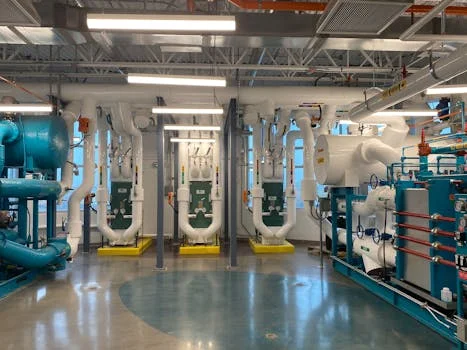
Thermal ZLD systems evaporate water from high-salinity semiconductor brines that membranes cannot finish economically. Brine concentrators commonly recover 90-95% of feed water as distillate; crystallizers then reduce the residual liquor to a solid cake or recoverable salt. Vendor thermal packages in this duty often quote that recovery window when metallurgy and pretreatment are matched to fluoride and sulfate chemistry. Distillate quality is usually high enough for utility reuse after light polishing.
Energy is the binding constraint. Full thermal ZLD trains typically draw 50-100 kWh/m³ of product water, versus 5-15 kWh/m³ for membrane hybrids. Mechanical vapor recompression (MVR) recovers latent heat and cuts steam demand, but the absolute load stays high. Modular packages pair ultrafiltration pretreatment with MVR evaporators and crystallizers for HF, PFAS-bearing, or high-TDS fab brines. Gypsum from H₂SO₄ neutralization and copper hydroxide from fluoride streams can become byproducts if purity specs are met. Upstream chlorine dioxide for TOC reduction in semiconductor wastewater sometimes protects byproduct quality. Crystallizer solids are usually dewatered on a plate and frame filter press for sludge dewatering before landfill or off-site refining. Expect a 2-3× larger footprint than a membrane train of similar hydraulic capacity.
| Parameter | Brine Concentrator (Evaporator) | Crystallizer |
|---|---|---|
| Process Principle | Evaporation, Condensation | Controlled Crystallization |
| Water Recovery | 90-95% (from feed brine) | Residual liquid reduced to solids |
| Energy Consumption | 50-100 kWh/m³ (overall thermal ZLD) | Integrated into overall thermal ZLD energy |
| Operating Temperature | Typically 60-100°C | Typically 60-100°C |
| Output | Distilled water, Concentrated brine | Solid salt cake, Condensate |
| Suitability | High-TDS brines, inorganic salts, some organics | Achieving solid discharge, byproduct recovery |
| Key Components | Heat exchangers, vapor compressors (MVR), separators | Reactor vessel, agitators, filtration (e.g., filter press) |
ZLD Technology Comparison: Membrane vs Thermal Systems for Semiconductor Fabs
Membrane FO-NF hybrids and thermal evaporator-crystallizer trains diverge on energy, footprint, and brine toughness for the same 200-1,000 m³/day fab hydraulic window. FO-NF favors lower-TDS acidic streams, compact skids, and sites paying high industrial power rates. Thermal trains favor osmotic-pressure-limited brines, mixed fluoride/sulfate salts, and sites that must ship a dry cake with almost no liquid heel.
Taiwan fabs with high power cost and tight land often lean membrane-first for recycle duty. Some Arizona facilities have favored thermal finishing where brine TDS and disposal rules outweigh energy OPEX. FO-RO hybrids and electrodialysis reversal (EDR) remain useful niche tools for selective ion work before either core path.
| Parameter | FO-NF Hybrid ZLD System | Thermal ZLD System |
|---|---|---|
| CAPEX (200-1000 m³/day) | $2M - $6M | $5M - $10M |
| OPEX (Energy) | 5-15 kWh/m³ | 50-100 kWh/m³ |
| Water Recovery Rate | 90-98% | 95-99% |
| Footprint (Relative) | Compact (1x) | Large (2-3x) |
| Maintenance | Membrane cleaning/replacement | Scaling, corrosion, mechanical |
| Scalability | Modular, relatively easy | More complex, larger increments |
| Byproduct Recovery | Concentrated metals, acids (liquid) | Solid salts, metal hydroxides (solid) |
| Regulatory Compliance | High (meets discharge limits) | Excellent (zero liquid discharge) |
| Suitability for HF/H₂SO₄ | Good (with pretreatment for HF) | Excellent (robust for high TDS) |
| Typical Application | Lower-TDS streams, water reuse, space-constrained fabs | High-TDS brines, complex mixtures, complete solids discharge |
2026 Cost Analysis: CAPEX, OPEX, and ROI for Semiconductor ZLD Systems
Installed ZLD CAPEX for 200-1,000 m³/day semiconductor service still clusters between $2 million and $10 million in 2026 budgeting models, with FO-NF hybrids usually at $2M-$6M and thermal evaporator-crystallizer packages at $5M-$10M. For a mid-size 500 m³/day design basis, equipment plus install and engineering commonly totals about $2.2M-$5.5M for membrane hybrids and $4.8M-$10.3M for thermal trains. Metallurgy for fluoride and chloride duty explains much of the thermal premium.
OPEX is energy-led on thermal plants and membrane-cycle-led on FO-NF plants. Energy often accounts for 50-70% of thermal OPEX. Membrane replacement every 3-5 years typically contributes 10-20% of membrane-plant OPEX. Labor usually lands at 5-10%, chemicals at 5-15%. Unit energy cost bands of roughly $0.05-$0.20/m³ for membrane duty and $0.50-$2.00/m³ for thermal duty dominate comparative cash flow when local power exceeds about $0.08/kWh.
Payback of 3-7 years remains the planning band when recycled water is valued at $0.50-$2.00/m³ and avoided discharge or curtailment risk is material. Solid-waste disposal at $0.10-$0.50/kg and redundancy for fab uptime are the hidden line items that stretch ROI if ignored in the first pass model.
| Cost Category | Sub-component | Membrane ZLD (FO-NF Hybrid) | Thermal ZLD (Evaporator-Crystallizer) |
|---|---|---|---|
| CAPEX (Estimated for 500 m³/day) | Equipment Purchase | $1.5M - $3.5M | $3.5M - $7.0M |
| Installation & Commissioning | $0.5M - $1.5M | $1.0M - $2.5M | |
| Engineering & Design | $0.2M - $0.5M | $0.3M - $0.8M | |
| Total CAPEX Range | $2.2M - $5.5M | $4.8M - $10.3M | |
| OPEX (Estimated per m³ treated) | Energy Consumption | $0.05 - $0.20/m³ | $0.50 - $2.00/m³ |
| Membrane/Spares Replacement | $0.08 - $0.15/m³ | $0.02 - $0.05/m³ (for pumps/valves) | |
| Chemicals (Pretreatment, Cleaning) | $0.05 - $0.10/m³ | $0.05 - $0.15/m³ | |
| Labor & Maintenance | $0.05 - $0.10/m³ | $0.08 - $0.18/m³ | |
| Total OPEX Range (per m³) | $0.23 - $0.55/m³ | $0.65 - $2.38/m³ | |
| Financial Benefits | Water Savings (Recycled Water Value) | $0.50 - $2.00/m³ (site-specific) | |
| Regulatory Avoidance (Fines, Production Loss) | Significant, highly variable (e.g., $14M fine avoidance) | ||
What data does a UPW piping spec need?
A semiconductor UPW piping specification needs design flow, peak-to-average ratio, resistivity/TOC targets, material class, dead-leg limits, and sanitize method before any long-term cost quote is meaningful. Most plants we support freeze those fields first, then price Georg Fischer-class PVDF/PFA loops against stainless only where thermal or mechanical duty forces the upgrade. Without that minimum data package, CAPEX spreads of 2× between bids usually reflect missing scope, not true market noise.
What is 20-year TCO for fab UPW systems?
Twenty-year total cost of ownership for semiconductor ultrapure water systems is dominated by energy, membrane/resin changeout, and water intake—not the initial pipe invoice. When ZLD permeate or distillate supplies 30-70% of UPW makeup, intake OPEX falls enough to change the 20-year ranking between membrane-first and thermal-first ZLD. Flow margin for fab expansion should sit in the loop hydraulic design at the same time; undersized return headers are a common retrofit cost five to eight years after tool-count growth.
Selection Checklist, Audience Fit, and Next Step
Use this short checklist before locking a flowsheet:
- Map segregated HF, sulfate, copper, TOC, and CMP/PFAS loads with measured daily peaks.
- Confirm the binding permit: local fluoride ppm, copper, TDS, and any PFAS monitoring clause.
- Compare FO-NF at 5-15 kWh/m³ versus thermal finishing at 50-100 kWh/m³ on site power price.
- Size solid-waste handling and cake disposal at $0.10-$0.50/kg before claiming ROI.
- Reserve UPW-makeup polishing capacity and loop flow margin for the next tool install wave.
- Require CIP, redundancy, and metallurgy notes that match fluoride/chloride duty.
This page is for fab process, EHS, and EPC engineers sizing 200-1,000 m³/day recycle or ZLD projects. Teams only needing once-through neutralization without reuse targets should look at conventional precipitation first. To match FO-NF, thermal, or hybrid scope to your influent and permit package, request a semiconductor ZLD design review with HydroPureWater.
Frequently Asked Questions
What is the primary benefit of ZLD for semiconductor fabs?
The primary benefit is operational water security plus permit headroom. Recycling 90-99% of process wastewater cuts freshwater intake and discharge volume at the same time. Fabs in drought-prone hubs use that recycle ratio to keep tools running when municipal allocations tighten, while also reducing exposure to fluoride and metal fine risk.
How do FO-NF systems handle HF wastewater?
FO-NF systems treat HF wastewater by using the acidic stream as FO feed against a high-osmotic Na₂SO₄ draw. Water leaves the HF side, concentrating fluoride and copper for recovery or finishing treatment, while the diluted draw is polished by NF to recover high-purity water. Typical copper rejection on the FO step exceeds 90% when membranes and pretreatment are matched to the feed.
What are the main energy drivers for thermal ZLD?
Latent heat of vaporization and vapor recompression power dominate thermal ZLD energy use. Even with MVR, overall demand commonly sits at 50-100 kWh/m³ of recovered water, versus 5-15 kWh/m³ for membrane hybrids. Heat-recovery design and brine TDS set whether a site can live with that OPEX.
Can valuable metals be recovered from ZLD processes?
Yes. Copper can be recovered when FO or precipitation concentrates Cu²⁺ from etching and cleaning wastes. FO can raise copper more than three-fold in the feed-side concentrate before electrochemical or hydroxide recovery. Thermal crystallizers can also yield metal-bearing solids if impurity specs allow sale or refining.
What are typical payback periods for semiconductor ZLD?
Typical payback runs 3-7 years when recycled water is valued at $0.50-$2.00/m³ and avoided fines or production loss are counted. Exact ROI tracks local power price, cake disposal cost, and whether ZLD permeate offsets UPW makeup. Sites that ignore solids handling usually understate true payback by one to two years.