
Separate the capacity question from the compliance route
The required capacity for an industrial membrane bioreactor serving Rivian’s Texas EV factory cannot be calculated from the supplied public evidence because no site-specific wastewater flow, production ramp, discharge route, or pollutant mass balance is established. The engineering sequence is to identify the governing compliance route, construct a verified source-by-source wastewater balance, size pretreatment from the measured contaminants, and then apply hydraulic, biological, membrane, and redundancy criteria. Fort Worth’s 10 million-US-gallon-per-day reclamation project is a municipal benchmark, not evidence of Rivian’s required capacity. The Rivian Texas wastewater compliance and treatment assessment provides the applicable permit framework, but it does not supply the missing plant data.
A direct surface-water discharge and a connection to a publicly owned treatment works (POTW) lead to different equipment and compliance scopes. For direct discharge, obtain the TCEQ individual wastewater permit, site-specific limits under 30 TAC Chapter 307, applicable categorical standards, discharge points, receiving-water limits, and narrative conditions. For a POTW route, obtain the sewer-use ordinance, Local Limit study, sampling requirements, surcharge rules, categorical industrial user requirements under 40 CFR Part 403, and POTW influent data. The more stringent applicable requirement remains controlling.
A proposed no-surface-water-discharge position must be documented and confirmed with TCEQ rather than treated as an automatic exemption. Industrial wastewater entering a municipal sewer may still require pretreatment. In the permit-transfer workstream, written notice of the change in operational control is due within 30 days after closing, with reissuance sought through Form 10311 under 30 TAC Chapter 305.
| Discharge route | Owner or authority input | Treatment implication |
|---|---|---|
| Direct surface-water discharge | TCEQ individual permit; Chapter 307 limits; categorical standards; receiving-water conditions | Design to site-specific final effluent and narrative conditions |
| Industrial wastewater to POTW | Sewer-use ordinance; Local Limit study; sampling and surcharge rules; 40 CFR Part 403 permit; POTW influent data | Design to the controlling local or categorical limit and receiving-system conditions |
| No surface-water discharge | TCEQ confirmation of the no-source determination; separate POTW requirements | Do not omit pretreatment scope without both confirmations |
Build a stream-by-stream wastewater balance
The wastewater balance must be assembled from measured or committed plant streams rather than inferred from EV production volume. Request average and peak flow, diurnal data, the production ramp, sanitary flow, cooling-tower blowdown, reverse-osmosis reject, boiler blowdown, and anticipated reuse demand. Each stream needs its own flow, pollutant, routing, and disposal basis before the industrial membrane bioreactor can be sized.
Assembly wastewater requires separate characterization. Stamping and machining rinse water can contain nickel and zinc, while e-coat or phosphate pretreatment can add other contaminants. Detack and wash water can carry toxic organics, oil and grease, total suspended solids, and FOG. These streams should not be represented by one generic assembly wastewater flow unless sampling demonstrates comparable behavior.
Battery manufacturing adds distinct waste streams. NMP recovery condensate is a high-BOD/COD solvent stream with nitrogen loading; trace-metal rinse water can contain lithium, nickel, and cobalt; formation-cycle electrolyte can contribute fluoride; and black-mass processing filtrate requires its own treatment and disposal evaluation. Because 40 CFR Part 433 does not directly regulate every lithium-ion cell and pack production stream, site-specific, state, and local requirements govern.
Use pH, TSS, FOG, COD, BOD, nitrogen, metals, fluoride, and TTO as screening parameters, then replace assumptions with production-mix data and site sampling. The worksheet below identifies the input and responsible provider. Blank fields remain unresolved design inputs; they are not values a bidder may fill with generic assumptions.
| Design input | Required information | Responsible provider |
|---|---|---|
| Flow basis | Average, peak, diurnal and production-ramp flow by source | Owner and process engineer |
| Assembly pollutants | pH, TSS, FOG, COD, BOD, oil and grease, nickel, zinc and applicable metals | Owner and sampling contractor |
| Battery pollutants | COD, BOD, nitrogen, fluoride, lithium, nickel, cobalt and source-specific flow | Owner and sampling contractor |
| Sanitary and utility flows | Average and peak sanitary flow; cooling-tower blowdown; RO reject; boiler blowdown | Owner and utilities lead |
| Compliance limits | Permit, Local Limit study, categorical requirements and reuse authorization | Permitting authority, POTW and engineer |
| Reuse | Reuse flow, application, process-water quality criteria and disposal of residual streams | Owner and reuse authority |
Size pretreatment before the MBR
Pretreatment must prevent shock loading, metal precipitation in the biological stage, and membrane fouling. For assembly wastewater containing suspended solids, FOG, oil and grease, or colloidal matter, evaluate DAF pretreatment for EV assembly wastewater. HydropureWater’s product catalogue lists 13 DAF models from 4 to 300 m³/h; that is a catalogue selection range, not a calculated Rivian requirement. The selected capacity must follow the peak flow and contaminant loading established by the source balance.
Dissolved copper, zinc, and other metals require a different treatment path. The supplied analysis describes pH adjustment and chemical precipitation followed by lamella clarification, multimedia filtration, and carbon polishing. It cites hydroxide precipitation at an elevated pH range of 9–10, with examples at 9.5–10, as described in the 40 CFR 433.10 categorical standards as adopted by Texas POTWs. The permit or Local Limit study must establish the residual metal target, reagent dose, and solids-disposal basis before this sequence is fixed.
NMP recovery condensate and black-mass processing filtrate should follow controlled, dedicated routes rather than commingling with the general wastewater balance. The design must prevent a solvent, electrolyte, or metals excursion from reaching the biological and membrane systems. Actual stream chemistry determines whether source control, recovery, dedicated treatment, or disposal is appropriate.
Chemical and biological solids handling belongs in the same sizing exercise. HydropureWater’s plate-and-frame filter-press catalogue covers filtration areas from 1 to 500 m², but final area cannot be calculated without projected cake volume and moisture data. The owner must also define the disposal route and acceptable cake characteristics.
Calculate MBR capacity from verified design criteria
MBR capacity follows the verified final design flow, pollutant basis, and reuse requirement—not the nearest municipal project size. Use final design flow for biological and membrane sizing. Peak-flow equalization or storage must then be identified from the verified diurnal and production-ramp profile. Fort Worth’s Mary’s Creek project identifies equalization and peak-flow storage basins as part of a large-scale treatment project, according to Smart Water Magazine’s 2026-11-05 report; it does not establish Rivian’s storage requirement.
Define biological loading from the agreed average COD and BOD basis, nutrient targets, temperature correction, recycle assumptions, and process-control strategy. Calculate membrane area from the supplier’s warranted design flux after accounting for expected fouling conditions. The integrated MBR wastewater treatment system covers 10–2,000 m³/day and uses submerged PVDF membranes with filtration below 1 μm, but those are supplier specifications and selection bounds, not guaranteed site performance.
The worksheet separates a confirmed project benchmark from an unresolved Rivian input. Hydraulic loading rate, membrane area, biological volume, and redundancy cannot be finalized until the responsible party supplies the stated evidence. A complete MBR versus activated sludge for EV wastewater comparison remains useful for evaluating biological alternatives, but it cannot replace the factory mass balance.
| Calculation or check | Calculation basis | Evidence still required |
|---|---|---|
| Hydraulic capacity | Final design flow and selected hydraulic loading rate | Verified average and peak flow by stream |
| Biological capacity | Agreed COD and BOD loading, nutrient targets, temperature correction and recycle assumptions | Production-mix data, temperature basis and process-control criteria |
| Membrane area | Final flow divided by warranted design flux, with fouling allowance defined | Supplier flux warranty and site-specific fouling basis |
| Peak management | Equalization or storage response to the verified profile | Diurnal and ramp data |
| Redundancy | Specified standby and maintenance strategy | Owner reliability requirement and bidder design |
| Reuse | Permeate flow and required water quality | Reuse authorization, application and process criteria |
Only two plant-scale references in the supplied evidence are benchmarks. Fort Worth’s facility is designed to process 10 million US gallons of wastewater per day, while Newterra’s Travis County project has a 60,000-gpd first phase and a 120,000-gpd full build-out, according to its 2024-10-02 release. Their scales differ from the unresolved Rivian case, and neither establishes its loading, redundancy, or equipment requirement.
Convert the design basis into a bid-ready package
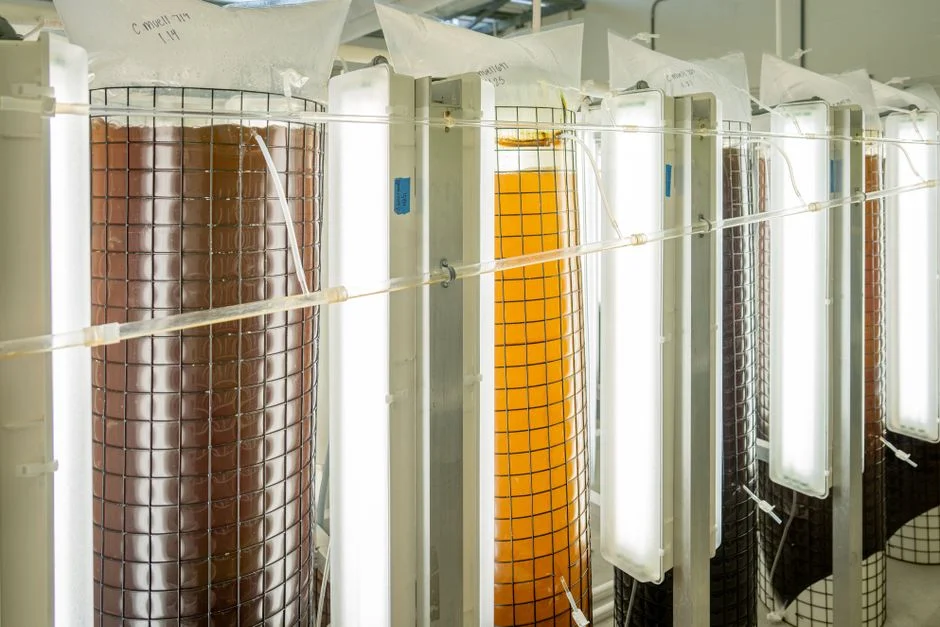
A defensible bid uses one shared design basis. Every bidder should receive the same stream inventory, peak-flow basis, permit and Local Limit targets, guaranteed effluent performance, sludge-disposal assumptions, controls scope, utilities, installation boundaries, commissioning plan, and lifecycle operating-cost assumptions. The industrial factory wastewater route comparison provides a useful structure for separating route-specific treatment from common procurement requirements.
The owner must supply the production ramp and water balance, current permit and compliance records, Local Limit study, reuse authorizations, waste manifests, electrical and control requirements, and access to sampling points. Missing items should be identified expressly rather than treated as proof that no requirement exists.
Supplier deliverables should include process calculations, membrane sizing and flux basis, hydraulic profile, redundancy, performance guarantees with test conditions and exclusions, O&M plan, spare parts, commissioning criteria, and training. The purchase order should state who owns each design assumption and what happens when a guarantee condition changes.
Permitting must appear in the project schedule. TCEQ reports a 90–180-day standard review period for TPDES reissuance and an approximately four-month period for a filing without a contested hearing; the supplied assessment reports a 30–90-day typical turnaround for a POTW categorical industrial user application, according to TCEQ, 2026. These are planning ranges, not guarantees. The post-closing written-notice deadline remains 30 days.
| Package element | Owner or bidder deliverable | Acceptance check |
|---|---|---|
| Owner inputs | Flow balance, production ramp, permits, Local Limit study, reuse criteria, sampling access and utilities | Each field is issued, dated and identified as measured, committed or unresolved |
| Bidder calculations | Pretreatment, biological, membrane, hydraulic, redundancy and solids calculations | Calculations cite the common design basis and stated assumptions |
| Performance guarantee | Effluent limits, test methods, test conditions, exclusions and acceptance criteria | No guarantee without a defined sampling and test protocol |
| Commercial boundaries | Equipment, installation, utilities, controls, sludge handling, commissioning and training | Clarify exclusions and lifecycle assumptions before price comparison |
| Schedule | Permitting, fabrication, delivery, installation, testing and commissioning | Show dependencies and approvals separately |
Frequently Asked Questions
What MBR capacity is required for Rivian’s Texas EV factory?
The available evidence does not support a numeric MBR capacity for Rivian’s Texas factory. No factory wastewater flow, discharge route, production ramp, pollutant balance, or reuse requirement has been established. Capacity must be calculated after those inputs are verified.
What information is needed before suppliers can size the system?
The owner and engineer must provide stream-by-stream average and peak flows, production-ramp data, sampled pollutant concentrations, permit or Local Limit targets, reuse criteria, and the anticipated solids-disposal route. The permit authority or POTW must confirm applicable limits and discharge conditions. A bidder should identify any remaining assumption rather than price an unsupported flow.