Separate the Wastewater Streams Before Choosing Equipment
A data center in Bukit Rahman Putra generally needs two connected treatment decisions: control and recover cooling tower blowdown, and treat or divert other wastewater streams. Blowdown contains concentrated dissolved solids and scaling compounds such as silica, calcium carbonate, and calcium sulfate, so it should first be characterized for pH, conductivity, hardness, silica, suspended solids, and treatment chemicals. The preferred train is usually optimized cooling chemistry, solids removal, appropriate RO pretreatment, and controlled reverse osmosis, with recovered permeate reused as cooling make-up when water quality permits. Domestic sewage and equipment-room wastewater should remain separate and be assessed for sewer discharge or package treatment. Final equipment capacity depends on measured flow, water chemistry, evaporation, cycles of concentration, and the applicable discharge or sewer conditions, which are not provided in the research.
Do not route every wastewater stream through one treatment plant. Cooling blowdown is concentrated, heated circulating water; domestic sewage carries a different contaminant profile; equipment-room drains may contain oil, cleaners, or suspended solids; and contaminated stormwater requires its own source controls. A common treatment train can therefore create compliance problems, increase membrane loading, or contaminate water intended for reuse.
Build the first design package around four questions: what enters the system, what leaves each process step, which stream has a reuse destination, and which authority or utility must accept the residual discharge. Black & Veatch states that wastewater sampling is necessary because discharge characteristics differ between facilities.
| Site stream | Primary contaminants and characteristics | Treatment decision | Information required before selection |
|---|---|---|---|
| Cooling tower blowdown | Concentrated dissolved minerals, scaling compounds, residual chemicals, suspended solids | Optimize cooling, pretreat, recover by RO where suitable, then reuse or discharge | Tower configuration, makeup source, evaporation, drift, blowdown flow, chemistry and control logic |
| Domestic sewage | Organic matter, nutrients and sanitary contaminants | Connect to sewer or provide a dedicated biological treatment system | Flow, fixture loading, sewer availability, sampling and permit requirements |
| Equipment-room wastewater | Suspended solids and possible oil, grease, cleaners or other process chemicals | Characterize before choosing DAF, filtration, chemical dosing or sewer disposal | Floor-drain sources, discharge events, contaminant concentrations and prohibited constituents |
| Contaminated stormwater | Site-dependent pollutants carried by rainfall | Source control and dedicated treatment or discharge assessment | Drainage plan, catchment, potential contaminants and receiving route |
For the broader treatment context, use the Kuala Lumpur effluent treatment plant buyer’s guide to structure endpoint questions. For sanitary wastewater, the domestic sewage treatment guide for Kuala Lumpur provides a separate route for biological treatment decisions.
Characterize the Cooling Tower Blowdown
Cooling tower blowdown must be sized from measured flow and chemistry, not from the tower’s nameplate duty alone. Evaporation leaves dissolved minerals behind, and periodic purge removes a portion of the circulating water to control scaling and corrosion. The monitoring package should cover makeup water, evaporation, drift, blowdown volume, conductivity, pH, suspended solids, hardness, silica, chloride, sulfate, alkalinity, and residual cooling chemicals.
Cycles of concentration are defined by the ratio of dissolved-solids concentration in circulating water to that in makeup water. Genesis Water Technologies gives the theoretical blowdown relationship as 1 divided by cycles of concentration minus 1. On that basis, blowdown equals 25% of makeup-water volume at four cycles and 20% at six cycles.
Do not convert that theoretical ratio directly into equipment capacity. Genesis Water Technologies reports that measured blowdown can exceed theoretical calculations by 15–30% because of unmeasured losses and emergency dumps. Sampling should therefore capture normal operation, peak cooling demand, seasonal makeup-water changes, upset conditions and deliberate blowdown events.
The chemistry review must also identify the scaling mechanism. IDE describes silica, calcium carbonate and calcium sulfate as sparingly soluble compounds that can constrain conventional brackish-water reverse osmosis. A low-conductivity sample does not prove low scaling risk because conductivity does not identify the saturation behavior of every specific compound.
| Design input | Engineering use | Acceptable basis | Key caveat |
|---|---|---|---|
| Makeup, evaporation, drift and blowdown flow | Establishes the site data center water balance and preliminary hydraulic load | Measured hourly and daily data across operating conditions | A theoretical mass balance alone may omit losses and emergency discharges |
| Conductivity and pH | Tracks dissolved-solids concentration, corrosion control and treatment operation | Continuous instruments with a laboratory verification program | Conductivity alone cannot define scaling or sanitation suitability |
| Hardness, alkalinity and sulfate | Assesses carbonate and sulfate scaling risk | Representative laboratory analyses with control limits | Chemical dosing can change the species present in the feed |
| Silica | Sets membrane and recovery constraints | Representative analysis covering expected operating variability | Silica behavior must be reviewed with the selected membrane configuration |
| Suspended solids and residual chemicals | Determines pretreatment and downstream treatability | Operational sampling plus the cooling chemical inventory | Samples should align with the existing chemical program and blowdown controls |
Review the interaction between the proposed recovery train and the cooling chemistry using the closed-loop hydronic water treatment requirements. The key deliverable is not a single laboratory result, but a feed-water envelope that suppliers can use to state their guarantees and operating limits.
Optimize the Cooling System Before Building a Treatment Plant
Cooling-system optimization is the first capital-control measure because a treatment plant cannot correct avoidable water loss or suspended-solids accumulation. Genesis Water Technologies recommends repairing leaks, eliminating unnecessary once-through cooling, optimizing blowdown-control sequences and implementing self-cleaning filtration so suspended solids do not force premature purges.
Review cooling chemistry before increasing cycles of concentration. Genesis Water Technologies notes that biological growth, scale, corrosion and microbiologically influenced corrosion can offset expected water savings. The choice is therefore not simply to maximize cycles; it is to select the highest sustainable cycles for the existing tower materials, heat load, makeup-water chemistry and control strategy.
The arithmetic is often misread. Moving from four to six cycles reduces theoretical blowdown from 25% to 20% of makeup-water volume. That is a 20% reduction in blowdown volume, not the 50% reduction implied by comparing the raw cycle values.
Chemical programs also affect the recovery train. Phosphonates, dispersants, corrosion inhibitors, biocides and scale inhibitors can add dissolved solids and increase treatment complexity. Genesis Water Technologies states that more intensive chemical programs can increase the dissolved-solids load in blowdown and make downstream treatment more difficult. Any proposed chemical change should therefore be reviewed for both cooling performance and recoverability.
Use continuous or trend-based conductivity, pH and flow monitoring to test the assumed water balance. A rising blowdown rate without a corresponding cooling-load change can indicate leakage, carryover, excessive drift or an emergency dump. These data also determine whether the proposed treatment capacity is based on normal operation or an uncontrolled upset.
The data center cooling blowdown treatment framework provides a useful cross-check for the sequence: establish the water balance, optimize the existing system, then size treatment against verified flows and chemistry.
Select a Blowdown Treatment and Reuse Train
A modular blowdown train should remove contaminants in the order that protects each downstream step: optimize cooling chemistry, remove suspended solids and colloids, condition the feed where necessary, apply RO for cooling make-up recovery, disinfect where the reuse assessment requires it, and manage the residual concentrate.
Where bacteria, colloids or suspended solids could compromise downstream membranes, an ultrafiltration system for blowdown pretreatment is a candidate. HydropureWater’s catalog range is 2,000–40,000 L/h, using 0.03 micron PVDF membranes with automatic backwash and air scour. Those catalog figures describe the offered equipment; they do not establish the flow required for the Bukit Rahman Putra site.
Where suspended-solids removal and RO protection are the priorities, multi-media filtration is another option. HydropureWater’s catalog states that the filter is designed to achieve SDI values suitable for protecting RO membranes. The selected filter still needs a defined feed-water envelope and verified pretreatment performance.
Chemical softening should be evaluated only after representative hardness and scaling analysis. It adds sodium to the water and can change the chemistry that must be managed at the cooling tower and in the residual brine route. It is not justified merely because the water is hard.
An industrial reverse osmosis system for cooling make-up recovery should be evaluated as a complete system. HydropureWater states that its industrial RO product offers recovery rates up to 95%, but feed chemistry, pretreatment, membrane configuration, concentrate disposal and site objectives govern the achievable result. IDE reports that conventional brackish-water RO typically plateaus at 75–80% recovery before scaling becomes unmanageable.
IDE also reports a combined salt-precipitation and RO application operating at around 95% recovery, with permeate silica reduced to about 1 mg/L. That result demonstrates a possible high-recovery architecture; it does not establish the same performance for an unspecified local feed.
Disinfection is a separate decision for storage or reuse. Required performance depends on recovered-water quality, intended use and the site risk assessment. HydropureWater offers chlorine dioxide generators, including a fully automated 20,000 g/h configuration, but generator capacity does not replace validation of dose, contact conditions and monitoring.
| Process step | Treatment objective | Selection trigger | Evidence or design input required |
|---|---|---|---|
| Cooling optimization | Reduce avoidable blowdown and improve feed consistency | Leaks, premature purging or unsuitable chemistry are present | Water balance, control sequences, chemical program and trend data |
| Multi-media filtration or UF | Remove suspended solids, colloids and relevant biological load | Particulate fouling would compromise RO or reuse quality | Turbidity, suspended solids, SDI, microbiology and expected backwash demand |
| Chemical softening or other conditioning | Control a verified scaling or membrane-fouling mechanism | Representative analysis shows an actionable target | Hardness, alkalinity, sulfate, silica, chemical compatibility and residual effects |
| RO | Recover low-salt water for cooling make-up | Permeate quality and system recovery can meet the reuse target | Feed-water envelope, recovery definition, permeate target, concentrate route and cleaning assumptions |
| Disinfection | Control microbiological risk in storage or reuse | Risk assessment identifies a required barrier | Intended use, residence time, dose-response evidence and monitoring plan |
| Solids and concentrate management | Provide a safe, controlled residual route | Treatment generates sludge, pellets or brine | Residual quantity, composition, collection method, transport and disposal acceptance |
Compare Sewer, Discharge, and Internal Reuse Options
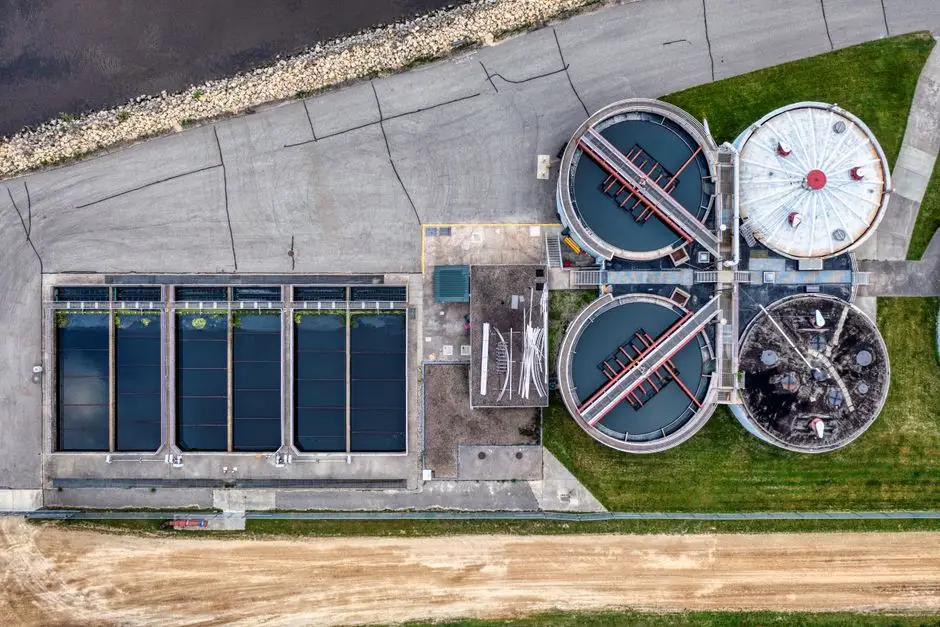
The endpoint decision determines the required treatment train. Direct discharge, connection to a local wastewater treatment plant, on-site treatment followed by discharge, and internal reuse each impose different water-quality, infrastructure and operating requirements.
Black & Veatch used up to three discharge alternatives in an actual assessment: direct discharge to a receiving body, discharge to the local wastewater treatment plant without additional treatment, and installation of on-site treatment. Its questions also included whether the local interceptor could handle the proposed wastewater flow. This is a useful structure for the Bukit Rahman Putra project, but it is not evidence of local sewer capacity or acceptance conditions.
Ask the sewer authority to confirm acceptance criteria, permitted flow and pollutant loading, sampling requirements, control-manifold or analyzer requirements, connection requirements and interceptor capacity. Do not assume that chlorinated or saline blowdown is acceptable merely because it originates from a cooling system. Black & Veatch notes that spent cooling water contains salt and dissolved solids and that discharge quality varies by facility.
Internal reuse may produce the strongest operating and water-value case when the recovered water can meet the cooling make-up target. The comparison should include avoided water, sewer and disposal costs against treatment capital, energy, chemicals, membrane cleaning, maintenance and residual handling.
| Endpoint option | Principal advantage | Principal risk or missing input | Decision check |
|---|---|---|---|
| Direct discharge to a receiving body | Avoids an additional on-site treatment train if permitted | Site-specific receiving-water and discharge conditions are not supplied | Obtain the applicable discharge permit and demonstrate compliance with measured discharge quality |
| Connection to a local wastewater treatment plant | May avoid on-site treatment if the sewer accepts the stream | Flow, pollutant loading, salinity, chlorination and connection requirements are unknown | Request written acceptance criteria and confirm interceptor capacity |
| On-site treatment followed by discharge | Can tailor treatment to permit or sewer requirements | Adds equipment, energy, chemicals, controls and residual handling | Define the required final quality before selecting the treatment train |
| Internal cooling make-up reuse | Can reduce freshwater withdrawal and cooling discharge | RO scaling, membrane fouling, storage and disinfection risks | Compare measured permeate with the cooling-system water-quality specification |
The final endpoint must be confirmed with the relevant Malaysian authorities and utility operators. The supplied research does not establish Bukit Rahman Putra discharge limits, sewer conditions, tariffs or permit conditions. Those items belong in the compliance and commercial brief, not in an assumed design basis.
Handle Non-Cooling Wastewater on a Separate Basis
Domestic sewage should remain a sanitary stream. A sewer connection or a dedicated package treatment system may be appropriate, but cooling-water equipment should not be treated as a sewage plant because sanitary loading changes biological, solids and disinfection requirements.
HydropureWater’s underground WSZ system combines anaerobic or aerobic biological treatment, sedimentation and disinfection in a package unit. Its stated capacity range is 1–80 m³/h. That range can inform a supplier query, but it cannot size the system without site flow and load data.
Where higher-quality reclaimed water or a compact footprint is required, an MBR option may be considered. HydropureWater states that its MBR system covers 10–2,000 m³/day and provides filtration below 1 μm with near-reuse-quality effluent. The required standard and reuse destination must still be established before selecting it.
Equipment-room drains require source-specific review for suspended solids, oil and grease, cleaners and other contaminants. Depending on the findings, the route may be direct sewer disposal, dissolved air flotation, filtration, chemical treatment or controlled collection. Automatic dosing should follow identification of the chemical, control range, dose-response testing and required operator interface.
| Non-cooling stream | Potential treatment approach | Key decision | Required information |
|---|---|---|---|
| Domestic sewage | Sewer connection or package biological treatment | Whether the sewer is adequate or on-site treatment is required | Flow, load, sewer criteria, footprint and reuse objective |
| Equipment-room wastewater | DAF, filtration, chemical treatment or sewer disposal | Which contaminants require removal or containment | Floor-drain inventory, contaminant analyses and discharge events |
| Contaminated stormwater | Source control, segregation and dedicated treatment | Whether drainage should be segregated from clean runoff | Catchment map, rainfall exposure, pollutants and receiving route |
Use the domestic sewage treatment guide for Kuala Lumpur to prepare the sanitary-stream brief, and the Malaysian sewage treatment equipment guide to compare package treatment routes.
Build the Project Roadmap and Supplier Brief
The project should follow five stages: characterize the streams; optimize the existing cooling system; confirm the discharge or reuse endpoint; pilot or validate the selected treatment train; then install, commission and monitor performance. This sequence prevents the treatment scope from being defined around an unverified flow, chemistry assumption or sewer condition.
Request quotations using measured hourly and daily flows, seasonal water-quality data, tower configuration, evaporation and drift, blowdown-control logic, available footprint and utilities, reuse targets and the selected discharge route. Require the supplier to identify any missing input that prevents a defensible guarantee.
Specify required functions rather than only equipment names: flow balancing, backwash or cleaning, membrane controls, conductivity and pH monitoring, justified chemical dosing, sludge or concentrate handling, and safe maintenance access. Guarantee recovery and permeate quality against the stated feed-water envelope, not against a generic catalogue condition.
HydropureWater offers PLC-controlled chemical dosing, RO and UF membranes, filtration equipment and monitoring components that can support a packaged or project-specific architecture. The quotation should still define the process duty, control philosophy, utilities, residuals and performance tests.
Plan operations and maintenance before award. The brief should cover membrane-cleaning intervals, media replacement, chemical inventory, alarm response, laboratory access, spare-parts strategy, operator training and performance reporting. The Kuala Lumpur effluent treatment plant buyer’s guide remains useful for developing the procurement and acceptance package, although it does not establish local limits or project costs.
| Stage | Required output | Release condition | Supplier or authority information requested |
|---|---|---|---|
| 1. Characterize | Water balance, stream inventory and representative analyses | Measured data covers normal and peak operation | Flow, pH, conductivity, solids, hardness, silica, alkalinity, chloride, sulfate and chemical inventory |
| 2. Optimize cooling | Leak repairs, control changes and revised blowdown strategy | Trend data verifies the revised balance | Expected cycles of concentration, purge triggers and operating limitations |
| 3. Confirm endpoint | Approved reuse, sewer or discharge basis | Authority and utility conditions are documented | Permit criteria, sewer acceptance, flow capacity, sampling and connection requirements |
| 4. Validate | Pilot or engineering proof for the critical unit | Feed envelope and acceptance tests are agreed | Recovery definition, permeate target, cleaning frequency and residual route |
| 5. Implement | Installed train, commissioning records and O&M plan | Performance and operator acceptance are completed | Utilities, controls, training, spares, maintenance schedule and monitoring package |
Frequently Asked Questions
Can we size wastewater treatment equipment before the site flow and chemistry are measured?
No defensible equipment size can be selected until measured blowdown flow, cooling configuration, water chemistry and the discharge or reuse endpoint are known. Ask the bidder to submit a load calculation showing how makeup water, evaporation, drift and blowdown produce the design flow, and how the feed-water envelope supports the proposed recovery and permeate guarantees.
What should the budget comparison include for blowdown recovery?
Request a total-cost comparison covering capital, utility water, wastewater and disposal charges, energy, chemicals, membrane cleaning, media replacement, operator labour and residual disposal. The supplied research provides no site-specific quotation for Bukit Rahman Putra, so a price should not be inferred from generic equipment capacities. Require priced alternatives for sewer disposal, on-site treatment and internal reuse, with the assumptions stated separately.
Should a supplier guarantee the headline RO recovery rate?
No. HydropureWater states that its industrial RO product offers recovery rates up to 95%, while IDE reports that conventional brackish-water RO generally plateaus at 75–80% recovery before scaling becomes unmanageable. Make the guarantee conditional on the supplied feed-water envelope, pretreatment, membrane configuration, permeate target and concentrate route. This also explains why the data center blowdown treatment comparison should be used to test technology fit, not headline performance.
Why must cooling optimization come before treatment-plant installation?
Treatment capacity should reflect the water balance after avoidable losses and premature purges have been addressed. Genesis Water Technologies reports that measured blowdown can exceed theoretical calculations by 15–30% because of unmeasured losses and emergency dumps. Its four-to-six-cycle example reduces theoretical blowdown from 25% to 20% of makeup-water volume, so treating the unoptimized system would add unnecessary equipment cost.
Which treatment units should be matched to each verified problem?
Use UF or multi-media filtration for suspended solids, colloids and membrane-fouling control; RO for dissolved-salt removal where cooling make-up quality requires it; softening only for confirmed hardness scaling; DAF or filtration for oil and floatable contaminants in equipment drains; MBR for defined domestic-sewage reuse quality; and disinfection for a verified microbiological risk. Each unit should answer a documented contaminant or reuse requirement rather than being selected by product category alone.