Separate the Wastewater Streams Before Choosing Equipment
A Düsseldorf data center needs a treatment design that separates domestic sewage from cooling tower blowdown and humidifier condensate before combining them for discharge or reuse. Cooling blowdown requires source control, solids removal, scaling control and monitored chemistry; domestic sewage is normally handled as a biological stream. Reuse options range from lower-demand service water to cooling makeup, with advanced reverse osmosis justified only after site testing, permit review and recovery targets are defined. Düsseldorf-specific sewer limits, tariffs and receiving-WWTP requirements must be confirmed rather than inferred from Frankfurt figures.
The Frankfurt reference architecture separates cooling tower blowdown from domestic sewage and assigns the latter to an isolated MBR train, according to the HydropureWater Frankfurt guide, Data Center Wastewater & Cooling Blowdown Treatment in Frankfurt (2026). Its 30 MW reference case produces approximately 9,000 m³/month of blowdown and 10–25 m³/day of domestic sewage. Those quantities are reference inputs, not Düsseldorf design flows: a local project must be calculated from measured make-up water, operating profile and seasonal variation.
Map each stream before selecting equipment. Cooling tower blowdown contains concentrated dissolved solids, suspended matter and residual treatment chemicals. Humidifier or air-handling condensate can have a different ionic composition and should not be assigned the same chemistry without sampling. Domestic sewage requires biological treatment; equipment wash water may contain cleaning residues; and stormwater needs a separate assessment because rainfall and roof or paving contamination affect quality. A data center wastewater treatment guide provides a useful stream-separation framework, but its site-specific values must not be transferred to Düsseldorf.
| Stream | Principal treatment concern | Düsseldorf design inputs required |
|---|---|---|
| Cooling tower blowdown | Dissolved solids, scaling species, suspended matter and treatment chemicals | Make-up source, flow meters, cooling configuration, cycles of concentration, chemical program and seasonal profile |
| Humidifier or air-handling condensate | Different dissolved-solids composition; possible treatment exposure | Source, quantity, conductivity, pH, hardness and corrosion assessment |
| Domestic sewage | Organic matter and biological treatment | Population and staffing pattern, peak flow, wastewater classification and reuse destination |
| Equipment wash water | Cleaning chemicals and episodic contamination | Cleaning agents, discharge frequency and segregation requirements |
| Stormwater | Site-specific contamination and variable flow | Drainage map, rainfall exposure, paving condition and discharge route |
Build a Düsseldorf Water Balance Before Sizing the Plant
Equipment capacity should follow the Düsseldorf water balance, not an IT-load benchmark or another city’s case study. Install or verify meters for make-up water, blowdown, evaporation and drain flow, and monitor conductivity, pH and suspended solids across normal and peak operating periods. The purpose is to distinguish consumed water from recoverable discharge and to identify seasonal variation, leaks, uncontrolled drains and emergency dumps.
Concentration of concentration cycles, usually abbreviated CoC, describes the ratio of dissolved-solids concentration in circulating water to that in make-up water. The theoretical blowdown ratio is make-up × 1/(CoC−1). Genesis Water Technologies, Why Cooling Tower Blowdown Is Your Hidden Opportunity (2026), states that at 4 CoC theoretical blowdown is 25% of make-up, while at 6 CoC it is 20%. Moving between those operating points therefore reduces blowdown by five percentage points, not 50%.
Design flow must still retain an operating allowance. Genesis reports that measured blowdown can exceed theoretical calculations by 15–30% because of unmeasured losses and emergency dumps (2026). That allowance does not replace measurement; it supports equipment selection while the water balance is refined. Controls should also distinguish evaporation, which consumes water, from treated blowdown discharged or reused, which remains recoverable through the receiving pathway.
Before tendering, document make-up source, meter accuracy and locations, cooling configuration, design and operating CoC, minimum and maximum flows, evaporation, drainage and seasonal operating profile. Related water-treatment parts and media should be selected only after this basis is fixed. Do not infer Düsseldorf flow from the Frankfurt 30 MW reference case; its approximately 9,000 m³/month blowdown must be replaced by local measurements.
| Water-balance item | Engineering use | Required evidence |
|---|---|---|
| Make-up water | Establishes the water-use baseline and theoretical blowdown | Metered flow by source and operating period |
| Blowdown | Sets hydraulic treatment capacity | Continuous or campaign measurement, including dumps |
| Evaporation | Separates consumption from recoverable discharge | Measured or reconciled water balance |
| Conductivity | Checks CoC and detects concentration drift | Make-up and circulating-water measurements |
| Suspended solids and pH | Sets pretreatment and chemical-control requirements | Representative samples across operating conditions |
Control the Pollutants That Drive Treatment Demand
The pollutants that drive treatment demand must be characterized before the cooling-water chemical program or downstream process is fixed. Take site-specific samples and analyze conductivity, pH, suspended solids, hardness, silica, chloride, sulfate, temperature and residual treatment chemicals. The analysis should cover both circulating water and blowdown because concentration changes the mass loading seen by a treatment train.
Calcium carbonate, calcium sulfate and silica create a scale-management problem before osmotic pressure becomes the controlling constraint. The HydropureWater Frankfurt guide (2026) states that these sparingly soluble salts can reach scaling thresholds on the membrane-concentrate side while osmotic limits remain less restrictive. Hardness, silica and temperature therefore belong in the membrane design envelope, not only in a general permit sample.
The cooling chemistry also affects reuse. Genesis Water Technologies (2026) states that phosphonates, dispersants, corrosion inhibitors and biocides can increase dissolved-solids loading and complicate downstream treatment. A change toward physical or lower-solids chemical control may improve reuse readiness, but it should proceed only after cooling performance, corrosion control and microbiological control are validated.
Automatic dosing can support a controlled retrofit, as discussed in the supplier’s material on automatic chemical dosing with conductivity control. Dose selection must follow the measured water chemistry and selected downstream process; automatic control does not correct an unsuitable chemical program. Obtain residual-chemical data because treatment and reuse facilities may need additional polishing or disinfection.
| Parameter | Process relevance | Decision enabled |
|---|---|---|
| Hardness and alkalinity | Carbonate scale risk | Chemical control, precipitation or RO pretreatment |
| Silica | Scale and membrane rejection risk | Reuse-water target and concentration control |
| Chloride and sulfate | Residual dissolved-solids loading | Discharge route and RO concentrate handling |
| Suspended solids | Filter, DAF and membrane fouling | Physical pretreatment selection |
| Residual chemicals | Reuse suitability and treatment demand | Polishing, disinfection or chemistry change |
Match Each Treatment Objective to the Right Process
The correct treatment train follows the intended water destination. A Düsseldorf project should compare three paths: compliant discharge, lower-demand reuse such as toilet flushing or washing, and higher-quality reuse as cooling makeup. Each path has a different water-quality target, treatment intensity and economic case.
For compliant discharge, the design starts with the applicable indirect-discharge permit and confirmed sewer route. For lower-demand reuse, filtration and physical separation may be sufficient if the receiving use can accept the measured quality. DAF can remove suspended solids, oil and grease or colloidal material when analysis confirms those loads. Filtration provides lower-solids polishing where the contaminant profile supports it. Selection should be based on measured loading rather than generic water-quality labels.
Cooling-makeup reuse has tighter requirements. The HydropureWater Frankfurt guide (2026) identifies silica at or below 1 mg/L and conductivity below 50 µS/cm as tight cooling-makeup targets. It associates these targets with an industrial RO system for cooling-water reuse at up to 95% recovery, paired with upstream chemistry control.
That recovery figure is a process limit, not a blanket site selection. The same Frankfurt guide reports that conventional brackish-water RO commonly plateaus at 75–80% recovery because scaling constraints become binding. Feedwater chemistry, scaling control, recovery, reject-water destination and equipment configuration must therefore be developed together.
Zero liquid discharge is a separate business and permitting decision. The Frankfurt guide (2026) reports that full ZLD can increase capital cost by 2–3 times and power consumption per cubic metre by an order of magnitude, with payback extending beyond 10 years at German tariff levels. It should not be selected merely because reuse is desirable.
| Objective | Indicative process path | Critical gate |
|---|---|---|
| Compliant discharge | Characterization → physical pretreatment → approved discharge | Written Düsseldorf discharge conditions and sewer route |
| Service-water reuse | Filtration or DAF → storage → non-potable demand | Measured quality acceptable to the receiving application |
| Cooling-makeup reuse | DAF or filtration → UF → RO → polishing and storage | Feedwater analysis, scaling control, recovery target and reject route |
| Full ZLD | Advanced separation → concentrate management → residual handling | Verified life-cycle cost, energy availability and residual-disposal route |
Pretreat Blowdown and Treat Domestic Sewage Separately
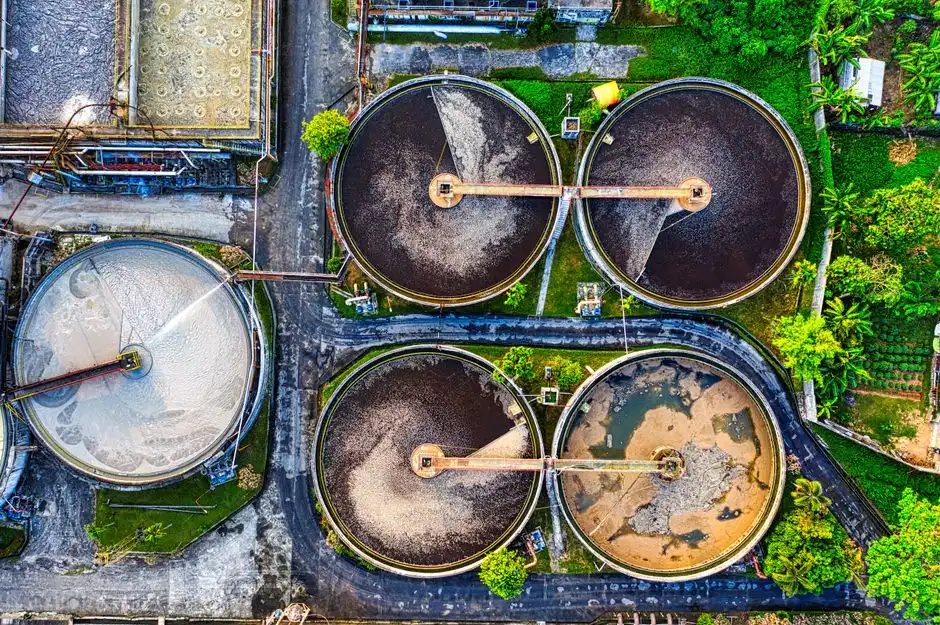
Domestic sewage should remain a separate biological train when that separation simplifies both operation and reuse. For blowdown, physical pretreatment should protect membranes and downstream equipment only where measured contaminants justify it. DAF is appropriate when analysis confirms suspended solids, oil and grease or colloidal material requiring removal before a sensitive process.
UF is relevant where a physical barrier is required ahead of reuse stages. HydropureWater specifies 0.03 μm PVDF pretreatment for blowdown reuse, capacities of 2,000–40,000 L/h, chemical-free operation and turbidity acceptance up to 300 ppm. These are supplier specifications rather than Düsseldorf design values. Feedwater analysis and pilot testing must confirm actual performance.
For domestic sewage requiring near-reuse-quality effluent, the Frankfurt reference uses an isolated MBR. HydropureWater specifies MBR capacity from 10–2,000 m³/day and filtration below 1 μm. The selected unit must still be matched to Düsseldorf staffing patterns, peak flow, wastewater composition and the receiving municipal treatment or reuse requirements.
Industrial RO can provide polished cooling makeup after suitable pretreatment. HydropureWater specifies recovery rates up to 95%, PLC automation and minimal chemical consumption, subject to feedwater analysis and scaling control. Treat those claims as an equipment envelope, not a performance guarantee for every site. Verification should include pilot work where feedwater variability or scaling risk is material.
| Unit operation | Role | Minimum verification input |
|---|---|---|
| DAF | Removes suspended solids, oil and grease or colloids where confirmed | Load analysis, settling characteristics and recovered-solids destination |
| UF | Provides a physical barrier ahead of sensitive reuse stages | Turbidity, solids, feed temperature and flux-development requirement |
| MBR | Separate biological domestic-sewage treatment | Daily and peak flow, organic loading and effluent destination |
| RO | Produces polished cooling makeup | Hardness, silica, sulfate, chloride, temperature and recovery target |
Convert the Concept into a Permit and Procurement Package
The procurement package should begin with a written Düsseldorf design basis, not an equipment price. Obtain confirmation from the competent Düsseldorf authority or sewer operator on the applicable indirect-discharge conditions. Do not transfer Frankfurt thresholds or tariff assumptions to Düsseldorf. The sewer-limit compliance planning approach illustrates why discharge limits must be tied to the receiving authority and route.
Confirm the site’s industrial or commercial waste classification, whether cooling blowdown may enter the municipal sewer, receiving-WWTP capacity, and any restrictions on temperature, conductivity, pH, chloride, sulfate or listed substances. If reuse is proposed, document the point of use, storage controls, public-health requirements and monitoring obligations. These matters require local verification rather than extrapolation from Frankfurt.
Require bidders to state design flow, design CoC, minimum and maximum flow, feedwater envelope, recovery, reject-water destination, chemical consumption, redundancy, controls and acceptance tests. A cooling blowdown treatment methodology provides a comparable structure for defining site data, but it is not evidence of a Düsseldorf requirement.
Compare life-cycle cost using verified Düsseldorf water and wastewater tariffs, disposal or reuse value, energy, chemicals, membrane replacement, operator labor and residual-discharge risk. Keep the Frankfurt 30 MW case only as a reference architecture: approximately 9,000 m³/month of blowdown and its associated treatment assumptions must be replaced by Düsseldorf measurements. No quotation should be accepted until the flow basis, permit route, recovery target and acceptance criteria are documented.
| Procurement package | Required information | Buyer check |
|---|---|---|
| Permit basis | Authority, sewer route, waste classification, local limits and receiving-WWTP capacity | Written site-specific confirmation |
| Design basis | Measured streams, flows, CoC, feedwater envelope and reuse destination | Traceable to meters and samples |
| Equipment scope | Recovery, controls, redundancy, chemicals, reject route and maintenance | Clear allocation of bidder responsibilities |
| Commercial model | Verified tariffs, energy, chemicals, labor, replacement and residual handling | Life-cycle comparison using one cost boundary |
| Acceptance | Capacity, product-water quality, availability and compliance tests | Measured performance under agreed conditions |
Frequently Asked Questions
How much should a Düsseldorf data center budget for wastewater and cooling blowdown treatment?
No supported Düsseldorf quotation was provided. Request a scenario-based quotation covering equipment, installation, controls, pretreatment, storage, reject handling, energy, chemicals, membrane replacement, operator labor and acceptance testing. Ask the supplier to show how the result changes with measured blowdown flow, reuse recovery and verified local tariffs.
Should blowdown and domestic sewage be treated in one system?
Keep them separate unless a verified combined design offers a clear advantage. The HydropureWater Frankfurt guide (2026) treats domestic sewage as a separate MBR stream, while blowdown requires scaling and solids controls. A combined system would need one influent envelope covering both streams and would be harder to operate and reuse.
What capacity and pretreatment data must a supplier receive before quoting equipment?
Provide metered make-up, blowdown, evaporation and drain flows; design and operating CoC; minimum, maximum and seasonal conditions; conductivity, pH, suspended solids, hardness, silica, chloride, sulfate, temperature and residual-chemical data; plus the intended discharge or reuse destination. These inputs are more defensible than an IT-load estimate.
Can a modular system meet Düsseldorf discharge and reuse requirements, or is a large continuous plant required?
Modularity can support staged deployment, but the answer depends on the measured load, required recovery, operating profile and redundancy. Ask bidders to define whether modules can be isolated, expanded and maintained without losing the required effluent quality. Confirm that the final configuration—not only the pilot—meets the written Düsseldorf permit and reuse criteria.
What acceptance tests prove that the installation is compliant and fit for reuse?
Require a site water-balance reconciliation, calibrated flow measurements, product-water and reject-water analyses, demonstrated design-flow operation, control checks, availability tests and verification against the written discharge or reuse specification. Include fouling, scaling and chemical-control checks over an agreed operating period rather than accepting a single clean-water sample.