Why Wood Processing COD Cannot Be Designed as One Generic Stream
Wood-processing COD is the oxygen demand associated with dissolved and particulate wood extractives, adhesives, resins, fillers, bark material, and coating-related compounds. Its composition changes with wood species, process conditions, storage time, and chemicals used, so source segregation and 24-hour composite testing must precede equipment sizing. A plywood or panel mill should characterize glue-spreader wash water, dryer condensate, cooling blowdown, and other side streams separately rather than average them into one design flow.
The supplied research identifies different COD:N:P ratios among plywood streams, while ClearFox’s 2026 wood-industry guidance emphasizes that MDF, HDF, chipboard, coating, solvent-cleaning, and exhaust-condensate streams can contain resins, adhesives, solvents, or intermittent discharges capable of upsetting a biological plant (ClearFox, 2026). For adjacent process selection, see the adhesive manufacturing wastewater COD removal guide.
The South Kalimantan plywood plant is a high-strength example, not a universal design basis: its inlet COD was 2,545.7 ppm, BOD5 1,426 ppm, TSS 865 ppm, total phenol 56.98 ppm, total ammonia 1,652 ppm, and pH 7.93 (Soedarmanto and Setiawati, 2022, as reported in the HydropureWater plywood guide, 2026). The same study’s broader plywood literature included COD 9.89–36.82 mg/L and TSS 104–241 mg/L; those values describe a literature envelope, not the mill’s actual load. The design basis must come from 24-hour composites of each production stream.
Source segregation also prevents dilution from hiding a toxic or concentrated discharge. ClearFox reported bark press water at approximately 2,470 mg/L total polyphenols as TOC, compared with approximately 240 mg/L in debarking water (ClearFox, 2026). That difference supports separate sampling, equalization, and treatment decisions for bark-rich streams.
| Stream or parameter | Procurement interpretation | Evidence boundary |
|---|---|---|
| Glue-spreader wash water | Segregate and composite separately; characterize adhesives, BOD5:COD, phenol, and discharge frequency. | Its COD:N:P ratio differs from other plywood streams (HydropureWater plywood guide, 2026). |
| Dryer condensate and cooling blowdown | Include in flow and load balance; assess extractives and operating variability. | Do not assign the glue-spreader stream’s composition. |
| MDF/HDF, chipboard, coating, solvent-cleaning, and exhaust-condensate streams | Characterize separately for resins, adhesives, solvents, fines, and intermittent toxicity; decide whether to segregate, pretreat, or exclude from biology. | These can upset biological treatment according to ClearFox, 2026. |
| South Kalimantan plywood inlet | Use as a measured high-strength case: COD 2,545.7 ppm, BOD5 1,426 ppm, TSS 865 ppm, phenol 56.98 ppm, NH3 1,652 ppm, pH 7.93. | Soedarmanto and Setiawati, 2022, reported in the HydropureWater plywood guide, 2026. |
| Bark press versus debarking water | Plan stronger front-end controls where the polyphenol load is concentrated. | Approximately 2,470 versus 240 mg/L polyphenols as TOC; ClearFox, 2026. |
Build the Treatment Train Around the Actual COD Fractions
A defensible wood-processing COD treatment train assigns each stage a removable pollutant fraction: screening and grit removal protect downstream equipment; equalization and pH trim control shock loads; coagulation and flocculation transfer colloids and suspended material into flocs; DAF or lamella clarification separates those solids; biology removes biodegradable BOD and nitrifies ammonia; and polishing addresses residual refractory COD and phenol.
- Screen and remove grit. Remove wood fiber, bark, chips, and debris before pumps and chemical equipment.
- Equalize flow and trim pH. Buffer glue-spreader wash events, dryer-condensate variation, rainfall, and changes in storage-related extractives.
- Coagulate and flocculate. Use flow-paced automatic coagulant and pH dosing system and validate the dose against site wastewater.
- Separate solids. Select an industrial DAF system for wood-processing solids removal where fibers, colloids, or slowly settling flocs dominate; use lamella clarification where the separated stream is suitable for primary settling.
- Remove biodegradable organics and ammonia. Apply biological aeration or an MBR membrane bioreactor for wood-processing wastewater, sized from measured load and the current ammonia target.
- Filter and polish. Sand filtration protects the adsorber; activated carbon addresses residual refractory COD and phenol; add ammonia or trace-ion polishing if required by the current permit.
At the South Kalimantan plant, coagulation reduced BOD5 by 42.5%, COD by 19.5%, and NH3 by 39.3%; adding flocculation increased the reported reductions to 72.5%, 58.6%, and 68.9%, respectively (Soedarmanto and Setiawati, 2022, as reported in the HydropureWater plywood guide, 2026). Those results show why chemical conditioning is necessary, but not sufficient.
The reported inlet BOD5:COD ratio was 1,426/2,545.7, approximately 0.56, leaving a substantial fraction that biology could not be expected to remove as biodegradable BOD (HydropureWater plywood guide, 2026). Across the complete train—sedimentation, coagulation, flocculation, aeration, sand filtration, activated carbon, and ion exchange—final COD was 34.7 ppm and phenol was 1.45 ppm. Activated carbon was credited with 98.6% final COD reduction and 98.9% final TSS reduction (Soedarmanto and Setiawati, 2022).
The study cited Kep-51/MenLH/10/1995 reference limits of COD 125 mg/L, BOD5 75 mg/L, TSS 50 mg/L, phenol 0.25 mg/L, and NH3 4 mg/L; these are study-era references, not current 2026 permit limits (Soedarmanto and Setiawati, 2022). The reported phenol outlet of 1.45 ppm exceeded the cited 0.25 mg/L phenol reference, even though the final outlet was described as meeting the study’s reference limits.
| Treatment role | Main target | South Kalimantan evidence | What it cannot establish |
|---|---|---|---|
| Coagulation plus flocculation | Suspended solids, colloids, and part of the particulate or precipitated COD load. | Reductions of 72.5% BOD5, 58.6% COD, and 68.9% NH3 after flocculation; Soedarmanto and Setiawati, 2022. | It does not demonstrate compliance with a dissolved refractory COD or phenol limit. |
| Biological aeration | Biodegradable BOD and ammonia through nitrification. | The full train achieved 97.9% final BOD5 reduction and 99.7% final ammonia removal; Soedarmanto and Setiawati, 2022. | Biological removal percentages do not establish site capacity without load, F:M, SRT, and temperature data. |
| Activated carbon | Residual refractory COD and phenolic compounds. | Credited with 98.6% final COD reduction; final COD was 34.7 ppm; Soedarmanto and Setiawati, 2022. | Generic removal claims do not establish carbon life or EBCT for the mill. |
| Final phenol and ammonia control | Permit-sensitive residuals. | Final phenol was 1.45 ppm and ammonia 4.56 ppm; Soedarmanto and Setiawati, 2022. | The phenol result remained above the study’s cited 0.25 mg/L reference. |
Choose DAF, MBR, or Clarification by Process Role
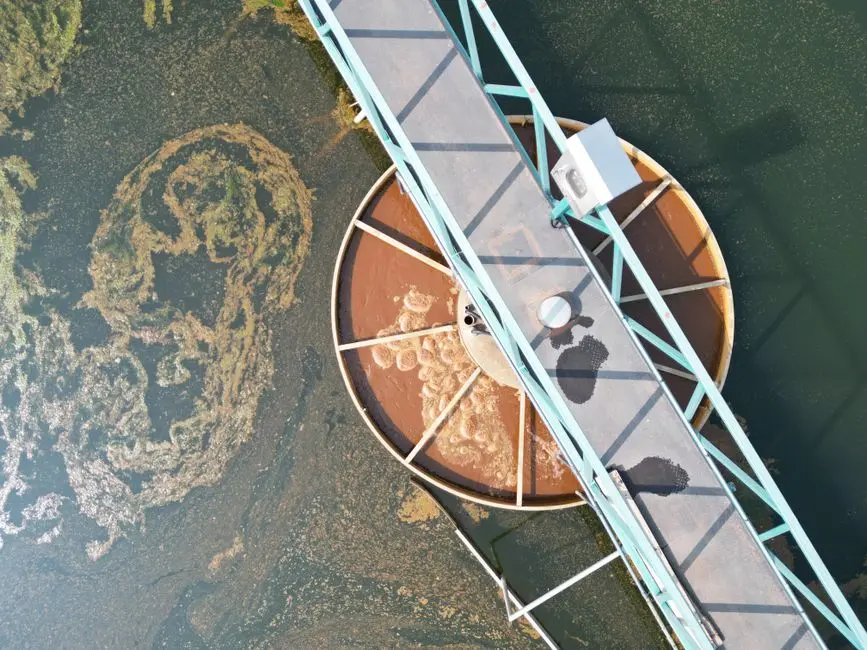
DAF, MBR, lamella clarification, activated carbon, and electrocoagulation perform different jobs, so their catalog capacities cannot be compared as equivalent COD-removal guarantees. Choose each unit from its hydraulic and contaminant-removal role, then require a guaranteed outlet based on the mill’s own wastewater.
DAF is the stronger primary option when bark fines, colloids, floating material, or chemically conditioned flocs would overload or bypass conventional settling. The HydropureWater catalog range covers 4–300 m³/h across 13 standard models, but that capacity statement is not a plant-performance guarantee (HydropureWater product specifications, 2026). Lamella clarification is a compact primary-settling option for suitable low-FOG streams. The catalog reports 20–40 m/h surface loading rates and chemical-consumption reduction of up to 30%; these are supplier specifications rather than guaranteed outcomes for wood-processing effluent (HydropureWater sedimentation-tank specifications, 2026). The DAF versus clarifier comparison for pulp and paper wastewater provides a related selection basis.
MBR combines biological treatment and solids separation when footprint matters. The HydropureWater range covers 10–2,000 m³/day with submerged PVDF filtration below 1 μm (HydropureWater MBR specifications, 2026). Neither filtration capability nor daily capacity guarantees a COD, phenol, or ammonia outlet; those guarantees must follow from the design influent, biological loading, residence time, and final polishing.
Activated carbon is the principal polishing candidate for refractory COD and phenol. Require empty bed contact time, media-transfer quantities, and expected carbon life calculated against the measured phenol load—not a generic COD-removal percentage. Electrocoagulation remains a pilot-stage candidate for a segregated stream, not a transferable catalog claim.
Muslim and Asel reported 99.5% COD removal from petroleum wastewater using four aluminium and four iron electrodes, a 2 cm gap, 12 cm submergence, 10.5 V, 50 minutes, 0.5 g/L NaCl, initial COD of 710 mg/L, and estimated energy consumption of 12 kWh/m³ (Wasit University study, as cited in the supplied research; publication details not provided in the research pack). That wastewater matrix differs from plywood wastewater. Transferring the result without testing site wastewater would turn a study-specific result into an unsupported guarantee.
| Technology | Process role | Buyer-controlled design input | Required guarantee or evidence |
|---|---|---|---|
| DAF with coagulation | Primary separation of fibers, colloids, floating material, and conditioned solids. | Peak flow, solids and fiber characterization, floc properties, chemical demand, and sludge yield. | Guaranteed solids outlet and performance on site wastewater; catalog capacity alone is insufficient. |
| Lamella clarification | Compact primary settling for suitable streams. | Settling behavior, FOG content, hydraulic loading, and chemical requirements. | Site-specific solids outlet; 20–40 m/h and 30% are supplier specifications, not plant guarantees (HydropureWater, 2026). |
| MBR | Biological BOD and ammonia removal with integrated solids separation. | COD, BOD5, ammonia, flow, temperature, biodegradability, F:M, SRT, and footprint. | Guaranteed COD, BOD5, and ammonia outlet; 10–2,000 m³/day and filtration below 1 μm are catalog specifications (HydropureWater, 2026). |
| Activated carbon | Residual refractory COD and phenol polishing. | Measured phenol, COD fractions, background matrix, contact time, and media-transfer rate. | EBCT, media quantity, service life, and outlet phenol/COD on site wastewater. |
| Electrocoagulation | Possible segregated-stream pretreatment or polishing after pilot confirmation. | Stream matrix, conductivity, electrode arrangement, gap, submergence, voltage, current, time, and salinity. | Pilot removal, energy use, sludge generation, and electrode consumption; the 99.5% petroleum result is non-transferable. |
| Dosing | Flow-paced coagulant, flocculant, pH control, and carbon dosing. | Jar tests, raw-water demand curves, storage constraints, and control strategy. | Chemical consumption range linked to the guaranteed outlet. |
| Sludge dewatering | Separation and handling of screenings, DAF sludge, and biological solids. | Dry-solids generation, solids capture, cake target, hours of operation, and disposal route. | Machine duty tied to calculated dry-solids load, not peak flow alone. |
Turn the Design Basis into a Supplier RFQ
The RFQ should require a traceable design basis and guaranteed outlet values on the mill’s own wastewater. A supplier that cannot identify its design flow, influent, loading basis, and acceptance method has not supplied a comparable bid.
- Require source-specific testing. Include 24-hour composite samples by stream, with average and peak COD, BOD5, TSS, phenol, ammonia, pH, flow, and temperature, together with the current permit or reuse target.
- Require biological design data. State F:M ratio, SRT, temperature assumptions, and the ammonia outlet guarantee. In the South Kalimantan case, total ammonia entered at 1,652 ppm and left the full train at 4.56 ppm (Soedarmanto and Setiawati, 2022).
- Require carbon design data. State EBCT, media-transfer quantities, expected carbon life, and replacement criteria against the measured 56.98 ppm inlet phenol in the South Kalimantan case.
- Require solids-separation data. For DAF and lamella systems, request hydraulic loading, chemical-demand range, flotation-sludge yield, guaranteed solids outlet, and site-wastewater performance.
- Require a sludge route. Specify solids capture, sludge accumulation, dewatering duty, cake-handling constraints, and the final disposal or reuse route. The South Kalimantan study did not quantify sludge mass, so a supplier cannot use that case to size dewatering without the mill’s dry-solids calculation.
- Require comparable costs. The supplied research contains no defensible wood-processing CAPEX or OPEX figures. Request line-item chemical, aeration, carbon replacement, sludge dewatering, maintenance, and disposal costs, tied to the guaranteed outlet.
For primary-separation bids, compare an industrial DAF system for wood-processing solids removal against the high-efficiency lamella sedimentation tank using site wastewater and identical acceptance criteria. For sludge, request a plate-and-frame sludge dewatering system sized from calculated dry-solids load. HydropureWater’s plate-and-frame range spans 1–500 m² filtration area; this is a catalog range, not a plant-duty guarantee (HydropureWater plate-and-frame specifications, 2026).
Operational-cost comparison should also include the maintenance and replacement logic behind the activated-carbon maintenance cost framework. Sludge troubleshooting should be addressed in the industrial sludge dewatering troubleshooting guide.
| RFQ package | Minimum information to request | Bid-comparison rule |
|---|---|---|
| Design basis | 24-hour composites by stream; average and peak flow, COD, BOD5, TSS, phenol, ammonia, pH, and temperature; current permit or reuse target. | Reject bids based only on literature ranges or an averaged plant stream. |
| Biological system | F:M, SRT, temperature basis, hydraulic residence time, sludge production, and guaranteed BOD5, COD, and ammonia outlets. | Compare design assumptions and guaranteed outlet values, not tank volume alone. |
| DAF or lamella | Hydraulic loading, chemical demand, solids outlet, sludge yield, and performance on site wastewater. | Do not convert supplier specifications into guarantees. |
| Activated carbon | EBCT, media quantity, expected service life, replacement criteria, and measured outlet phenol and COD. | Price media transfer and replacement against the actual load. |
| Electrocoagulation | Pilot protocol, energy use, electrode consumption, sludge generation, and site-wastewater results. | Do not transfer the petroleum-study removal result to plywood wastewater. |
| Sludge and costs | Dry-solids balance, dewatering area and cycle time, disposal route, and line-item CAPEX and OPEX. | Compare complete delivered and operating costs against common outlet guarantees. |
Frequently Asked Questions
What data is needed before sizing wood-processing wastewater COD removal equipment?
Require the design flow plus 24-hour composite results for each segregated stream: COD, BOD5, TSS, phenol, ammonia, pH, flow, temperature, and stream composition. Also provide the current discharge or reuse criteria. The South Kalimantan values—COD 2,545.7 ppm, BOD5 1,426 ppm, TSS 865 ppm, phenol 56.98 ppm, and ammonia 1,652 ppm—describe that plant’s high-strength stream only (Soedarmanto and Setiawati, 2022). They cannot size an MDF, chipboard, or panel-mill installation without site testing.
How should a buyer select between DAF, MBR, and lamella clarification?
Match the unit to its process role, then require site-wastewater guarantees. DAF is appropriate when fibers, colloids, or conditioned solids require primary flotation; lamella clarification is appropriate for suitable settling duties; MBR combines biological treatment and solids separation when footprint is constrained. Ask each supplier to state hydraulic loading, chemical demand, residence time, biological F:M and SRT where applicable, sludge generation, and guaranteed outlet values. Capacity, filtration specifications, or catalog removal claims are not substitutes for these terms.
What should a wood-processing wastewater COD treatment bid include for cost and budget control?
Request a line-item cost model covering chemicals, aeration, activated-carbon media transfer and replacement, sludge dewatering, maintenance, and final disposal. The supplied research contains no defensible plant-wide CAPEX or OPEX figure for wood-processing wastewater, so a single price cannot be inferred from the case study. Require each price to correspond to the same guaranteed COD, phenol, ammonia, and solids outlet; otherwise bids are not comparable. Also request sensitivity cases for chemical dose, carbon service life, and sludge-disposal frequency.
Does the South Kalimantan case prove compliance with current 2026 discharge requirements?
No. The study used Kep-51/MenLH/10/1995 reference limits of COD 125 mg/L, BOD5 75 mg/L, TSS 50 mg/L, phenol 0.25 mg/L, and NH3 4 mg/L (Soedarmanto and Setiawati, 2022). These are study-era references, not confirmation of a site’s current permit. The reported final phenol concentration was 1.45 ppm, above the cited 0.25 mg/L reference. Before procurement, obtain the applicable 2026 permit or reuse specification and require the supplier to guarantee every listed parameter on the mill’s own wastewater.
Can the reported electrocoagulation performance be used for plywood wastewater?
No. The 99.5% COD result was obtained from petroleum wastewater at an initial COD of 710 mg/L, using four aluminium and four iron electrodes, a 2 cm gap, 12 cm submergence, 10.5 V, 50 minutes, and 0.5 g/L NaCl, with estimated energy consumption of 12 kWh/m³ (Wasit University petroleum-wastewater study, publication details not provided in the research pack). Electrocoagulation may be considered for a segregated wood-processing stream only after pilot testing confirms removal, energy use, electrode consumption, and sludge generation under the actual wastewater matrix.