What Treatment Route Fits a Brazilian Hotel or Resort?
Hotel resort wastewater treatment in Brazil should begin with the discharge destination: sewer connection, receiving water, or on-site reuse. A buried A/O packaged plant may suit standard sewer disposal, while an MBR is the stronger option for reuse, sensitive receiving waters, or constrained sites. Brazilian projects must address CONAMA Resolution 430/2011 and applicable state or local conditions, including INEA requirements in Rio de Janeiro. For preliminary resort sizing, HydropureWater's 2026 Rio guide uses 150–250 L per guest per day and identifies daytime peaks of 2.5–3.0 times the daily average. Kitchen, laundry, and spa flows should be characterized separately before final equipment selection.
The first decision is therefore not which package has the largest capacity. It is which compliance route the project must satisfy. A sewer discharge may permit a conventional biological package, subject to the sewer authority's requirements. Direct discharge to surface water requires an explicit receiving-water assessment and a permit basis. Reuse changes the engineering brief because the treated water must meet the intended use, not merely a discharge standard.
CONAMA Resolution 430/2011 amended and supplemented Resolution 357/2005 and is identified as the federal reference by HydropureWater's 2026 guide, Rio de Janeiro hotel wastewater treatment requirements. The same source states that INEA issues the Licença de Instalação and Licença de Operação in Rio de Janeiro and may impose stricter site-specific conditions for sensitive locations. Buyers should confirm current requirements with the responsible authority rather than treating the federal limit as the complete permit.
The guide cites BOD limits of no more than 120 mg/L for discharge to waterways and no more than 40 mg/L for more sensitive receiving waters. Those benchmarks are not universal site approvals: the receiving water and jurisdiction determine the final condition.
| Decision point | Preferred route | Questions to resolve |
|---|---|---|
| Public sewer available and accepted | Sewer discharge with appropriately sized biological pretreatment | Does the utility accept the proposed flow, solids load and treatment standard? |
| Direct discharge to receiving water | A/O or MBR selected against site-specific permit limits | Which authority issues the licence, and what are the receiving-water conditions? |
| Toilet flushing or irrigation | MBR followed by any required reuse polishing | What end-use quality, reliability and distribution requirements apply? |
| Variable kitchen, laundry or spa loading | Source control, equalization and pretreatment before biology | Are FOG, debris, chemicals or surfactants present? |
Size the Resort Around Guests, Occupancy, and Peak Events
Guest-day flow is only the starting estimate for a resort wastewater flow design because occupancy, amenities and events produce unequal hydraulic and organic loads. HydropureWater's 2026 Rio guide provides a preliminary wastewater design allowance of 150–250 L per guest per day and a conservative default of 200 L per guest per day. These are source-specific design inputs, not universal Brazilian statutory sizing rates.
The same guide states that daytime loading from pool decks, beach clubs and restaurants can reach 2.5–3.0 times the daily average, while banquet and event peaks can reach 4.0 times. These factors should influence equalization and peak-capacity checks rather than simply increasing the nominal biological plant without checking how the peak reaches it.
For the guide's example, 200 rooms multiplied by 1.8 guests per occupied room and 200 L per guest per day gives approximately 72 m³/day average. Applying the cited daytime factors gives 180–216 m³/day for that period. The arithmetic does not replace a hydraulic model, and the biological process must also be checked against organic and solids loading.
- Establish occupied rooms and a defensible guest multiplier.
- Add restaurant, banquet, pool, spa and laundry flows from operating schedules.
- Apply the selected average-flow basis and event peak factors.
- Check equalization, collection, pretreatment and biological-stage hydraulics.
- Confirm storage, standby and commissioning requirements.
| Sizing input | Evidence available | Procurement treatment |
|---|---|---|
| Average wastewater flow | 150–250 L per guest per day; 200 L per guest per day conservative default, from HydropureWater's 2026 Rio guide | Preliminary design only; verify against property-specific operating data |
| Daytime peak | 2.5–3.0 times daily average, from HydropureWater's 2026 Rio guide | Check the collection and equalization system against the applicable peak |
| Event peak | Up to 4.0 times daily average, from HydropureWater's 2026 Rio guide | Use the event schedule to determine whether storage or temporary capacity is required |
| Organic and solids load | No resort-specific values supplied | Request current site-specific wastewater characterization before final process sizing |
Final engineering also needs fixture counts, occupancy profiles, operating hours, infiltration assumptions, pool and spa discharge, kitchen FOG, laundry flows, storage requirements and the measured or vendor-provided wastewater characteristics. The guest-day figure alone does not establish biological capacity.
Characterize Hotel, Kitchen, Laundry, and Spa Wastewater
Domestic sewage should not be blended blindly with kitchen, laundry, pool and spa wastewater because these streams carry different solids, FOG, chemicals and hydraulic patterns. Separate collection or targeted pretreatment can prevent a biological stage from being overloaded or fouled.
HydropureWater's 2026 Rio guide directs hotels with significant kitchen, laundry or spa flow to evaluate DAF pretreatment upstream of the biological stage. The industrial DAF and wastewater pretreatment guide provides the relevant pretreatment context, but the resort project still needs a site-specific source survey.
For solids protection, a GX rotary mechanical bar screen is relevant where rags, plastics, fibrous debris or other suspended material could obstruct pumps, valves or biological treatment, according to the supplied product catalog. It should not be included merely because the plant is a hotel package; its duty follows from the debris survey and downstream equipment.
Ask for current sampled and composite wastewater characterization rather than assigning unsupported pollutant concentrations. Where the survey shows variable flows, the package should address equalization, grease management, debris removal, odor control and sampled composite testing. Kitchen FOG is a process-control issue: identify where it enters, how it will be removed and how the residual will be handled.
Separation also reduces uncertainty. A spa or laundry discharge should not automatically pass through the domestic biological train without checking its chemical and solids effects. Pool discharges need their own flow and quality basis. A practical source-control survey records fixtures, traps, grease traps, cleaning practices, chemical use, sampling points, discharge points and operating periods.
Compare Buried A/O, MBR, and Source-Control Pretreatment
The WSZ underground integrated plant combines anoxic and aerobic A/O contact oxidation, sedimentation and disinfection in a buried package, with a catalog capacity of 1–80 m³/h and automatic operation without a full-time operator. Its buried A/O package sewage treatment plant is suited to applications where a conventional biological process, buried installation and automatic operation are appropriate.
The catalog MBR combines activated sludge with submerged PVDF membrane filtration and lists a capacity of 10–2,000 m³/day, filtration below 1 μm and a footprint stated as 60% smaller than conventional systems. An integrated MBR membrane bioreactor becomes more compelling when reuse, sensitive discharge conditions or site footprint are part of the design brief.
HydropureWater's 2026 Rio guide describes A/O output as BOD of 20–40 mg/L and TSS of 20–30 mg/L. It describes the MBR case as BOD no more than 5 mg/L and TSS no more than 1 mg/L after disinfection. These are comparison figures from that guide, not automatic discharge guarantees. The bidder should guarantee performance under the resort's documented flow and wastewater basis.
DAF is a pretreatment option for suspended solids, FOG, oil and grease and colloidal matter. Its catalog range is 4–300 m³/h across 13 standard models. Add it where source characteristics justify the separation; do not use it as a substitute for reviewing grease traps or collecting kitchen waste at source.
| Option | Catalog basis | Appropriate selection logic | Key buyer check |
|---|---|---|---|
| Buried A/O package | 1–80 m³/h; integrated A/O, sedimentation and disinfection | Straightforward sewer disposal or less restrictive receiving-water conditions | Confirm hydraulic, solids and effluent performance against the actual design basis |
| MBR | 10–2,000 m³/day; submerged PVDF membranes; filtration below 1 μm; stated footprint 60% smaller | On-site reuse, sensitive receiving waters or constrained sites | Require project-specific effluent guarantees and membrane lifecycle terms |
| DAF pretreatment | 4–300 m³/h; 13 standard models | Resort kitchens or other sources with FOG, oil and grease or solids requiring removal | Provide source wastewater data and define sludge or FOG handling |
| Mechanical screening | GX rotary bar-screen catalog basis | Protection where fibrous debris and solids could foul pumps or downstream equipment | Verify screen aperture, capacity, extraction and maintenance access |
The selection is conditional: A/O for a conventional route where acceptable, MBR where reuse or site conditions justify membrane separation, DAF where the source survey supports it, and screening where debris protection is needed. The buried A/O versus MBR sewage treatment comparison provides a useful framework, but the resort's discharge destination and source streams control the decision.
Build a Treatment Train That Protects the Biology
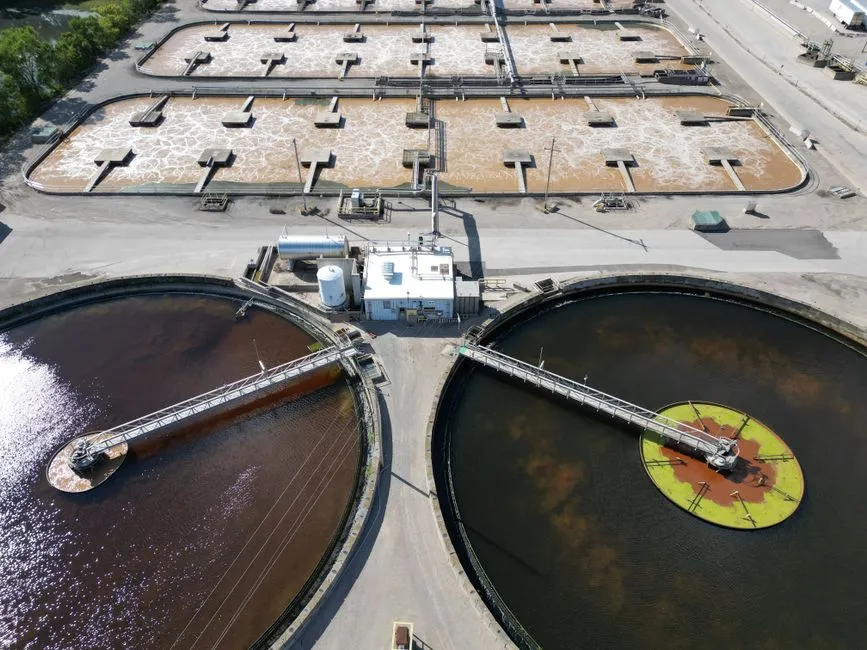
A defensible treatment train follows the sequence of source control and equalization, screening or headworks where needed, FOG or DAF pretreatment where justified, biological treatment, solids separation or membrane filtration, disinfection and reuse polishing where required. Each step should have a defined duty, capacity and maintenance access.
For an A/O route, the WSZ package supplies the integrated anoxic and aerobic biological stage, sedimentation and disinfection before discharge. For an MBR route, the integrated biological reactor and submerged membrane stage can be followed by on-site chlorine dioxide disinfection where the project specification supports it. The supplied catalog range for the chlorine dioxide generator is 50–20,000 g/h. Selection still depends on the required dose, chemistry, safety provisions and permit conditions.
For demanding reuse applications, HydropureWater's 2026 Rio guide identifies filtration followed by reverse osmosis as a route for cooling towers, boiler make-up or unrestricted irrigation. The actual end-use specification and water-quality validation must govern the decision; filtration and RO should not be added merely to call the plant “reuse-ready.”
The DF flat-sheet MBR modules are another catalog option where a submerged PVDF configuration with 0.1 μm pore size and integrated aeration is relevant. Listed configurations span 80–225 m² and produce 32–135 m³/day.
| Process stage | Required function | Applicable package or evidence |
|---|---|---|
| Source control and equalization | Separate atypical streams and smooth variable loading | Scope must follow the resort source survey |
| Headworks or screening | Remove debris that could damage or obstruct downstream equipment | GX rotary mechanical bar screen where the survey supports it |
| FOG or DAF pretreatment | Remove oil, grease and relevant solids before biology | DAF catalog capacity: 4–300 m³/h across 13 standard models |
| Biological treatment | Remove biodegradable organics | Integrated A/O stage or activated sludge |
| Solids separation | Clarify biological solids or retain biomass on membranes | WSZ sedimentation or submerged MBR membrane stage |
| Disinfection | Control pathogens against the specified requirement | Integrated package disinfection or on-site chlorine dioxide generation |
| Reuse polishing | Meet the receiving equipment or non-potable reuse specification | Filtration and RO as identified by the 2026 Rio guide for demanding end uses |
Comparison with the MBR versus conventional activated sludge framework can clarify membrane versus clarification tradeoffs, but it must be applied to resort wastewater rather than mining or chemical-feed assumptions.
Write the Permit, Procurement, and Performance Package
A procurement package should begin with the supplier's written design basis. It must identify average and peak flow, wastewater characteristics, discharge destination, reuse target, applicable federal and state requirements, design margins and treatment objectives. A generic “hotel wastewater package” description is not an auditable offer.
Require measurable guarantees for hydraulic capacity, process performance, automation, sludge or FOG handling, odor control, disinfection and site utilities. The performance basis must identify the design flow, influent characteristics and receiving or reuse condition to which each guarantee applies. Otherwise, catalog treatment values can be mistaken for project performance.
Bid comparison should use a resort-specific reference framework, not mining or industrial-feed data. Each bidder should demonstrate how the proposed configuration handles domestic sewage, kitchen FOG, laundry, spa, pool and event peaks. MBR bidders should also state membrane cleaning, replacement and recovery provisions; A/O bidders should define sludge removal, odor control and access.
Include commissioning, operator training, remote or automatic controls, maintenance access, spare parts, membrane cleaning or replacement provisions, sludge and FOG handling, and ongoing monitoring in the scope. The domestic sewage treatment buyer guide and filter-press procurement reference can support broader equipment-document checks, but they do not establish resort treatment costs.
Do not use an unsupported Brazil-wide packaged-plant price. The supplied research does not provide a reliable Brazil-wide figure for this scope. Request a project-specific quotation using verified flow, treatment requirements, reuse objectives, site utilities, civil works, sludge handling and commissioning obligations. Compare quotations only after normalizing those commercial boundaries.
Frequently Asked Questions
What wastewater treatment system is best for a hotel resort in Brazil?
Choose by discharge route: a buried A/O package may suit standard sewer disposal where acceptable, while an MBR is the stronger option for on-site reuse, sensitive receiving waters or constrained sites. Add DAF where kitchen FOG and solids require it, and screening where the source survey shows debris risk. Confirm the final selection against current permit conditions.
How much wastewater should a Brazilian hotel generate per guest?
HydropureWater's 2026 Rio guide uses 150–250 L per guest per day and identifies 200 L per guest per day as a conservative default. These are preliminary design inputs rather than universal statutory rates. Verify them against occupancy, fixtures, restaurant, pool, spa and laundry flows before final sizing.
What permits are required for a hotel resort wastewater treatment plant in Brazil?
CONAMA Resolution 430/2011 is the federal reference identified by the supplied 2026 Rio guide. State and local conditions must also be checked. In Rio de Janeiro, the guide states that INEA issues the Licença de Instalação and Licença de Operação and may impose stricter site-specific requirements.
How much does hotel wastewater treatment cost in Brazil?
The supplied research does not establish a defensible Brazil-wide price for a complete resort package. Request comparable quotations using the same verified flow, peak basis, treatment route, reuse target, civil works, utilities, sludge handling, automation, commissioning and warranty scope.
How do I choose a wastewater treatment supplier for a Brazilian resort?
Check the design basis, site-specific performance guarantees, permitting responsibility, automation, maintenance access, membrane or sludge provisions, reuse deliverables, commissioning evidence and lifecycle support. Require the supplier to demonstrate the proposed configuration against resort source streams and event peaks, not only generic product capacity.