Which Fabricated Metals Plants Near Minneapolis Are Covered in 2026
Coverage under 40 CFR Part 433 — the US EPA Metal Finishing Effluent Guidelines — is process-based rather than sector-based, which dictates every scoping decision a Minneapolis fabricator makes in 2026. If a plant performs any of six core metal-finishing operations, discharges from the 46 operations listed in 40 CFR 433.10(a) are subject to the Part 433 standards, regardless of how the plant classifies itself in NAICS (US EPA). Part 433-regulated facilities are often, but not exclusively, drawn from SIC Major Groups 34 through 39 — fabricated metal products, industrial and commercial machinery, electronic and electrical equipment, and transportation equipment — which captures most Twin Cities job shops, stamping operations, and metal-finishing lines (US EPA).
The second layer is local. Discharges to the sanitary sewer in the metro fall under the Metropolitan Council Environmental Services (MCES) industrial pretreatment program for plants tied to MCES interceptors, or under an individual POTW for plants discharging elsewhere in the seven-county area. The supplied research does not enumerate MCES numeric limits, so a fabricator must pull the current site-specific permit from MCES before sizing equipment. The third layer is the EPA's active PFAS rulemaking, announced under Preliminary Effluent Guidelines Program Plan 15 (September 2021), targeting a subset of the Metal Finishing and Electroplating point source categories (US EPA). The EPA defines a "chrome finishing facility" by four operations where PFAS is used to suppress hexavalent chromium emissions: chromium plating, chromium anodizing, chromic acid etching, and chromate conversion coating (US EPA). A Minneapolis shop that runs any of those four lines falls under the scope of the rulemaking even if no federal PFAS numeric limit has been promulgated yet.
The 2026 Compliance Stack: Federal Rule, Local Permit, and PFAS Rulemaking
Three regulatory layers stack on a single discharge point, and each one can be the binding constraint at any given time. The base layer is the federal categorical standard at 40 CFR Part 433, which sets pretreatment effluent limits for the 46 operations listed in 40 CFR 433.10(a) once a plant triggers coverage by performing one of the six core operations (US EPA). On top of that, the MCES industrial pretreatment program — or a connecting POTW — applies local limits, which are often more stringent than the federal floor for metals, pH, and oil and grease. Above both, the PFAS rulemaking under docket EPA-HQ-OW-2022-0869 applies to chrome finishing operations specifically (US EPA).
The practical 2026 risk for a Minneapolis-area fabricator is Significant Non-Compliance, the status a local pretreatment coordinator publishes when a facility misses permit limits, reporting deadlines, or compliance milestones. The supplied research does not contain the MCES SNC criteria, so the facility must obtain the current definition from MCES and treat it as the operational ceiling rather than the federal Part 433 minimum. Because the PFAS rulemaking is active but does not yet publish numeric effluent limits in the materials supplied, the right 2026 posture for any shop running chromium plating, anodizing, chromic acid etching, or chromate conversion coating is to sample influent and effluent for PFAS now and budget source control as a 2026 capex line item (US EPA).
Two EPA contacts handle the workload, and the agency publishes them for this kind of scoping question. Phillip Flanders ([email protected], 202-566-8323) covers the PFAS rulemaking; Ahmar Siddiqui ([email protected], 202-566-1044) handles other Part 433 questions (US EPA). The canonical reference page — epa.gov/eg/metal-finishing-effluent-guidelines — should be bookmarked because the docket is updated as the rulemaking moves (US EPA).
A 2026 Treatment Train for Minneapolis Fabricated Metals Plants
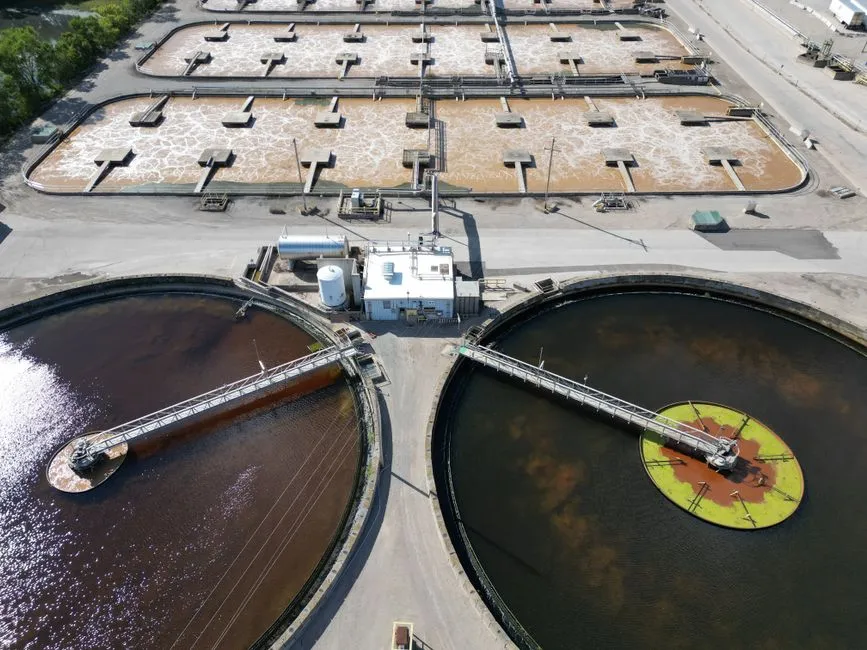
A functional treatment train for a fabricated metals plant in the Twin Cities requires a sequence of unit operations matched to the specific finishing processes on the floor. Preliminary treatment starts with a rotary mechanical bar screen and grit chambers sized to protect downstream pumps and tanks; these are fabricated components built from stainless steel, carbon steel, aluminum, or nickel alloys for corrosion resistance in the metal-fabrication wastewater environment (getchemready.com).
From there, flow equalization smooths the dump-and-batch pattern typical of rinse-water discharges from plating lines, and oil/water separation addresses the free oils, cutting fluids, and lubricants common in fabricated metals operations. A dissolved air flotation system is widely used for emulsified oil and TSS removal at this stage, but the supplied research does not contain removal-efficiency numbers, so the fabricator must request vendor-specific performance data tied to the actual oil and TSS load on site. Next, pH adjustment and chemical precipitation handle dissolved heavy metals. Chrome finishing operations that carry hexavalent chromium need a dedicated reduction step before precipitation, fed by an automatic chemical dosing system; dose rates depend on influent metals speciation, which the supplied research does not quantify, so the buyer should pull jar-test results and vendor curves rather than make assumptions.
Solids–liquid separation after precipitation is typically handled by a high-efficiency sedimentation tank (lamella clarifier) and/or a DAF polishing step, with the underflow routed to a plate and frame filter press for sludge dewatering. Cake-dryness and throughput numbers must be requested from the vendor because the supplied research does not provide them. Disinfection is not a default Part 433 requirement and should be added only if the MCES or POTW permit calls for it — confirm with the local utility before sizing a chlorination or UV stage.
Parameter and Compliance Map: What to Target, With What Unit Operation
The table below pairs each contaminant family a Minneapolis fabricator typically manages with the unit operation that addresses it and the compliance driver. Numeric effluent values are qualitative here; the actual limits come from the EPA for Part 433 and from the local MCES/POTW permit for site-specific numbers, both of which the buyer must obtain directly.
| Contaminant family | Typical unit operation | Equipment family | Compliance driver |
|---|---|---|---|
| Free oils and grease | Oil/water separation, skimming | API/CPI separator, DAF | MCES/POTW local limits |
| Emulsified oils, cutting fluids, TSS | Chemically enhanced DAF or lamella | Dissolved air flotation system | 40 CFR Part 433 + MCES/POTW |
| pH outside permit range | Acid/alkali dosing with mixing | Automatic chemical dosing system | 40 CFR Part 433 + MCES/POTW |
| Dissolved heavy metals (total) | Chemical precipitation, pH adjustment | Dosing + high-efficiency sedimentation tank | 40 CFR Part 433 + MCES/POTW |
| Hexavalent chromium | Reduction (e.g., sulfite or ferrous) then precipitation | Two-stage chemical dosing + clarifier | 40 CFR Part 433 + PFAS rulemaking (source-control layer) |
| Suspended solids after precipitation | Lamella clarification or DAF polishing | Lamella clarifier, DAF | 40 CFR Part 433 + MCES/POTW |
| Sludge volume | Mechanical dewatering | Plate and frame filter press | MCES/POTW (hauling/disposal), 40 CFR Part 433 |
| PFAS in rinse water (chrome lines only) | Source control, fume suppressant substitution, future end-of-pipe treatment | TBD pending EPA numeric limits | PFAS rulemaking under EPA-HQ-OW-2022-0869 (US EPA) |
The last row matters because the four "chrome finishing facility" operations — chromium plating, chromium anodizing, chromic acid etching, and chromate conversion coating — are the EPA's defined trigger for the active PFAS rulemaking (US EPA). A facility that performs any of those four should treat PFAS sampling and source control as part of the 2026 compliance scope.
How Should a Fabricator Scope 2026 Equipment and Vendor Selection?
A practical 2026 procurement path has five steps, and skipping the first two often leads to over-buying capacity. Step 1 — Map the influent. List every one of the six core operations performed on site and cross-check against the 46 operations listed in 40 CFR 433.10(a); this single pass determines whether Part 433 applies at all and which rinses must be treated (US EPA). Step 2 — Pull the local permit. Obtain the current MCES/POTW permit, confirm the SIC code falls inside Major Groups 34–39 if applicable, and record any site-specific effluent limits; the supplied research does not contain these local numeric limits, so they must come from MCES, not from a generic spec sheet.
Step 3 — Stress-test the train for PFAS. If any of chromium plating, chromium anodizing, chromic acid etching, or chromate conversion coating runs on site, treat PFAS sampling and source control as a 2026 capex line item, because the rulemaking under docket EPA-HQ-OW-2022-0869 is active and PFAS fume suppressants are the upstream cause the EPA is targeting (US EPA). Step 4 — Match equipment to flow and load. Size the rotary mechanical bar screen, the dissolved air flotation system, the automatic chemical dosing system, the high-efficiency sedimentation tank, and the plate and frame filter press to the plant's actual flow envelope, with surge capacity sized to the largest single rinse-water dump. Vendor-specific performance data must be requested because the supplied research does not provide numeric efficiencies for any of these unit operations.
Step 5 — Build the RFQ checklist. Send each shortlisted vendor the same package: influent characterization, peak hourly flow, list of regulated operations on site, target effluent quality versus permit limits, automation level (PLC versus manual), and a request for references at similar SIC 34–39 fabricators. For context on how a comparable metals pretreatment program was scoped in 2026, the Connersville mining pretreatment 2026 guide and the DAF vs clarifier for mining and metals wastewater comparison walk through the same decision logic at other sites. A useful parallel for a Twin Cities fabricator reviewing end-to-end pretreatment scoping is the Hartsville mining and metals pretreatment 2026 guide.
Frequently Asked Questions
Does 40 CFR Part 433 apply to my fabricated metals shop near Minneapolis?
It applies if the plant performs any of the six core metal-finishing operations. Once it does, discharges from the 46 operations listed in 40 CFR 433.10(a) are covered by the Part 433 standards, and most Minneapolis-area fabric
Frequently Asked Questions
Does 40 CFR Part 433 apply to a fabricated metals plant near Minneapolis in 2026?
Yes, 40 CFR Part 433 (Metal Finishing Point Source Category) applies to any facility that performs any of the six core metal finishing operations—electroplating, electroless plating, anodizing, coating, chemical etching and milling, or printed circuit board manufacturing—and discharges process wastewater to a Publicly Owned Treatment Works (POTW). For plants in Minneapolis, compliance is managed through the Metropolitan Council Environmental Services (MCES) Industrial Discharge Permit program, which incorporates federal categorical pretreatment standards alongside local limits for pollutants like total toxic organics (TTO) and heavy metals.
How does the EPA PFAS rulemaking affect chrome finishing operations like plating and anodizing?
The EPA’s final rule under the Clean Water Act mandates strict limitations on per- and polyfluoroalkyl substances (PFAS) commonly found in traditional fume suppressants used for hexavalent chromium plating. Facilities must transition to PFAS-free wetting agents or implement advanced oxidation processes (AOP) or granular activated carbon (GAC) filtration to meet effluent discharge limits that are increasingly trending toward non-detect levels for specific compounds like PFOS and PFOA.
What is a reasonable 2026 budget for a fabricated metals pretreatment upgrade?
Budgeting for 2026 pretreatment upgrades typically ranges from $150,000 for basic pH adjustment and solids removal systems to over $750,000 for integrated systems featuring heavy metal precipitation, membrane filtration, and PFAS-specific treatment stages. Costs vary significantly based on flow volume, with typical small-to-medium shops requiring capital expenditures between $250,000 and $500,000 to achieve compliance with updated local and federal discharge standards.
How long does it take to install a DAF or lamella system for a metal finishing shop?
The installation timeline for a Dissolved Air Flotation (DAF) or lamella clarifier system generally spans 16 to 24 weeks from final design approval to operational commissioning. This duration accounts for a 10-14 week lead time for equipment fabrication and shipping, followed by 4-6 weeks for on-site mechanical piping, electrical integration, and system startup and performance testing.
Who at the EPA should we contact about the PFAS rulemaking for chrome finishing facilities?
Facilities should contact the EPA Office of Water’s Engineering and Analysis Division, specifically the team managing the Metal Finishing Effluent Guidelines (40 CFR Part 433). For site-specific compliance guidance, Minneapolis-based facilities are advised to first consult with their assigned MCES industrial waste inspector, who serves as the primary liaison between local categorical users and the EPA’s regional regulatory framework.