

What a Kinshasa factory actually needs from an ETP in 2026
A factory in Kinshasa, DR Congo typically needs a packaged industrial ETP whose first active stage is a Dissolved Air Flotation (DAF) system rated for the site's hourly flow, followed by biological and polishing stages. DAF uses pressurized air released as 10–100 micron micro-bubbles to lift suspended solids, oils, and colloids to the surface for skimming, and can reach 95% or higher Total Suspended Solids removal when paired with appropriate coagulants and flocculants. For Kinshasa, the DAF must be sized for tropical ambient conditions, intermittent grid power (hence standby pumping or air supply), and the receiving-water expectations of the local environment authority. Standard packaged DAF units are commonly offered across 4–300 m³/h, which covers most light-to-medium industrial factories in the city.
Kinshasa's tropical climate is not a footnote — it changes the design. Warm influent lowers dissolved-oxygen solubility, which pushes the biological stage toward diffused-air or mechanical-surface aeration rather than purely anaerobic configurations that depend on cooler water. A second consequence is hydraulic: the rainy season (roughly October through May) elevates groundwater infiltration into process drains, so the DAF equalization tank should be sized for wet-season peaks, not just dry-season averages. The Kinshasa packaged sewage treatment guide covers the same climate envelope for residential flows and applies to the factory receiving the same monsoon loading.
Grid power in industrial zones of Kinshasa is intermittent, and any ETP that depends on aerobic blowers, DAF recycle pumps, or chemical dosing skids must be specified with standby capacity. The cheapest defensible approach is an automatic transfer switch paired with a diesel generator sized for the simultaneous running load of recycle pump, saturator compressor, and skimmer drive, plus a UPS on the PLC to ride through sub-second dropouts. If the site cannot guarantee a generator, the hydraulic profile should be designed so that the equalization tank can gravity-feed the DAF for at least 20 minutes without power, preventing a float blanket from collapsing back into the mixed liquor.
Discharge is to the Congo River or its tributary streams, so the ETP must produce effluent that is at minimum visually clear, oil-free, and within the parameters accepted by DRC's environment authority for industrial discharge. Local industrial influents commonly mix process water, wash water, and limited domestic sewage from the same site, so a packaged ETP sized 4–300 m³/h typically covers small to mid-sized factories without bespoke civil works.
How a DAF unit actually works inside an industrial ETP
DAF works by pressurizing a sidestream of clarified effluent with air, then releasing it into the main flotation tank at atmospheric pressure so the dissolved air forms 10–100 micron micro-bubbles that attach to suspended solids, oil droplets, and colloids (Quora/OpenBlueprint, July 2025). The mechanism is straightforward enough to read off a P&ID: a portion of the clarified effluent is pumped into a pressure vessel (the saturator) where compressed air is dissolved at 4–6 bar; the supersaturated stream then enters the main flotation tank through a needle-valve or nozzle manifold, and the sudden pressure drop nucleates the air into a cloud of micro-bubbles.
Attached bubbles reduce the effective specific gravity of the particles, lifting them to the surface where a mechanical skimmer removes the float layer into a sludge holding tank while clarified water exits under an overflow weir (Quora/OpenBlueprint, July 2025). Hydraulically, the unit needs three things from the buyer: a steady feed flow, a saturated recycle flow (typically 20–30% of feed), and a skimmer torque rating that matches the expected float solids load. For an industrial DAF system specified for a Kinshasa factory, the recycle pump and saturator are the components most sensitive to power-quality issues and should be the first items on the standby-power list.
In a refinery-style ETP, DAF sits between an API oil-water separator and the biological reactors specifically to protect microbial colonies from emulsified oil that would otherwise coat and suffocate them (Quora/OpenBlueprint, July 2025). The same logic applies in a Kinshasa food, soap, or light-manufacturing plant: any oil or FOG that escapes the DAF will foul aeration diffusers and starve the biological stage of oxygen. DAF is therefore not an optional add-on — it is the protective barrier that makes the downstream biological stage work.
DAF is one building block in a full ETP and is normally paired with rotary screening upstream, biological treatment downstream, and a sludge dewatering stage such as a plate-and-frame filter press that can convert 2–3% sludge to 25–28% dry cake (Parason). The full ETP train for a Kinshasa factory typically reads: rotary bar screen → equalization → DAF → biological (aerated lagoon, SBR, or MBBR) → secondary clarifier or lamella → disinfection → sludge holding → dewatering. Skipping any of these stages trades operating cost for compliance risk.
When a Kinshasa factory should pick DAF over a lamella clarifier
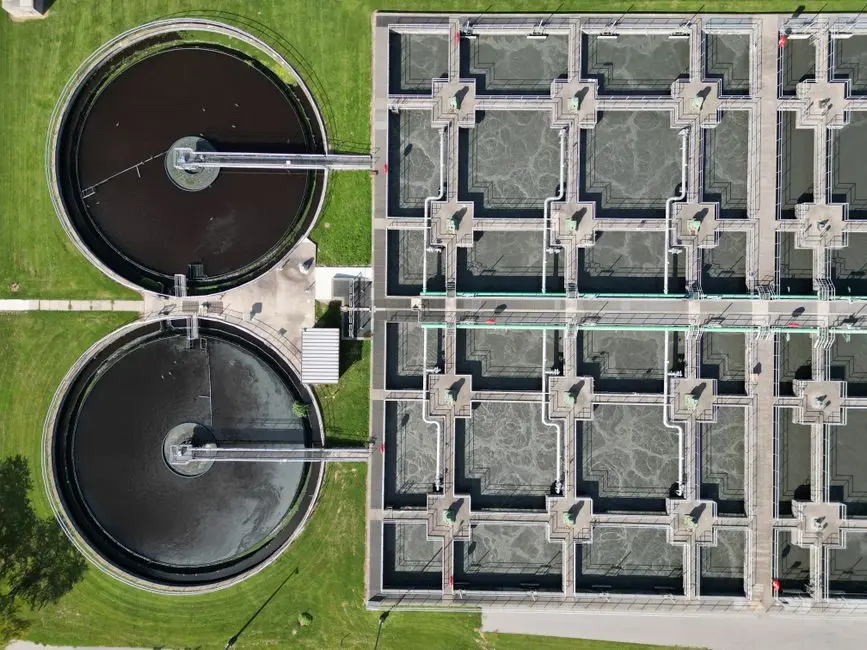
Pick DAF when the influent carries emulsified oil, FOG from food or metalworking fluids, free-floating fibers, or colloidal matter that a gravity clarifier cannot lift in the available retention time (Parason). Pick a HydropureWater lamella clarifier when the influent is mainly settleable inorganic suspended solids, the available footprint is small, and oil and grease content is consistently low, since lamellas achieve high surface loading rates of 20–40 m/h with reduced chemical consumption. For most Kinshasa factories that mix process wash water, light food or soap production, or light manufacturing runoff, a DAF is the safer default because it handles influent variability — the same cannot be said for a gravity lamella.
The decision below is built around the DAF vs API separator comparison logic: as influent variability rises, the gap between a gravity lamella and a DAF widens, because a lamella relies on density separation while DAF actively attaches bubbles to whatever it can nucleate. A factory with a single-product line and a stable influent (a beverage bottler, for instance) can get away with a lamella primary; a factory with batch discharges, cleaning-in-place spikes, or a mix of oily and fibrous streams should not.
| Influent characteristic | DAF (4–300 m³/h) | Lamella clarifier | Kinshasa factory default |
|---|---|---|---|
| Emulsified oil / FOG above 50 mg/L | Strong fit — bubbles attach to oil droplets | Poor — oil rises slowly, fouls plates | DAF |
| Mostly settleable inorganic TSS, low oil | Works but over-specified | Strong fit — 20–40 m/h surface loading | Lamella |
| Variable batch discharges (food, soap, beverage) | Tolerates spikes with equalization | Sensitive to hydraulic shock | DAF |
| Footprint-constrained site, stable influent | Larger tank per m³/h | Compact inclined-plate footprint | Lamella |
| Mixed domestic + process at one site | Good primary; pair with lamella as polisher | Can work as post-DAF polishing step | DAF primary, lamella polish |
| Chemical coagulant / flocculant use | Required for 95% TSS benchmark | Optional, lower doses | Either, DAF needs dosing skid |
For mixed domestic-and-process flows at a single Kinshasa site, a lamella clarifier can work as a post-DAF polishing step before disinfection, recovering some of the footprint advantage of inclined plates. This DAF-primary, lamella-polish configuration is a common compromise on tight sites. If the factory is large enough to justify two clarifiers in series, the lamella downstream of DAF also acts as a catch for any floc that escapes the float layer, which improves sludge consistency going to the dewatering press.
Sizing a DAF system for a Kinshasa factory: flow, load, and ambient factors
Size DAF hydraulic capacity to the peak hourly wastewater flow from the factory, not the average, because Kinshasa production shifts and shift-cleaning spikes can double instantaneous flow. A flow equalization tank upstream of the DAF is the single most cost-effective buffer against these spikes, and it should hold at least four hours of average flow to flatten the worst cleaning events. Without equalization, a DAF rated at "average" flow will be overloaded during CIP or shift-change surges, and the float blanket will collapse into the clarified water.
Verify the vendor's stated removal efficiency applies at the target hydraulic loading — Parason cites 95% or higher TSS removal only when DAF is combined with appropriate coagulant and flocculant dosing. The 95% benchmark is not a free-standing equipment claim; it is contingent on a matched chemical program, and any vendor that quotes 95% without asking about the influent TSS, the oil content, or the planned coagulant is over-promising. A Kinshasa buyer should request the removal curve at three hydraulic loadings (low, design, peak) before signing.
Specify the equipment for tropical ambient temperatures, including any refrigerant-cooled air supply for the saturator if the vendor's standard is calibrated to 20°C inlet conditions. Warm water holds less dissolved air at a given pressure, so the saturator efficiency drops in tropical conditions unless the vendor has either overspec'd the compressor or chilled the recycle stream. Confirm the chemical dosing skid is included or matched — a PLC-controlled coagulant and flocculant dosing skid is shipped as separate pre-wired units, and the buyer must ensure dosing points, mixing reactors, and maturation tubes are coordinated.
Plan for power resilience: DAF recycle pumps, air compressors, and skimmer drives must run through generator cutover without dumping the float blanket, so specify UPS or VFD-controlled pump ramp-down. The table below is the minimum a Kinshasa buyer should take into a vendor meeting.
| Sizing parameter | What to specify | Kinshasa-specific note |
|---|---|---|
| Hydraulic capacity | Peak hourly flow (m³/h), not average | Include CIP / shift-cleaning spikes |
| Removal efficiency | TSS % at design and peak loading | 95% achievable only with matched coagulant/flocculant |
| Ambient temperature rating | Saturator performance at site water temperature | Tropical conditions reduce dissolved-air capacity |
| Chemical dosing | Pre-wired PLC skid, matched to flow | Include pH adjustment for Congo River influent variability |
| Power resilience | ATS + generator sizing, UPS on PLC | Specify VFD ramp-down to preserve float blanket |
| Sludge handling | Float-to-dewatering transfer, press capacity | Plate-and-frame press converts 2–3% to 25–28% cake |
The full decision logic, including DAF cost envelopes and a parallel African project example, is in the best DAF unit engineering specs guide.
Cost, logistics, and supplier selection for a DR Congo ETP project

Most of the published cost data for DAF and ETP equipment in Africa comes from country-specific case studies rather than generic price lists, so request a line-item quote rather than a per-m³ benchmark. The HydropureWater blog library includes parallel factory guides for other tropical and emerging-market sites — see the parallel ETP/DAF factory guide for Santiago and the Buenos Aires factory guide — but each frames CAPEX in its own local currency and scope, so none of them can be directly mapped onto a Kinshasa site. A Kinshasa buyer should ask for a line-item quote that names each skid, tank, pump, instrument, and the marine-freight cost separately.
For DR Congo, sea-freight routing typically enters through the port of Matadi and is then trans-shipped by road or rail to Kinshasa, so equipment must be specified in container-friendly modules with lifting points and a documented reassembly sequence. The Matadi–Kinshasa corridor is congested and politically sensitive, and a vendor that has shipped through it before is worth a premium over one that has only quoted CIF Matadi. Inland container depots in Kinshasa add demurrage days quickly, so the on-site reassembly crew should be scheduled against a known customs-clearance date, not a generic lead time.
A complete ETP scope for a Kinshasa factory usually includes a rotary bar screen, an industrial DAF system, a biological stage, sludge dewatering such as a plate-and-frame filter press (1–500 m² filtration area, HydropureWater plate and frame filter press), and a disinfection step. None of these items is optional for Congo River discharge — skipping the screen will clog the DAF; skipping the press will create a sludge storage problem; skipping disinfection will fail any environment-authority inspection.
The supplied research does not give a Kinshasa-specific CAPEX or OPEX figure, so treat any vendor price below five-digit USD for a full ETP as a red flag and ask for the equipment list behind it. A defensible shortlist applies the five criteria below to every bidder; reject any vendor that cannot produce evidence for all five.
| Qualification criterion | What evidence the buyer requests | Why it matters in DR Congo |
|---|---|---|
| Tropical / equatorial reference sites | List of installations, operator contact, photos | Proves the design handles 25–32°C ambient and warm influent |
| Written TSS guarantee at quoted loading | Performance curve at low / design / peak flow | Prevents the 95% claim without chemical context |
| Factory acceptance test (FAT) video | Recorded water test of identical or similar unit | Verifies the unit before it ships, not after it lands in Matadi |
| Reachable reference sites | Phone / WhatsApp contact for a past buyer | Filters out traders with no after-sales or commissioning capacity |
| Matadi / Kinshasa logistics experience | Incoterm, containerization plan, reassembly crew | Demurrage and inland transport are the real schedule risk |
Frequently Asked Questions
How much does a packaged industrial ETP with DAF cost for a Kinshasa factory in 2026?
The supplied research does not give a Kinshasa-specific CAPEX figure, and per-m³ benchmarks from other African or Latin American sites cannot be safely mapped onto DR Congo without adjustment for the Matadi–Kinshasa logistics corridor and grid-power standby equipment. Request a line-item quote that names each skid, tank, pump, and instrument, plus a separate line for sea-freight, inland transport, customs clearance, and commissioning. Treat any vendor price below five-digit USD for a full ETP as a red flag and ask for the equipment list behind it.
What should a Kinshasa buyer check before selecting a DAF or ETP supplier?
Apply the five-criterion shortlist from the table above: documented tropical reference sites, a written TSS guarantee at the quoted hydraulic loading, a recorded factory acceptance test, reachable reference customers, and prior Matadi / Kinshasa logistics experience. A vendor who fails any one of these is not a defensible supplier for a 2026 Kinshasa project, regardless of price.
What flow range should a Kinshasa factory size its DAF for?
Size the DAF to peak hourly flow, not average, and include at least four hours of equalization upstream to flatten shift-cleaning and CIP spikes. Standard packaged DAF units are commonly offered across 4–300 m³/h, which covers most light-to-medium industrial factories in Kinshasa without bespoke tank fabrication.
How long does it take to deliver and install a packaged ETP in DR Congo?
The supplied research does not give a Kinshasa-specific lead time, so request the vendor's Matadi-to-commissioning schedule in writing, with the demurrage and inland-transport segments separated from the manufacturing lead time. A defensible answer should name the FAT date, the Matadi ETA, the customs-clearance window, and the on-site commissioning duration as four distinct milestones.