How Domestic Sewage Is Collected and Treated in Kuwait City
Kuwait operates five wastewater treatment plants—Riqqa, Umm al-Hayman, Sulaibiya, Kabd, and the Khiran pilot—with the Sulaibiya WWTP and reclamation plant serving as the primary asset for domestic sewage treatment in Kuwait City (Fanack, citing Aleisa & Alshayji 2019). Commissioned in 2005 as the largest facility worldwide to apply ultrafiltration and reverse osmosis for municipal sewage reuse, Sulaibiya receives the entire sewage flow from Kuwait City and Hawalli governorates and treats approximately 64% of Kuwait's national sewage load (Fanack, citing Aleisa & Alshayji 2019; Hamoda 2013).
The Sulaibiya process train starts with pre-screening of municipal influent arriving from residential, governmental, and commercial buildings plus surface water ingress. Pre-screened effluent first undergoes an ultrafiltration backwash, then distributes across nine aeration tanks with a combined volume of 208,900 m³. Mixed liquor flows to secondary clarifiers and is pumped to the UF section; UF-purified effluent then passes to a three-stage RO section containing 21,000 membranes. About 85% of the UF/RO inlet is recovered as treated water suitable for reuse, and the remaining concentrate is rejected as brine and discharged to the sea (Fanack, citing Aleisa & Alshayji 2019).
Kuwait's sewerage service is government-funded, and no user fee is charged for wastewater collection (Fanack, citing Enezi et al. 2004). Stormwater is kept on a separate network and discharged untreated, so any new site must connect to the government-funded trunk main or treat on site. For hotels, labour camps, and remote compounds that fall outside the trunk envelope, the relevant engineering question is which packaged technology to deploy—a sizing problem addressed by the hotel and resort wastewater treatment in Kuwait guide.
Sizing Domestic Flows in 2026: What the Ardiya Numbers Mean for a Kuwait City Project
The Ardiya catchment recorded a per-capita flow of 253 L/c.d of wastewater generation in 2020, against a 2015–2020 five-year average of 436 L/c.d of water use (Journal of Environmental Engineering and Landscape Management, 2022). The same source attributes the 2020 uptick to heavier use of cleaning agents, sanitisers, and disinfectants during the COVID-19 period, with potential impacts on treatment operations. For a 2026 design, the engineer should verify current influent loads at the nearest operational plant rather than relying solely on the 2015–2020 average.
The sizing method involves taking the design population, multiplying by 253 L/c.d (0.253 m³/c.d) of wastewater generation, applying a peak factor, and converting to m³/h. The peak factor, the diurnal curve, and any food-service, laundry, or pool-backwash contribution are inputs the engineer must request from the operator, as published research provides the baseline but not project-specific peak factors. Once the average and peak daily flows are fixed, the choice between a buried A/O unit and a membrane bioreactor depends on reuse and footprint requirements.
Approximately 90% of Kuwait's population has access to water and sanitation services, ranking the country first among Arab nations and fifth globally (Fanack, citing UNEP GEMS/Water and Aleisa & Zubari 2017). The remaining 10%—plus compounds, labour accommodation, and new builds that cannot wait for trunk extensions—require decentralized sizing. The rural sewage treatment in Kuwait 2026 guide covers the regulatory requirements for this off-network cohort.
| Parameter | Value | Source |
|---|---|---|
| Ardiya per-capita water use, 2020 | 446 L/c.d | Journal of Environmental Engineering and Landscape Management, 2022 |
| Ardiya per-capita wastewater generation, 2020 | 253 L/c.d | Journal of Environmental Engineering and Landscape Management, 2022 |
| Ardiya 5-year average water use, 2015–2020 | 436 L/c.d | Journal of Environmental Engineering and Landscape Management, 2022 |
| National sewerage coverage | ~90% of population | Fanack, citing UNEP GEMS/Water and Aleisa & Zubari 2017 |
| Sanitation user fee | None (government-funded) | Fanack, citing Enezi et al. 2004 |
When You Cannot Connect to the Network: Decentralized Options for Kuwait City Sites
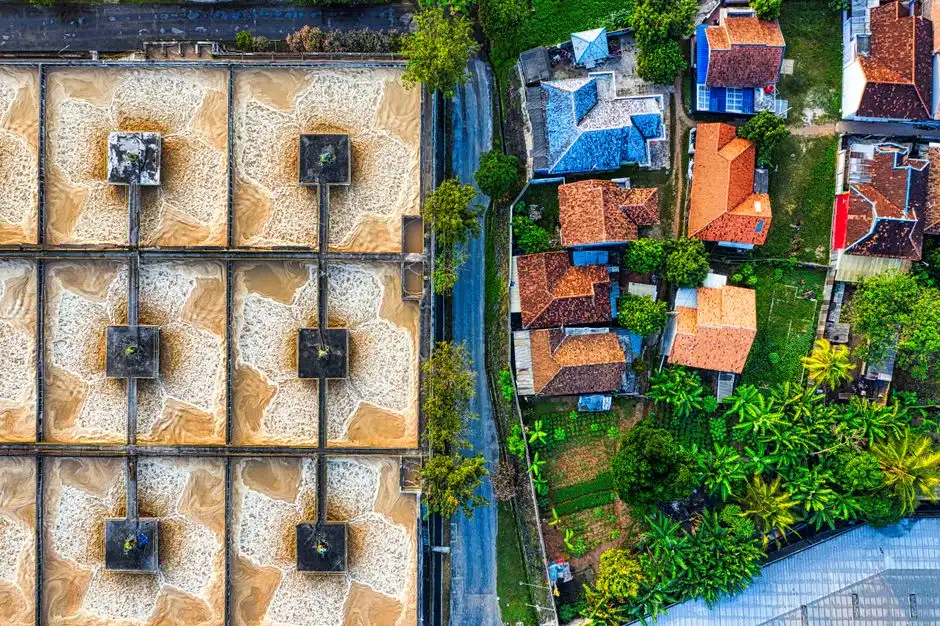
The primary decision for any Kuwait City site is whether the project falls within the sewered ~90% of the population or requires an off-network solution. If the trunk main is at the boundary, the project involves connecting to the government-funded sewer; if the site is outside the network, the project requires a packaged plant, typically an underground anoxic/aerobic A/O unit (the WSZ underground A/O package plant) or an MBR membrane bioreactor system.
The WSZ envelope combines anoxic/aerobic (A/O) biological contact oxidation with sedimentation and disinfection in a single buried package unit, is fully automated, and is rated for 1–80 m³/h. Its applications include residential communities, hotels, hospitals, factories, and rural areas, with installation options for below-grade burial or trailer-mounted mobile deployment (HydropureWater WSZ product catalog). For a small compound or labour camp requiring compliant discharge to a soakaway or sewer, the buried A/O unit provides a low-footprint, low-maintenance solution.
The MBR envelope integrates activated sludge with submerged PVDF membrane filtration to deliver near-reuse-quality effluent at under 1 µm, with a footprint approximately 60% smaller than a comparable conventional activated sludge plant, in a 10–2,000 m³/d capacity range (HydropureWater MBR product catalog). Because the Sulaibiya UF + RO process sets a national expectation for high-quality reuse, decentralized projects in Kuwait City are often benchmarked against RO-grade reuse. This benchmark frequently directs projects with on-site irrigation or cooling-water reuse requirements toward the MBR envelope.
MBR vs Underground A/O Package Plant: A 2026 Decision Matrix for Kuwait City
The technology choice is best evaluated against specific criteria: effluent quality, footprint, capacity envelope, operating model, and use-case fit. The following table consolidates these criteria from the WSZ and MBR product catalogs.
| Criterion | Underground A/O (WSZ) | MBR (PVDF submerged) |
|---|---|---|
| Effluent quality | Suitable for municipal discharge or irrigation; standard biological-treatment polish | Near-reuse quality under 1 µm; suitable for on-site landscape irrigation or cooling |
| Footprint | Buried unit — surface can be landscaped or parked on | About 60% smaller than a comparable conventional activated sludge plant; still needs an above-grade equipment room |
| Capacity envelope | 1–80 m³/h in a single packaged unit | 10–2,000 m³/d integrated; flat-sheet modules at 32–135 m³/d per cassette (80–225 m²) |
| Operation | Fully automated, no operator required | Membrane maintenance (CIP, aeration management); trained operator normally required |
| Use-case fit (Kuwait City) | Small compounds, hotels, labour camps where disposal to a sewer or soakaway is acceptable | Sites that want to reuse effluent for irrigation under Kuwait's reuse framework, or where space is constrained |
| Reuse benchmark | Below the 85% UF/RO national benchmark | Closer to reuse standard, but still not a substitute for full UF/RO trains like Sulaibiya |
The reuse requirement typically dictates the selection. A hotel or residential compound needing only compliant disposal to a sewer is generally a WSZ case, offering lower civil works and no operator requirement. A site requiring on-site irrigation or facing space constraints is an MBR case, requiring the engineer to account for operator hours in the total cost of ownership (HydropureWater MBR product catalog). Regardless of the system, mechanical pre-treatment—such as a rotary mechanical bar screen—and downstream chemical conditioning remain essential components.
What to Verify Before You Buy a Package Plant in Kuwait City in 2026
The following checklist details the information an engineer should confirm before issuing a procurement enquiry.
- Confirm sewer availability at the boundary. With approximately 90% national coverage and a government-funded service (Fanack, citing UNEP GEMS/Water and Aleisa & Zubari 2017), the first step is to verify if a trunk main reaches the plot.
- Confirm reuse compliance with the Environment Public Authority. Sulaibiya recovers 85% of inlet flow through UF/RO (Fanack, citing Aleisa & Alshayji 2019); if the project intends to reuse effluent, the applicable standard must be confirmed against local regulations.
- Specify site conditions in the enquiry. Brackish groundwater and high water tables in coastal Kuwait City affect tank buoyancy and material selection for buried units like the WSZ.
- Lock the operation model. The WSZ is fully automated with no operator required (HydropureWater WSZ product catalog), whereas an MBR plant requires membrane maintenance and a trained operator; the choice should reflect both CAPEX and OPEX requirements.
- Confirm the discharge route for residuals. Residual-handling plans for brine and sludge should be agreed upon in writing before the plant is sized.
- Plan chemical dosing around the chosen process. An automatic chemical dosing system should be specified in the enquiry to ensure the dosing curve matches the actual influent characteristics.
Frequently Asked Questions
How do I know if my site in Kuwait City is inside the sewered area?
About 90% of Kuwait's population is connected to government-funded sewerage with no user fee, so the initial step is to confirm trunk-main availability at the plot boundary with the local utility before sizing a package plant (Fanack, citing UNEP GEMS/Water and Aleisa & Zubari 2017).
What per-capita flow should I use to size a package plant in 2026?
Use the Ardiya 2020 figure of 253 L/c.d of wastewater generation as the baseline, applying a project-specific peak factor (Journal of Environmental Engineering and Landscape Management, 2022). The 2015–2020 average of 436 L/c.d of water use serves as a long-term reference.
How do I select a package plant supplier in Kuwait in 2026?
Prioritize suppliers with a proven UF/RO reuse track record, high automation levels, and local service support. The operational difference between a fully automated WSZ unit and an MBR plant requiring membrane maintenance should drive the supplier shortlist (HydropureWater product catalog).
What does a package plant cost in Kuwait City in 2026?
Request a site-specific quote that includes civil works, membrane replacement, and sludge handling alongside the equipment price, as generic per-m³ figures from non-Kuwait references are insufficient for accurate budgeting.